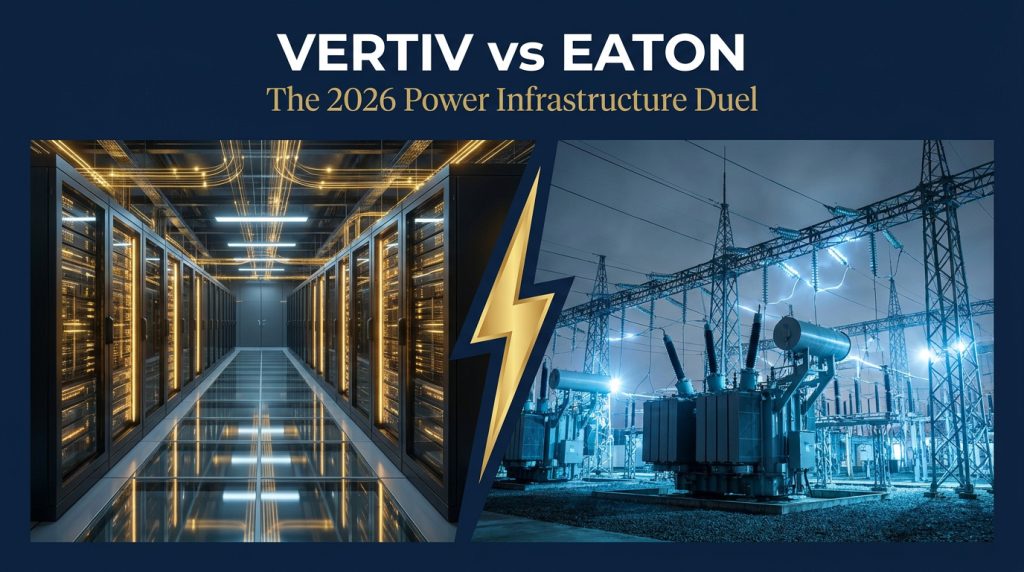
The Vertiv vs Eaton debate has become one of the most interesting stock comparisons in the entire AI infrastructure universe — and trust me, I’ve been watching both of these companies very closely from my armchair.
If you’re trying to figure out where to put money in the power and data center infrastructure space, you’ve probably stumbled across these two names. Both are riding the same mega-trend: the explosive demand for electricity driven by AI data centers. But they are very different animals, and picking the wrong one for your portfolio could cost you real money.
Let Ajussi walk you through this properly.
Why Power Infrastructure Stocks Matter Right Now
The International Energy Agency has made it clear that data centers are one of the fastest-growing sources of electricity demand globally. According to the IEA, data center power consumption could double by 2026 compared to 2022 levels. That’s not a small number — that’s a structural shift in how the world uses electricity.
Every hyperscaler — Microsoft, Amazon, Google — is spending tens of billions on new data centers. And every single one of those facilities needs power management, cooling, uninterruptible power supplies, and electrical distribution equipment. That’s where Vertiv and Eaton both live.
The question is: which company do you want owning a piece of?
Vertiv vs Eaton: Company Overviews
Vertiv (VRT) — The Pure-Play Data Center Bet
Vertiv Holdings (ticker: VRT) is the pure-play option here. The company makes critical digital infrastructure — think power conditioning, thermal management, UPS systems, and IT infrastructure for data centers. When you walk into a hyperscale facility, there’s a good chance Vertiv equipment is keeping those servers alive and cooled.
Vertiv went public via a SPAC merger in 2020, which gave it a rocky start. But the company has since cleaned up its balance sheet and found enormous tailwinds in the AI build-out cycle. Revenue has been growing at a strong double-digit clip, and the company has been steadily expanding margins as it shifts toward higher-value, data-center-specific solutions.
For investors, VRT is the higher-risk, higher-reward play. If AI data center spending continues accelerating, Vertiv wins big. If capex cycles slow or hyperscalers pull back, VRT could get hit hard.
Eaton (ETN) — The Diversified Industrial Powerhouse
Eaton Corporation (ticker: ETN) is a completely different beast. Founded over 100 years ago, Eaton is a massive diversified power management company with businesses spanning electrical systems, aerospace components, vehicle power systems, and eMobility. It’s one of the most respected industrial conglomerates in the United States.
Eaton’s electrical segment — which includes switchgear, circuit breakers, and power distribution equipment — is highly relevant to the data center boom. But unlike Vertiv, data centers are just one slice of a very large pie for Eaton. The company also benefits from grid modernization, the energy transition, and industrial automation.
You can learn more about Eaton’s business directly on Eaton’s investor relations page.
For investors, ETN is the lower-volatility, sleep-well-at-night option. You get exposure to data center spending, but with diversification across multiple secular growth themes and a long dividend history to cushion the ride.
The 2026 Scorecard: What the Numbers Actually Say
Talk is cheap, so let me show you what both companies have actually put on the board this year.
Vertiv’s first quarter of 2026 was, frankly, a monster. Net sales came in at $2.65 billion, up 30% year over year, with 23% organic growth — and the Americas region alone grew 44% on data center demand. Management didn’t just meet expectations; they raised full-year guidance to roughly $13.75 billion in net sales (about 34% growth at the midpoint) and adjusted EPS of $6.35, up 51% versus 2025. Those are numbers you normally see from a young software company, not an industrial equipment maker.
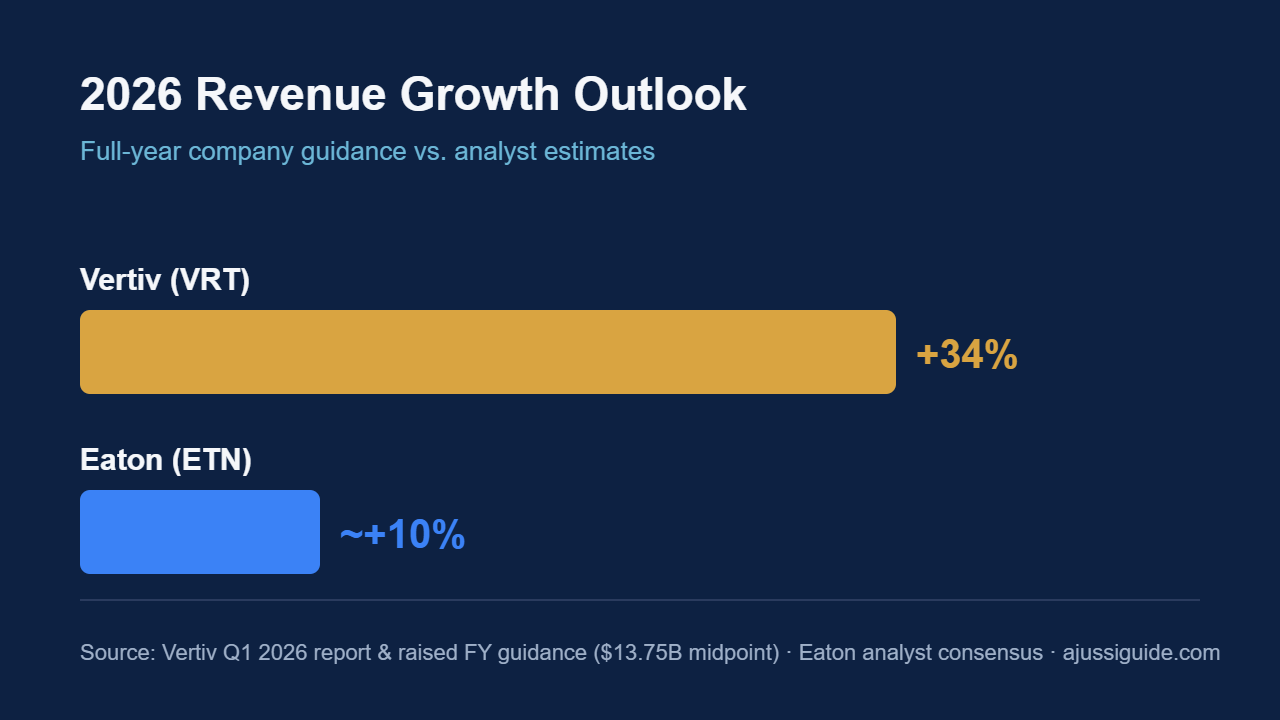
Eaton doesn’t put up numbers like that — and honestly, that’s the point of owning Eaton. Wall Street expects roughly 10% top-line growth this year, powered by a record electrical backlog, grid investment, and aerospace strength. Add a dividend around 1% that Eaton has kept paying through every downturn in its 100-plus-year history, and you get a very different kind of compounding machine.
One caveat from your uncle: these figures shift every quarter. Treat them as a snapshot from mid-2026, and always check the latest earnings before you put real money down.
Vertiv vs Eaton: Head-to-Head Comparison
Let me lay this out cleanly. Numbers shift with the market, so treat these as general profiles rather than real-time quotes. Always verify current figures before you trade.
| Metric | Vertiv (VRT) | Eaton (ETN) |
|---|---|---|
| Business Model | Pure-play data center infrastructure | Diversified power management conglomerate |
| Revenue Growth Profile | High (30%+ YoY recent) | Moderate-high (10–15% YoY recent) |
| Valuation (P/E) | Premium (often 50–65x forward) | Elevated but lower (often 25–35x forward) |
| Dividend | Minimal / negligible yield | Consistent dividend, ~1% yield |
| Balance Sheet | Improving, still carries debt from SPAC era | Investment-grade, strong cash generation |
| Key Risk | Concentration in data center capex cycles | Slower growth in non-electrical segments |
| Investor Profile | Growth-oriented, higher risk tolerance | Quality-growth, balanced risk appetite |
When Ajussi looks at this table, the answer isn’t automatically one or the other. It depends entirely on what kind of investor you are.
Growth Story: Where Vertiv vs Eaton Diverge Most
This is where the rubber meets the road. Vertiv’s revenue growth has been exceptional recently because nearly 100% of its business ties directly to data center spending. When hyperscalers are in full build-out mode, Vertiv’s order book explodes. The company has also been winning in liquid cooling — the emerging technology for cooling high-density AI chips like those from NVIDIA.
Eaton’s growth is real too, but it’s spread across more buckets. The electrical segment benefits from data centers, grid hardening, EV charging infrastructure, and industrial electrification. This diversification means Eaton won’t shoot up as dramatically during a data center boom, but it also won’t crater if AI capex spending hits a speed bump.
Think of it this way: Vertiv is the sports car and Eaton is the luxury SUV. Both get you where you’re going. One just does it with more drama.
Valuation and Risk: Don’t Ignore the Price You Pay
Ajussi always says: the business doesn’t matter if you overpay for it. And in this Vertiv vs Eaton conversation, valuation is a serious consideration.
Vertiv often trades at a steep forward P/E premium because the market is pricing in aggressive growth continuing for years. That’s fine if the growth delivers. But any miss on earnings or any sign that hyperscaler capex is slowing can send VRT down sharply. We’ve seen this kind of volatility in high-multiple growth stocks many times.
Eaton is expensive too, relative to its historical averages. But it’s a more predictable business, and the diversification gives you some margin of safety. If one segment disappoints, others can pick up the slack.
Neither stock is cheap by traditional metrics. If you’re a deep-value investor, you’re probably looking at the wrong sector entirely. But if you believe in the multi-year power infrastructure theme — and I do — then both are worth having on your watchlist.
Which One Is Right for Your Portfolio?
Here’s how I think about it from years of watching markets.
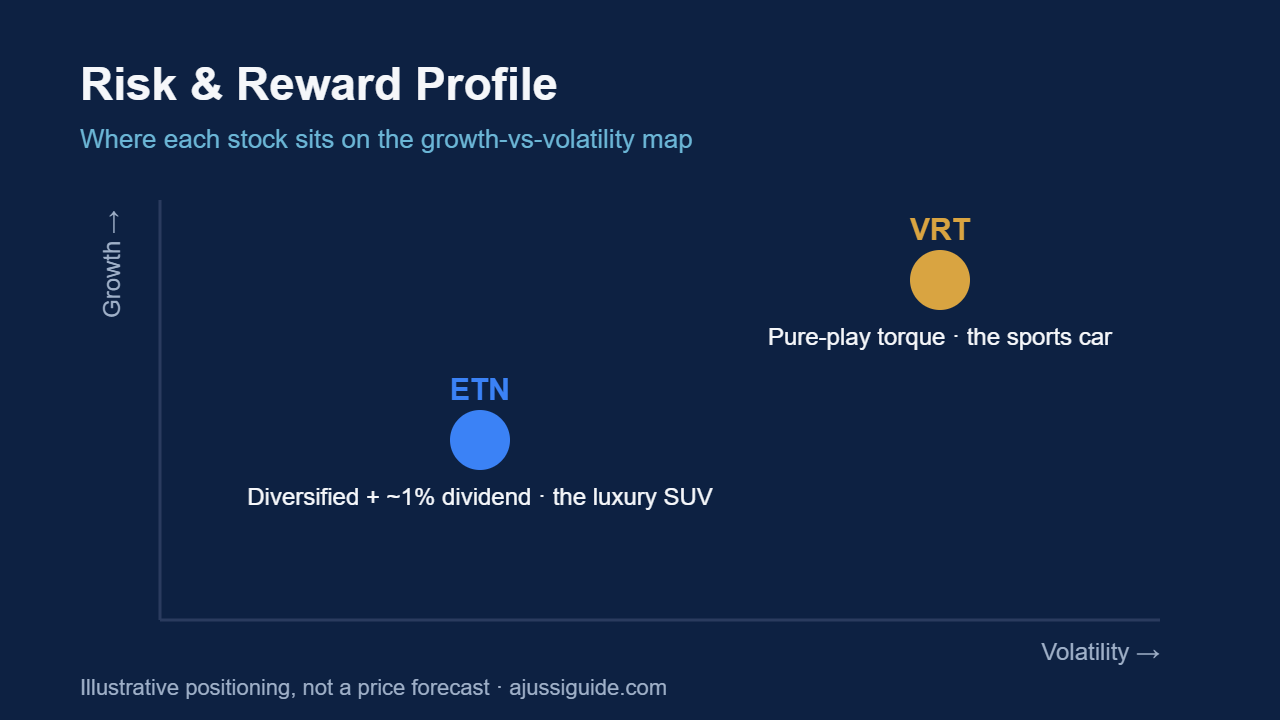
If you’re younger, have a longer time horizon, and can stomach a 20–30% drawdown without panic-selling, Vertiv gives you more torque on the AI data center trade. The upside is potentially bigger, but so is the downside if sentiment turns.
If you want quality exposure to the same megatrend with less volatility — maybe you’re building a core portfolio or you’re closer to retirement — Eaton is the smarter choice. You still get meaningful data center exposure alongside grid modernization, aerospace, and other durable growth themes. And you get a dividend while you wait.
Some smart investors I respect hold both. A core position in ETN for stability, a smaller satellite position in VRT for growth torque. That’s a perfectly reasonable approach.
🚀 Ajussi’s Trading Desk Gear
Watching this sector means watching a lot of charts. The gear guides I actually researched for my own desk:
📊 Best Monitors for Stock Trading (2026)
🤾 Best Dual Monitor Arms for a Clean Setup
🔌 Thunderbolt 5 & USB-C Docks — One-Cable Desk
💡 Best Monitor Light Bars — Save Your Eyes at Night
Frequently Asked Questions
Is Vertiv or Eaton the better long-term investment?
It depends on your risk tolerance. Vertiv (VRT) offers higher growth potential as a pure-play data center infrastructure company, but trades at a premium valuation with more volatility. Eaton (ETN) is more diversified across power management sectors, offering steadier growth and a dividend. If you want to see how Eaton stacks up against its closest global rival instead, I broke that down in a separate Schneider Electric stock comparison. Long-term, both benefit from AI-driven electricity demand, but Eaton tends to be the lower-risk choice for most retail investors.
Does Eaton pay a better dividend than Vertiv?
Yes. Eaton has a long history of paying and growing its dividend, making it more attractive for income-oriented investors. Vertiv pays a negligible dividend as it focuses on reinvesting in growth. If dividend income matters to your strategy, Eaton (ETN) is clearly the winner on this dimension.
Are both Vertiv and Eaton considered AI stocks?
They’re not AI companies in the software or chip sense, but both are considered key beneficiaries of the AI infrastructure build-out. AI requires enormous amounts of electricity and cooling — both of which Vertiv and Eaton help provide. Many analysts categorize them as AI infrastructure or AI picks-and-shovels stocks, which is a fair description of the investment thesis.
Disclaimer: This article is for informational purposes only and is not financial advice. Do your own research.
Related posts
- Kimi K3 Paused New Signups in 48 Hours: What It Means for AI Infrastructure Investors
- Liquid Cooling Suppliers: 7 Best Stocks Behind Nvidia’s Data Center Revolution
- Cooling Stocks Compared: Immersion vs Direct Liquid Cooling — 7 Names to Watch in 2026
- Super Micro vs Dell AI Server Stocks: Which Fits Your Portfolio? (2026)