Cooling stocks — companies building the thermal management systems inside AI data centers — are becoming one of the most overlooked plays in the entire infrastructure boom. And I’ll be honest with you: I slept on this sector way too long. Let me fix that for you right now.
When NVIDIA’s Blackwell GPUs and AMD’s MI300X accelerators are running at 700 watts or more per chip, you don’t have a computing problem. You have a heat problem. And whoever solves that heat problem gets paid — quietly, consistently, and for a very long time.
Why Cooling Stocks Are Having Their Moment
Traditional air cooling — those big fans blowing over server racks — is hitting a wall. It physically cannot remove heat fast enough from today’s densest AI clusters. This isn’t a future problem. Hyperscalers like Microsoft, Google, and Amazon are already specifying liquid cooling in new data center designs.
The IEA estimates that data centers could reach around 945 TWh by 2030, roughly double the 2024 level. A massive chunk of that energy goes directly to cooling. If you can cool more efficiently, you save money at enormous scale — and the operators will pay up for that efficiency.
This creates a durable, multi-year spending cycle. That’s exactly the kind of tailwind Ajussi likes to ride.
Immersion Cooling vs Direct Liquid Cooling: Know the Difference Before You Buy Cooling Stocks
Before you put money anywhere, you need to understand what you are actually buying. These two technologies are not the same thing, and the market opportunity — and the risk profile — differs meaningfully between them.
What Is Immersion Cooling?
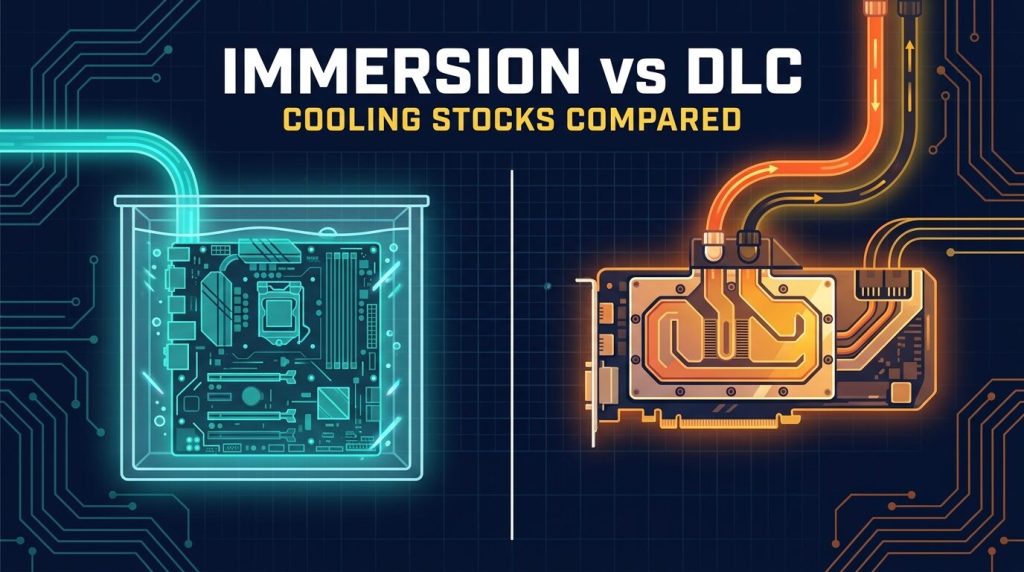
Immersion cooling means submerging entire server boards directly into a dielectric fluid — a non-conductive liquid that absorbs heat on contact. Think of it as bathing your GPU in a special oil. There are two main types: single-phase (the fluid stays liquid) and two-phase (the fluid boils and condenses in a closed loop).
The efficiency gains are dramatic. Immersion systems can achieve a Power Usage Effectiveness (PUE) close to 1.03, compared to 1.4 to 1.6 for traditional air-cooled facilities. That is a transformative difference. The catch? It requires significant upfront infrastructure redesign. You can’t just pour oil on an existing rack. Retrofitting is expensive and complex.
What Is Direct Liquid Cooling (DLC)?
Direct liquid cooling takes a more surgical approach. Instead of submerging the whole board, DLC attaches cold plates — precision-machined metal blocks with liquid flowing through them — directly onto the processor, GPU, or memory package. The heat transfers from chip to liquid, liquid moves to a heat exchanger, done.
DLC is far easier to integrate into existing data center infrastructure. You can retrofit a rack without tearing out the whole facility. This is why hyperscalers and colocation providers are deploying DLC at scale right now, today, while immersion cooling is more of a greenfield or next-generation build story.
Side-by-Side: Immersion vs Direct Liquid Cooling
| Factor | Immersion Cooling | Direct Liquid Cooling (DLC) |
|---|---|---|
| Cooling Efficiency (PUE) | ~1.02–1.05 (best-in-class) | ~1.1–1.2 (very good) |
| Retrofit Difficulty | High — major infrastructure changes | Low to Medium — rack-level integration |
| Current Adoption Stage | Early/Niche, growing fast | Mainstream, hyperscaler standard |
| Cost of Implementation | High upfront capex | Moderate; faster payback period |
| Best Use Case | Greenfield AI supercomputing, HPC | AI clusters, cloud, colocation retrofits |
| Key Risk | Slower enterprise adoption curve | Competition from multiple large suppliers |
The Companies Behind These Cooling Stocks
Now let’s talk names. I’m going to be straight with you — this sector has a mix of pure plays, large conglomerates with cooling divisions, and some speculative smaller names. Know what you own.
Direct Liquid Cooling Players
Vertiv Holdings (VRT) is probably the name most retail investors have heard. Vertiv makes thermal management systems, power distribution, and IT infrastructure for data centers. Their liquid cooling portfolio includes rear-door heat exchangers and direct liquid cooling units that are already inside hyperscaler facilities. This is a real, revenue-generating business with strong order books. Vertiv’s investor relations consistently highlights AI-driven demand as a growth driver. Revenue and backlog numbers have been strong. Watch the valuation — it has re-rated significantly upward.
Eaton Corporation (ETN) is a diversified industrial that gets less attention in the cooling conversation, but their data center power and thermal segment is substantial. Eaton also produces cooling distribution units (CDUs) used in liquid cooling deployments. Less pure-play than Vertiv, but more diversified if you want lower volatility exposure to the same infrastructure build-out.
Modine Manufacturing (MOD) is a smaller-cap name worth knowing. They make thermal management products across multiple industries, and their data center cooling business — including liquid cooling solutions — has been a key growth driver cited in recent earnings. The stock has had a dramatic run, so position sizing matters here.
Immersion Cooling Players
GRC (Green Revolution Cooling) is a private company, so US retail investors can’t buy shares directly. But it’s worth knowing the name because it may surface in an IPO or as an acquisition target. They are one of the few pure-play immersion cooling specialists.
Iceotope is another well-regarded immersion cooling company — also private, UK-based. Again, watch for future public market access.
Submer — Spanish immersion cooling specialist, also private. The immersion pure-play space is still largely private, which is a key insight: the most direct immersion cooling bets are not yet available on the NYSE or NASDAQ for most retail investors.
This means for public market investors, your immersion cooling exposure today often comes through larger companies — like specialty fluid makers or conglomerates with cooling divisions — rather than dedicated pure plays.
Fluids and Chemicals: An Indirect Angle
3M (MMM) was a major supplier of the Fluorinert and Novec dielectric fluids used in two-phase immersion systems. However, 3M completed its planned exit from PFAS manufacturing at the end of 2025 (these fluids contain per- and polyfluoroalkyl substances), which is a real regulatory headwind for two-phase immersion adoption broadly. This is a legitimate risk investors in that segment need to understand — it’s not just a stock story, it’s a chemistry and regulatory story.
Ajussi’s Honest Take on Cooling Stocks Risk
Here is where I put on my uncle hat and tell you what the headlines won’t say. Cooling stocks have already had big runs. Vertiv’s stock is not the bargain it was in 2022. Modine has moved dramatically. When a sector gets discovered, the easy money is usually already made by the time retail investors pile in.
That doesn’t mean you shouldn’t own any of these names. It means you need to be disciplined. Buy in tranches. Don’t chase. Set a price target based on earnings, not hype. The underlying demand for data center cooling is real and multi-year — but overpaying for a good business is still a bad investment.
Also watch the competitive dynamics. The major server OEMs — Dell, HPE, Lenovo — are increasingly building liquid cooling directly into their rack designs. This could commoditize some of the aftermarket cooling opportunity over time. It’s a slow risk, but a real one.
🚀 Ajussi’s Trading Desk Gear
Watching this sector means watching a lot of charts. The gear guides I actually researched for my own desk:
📊 Best Monitors for Stock Trading (2026)
🤾 Best Dual Monitor Arms for a Clean Setup
🔌 Thunderbolt 5 & USB-C Docks — One-Cable Desk
💡 Best Monitor Light Bars — Save Your Eyes at Night
Frequently Asked Questions
Are cooling stocks a good long-term investment?
The underlying demand is structural. AI compute density is rising, and heat removal is a physics problem that won’t go away. Companies with real technology, strong customer relationships, and pricing power in thermal management should see durable revenue growth. However, valuation matters enormously — buying cooling stocks at the right price is the job, not just identifying the right companies.
Which is better for investors: immersion cooling or direct liquid cooling companies?
For near-term revenue visibility, direct liquid cooling companies like Vertiv have a clearer path because DLC is being deployed at scale today. Immersion cooling is an earlier-stage, higher-upside story — but with more execution risk and fewer publicly traded pure plays available to US retail investors right now. A balanced approach might give you both angles.
How do I get exposure to cooling stocks without picking individual names?
Several data center and infrastructure ETFs hold companies with significant cooling exposure, including names like Vertiv. Look at ETFs focused on AI infrastructure or data center real estate and check their top holdings. This won’t give you concentrated cooling exposure, but it reduces single-stock risk while keeping you in the theme.
Disclaimer: This article is for informational purposes only and is not financial advice. Do your own research.
Immersion and direct liquid cooling are two of four heat paths. The full map of those paths and the companies on each one is in our liquid cooling stocks guide.