Liquid cooling stocks sit at the point where AI rack density stops being an air cooling problem and becomes a plumbing one.
Why Liquid Cooling Stocks Matter Right Now
AI accelerators pack far more heat into the same rack space than the servers most data centers were built around. NVIDIA documents a designed rack power of 120 kW for GB200 NVL72 and 135 kW for GB300 NVL72, against an ASHRAE baseline of 5 to 15 kW per rack.
When density moves that far, practical responses include spreading the workload across more racks, spending more on air movement and room conditioning, or changing how heat leaves the rack.
The shift toward that last option helped create this sector, and it is why liquid cooling stocks are not one group. A coil at the rack door, a cold plate on the die, and a tank of dielectric fluid are different products from different companies.
Where Cooling Sits in the AI Infrastructure Map
Cooling is not the first layer of an AI data center and it is not the last, and that shapes how liquid cooling stocks behave. It sits in the middle, and what happens on either side decides how much of it you need.
Power is generated and delivered before a rack turns on, and almost all of that electricity becomes heat that has to leave the building. Cooling only exists at this scale because the layers around it changed first.
Cooling demand is not created by cooling companies. It is created upstream, by the rack designs and power densities that arrive before anyone specifies a chiller.
That is why liquid cooling stocks behave differently from most infrastructure names. Their orders follow decisions made one layer up.
The chain runs generation, then transmission and distribution, then cooling, then servers and racks, compute, memory, and networking. This guide is the cooling link.
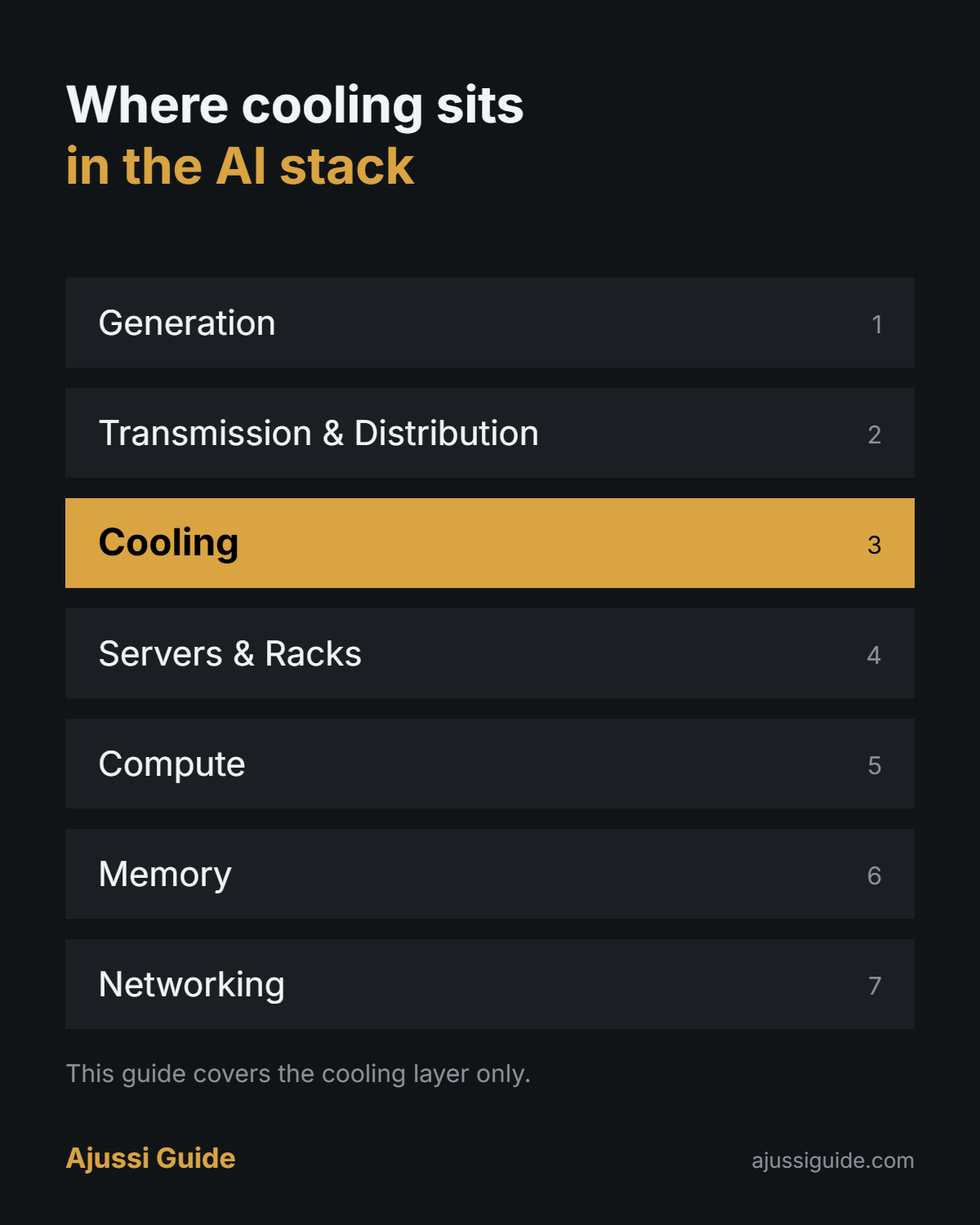
This guide covers the cooling layer only. Where the electricity comes from is covered in our power grid stocks guide, and how it reaches the site is covered in our transmission and distribution stocks guide. What the cooled racks themselves are, and who builds them, is covered in our server stocks guide, and the silicon inside them in our semiconductor stocks guide.
Air Cooling vs. Liquid Cooling: The Core Difference
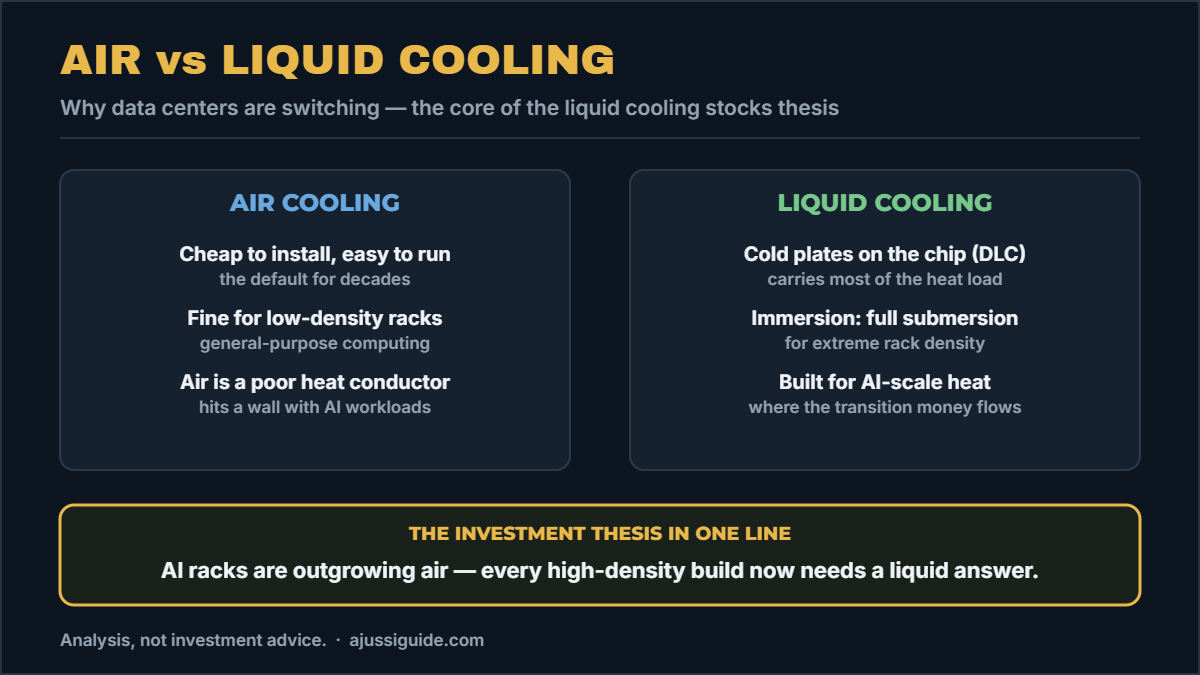
Conventional air cooling carries heat through server and room air. Liquid-assisted and liquid-cooling systems move that transfer point closer to the rack or chip. The next two sections show the actual heat paths and architectures.
Liquid carries heat away from a chip far more effectively than air, which is why density forces the change. The exact multiple depends on fluid, flow rate, and design, so we do not quote a single ratio.
According to the International Energy Agency (IEA), data centers already account for roughly 1–1.5% of global electricity demand, and that figure is expected to grow significantly as AI workloads scale. Cooling is a massive portion of that energy draw, which is exactly why enterprises and governments alike are pushing for liquid cooling adoption.
How Heat Moves from the Chip to Outside the Building
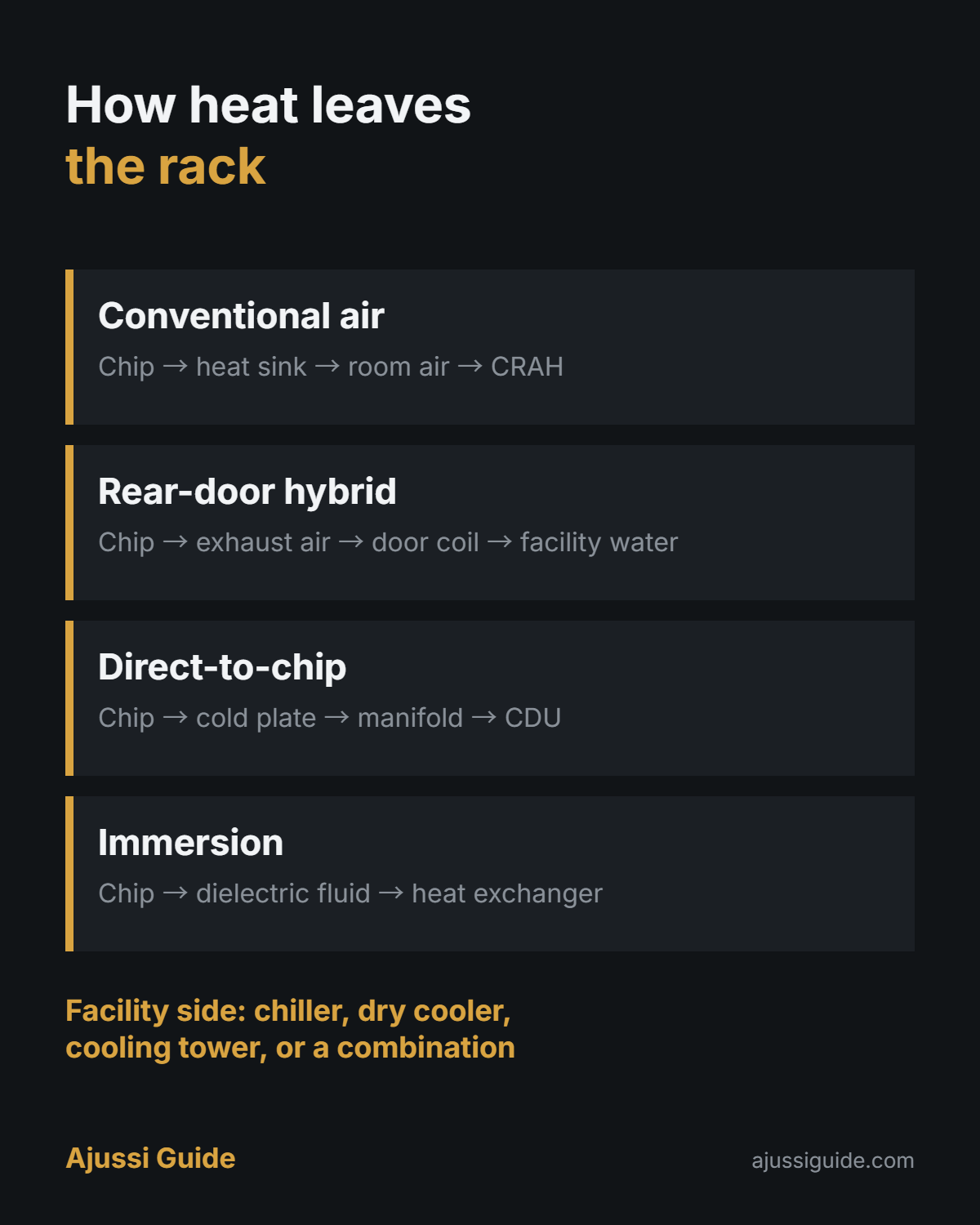
Heat does not take one path. It takes the path your architecture chose, and the vendors differ at every branch.
| Branch | Path the heat takes |
|---|---|
| Conventional air | Chip to heat sink to server air to room air, then CRAH or CRAC |
| Rear-door hybrid | Chip to heat sink to server exhaust air, then a liquid coil at the rack door, then facility water or a dedicated heat rejection unit |
| Direct-to-chip | Chip to cold plate to rack manifold, then a CDU, then facility water or liquid-to-air rejection |
| Immersion | Chip and board into dielectric fluid, then a pump and heat exchanger, or a condenser coil in two-phase designs |
| Facility side | Chiller plant, dry cooler, cooling tower, or a designed combination, then outside |
The facility side is not a fixed sequence. Chillers, dry coolers, and cooling towers are alternatives or combinations chosen for climate, water policy, and supply water temperature. NVIDIA notes that higher supply water temperatures can reduce or remove mechanical chillers in many climates.
The question is not which cooling technology wins. It is which branch a given site can actually retrofit into, and that answer is different for every building.
The Main Cooling Architectures Used in AI Data Centers
Four architectures matter for liquid cooling stocks, and the difference between them is where the heat changes from air to liquid. Immersion is split into two rows below because single-phase and two-phase behave differently.
Rear-door units are often filed under air cooling because the server still breathes air. At the door the heat crosses into a liquid loop, so the site needs a secondary fluid loop and somewhere to reject that heat, and the vendor set changes.
| Architecture | What actually changes |
|---|---|
| Conventional air | Heat leaves through server and room air. Common at the 5 to 15 kW per rack baseline ASHRAE describes. No universal ceiling applies. |
| Rear-door hybrid | Server stays air cooled, but exhaust air gives up heat to a liquid coil at the door. It fits sites that already have facility water, and sites without it can add a dedicated heat rejection unit. Standard rack form factors keep it retrofit friendly. |
| Direct-to-chip cold plate | A cold plate takes heat into liquid at the chip. Suited to 50 to 100+ kW. Servers need cold plates and manifolds. |
| Immersion, single-phase | Board sits in non-boiling dielectric fluid. High density, but tanks and service procedures change. |
| Immersion, two-phase | Fluid boils on the chip and condenses above it. Built for high heat flux. Not a simple rack retrofit. |
One caution on a widely quoted number. There is no primary source for a universal 20 kW per rack ceiling on air cooling. ASHRAE gives a 5 to 15 kW baseline for existing rooms and addresses liquid designs at 50 to 100+ kW.
Air cooling has no single hard ceiling, but NVIDIA’s 120 to 135 kW NVL72 rack designs sit well beyond ASHRAE’s legacy baseline.
Public, Private, or Buried Inside a Larger Company
Most lists of liquid cooling stocks tell you which companies do liquid cooling. Almost none tell you whether you can buy that business. Some names are listed, some are private, and some are real businesses sitting inside a much larger company where you can buy the parent but cannot see what the cooling business earns.
Several of the most recognizable specialist brands now sit in that last group. Ownership and disclosure status checked August 18, 2026.
>| Company | What you can buy, and what you can see |
|---|---|
| Vertiv | VRT on NYSE. Liquid cooling revenue not broken out; segments are geographic. |
| Modine | MOD on NYSE. Data Centers segment reported; liquid cooling share not disclosed. |
| Comfort Systems USA | FIX on NYSE. No data center or liquid cooling revenue line published. |
| nVent | NVT on NYSE. Data center and Systems Protection figures published; liquid cooling not disclosed. |
| Ecolab | ECL on NYSE. CoolIT has no separate stock and has no figure of its own yet. The close came after the quarter end, so the first check is the next quarterly report. |
| Schneider Electric | SU on Euronext Paris, US OTC ADR as SBGSY. No standalone cooling revenue line. |
| Eaton | ETN on NYSE. Boyd Thermal has no separate stock and its revenue is not disclosed. |
| LiquidStack | No LiquidStack stock. Owned by Trane Technologies since March 2026. |
| GRC | Privately funded. No listed share, revenue not publicly disclosed. |
Now look at the column on the right and notice what is missing.
As of August 18, 2026, not one of the seven separately reports liquid cooling revenue. The products are visible. The revenue is not.
Where Did the Liquid-Cooling Pure Plays Go?
Several recognizable specialists moved under larger infrastructure companies, leaving investors with indirect exposure and limited revenue visibility.
The supply side of liquid cooling stocks consolidated fast. From February 2025 through July 2026, four recognizable specialists moved under larger industrial parents. Three of those transactions completed between March and July 2026.
| Acquirer | Specialist and ownership change |
|---|---|
| Schneider Electric | Motivair, controlling interest acquired in February 2025 |
| Trane Technologies (NYSE: TT) | LiquidStack, acquisition completed March 2026 |
| Eaton (NYSE: ETN) | Boyd Thermal, acquisition completed March 2026 |
| Ecolab (NYSE: ECL) | CoolIT, acquisition completed July 2026 for approximately $4.75 billion |
This is one reason the disclosure column above is empty. In the consolidated results and closing materials published so far, specialist revenue is not broken out as a separate line, and for CoolIT the close fell after the quarter end, so the first check is the next quarterly report. It is not the only reason, since Vertiv, Modine, Comfort Systems, and nVent were already diversified. Either way you buy a parent company that contains a cooling business.
GRC is one verified specialist with private-company funding, but this review did not attempt to inventory every private liquid cooling vendor.
Liquid Cooling Stocks Worth Watching in 2026
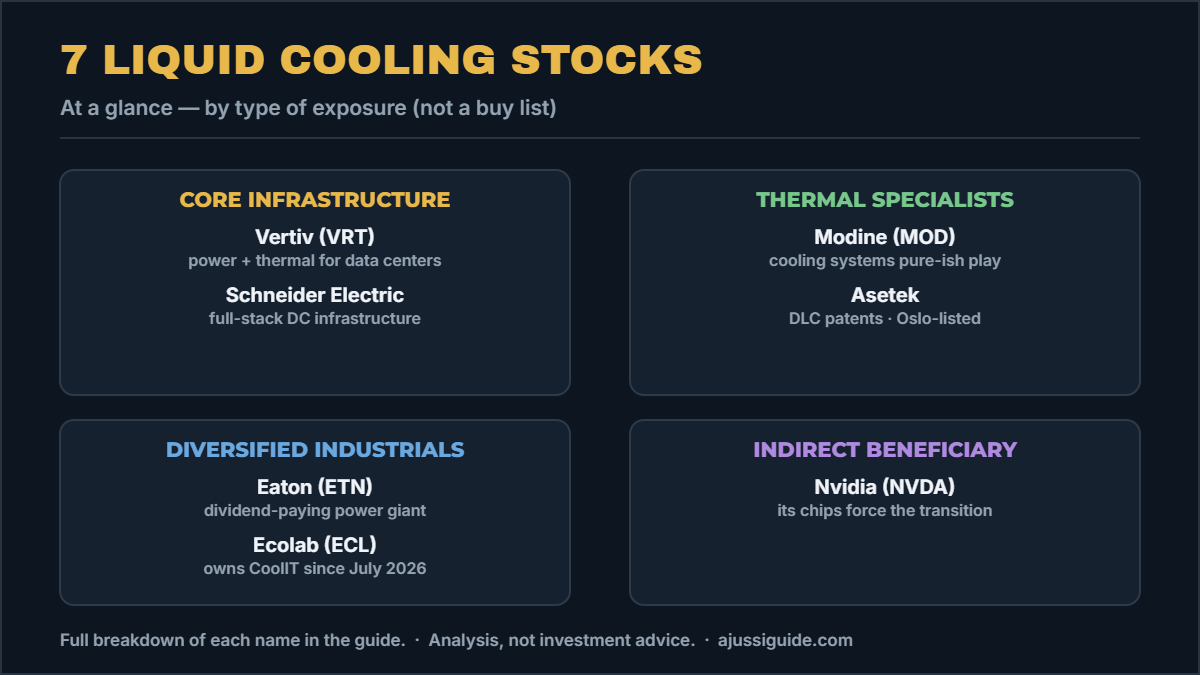
Seven listed names carry real exposure among liquid cooling stocks. None of them is a pure play, and the table above explains why that matters.
Vertiv Holdings (VRT)
Vertiv is a US-listed provider of power, thermal management, and IT infrastructure. It is not a liquid cooling pure play, and its geographic reporting segments do not break out liquid cooling revenue.
Eaton Corporation (ETN)
Eaton reports Electrical Americas and Electrical Global, not a standalone data center segment. Boyd Thermal is included in Electrical Global, and its liquid cooling revenue is not separately disclosed.
Modine Manufacturing (MOD)
Modine reports a Data Centers segment, so segment revenue is visible even though the liquid cooling share inside it is not. Airedale by Modine covers facility cooling rather than chip level hardware.
Schneider Electric
Schneider Electric is a large listed energy management and automation group, traded as SU in Paris with a US OTC ADR under SBGSY. Motivair gives it a liquid cooling portfolio, but no standalone cooling revenue line.
A legacy name that no longer fits the screen
Asetek still appears on liquid cooling stock lists, including the previous version of this guide, but it no longer fits this screen.
Nasdaq Copenhagen approved the delisting of Asetek shares on April 24, 2026, with May 21, 2026 as the last trading day, after a takeover by CQXA Holdings. There is no independent Asetek share to buy. The shares traded on Nasdaq Copenhagen, not the Oslo exchange.
The second reason matters more for this guide. Asetek’s own current company description reads as gaming hardware, covering all-in-one liquid coolers for PC and enthusiast gaming brands and SimSports products. Data center liquid cooling revenue does not appear in the latest official materials.
Ecolab (ECL), The New Entrant via CoolIT
Ecolab completed its CoolIT acquisition on July 2, 2026 for about $4.75 billion. CoolIT sits in the Global High-Tech platform inside Global Water, but the close came after the quarter that ended June 30, so the Q2 figures below do not include it. As of August 18, 2026 no post-close quarter has been reported, so whether CoolIT gets its own line cannot be checked yet.
Comfort Systems USA (FIX), the Installer Rather Than the Manufacturer
Comfort Systems is a mechanical and electrical contractor rather than an equipment manufacturer. Its exposure comes through installation, piping, and modular construction, which means labor availability, schedule, and project execution matter more to its results than any single cooling technology does.
nVent (NVT)
nVent supplies CDUs, TCS manifolds, racks and enclosures inside Systems Protection. Its 2025 divestiture of a separate Thermal Management business is a different business context and does not mean nVent left liquid cooling. We cover its exposure separately.
The company that creates the demand, not the supply
NVIDIA does not sell CDUs or chillers. It sets rack power density, and that is what creates the requirement. Its published design rack power is 120 kW for GB200 NVL72 and 135 kW for GB300 NVL72, and both are described as liquid cooled rack scale architectures in the product documentation.
That statement applies to those rack scale systems. It does not mean every NVIDIA GPU or every Blackwell server requires liquid cooling.
Current Snapshot, August 2026
Everything time sensitive about these liquid cooling stocks lives in this table. Read the label before comparing anything: a segment figure and a company wide figure are not the same kind of number, and none of these is a liquid cooling figure.
>| Company and metric | Value, label, period |
|---|---|
| Vertiv, Net sales | $3,274m REPORTED Q2 2026 (ended 06-30), released 07-29. Cooling share NOT DISCLOSED |
| Modine, Data Centers segment sales | $348.6m REPORTED FY2027 Q1 (ended 06-30), released 07-29. Cooling share NOT DISCLOSED |
| Comfort Systems USA, Revenue | $3.27bn REPORTED Q2 2026, released 07-23. Cooling share NOT DISCLOSED |
| Comfort Systems USA, Backlog | $14.06bn REPORTED as of 06-30, released 07-23. Cooling share NOT DISCLOSED |
| nVent, Systems Protection net sales | $1,072.1m REPORTED Q2 2026, released 07-31. Cooling share NOT DISCLOSED |
| Ecolab, Global Water sales | $2,223.4m REPORTED Q2 2026, released 07-28. The CoolIT close on July 2 falls after this quarter, so it is not included |
| Schneider Electric, Group revenue | €21.2bn REPORTED H1 2026, released 07-30. Cooling share NOT DISCLOSED |
| Eaton, Electrical Global sales | $2.5bn REPORTED Q2 2026, released 07-31. Cooling share NOT DISCLOSED |
Three numbers circulate widely and are frequently used as if they were results. They are not.
| Figure often quoted | What it actually is |
|---|---|
| Modine $4 billion | A long term capacity agreement running to 2029, FORWARD-LOOKING. Not backlog and not revenue. |
| Eaton liquid cooling $1.5 billion | A 2026 expectation stated when the Boyd acquisition was announced, FORWARD-LOOKING. Not reported revenue. |
| Ecolab $1.5 billion | Global High-Tech annualized run rate including Ovivo and CoolIT together. Not CoolIT revenue. |
| Research house | 2026 to 2033 estimate |
|---|---|
| MarketsandMarkets | $4.07bn to $27.65bn, CAGR 31.5%. FORWARD-LOOKING MARKET ESTIMATE, published 2026-03-24 |
| Grand View Research | $8.2bn to $29.5bn, CAGR 20.1%. FORWARD-LOOKING MARKET ESTIMATE, 2026 edition |
The two 2026 estimates differ by roughly 2.0x, CALCULATED from the two published figures. The 2033 endpoints are close. The starting points and growth rates are not, because the two definitions of the market differ in what technologies and services they include.
The Risks Ajussi Is Watching
I’ve been doing this long enough to know that a great theme doesn’t always mean great returns on every stock in the space. Here’s what I’m keeping an eye on.
Valuation risk is real. Several liquid cooling-adjacent stocks have re-rated significantly in the past 18 months. Paying too much for a correct thesis is still a way to lose money. Check price-to-earnings and price-to-free-cash-flow before you step in.
Technology risk exists too. Liquid cooling is not one monolithic technology. Cold plate, single-phase immersion, two-phase immersion, each has different economics and different winners. A company strong in one approach may be disrupted by advances in another.
Customer concentration. Many cooling suppliers are heavily dependent on a handful of hyperscalers, Amazon, Microsoft, Google, Meta. If any of these customers slow capex, as they have done in past cycles, orders can dry up faster than the liquid in a leaky server rack. That upstream number is exactly what we monitor in our Hyperscaler Capex Tracker, updated every earnings season.
For a broader look at energy and infrastructure demand from AI, I recommend checking Reuters’ ongoing coverage of AI infrastructure spending, which tracks hyperscaler capex announcements in real time.
How Ajussi Sizes a Position in This Sector
If none of the seven reports liquid cooling revenue, comparing liquid cooling stocks has to run on something else. Six questions do most of the work.
| Question | Why it separates companies |
|---|---|
| How large is cooling inside total revenue | Determines whether a cooling cycle moves the share price at all |
| Is the company a manufacturer or an installer | Manufacturers carry product margin and inventory risk. Installers carry labor, schedule, and project risk. The two do not respond to the same news |
| How long do orders take to become revenue | A capacity agreement running to 2029 and a quarter of shipped product are different cash timelines |
| How concentrated is the customer base | A small number of hyperscale customers can move a segment in one quarter, in both directions |
| Can it be bought directly in the US | A regular exchange listing, an OTC ADR, and a subsidiary with no stock are three different levels of access |
| Is liquid cooling reported as its own segment | As of August 18, 2026 the answer is no for all seven, which is itself a reason to size positions carefully |
What to Check Before the Next Earnings
Do not carry a fixed earnings date for these liquid cooling stocks in your notes. Companies move them. Carry the metric and the page instead.
| What to look for | Where to confirm it |
|---|---|
| Vertiv: organic orders, backlog, whether liquid cooling capacity turns into revenue | Vertiv events and presentations |
| Modine: Data Centers segment sales and margin, how much of the $4bn agreement converts | Modine events and presentations |
| Comfort Systems: mechanical and electrical backlog, modular revenue and margin | Comfort Systems investor relations |
| nVent: data center sales, Systems Protection sales, backlog, new liquid cooling capacity | nVent events and presentations |
| Ecolab: Global High-Tech growth, CoolIT integration, whether any separate disclosure appears | Ecolab events and presentations |
| Schneider: data center demand commentary, Motivair integration, any new cooling KPI | Schneider financial calendar |
| Eaton: Electrical Global sales, orders and backlog growth, whether Boyd gets its own line | Eaton presentations and webcasts |
One definitional trap is worth stating plainly, because these words are used loosely in coverage of this sector.
| Term | What it means here |
|---|---|
| Revenue | Sales recognized in the income statement for the period. It must not be replaced with orders or backlog. |
| Orders | New customer commitments booked in the period. Scope and cancellation terms differ by company, and some disclose only a growth rate. |
| Backlog | Contracted or committed work not yet recognized as revenue. It is neither recognized revenue nor guaranteed to convert in full. |
Related Cooling Research
This guide is the entry point for the cooling layer and for liquid cooling stocks generally. These go deeper on one branch each.
| If you want | Read |
|---|---|
| Who supplies the CDUs and cold plates behind NVIDIA racks | Liquid Cooling Suppliers |
| Whether immersion is investable today | Immersion Cooling Stocks |
| Water use and the utilities behind it | Data Center Water Stocks |
| Whether these names are expensive | Cooling Stocks Valuation |
| Fund based exposure instead of single names | Data Center Cooling ETF |
| The Ecolab and CoolIT deal in detail | Ecolab CoolIT Acquisition |
| nVent specific cooling exposure | nVent Electric Stock |
Frequently Asked Questions
Are liquid cooling stocks only for aggressive investors?
Not necessarily. Some names like Eaton (ETN) are large-cap, dividend-paying industrials with long operating histories, relatively conservative exposure to the theme. Smaller pure-plays like Modine carry more risk and volatility. As always, position sizing matters more than the label you put on a sector.
Will air cooling ever make a comeback in data centers?
How do I track liquid cooling stock performance as a sector?
There is no dedicated liquid cooling ETF. Broader data center and infrastructure funds hold several of these names, so fund exposure is indirect and diluted. We cover the fund route separately.
What are the top data center cooling stocks?
Data center cooling covers a wider universe than liquid cooling alone, including facility chillers, air handling, and water treatment. Liquid cooling is the subset where density forces the change.
Can you buy stock in CoolIT, Asetek, or LiquidStack?
None of the three trades as an independent listed share today. Ecolab completed the CoolIT acquisition on July 2, 2026, and LiquidStack has been owned by Trane Technologies since March 2026; neither specialist has its revenue broken out in the parent results. Asetek was delisted from Nasdaq Copenhagen with a last trading day of May 21, 2026.
Is it too late to invest in data center cooling stocks?
Nobody knows the timing. What can be tracked is disclosure: whether any of these companies starts reporting liquid cooling as its own line, and whether orders convert into revenue at the pace the buildout implies.
Do rising cooling orders mean rising margins for that company?
Not automatically, and the answer depends on what the company actually does.
A manufacturer shipping more cold plates carries product margin and inventory risk, and volume alone does not expand margin because mix, pricing, and utilization still decide it. An installer carries labor and schedule risk instead, so a bigger backlog can come with thinner margins.
If liquid cooling becomes standard, do air cooling businesses disappear?
No, and the framing of the question is the problem.
Facilities still need heat rejection after the liquid loop. A chiller, dry cooler, cooling tower, or a combination may sit on the facility side, so that part of the chain is not replaced by direct-to-chip adoption.
Ajussi’s Bottom Line
Liquid cooling is now part of specific high-density AI rack designs, but public-market exposure stays indirect. As of August 18, 2026 none of the seven separately reports liquid cooling revenue. For liquid cooling stocks that makes the heat path, disclosure level, and order conversion more useful than a pure-play label. The earnings checklist above is how we keep this current.
🖥️ Ajussi’s Trading Desk Gear
Watching this sector means watching a lot of charts. The gear guides I actually researched for my own desk:
📊 Best Monitors for Stock Trading (2026)
🦾 Best Dual Monitor Arms for a Clean Setup
🔌 Thunderbolt 5 & USB-C Docks, One-Cable Desk
💡 Best Monitor Light Bars, Save Your Eyes at Night
Disclaimer: This article is for informational purposes only and is not financial advice. Do your own research.
Sources and Update Log
Last verified: August 18, 2026
Company results
- Vertiv, Q2 2026 results
- Vertiv, 2025 Form 10-K
- Modine, FY2027 Q1 results
- Comfort Systems USA, Q2 2026 results
- Comfort Systems USA, 2025 Form 10-K
- nVent, Q2 2026 results
- nVent, 2025 Form 10-K
- Ecolab, Q2 2026 results
- Schneider Electric, financial results
- Eaton, Q2 2026 results
Ownership changes
- Ecolab closes CoolIT acquisition, July 2, 2026
- Eaton completes Boyd Thermal acquisition
- Eaton signs agreement to acquire Boyd Thermal
- Trane Technologies completes LiquidStack acquisition
- Schneider Electric liquid cooling portfolio with Motivair
- Modine $4 billion long-term capacity agreement
Business evidence
- nVent liquid cooling and power portfolio at SC25
- Comfort Systems USA off-site construction products
- Schneider Electric share information
- Schneider Electric US release showing the SBGSY OTC ticker
- GRC funding round and strategic investors, 2025
Asetek
Technical references
- ASHRAE AI Data Center Framework
- ASHRAE Handbook, data centers and telecommunication facilities
- NVIDIA Mission Control systems administration guide
- NVIDIA GB200 NVL72
- NVIDIA GB300 NVL72
- NVIDIA on Blackwell liquid cooling and water efficiency
- Vertiv liquid-to-air CDU announcement
Market size estimates
Update log. 2026-08-18: Added the infrastructure map, heat path, four architectures, listing and disclosure table, ownership change track, Current Snapshot, and this source list. Removed Asetek from the stock list. Corrected the LiquidStack ownership status, the Ecolab closing date, and the Asetek listing venue. Removed unsourced efficiency figures.
This guide is for information only and is not investment advice.
Related posts
- Eaton Power Stocks: 5 Data Center Picks Every Investor Should Know in 2026
- Vertiv Stock Analysis: 2026 Guide to the Best Data Center Power Play
- Hyperscaler Cooling Costs: 5 Numbers Every AI Investor Should Know
- Ecolab CoolIT Acquisition: 5 Reasons This Deal Could Reshape Data Center Cooling Stocks
Last verified: August 3, 2026. Backlog figures and acquisition status change quarterly; check the latest filings before acting on anything here.