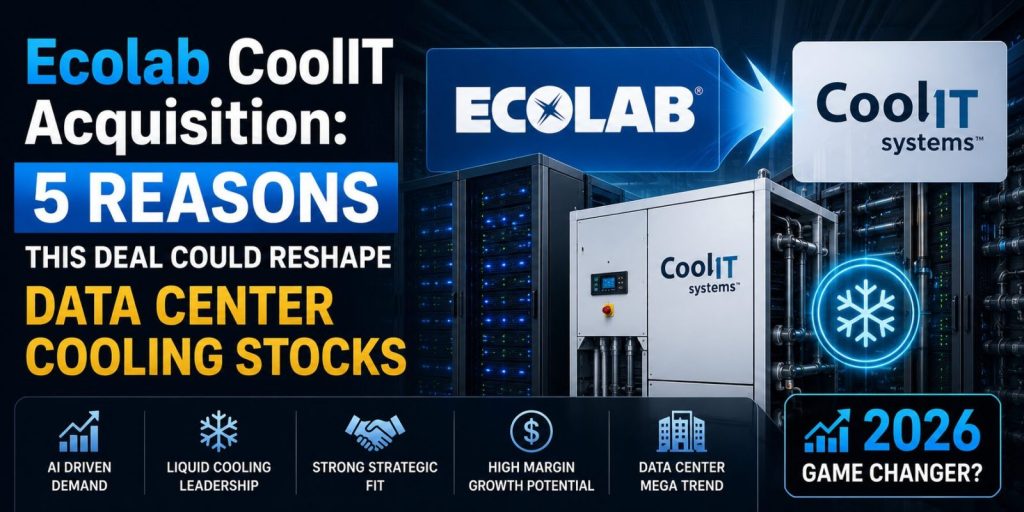
The Ecolab CoolIT acquisition is one of the most strategically interesting deals I’ve seen in the industrial space in years — and if you’re a retail investor trying to figure out how to play the AI infrastructure boom without buying another overvalued chip stock, you need to sit down and read this carefully.
I’m Ajussi. I’ve been watching water treatment, industrial chemicals, and now data center cooling converge in ways that would have sounded like science fiction a decade ago. Let me break this down for you the way I’d explain it to my nephew over galbi.
What Is the Ecolab CoolIT Acquisition, Exactly?
Ecolab (ticker: ECL) — the company most people associate with commercial dishwashers and hotel hygiene programs — announced the acquisition of CoolIT Systems, a Calgary-based private company that specializes in direct liquid cooling (DLC) technology for high-performance computing and AI server infrastructure.
CoolIT has been quietly supplying liquid cooling solutions to hyperscalers and enterprise data centers for years. Their rack-level and chip-level cooling systems are designed specifically for the kind of dense, power-hungry GPU clusters that companies like NVIDIA are selling by the thousands to AI labs and cloud providers.
Ecolab is paying approximately $4.75 billion for CoolIT, buying the company from private equity firm KKR. The deal was announced on March 20, 2026 and closed on July 1, 2026 — ahead of its originally expected third-quarter timeline. CoolIT is expected to generate roughly $550 million in sales over the next twelve months, so Ecolab is paying a rich growth multiple. The strategic logic, though, is loud and clear.
Why the Ecolab CoolIT Acquisition Makes Sense for ECL Stock
Here’s where I want you to think like an investor, not a consumer. Ecolab has always been in the business of managing water and thermal efficiency at industrial scale. They serve food processing plants, hospitals, hotels, and oil fields. But data centers? That’s the new frontier — and it’s enormous.
According to the International Energy Agency, global data center electricity consumption is set to more than double to around 945 TWh by 2030 — slightly more than Japan’s entire electricity consumption today. A massive chunk of that energy is wasted as heat. Cooling is not a side problem. It IS the problem.
Traditional air cooling is simply not keeping up with the thermal demands of modern AI accelerators. A single NVIDIA H100 GPU can produce over 700 watts of heat, and newer Blackwell-generation chips push past 1,000 watts per GPU. Rack densities are climbing from 10 kW to 100 kW and beyond. Liquid cooling is no longer optional — it’s mandatory at scale.
Ecolab walks into this space with existing relationships with Fortune 500 companies, a global service and distribution network, and deep expertise in water chemistry and thermal management. CoolIT brings the hardware technology. Together, this is a credible end-to-end cooling proposition.
Ecolab’s Existing Water and Thermal Moat
Let me give you some context. Ecolab already generates roughly $16 billion in annual revenue (2025). Their Global Industrial segment — which includes water treatment and process efficiency — is a consistent cash generator. This isn’t a startup trying to break into enterprise sales. ECL already has the relationships, the compliance track record, and the service infrastructure.
Adding CoolIT’s direct liquid cooling systems means Ecolab can now walk into a hyperscaler conversation and say: we can handle your cooling from the chip level all the way to the cooling tower on the roof. That’s a very powerful sales pitch.
Ecolab CoolIT Acquisition vs. Other Data Center Cooling Plays
Now, I know what you’re thinking. You’ve already heard about Vertiv, Schneider Electric, and a dozen other names in the data center infrastructure space. Let me put this in perspective with a simple comparison.
| Company | Ticker | Core Data Center Cooling Focus | Approach | Scale |
|---|---|---|---|---|
| Ecolab + CoolIT | ECL | Direct liquid cooling, water chemistry | Acquisition-led, full-stack cooling services | ~$16B revenue base |
| Vertiv Holdings | VRT | Thermal management, power distribution | Organic + acquisition, hardware-focused | ~$10B revenue base |
| Schneider Electric | SBGSY (ADR) | Cooling, power, data center infrastructure | Integrated energy management | ~€40B (≈$44B) revenue base |
| Modine Manufacturing | MOD | Thermal solutions, liquid cooling systems | Organic growth, Climate Solutions segment | ~$2.6B revenue base |
| Asetek | ASTEK (Oslo) | Rack-level liquid cooling for servers | Pure-play liquid cooling hardware | Smaller, niche player |
What makes ECL different is that it’s not a pure-play data center company — and that’s actually a feature, not a bug, in my opinion. Ecolab’s stock doesn’t get the same frothy AI multiple that Vertiv carries. That means you’re potentially getting data center cooling exposure at a more reasonable valuation, bundled inside a steady industrial compounder.
The Risk Side of the Ecolab CoolIT Acquisition
I’m not here to sell you a dream. There are real risks you need to weigh.
Integration risk is real. CoolIT is a hardware and engineering company. Ecolab is a chemicals and services company. Getting these cultures and product lines to work together takes time, management bandwidth, and sometimes money. History is full of industrial acquisitions that looked smart on paper and burned cash in execution.
Competition is fierce. Vertiv has a head start in liquid cooling mindshare. Schneider has deeper pockets and an existing hyperscaler customer base. NVIDIA itself is working with cooling vendors to certify solutions for its GPU platforms. Ecolab and CoolIT will need to move fast to win design wins at major data centers.
Timing uncertainty. Hyperscaler build-out cycles have historically been lumpy. Capital spending from the big cloud companies can slow or shift priorities faster than most retail investors expect. Ecolab’s core business would be fine, but the CoolIT growth thesis depends on sustained AI infrastructure investment.
You can check Ecolab’s investor relations page directly at ecolab.com/investor-relations for the latest filings, acquisition disclosures, and earnings commentary to do your own due diligence.
What Should Retail Investors Actually Do With This Information?
Here’s the Ajussi perspective after decades of watching deals like this play out. The Ecolab CoolIT acquisition positions ECL as a slow-burn beneficiary of the AI infrastructure wave — not a momentum trade, but a compounding story.
If you’re already overexposed to semiconductor stocks and want data center infrastructure exposure with a more defensive earnings base, ECL is worth adding to your research list. The company has raised its dividend for decades. It has investment-grade credit. It’s not going to zero if AI spending hits a speed bump.
But don’t buy it because of CoolIT alone. Buy it if you believe in the full Ecolab story — water scarcity, food safety, industrial efficiency, and now data center thermal management — as a multi-decade secular tailwind portfolio.
Position sizing matters. This is not a high-beta trade. Think of it as the steady anchor position in your AI infrastructure basket, not the moonshot. Pair it with more direct plays if you want upside torque, but appreciate what ECL brings: durability.
Frequently Asked Questions
Q: Did Ecolab officially complete the CoolIT acquisition?
A: Yes. Ecolab announced the deal on March 20, 2026 and completed the acquisition on July 1, 2026, ahead of its originally expected third-quarter close. Ecolab now targets growing its Global High-Tech business to $4 billion in sales by 2030. For integration updates, check Ecolab’s official investor relations page or SEC filings.
Q: Is ECL a good stock to buy for AI data center exposure in 2026?
A: ECL offers indirect exposure to AI data center infrastructure through the Ecolab CoolIT acquisition and its broader water and thermal management services. It is not a pure-play AI stock, which means lower volatility but also lower upside compared to names like Vertiv. It suits investors who want diversified, dividend-paying industrial exposure with a data center angle.
Q: How does liquid cooling actually work in AI data centers?
A: Direct liquid cooling (DLC) routes chilled water or other coolants directly to heat-generating components — like GPU chips — through cold plates or immersion baths. This removes heat far more efficiently than air cooling fans, enabling much higher server densities. CoolIT specializes in rack-level DLC systems that bolt onto existing server infrastructure, making adoption easier for data center operators already running conventional cooling.
🖥️ Ajussi’s Trading Desk Gear
Watching this sector means watching a lot of charts. The gear guides I actually researched for my own desk:
📊 Best Monitors for Stock Trading (2026)
🦾 Best Dual Monitor Arms for a Clean Setup
🔌 Thunderbolt 5 & USB-C Docks — One-Cable Desk
💡 Best Monitor Light Bars — Save Your Eyes at Night
Disclaimer: This article is for informational purposes only and is not financial advice. Do your own research.
The CoolIT deal is one of four ownership changes that reshaped this sector. We track all of them in our liquid cooling stocks guide.