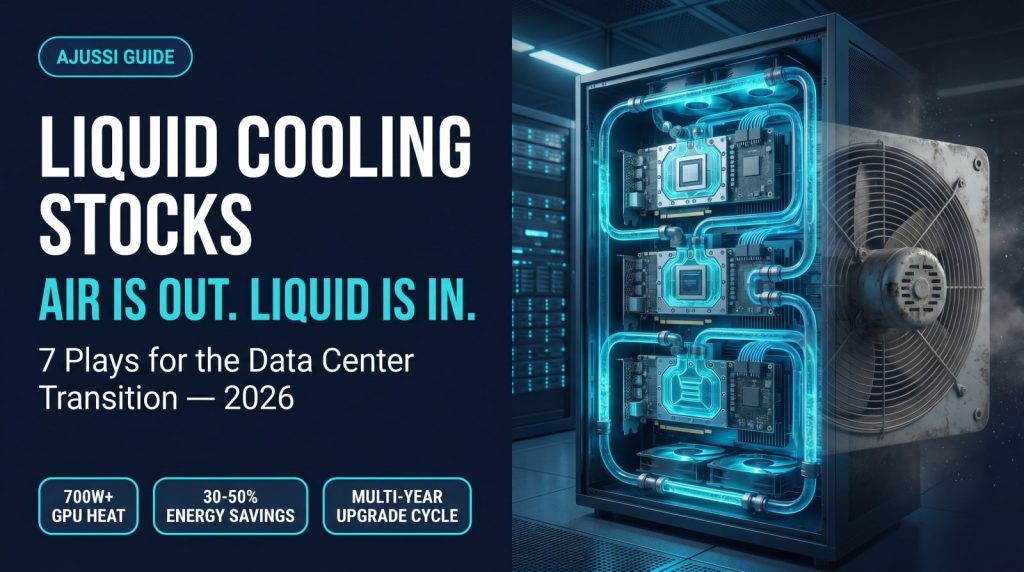
Liquid cooling stocks are becoming one of the most important infrastructure plays in the AI boom, and if you’re still sleeping on this sector, Ajussi is here to wake you up with a strong cup of coffee. Of all the data center cooling stocks investors are screening right now, the liquid cooling names are where the actual transition money is flowing.
I’ve been watching data center infrastructure for a long time. Servers get hot. That heat is the enemy of performance, uptime, and your electricity bill. For decades, blowing cold air through metal racks was good enough. But then AI happened — and suddenly “good enough” became a liability.
Why Liquid Cooling Stocks Matter Right Now
Here’s the problem in plain terms: the new generation of AI accelerators — think NVIDIA’s H100 and Blackwell-generation GPUs — generate enormous heat loads. We’re talking roughly 700 watts for an H100 and past 1,000 watts per chip for Blackwell-class parts. Traditional air cooling systems were engineered for chips burning maybe 50–150 watts. The math simply doesn’t work anymore.
When a hyperscaler tries to pack a modern AI training cluster into a data center designed for air cooling, they either run the chips throttled (slower, wasted money) or they watch their power costs go through the roof running bigger and bigger fans. Neither option is acceptable at scale.
This is exactly why liquid cooling — pumping chilled liquid directly to the heat source — has moved from niche to necessary almost overnight. And for us investors, that shift is creating real, durable demand for a set of companies that most retail investors haven’t priced in yet.
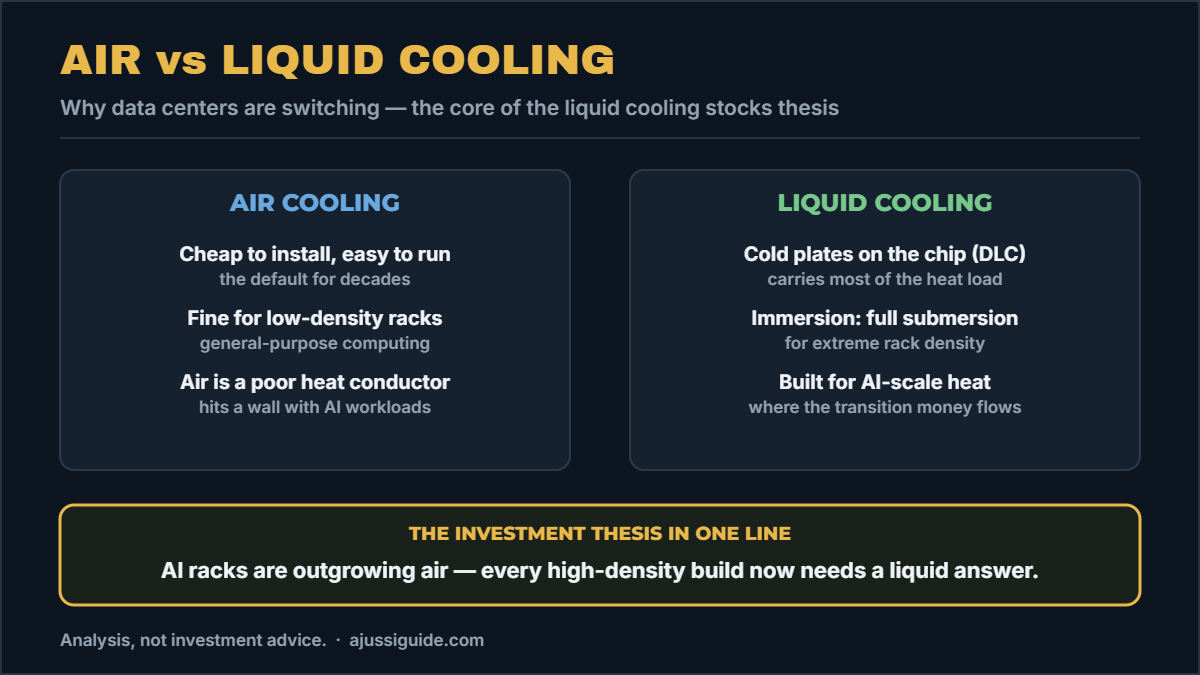
Air Cooling vs. Liquid Cooling: The Core Difference
Let me break this down simply. Air cooling moves heat away from chips by blowing conditioned air across heatsinks and fins. It’s cheap to install, easy to maintain, and fine for low-density workloads. The problem is that air is a terrible conductor of heat compared to water or dielectric fluids.
Liquid cooling comes in two main flavors. Direct Liquid Cooling (DLC) — also called cold plate cooling — runs liquid through metal plates pressed directly against the chip. This handles the majority of the heat load without touching the ambient air system. Immersion cooling goes further: you literally submerge the entire server in a non-conductive liquid bath. Immersion is more complex and expensive, but it can handle extreme heat densities that even cold plate systems struggle with. This technology split is also what separates liquid cooling stocks into very different risk profiles — a cold-plate leader and an immersion specialist are not the same bet.
The efficiency gap is not trivial. Liquid cooling can remove heat dramatically more efficiently — water conducts heat roughly 25 times better than air, and it typically reduces cooling-related energy consumption by 30–50%. For a hyperscaler spending hundreds of millions on electricity annually, that number is transformational.
| Feature | Air Cooling | Direct Liquid Cooling | Immersion Cooling |
|---|---|---|---|
| Heat removal efficiency | Low | High | Very High |
| Supported rack density | 5–15 kW/rack | 30–100 kW/rack | 100+ kW/rack |
| Installation complexity | Low | Medium | High |
| Upfront cost | Low | Medium-High | High |
| Energy savings vs. air | Baseline | 30–40% | 40–50%+ |
| Best use case | General IT workloads | AI/GPU clusters | Extreme density HPC/AI |
According to the International Energy Agency (IEA), data centers already account for roughly 1–1.5% of global electricity demand, and that figure is expected to grow significantly as AI workloads scale. Cooling is a massive portion of that energy draw — which is exactly why enterprises and governments alike are pushing for liquid cooling adoption.
Liquid Cooling Stocks Worth Watching in 2026
Now for the part you came here for. (If you want the pure stock-list version, our data center liquid cooling stocks guide covers it — this article focuses on the air-to-liquid transition and how each player fits it.) I’m not going to give you a buy list — that’s not my job and this isn’t financial advice. But I am going to walk you through the companies that are legitimately positioned in this theme, with real products and real revenues.
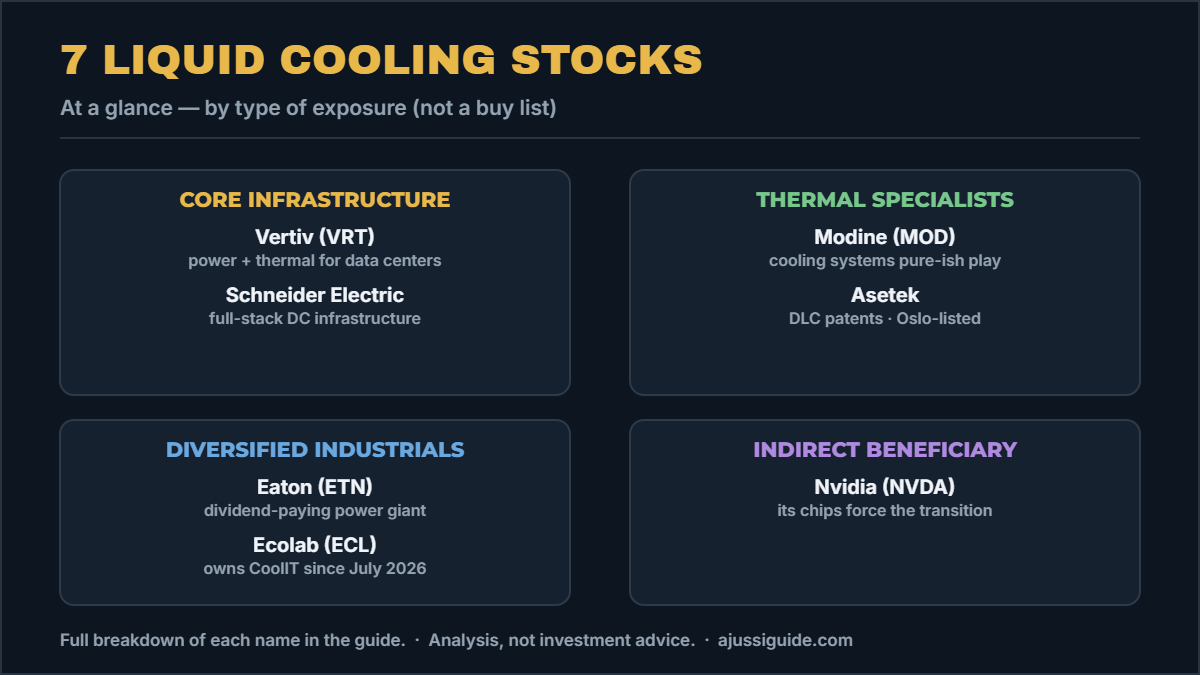
Vertiv Holdings (VRT)
Vertiv is probably the most direct pure-play on data center thermal management available to US retail investors right now. They make power, cooling, and IT infrastructure for data centers — and their liquid cooling product line has seen accelerating demand. The stock has been one of the top performers in the data center infrastructure space over the past two years. Watch their earnings calls closely; management discusses liquid cooling attach rates explicitly.
Eaton Corporation (ETN)
Eaton is a diversified industrial giant, but their data center segment — covering power distribution and cooling — is growing fast. They’ve made strategic moves into liquid cooling through acquisitions and partnerships. ETN gives you some diversification away from pure data center exposure while still capturing the trend.
Modine Manufacturing (MOD)
Modine is a smaller, more concentrated play. They produce thermal management systems and have been pivoting heavily toward data center cooling, including liquid cooling solutions. Smaller cap means more volatility, but also potentially more upside if execution is strong.
Schneider Electric
Schneider Electric (listed in Paris as SU, but accessible via ADR or international brokers) is a global leader in energy management and automation. Their EcoStruxure platform and data center cooling solutions are widely deployed. Their CEO has been vocal about liquid cooling being a generational shift in the industry.
NVIDIA (NVDA) — Indirect Beneficiary
This one might surprise you. NVIDIA doesn’t make cooling equipment, but their GPU roadmap is the single biggest driver of liquid cooling adoption. As they push to higher TDP chips with each generation, customers have no choice but to adopt liquid cooling to actually run these GPUs at rated speeds. NVIDIA’s success is the liquid cooling sector’s order book.
Asetek
Asetek is a Denmark-based company (traded on Oslo Stock Exchange) that has been in liquid cooling for data centers and high-performance computing for years. They have a real patent portfolio and recurring licensing revenue. Not easily accessible on US exchanges, but worth knowing about for context on where the intellectual property lives.
Ecolab (ECL) — The New Entrant via CoolIT
This one changed in 2026: CoolIT Systems — long considered the technology benchmark in direct liquid cooling — is no longer private. Ecolab completed its roughly $4.75 billion acquisition of CoolIT on July 1, 2026, instantly making ECL a serious liquid cooling player with a water-chemistry moat on top. We covered the deal in depth in our Ecolab-CoolIT analysis. Meanwhile, Submer Technologies (immersion cooling) remains private — if it ever pursues an IPO, it would be worth immediate attention.
Comfort Systems USA (FIX), the Installer Rather Than the Manufacturer
Every name above sells hardware. Comfort Systems sells the labor that puts it in the building. It is a mechanical and electrical contractor, so it gets paid on installation volume regardless of whose cold plates or CDUs end up in the rack. That makes it a different axis of exposure from the equipment vendors, and worth holding separately in your head.
The numbers have moved fast. Backlog reached a record 12.45 billion dollars in the first quarter of 2026, up 80.8 percent year over year, then climbed again to about 14.1 billion in the second quarter, when quarterly revenue topped 3 billion dollars for the first time. Management points to data center work driven by AI, cloud and high performance computing as the main driver, and expanded prefabrication and modular capacity by roughly 30 percent in 2026 to keep up.
What I watch here is not the backlog number itself but whether it converts. Contractors live and die on execution and skilled labor availability, and a backlog that grows faster than the crew can build it turns into margin pressure rather than profit. Among liquid cooling stocks this is the one where the risk is operational rather than technological.
The Risks Ajussi Is Watching
I’ve been doing this long enough to know that a great theme doesn’t always mean great returns on every stock in the space. Here’s what I’m keeping an eye on.
Valuation risk is real. Several liquid cooling-adjacent stocks have re-rated significantly in the past 18 months. Paying too much for a correct thesis is still a way to lose money. Check price-to-earnings and price-to-free-cash-flow before you step in.
Technology risk exists too. Liquid cooling is not one monolithic technology. Cold plate, single-phase immersion, two-phase immersion — each has different economics and different winners. A company strong in one approach may be disrupted by advances in another.
Customer concentration. Many cooling suppliers are heavily dependent on a handful of hyperscalers — Amazon, Microsoft, Google, Meta. If any of these customers slow capex — as they have done in past cycles — orders can dry up faster than the liquid in a leaky server rack. That upstream number is exactly what we monitor in our Hyperscaler Capex Tracker, updated every earnings season.
For a broader look at energy and infrastructure demand from AI, I recommend checking Reuters’ ongoing coverage of AI infrastructure spending, which tracks hyperscaler capex announcements in real time.
How Ajussi Sizes a Position in This Sector
In a thematic sector like this I treat the individual names as a basket rather than betting everything on one company. Cooling demand from AI data centers is a multi year trend I believe in. Which specific company captures the most share of it is a much harder call, and I do not pretend to know.
So I weight toward companies with diversified revenue, where cooling is a growing line rather than the whole business. That gives some cushion if the narrative shifts to a different thermal approach. A pure play rewards you more when the thesis works and punishes you harder when it does not.
I also read hyperscaler capex announcements as a leading indicator. When Microsoft, Google or Amazon commits to a multi billion dollar buildout, the suppliers underneath get their turn a few quarters later. Follow the money upstream rather than chasing the headline.
Frequently Asked Questions
Are liquid cooling stocks only for aggressive investors?
Not necessarily. Some names like Eaton (ETN) are large-cap, dividend-paying industrials with long operating histories — relatively conservative exposure to the theme. Smaller pure-plays like Modine carry more risk and volatility. As always, position sizing matters more than the label you put on a sector.
Will air cooling ever make a comeback in data centers?
Air cooling isn’t going away entirely — it still makes economic sense for lower-density, general-purpose computing. But for AI training and inference workloads at scale, the physics are clear: liquid wins. The question isn’t if liquid cooling becomes the dominant paradigm for high-density racks, but how fast and which companies capture the market.
How do I track liquid cooling stock performance as a sector?
There isn’t a dedicated ETF for liquid cooling stocks specifically as of mid-2026. Your best approaches are to follow the individual names mentioned above, watch data center infrastructure ETFs like those tracking broader industrial or technology infrastructure themes, and monitor quarterly earnings from Vertiv and Eaton which give the clearest visibility into cooling demand trends.
What are the top data center cooling stocks?
Data center cooling stocks span a wider universe than pure liquid plays — the category includes traditional air-side HVAC suppliers, thermal management specialists, and the liquid cooling names covered here. If you are screening the broader category, start with the seven companies above, then widen the lens to the power side of the buildout — our grid infrastructure stocks guide covers the layer that keeps those racks powered in the first place.
Can you buy stock in CoolIT, Asetek, or LiquidStack?
Only partly. CoolIT is no longer investable on its own — Ecolab (ECL) completed its acquisition in July 2026, so ECL is now the closest thing to a “CoolIT stock.” Asetek trades in Europe on the Oslo exchange, not on US markets. LiquidStack, the immersion cooling specialist, remains private as of mid-2026 — searches for a LiquidStack stock will come up empty. For most US investors, the seven liquid cooling stocks in this guide are the practical menu.
Is it too late to invest in data center cooling stocks?
Nobody knows, and anyone who answers that with certainty is guessing. What can be said is that the demand driver, AI compute that physically has to be cooled, is a multi year buildout rather than a one quarter event. Whether today’s prices already assume all of that growth is a separate question you have to work through name by name. Treat any thematic position as money you can afford to be wrong about.
Ajussi’s Bottom Line
I’ve watched a lot of technology transitions in my years as an investor — and the shift from air cooling to liquid cooling in data centers has all the characteristics of a durable, multi-year infrastructure upgrade cycle. It’s not driven by hype. It’s driven by physics and economics: AI chips are too hot, electricity is too expensive, and air is too inefficient. That combination forces a solution, and liquid cooling stocks are where that solution gets monetized.
Liquid cooling stocks sit at the intersection of AI infrastructure, energy efficiency, and industrial manufacturing — three of the most compelling investment themes of this decade. The companies that build and deploy these systems will see years of strong order flows as hyperscalers and enterprises retrofit existing facilities and build new ones from the ground up.
Do your homework on valuations. Diversify across the supply chain. And remember — the best themes in investing are the ones where the underlying demand is non-discretionary. When your server is overheating and your AI model isn’t training, you don’t shop around for six months. You buy cooling. That’s the kind of demand I like.
🖥️ Ajussi’s Trading Desk Gear
Watching this sector means watching a lot of charts. The gear guides I actually researched for my own desk:
📊 Best Monitors for Stock Trading (2026)
🦾 Best Dual Monitor Arms for a Clean Setup
🔌 Thunderbolt 5 & USB-C Docks — One-Cable Desk
💡 Best Monitor Light Bars — Save Your Eyes at Night
Disclaimer: This article is for informational purposes only and is not financial advice. Do your own research.
Related posts
- Eaton Power Stocks: 5 Data Center Picks Every Investor Should Know in 2026
- Vertiv Stock Analysis: 2026 Guide to the Best Data Center Power Play
- Ecolab CoolIT Acquisition: 5 Reasons This Deal Could Reshape Data Center Cooling Stocks
Last verified: August 3, 2026. Backlog figures and acquisition status change quarterly; check the latest filings before acting on anything here.