When people ask about Cerebras stock, they are usually asking about the news: a $6.38 billion IPO, $25.4 billion in remaining performance obligations, OpenAI running a frontier model on its chips. The news is real, but news is not a thesis. What decides whether Cerebras stock works as an investment is four structures underneath: how wafer-scale economics differ from GPUs, how the revenue is actually built, what the OpenAI agreement does and does not guarantee, and what the loss profile demands. I will walk through each one, and keep the perishable numbers in one table you can check against the next filing.
Structure 1: What Wafer-Scale Actually Changes
Most conventional AI accelerators start as a silicon wafer cut into hundreds of small chips, which then have to be wired back together: networking, interconnects, and stacks of external high-bandwidth memory. Cerebras builds one processor out of the entire wafer. The Wafer-Scale Engine keeps compute and memory on the same piece of silicon, which removes much of the chip-to-chip communication that slows down inference on GPU clusters. That single design choice is the foundation of the entire Cerebras stock story.
The architecture provides a technical basis for the speed advantage, though headline performance multiples remain workload and configuration specific. Moving data across a wafer is faster than moving it between separate chips across a network. The Wafer-Scale Engine is also an on-chip SRAM-centric architecture, which leaves Cerebras less exposed to the external HBM supply chain that every GPU buyer is fighting over. For investors who follow the HBM memory supply story, Cerebras is the notable attempt to route around that bottleneck rather than through it.
The trade-offs are just as structural. Wafer-scale manufacturing requires spare cores and routing designed to work around defects, and its manufacturing and supply chain have a shorter commercial track record than conventional GPUs. The software world is built around NVIDIA’s CUDA ecosystem, so every Cerebras deployment has to justify leaving the default path. And a wafer-scale system is workload-specialized rather than general-purpose: Cerebras systems support both large-scale model training and high-speed inference, but they are not the broad, do-everything platform that GPUs have become.
Structure 2: How the Revenue Is Built, and Who It Comes From
Cerebras stock is, at bottom, a claim on two revenue streams: selling systems, and selling inference as a cloud service. The cloud side is the strategic story, because it turns a lumpy hardware business into recurring usage, and it is currently the fastest-growing line in the company.
The more important structural fact is customer concentration. In 2024, one customer, UAE-based G42, was about 85% of revenue. In 2025, G42 fell to roughly a quarter of revenue, but a related UAE institution, MBZUAI, became the majority, and together the two UAE-linked customers were still about 86% of sales. Concentration did not disappear; it changed names. The question hanging over Cerebras stock for the next two years is whether the OpenAI relationship repeats that pattern at larger scale or genuinely broadens the base.
Structure 3: The OpenAI Agreement, Read Carefully
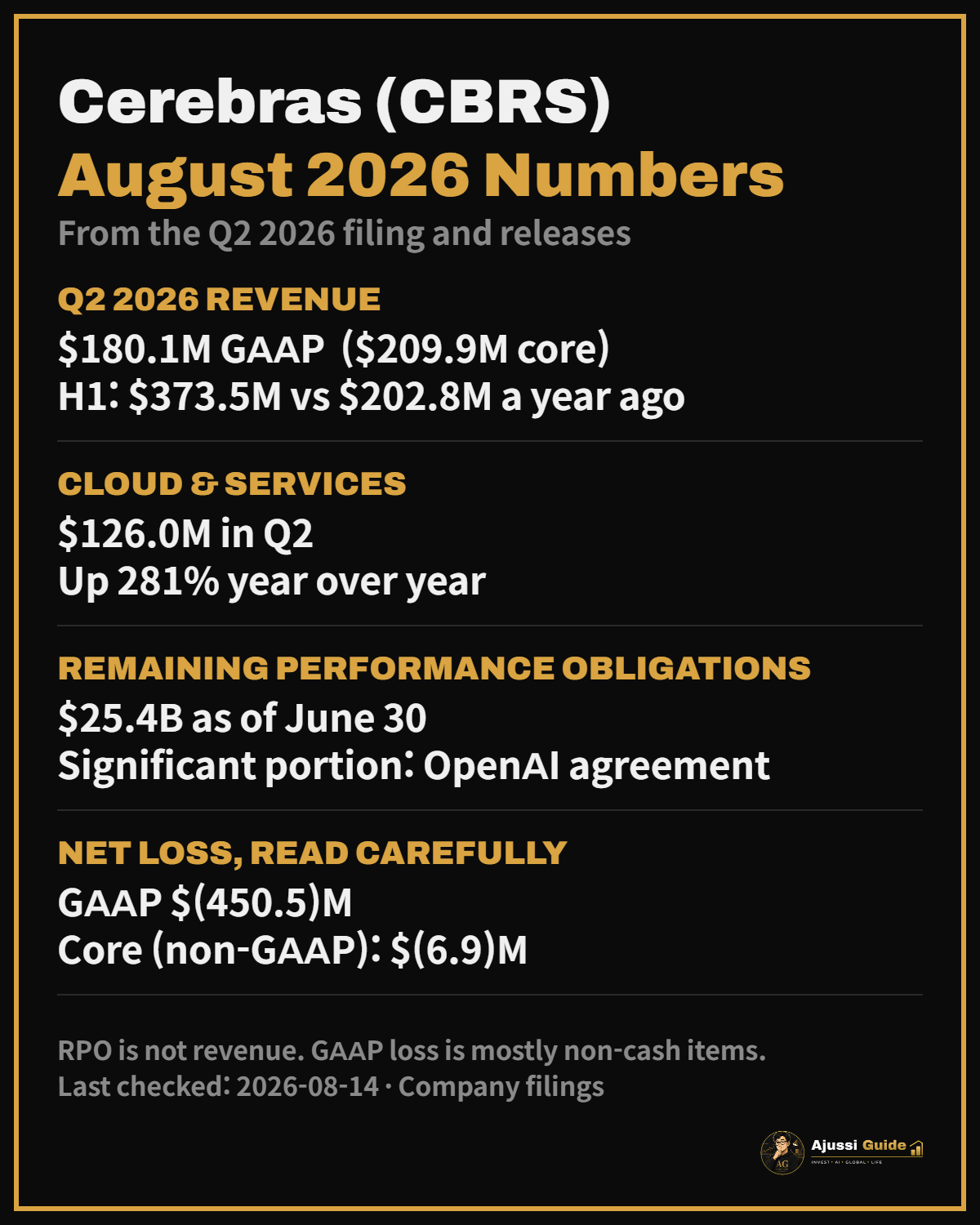
The other thing everyone asks about Cerebras stock is the OpenAI deal. In December 2025, Cerebras signed a master relationship agreement with OpenAI: a commitment to purchase 750 megawatts of AI inference capacity and related services, deployed in tranches from 2026 through 2028, with an option for another 1.25 gigawatts by the end of 2030. A significant portion of the company’s $25.4 billion in remaining performance obligations (RPO) is attributable to this agreement.
Two readings matter. The bullish reading: a frontier lab examined every inference option on the market and committed years of capacity to wafer-scale, and the Ultrafast mode launched in August 2026 is the public proof, running GPT-5.6 Sol at up to 750 output tokens per second, up to 14 times the standard speed, in limited preview. Among the uses OpenAI itself named are financial research and security. Ultrafast is a limited preview, so it is an important public validation of the partnership rather than proof of broad commercial-scale adoption.
The cautious reading: RPO is not revenue. Remaining performance obligations convert to revenue only as capacity is deployed and services are delivered, tranche by tranche, over years. And an RPO balance where a significant portion sits with a single counterparty is, structurally, the same concentration question as Structure 2 with a more famous name attached. If OpenAI’s own capacity plans shift, the timing of that conversion shifts with them.
Structure 4: The Loss Profile
Cerebras is growing fast while reporting large GAAP losses, and the composition of that loss matters more than its size. The $450.5 million GAAP net loss in the latest quarter was dominated by non-cash stock-based compensation and other IPO-related adjustments; the company-defined core net loss was $6.9 million. The GAAP figure should therefore not be treated as a direct measure of quarterly cash burn. The IPO raised roughly $6.38 billion gross, about $6.2 billion net of fees, and quarter-end cash, restricted cash and short-term investments stood at $8.6 billion. The company judges that liquidity sufficient for at least the next twelve months, though actual needs depend on data center investment and deployment pace. The structure to watch is the race between RPO converting into recognized revenue and the cash going into data centers and equipment. That race makes Cerebras stock a timing bet: if deployment slips, revenue recognition slips with it, and valuation volatility rises.
Cerebras Stock: The Numbers in One Place
Everything above is the structural case around Cerebras stock, and it should age slowly. The numbers below are a snapshot and will not. Check them against the latest filing before relying on them.
| Item | Figure |
|---|---|
| IPO | $185.00 per share, May 14, 2026, Nasdaq: CBRS Company press release |
| IPO proceeds | ~$6.38B gross (including underwriters’ option) Company press release |
| First-day close | $311.07, up 68% May 14, 2026 close |
| Q2 2026 revenue | $180.1M GAAP; $209.9M core (non-GAAP) Q2 2026 10-Q, quarter ended June 30 |
| H1 2026 revenue | $373.5M (vs $202.8M a year earlier) Q2 2026 10-Q |
| Cloud and services | $126.0M in Q2, up 281% YoY Q2 2026 10-Q |
| Q2 GAAP net loss | $(450.5)M, incl. $377.0M non-cash stock comp Q2 2026 10-Q |
| Q2 core net loss | $(6.9)M (company-defined non-GAAP) Q2 2026 earnings release |
| RPO | $25.4B as of June 30, 2026 Q2 2026 10-Q, largely OpenAI agreement |
| 2026 core revenue outlook | $880M to $890M (raised) Company guidance, Aug 12, 2026 |
| Customer concentration | UAE-linked ~86% of 2025 revenue (G42 ~24%, MBZUAI ~62%) S-1 registration statement |
Figures come from company filings, press releases and guidance commentary. Last checked: 2026-08-14. Share price and market value change daily and are deliberately not listed here.
What I Watch From Here
Not a price target for Cerebras stock. Four structural signals, one per structure above. First, deployment: how fast RPO converts into recognized revenue, disclosed every quarter. Second, breadth: whether customers outside OpenAI and the UAE relationships become a meaningful revenue share. Third, proof of demand at the product level: whether Ultrafast moves from limited preview to general availability, and whether other labs follow. Fourth, the burn: whether losses narrow as cloud revenue scales. A newly listed company also carries mechanical supply events, such as lock-up expirations, that are worth confirming in filings rather than assuming.
For the wider field this fits into, our picks-and-shovels map of AI infrastructure covers the layers around compute, and the AI server stocks breakdown covers the companies whose racks Cerebras is trying to displace.
Frequently Asked Questions
Is Cerebras profitable?
Not on a GAAP basis. The latest quarterly GAAP net loss was dominated by non-cash stock-based compensation and IPO-related adjustments, while the company-defined core net loss was far smaller. The case for Cerebras stock rests on revenue growth and RPO conversion, not on current GAAP profitability.
Who are Cerebras’ main customers?
Historically, UAE-linked customers G42 and MBZUAI dominated revenue, together about 86% of 2025 sales. The December 2025 OpenAI master agreement is now the largest committed relationship and accounts for a significant portion of the $25.4 billion in remaining performance obligations. Concentration, under different names, has been a constant in the company’s history so far.
What is the Wafer-Scale Engine?
A processor built from an entire silicon wafer instead of hundreds of small chips cut from it. Keeping compute and memory on one piece of silicon removes much of the chip-to-chip communication overhead that limits inference speed on GPU clusters, at the cost of unique manufacturing and ecosystem challenges.
How is Cerebras different from NVIDIA?
NVIDIA sells general-purpose accelerators wired together in clusters with external HBM memory, backed by the CUDA software ecosystem. Cerebras sells a workload-specialized wafer-scale platform that supports both large-scale training and high-speed inference, built on an on-chip SRAM-centric architecture. They compete for inference workloads, but they are structurally different products with different supply chains.
What did the OpenAI deal actually commit?
Under the December 2025 master relationship agreement, OpenAI committed to purchase 750MW of inference capacity deployed in tranches from 2026 through 2028, with an option for a further 1.25GW by end of 2030. The Ultrafast mode for GPT-5.6 Sol, launched in limited preview in August 2026, is the newest public product of the relationship, not the first: OpenAI’s GPT-5.3-Codex-Spark was released as a research preview to ChatGPT Pro users on Cerebras infrastructure in February 2026.
Is the $25.4 billion in remaining performance obligations guaranteed revenue?
No. Remaining performance obligations convert to revenue only as capacity is deployed and services are delivered over several years. Deployment timing, counterparty plans and contract terms all affect how much arrives and when. Treat RPO as a demand signal, not as booked sales.
Does Cerebras use HBM memory?
The current Wafer-Scale Engine is an on-chip SRAM-centric architecture that the company states does not use HBM, which reduces dependence on the external HBM supply chain that GPU systems rely on. Complete CS-3 systems do include separate external memory components, so check company documentation for the exact configuration of each product generation.
What should I check before evaluating Cerebras stock?
The four structures in this article: how fast RPO converts to revenue, whether the customer base broadens beyond OpenAI and the UAE relationships, whether Ultrafast reaches general availability, and whether losses narrow. Those are questions the quarterly filings answer directly, without anyone’s price prediction.
When did Cerebras go public?
Cerebras stock began trading on May 14, 2026, on the Nasdaq under the ticker CBRS, at $185 per share, raising roughly $6.38 billion in gross proceeds including the underwriters’ option.
Sources
Customer concentration history is from the S-1 registration statement. Financials and remaining performance obligations are from the Q2 2026 Form 10-Q filed with the SEC. IPO terms are from the company’s closing press release. Ultrafast mode details are from OpenAI’s announcement and the Cerebras engineering blog.
Last verified: 2026-08-14. Company descriptions reflect publicly available information as of this date. This post is for informational purposes only. It is not investment advice and does not constitute a buy or sell recommendation for any security. All investment decisions are yours alone, and you carry the full responsibility for any outcome.
For where Cerebras sits relative to the rest of the compute layer, including how merchant GPUs and hyperscaler-designed accelerators split the same supply chain, see custom AI chips vs NVIDIA. For the wider industry map, covering design, foundry, memory and equipment, see Semiconductor Stocks. >