Search for networking stocks and you get four kinds of answers. A stock screener. An industry ranking page. A three stock article syndicated across two sites. And a page about professional networking, which is a different subject entirely.
This guide is about the companies that carry data between AI accelerators, not about professional networking or cybersecurity names that share the same search term. Switches, the silicon inside them, the optical links between racks, and the fiber underneath.
The interesting part is not which companies belong on the list. Google’s result page crosses the same boundaries: the AI Overview mixes systems, silicon and optics, while a PAA answer adds Corning. The interesting part is that once you have the list, the eight companies report their business on different reporting axes, and none of them reports AI networking revenue as a separate line.
Every company figure below comes from a filing I opened. The source list counts are page measurements dated 2026-08-20. The filings do not share a common period end, so each number carries its own date.
Where networking fits in the AI infrastructure stack
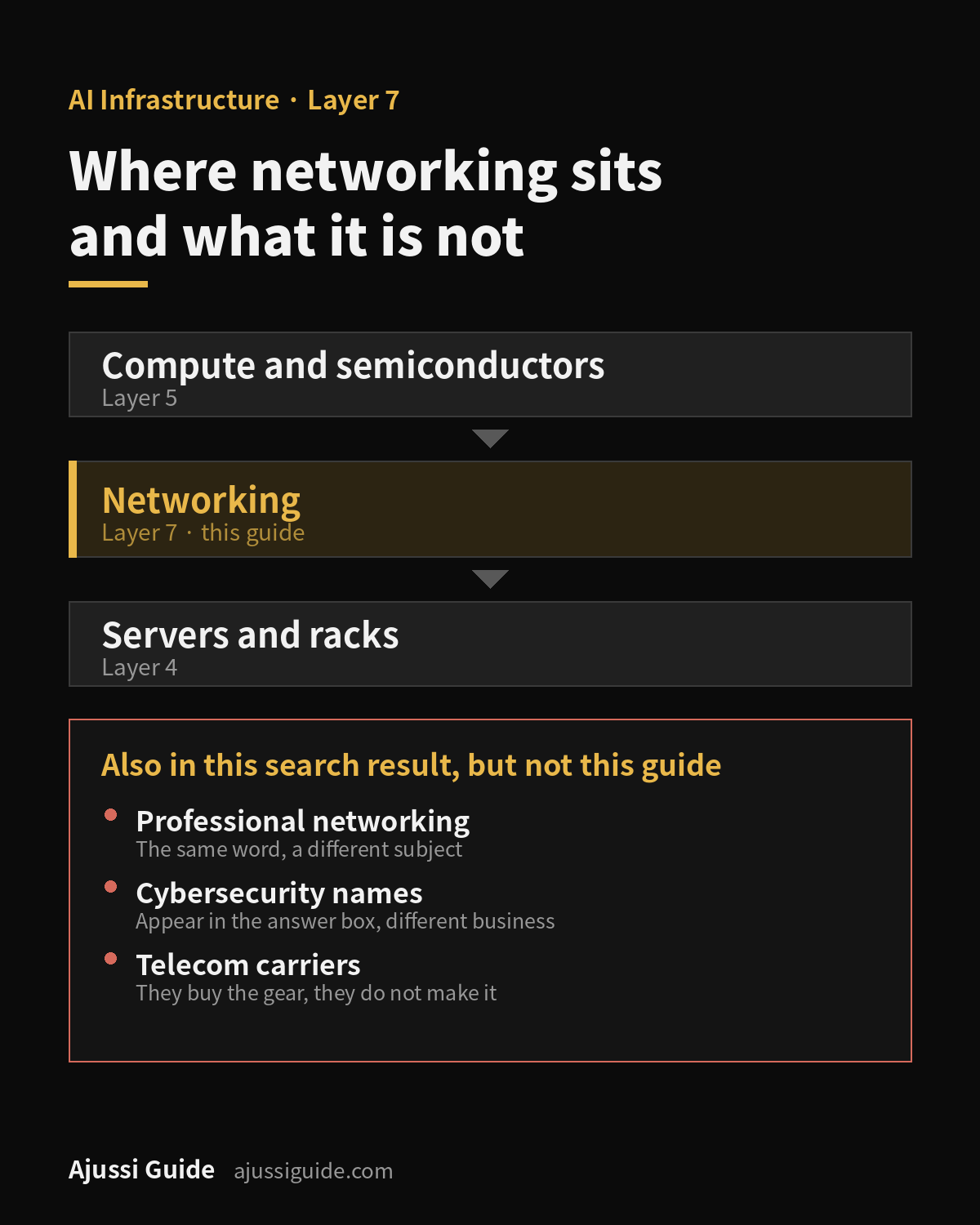
Networking stocks sit at the layer that connects accelerators to each other and to storage. That layer sits alongside compute and semiconductors and memory, and inside the racks described in the server layer.
The demand driver is specific. Training and inference clusters move enormous volumes of data between chips, and the fabric that carries it has become a capacity constraint of its own. Cisco describes growth in its Networking product category as driven “particularly within our AI Infrastructure and Campus Networking solutions.” Marvell attributes data center growth to “AI-related demand for a broad range of our products, including electro-optics, custom, storage, and switching.”
Both sentences are qualitative. Neither company attaches a dollar figure to the AI portion. That pattern holds across all eight companies in this guide.
Four types of networking exposure
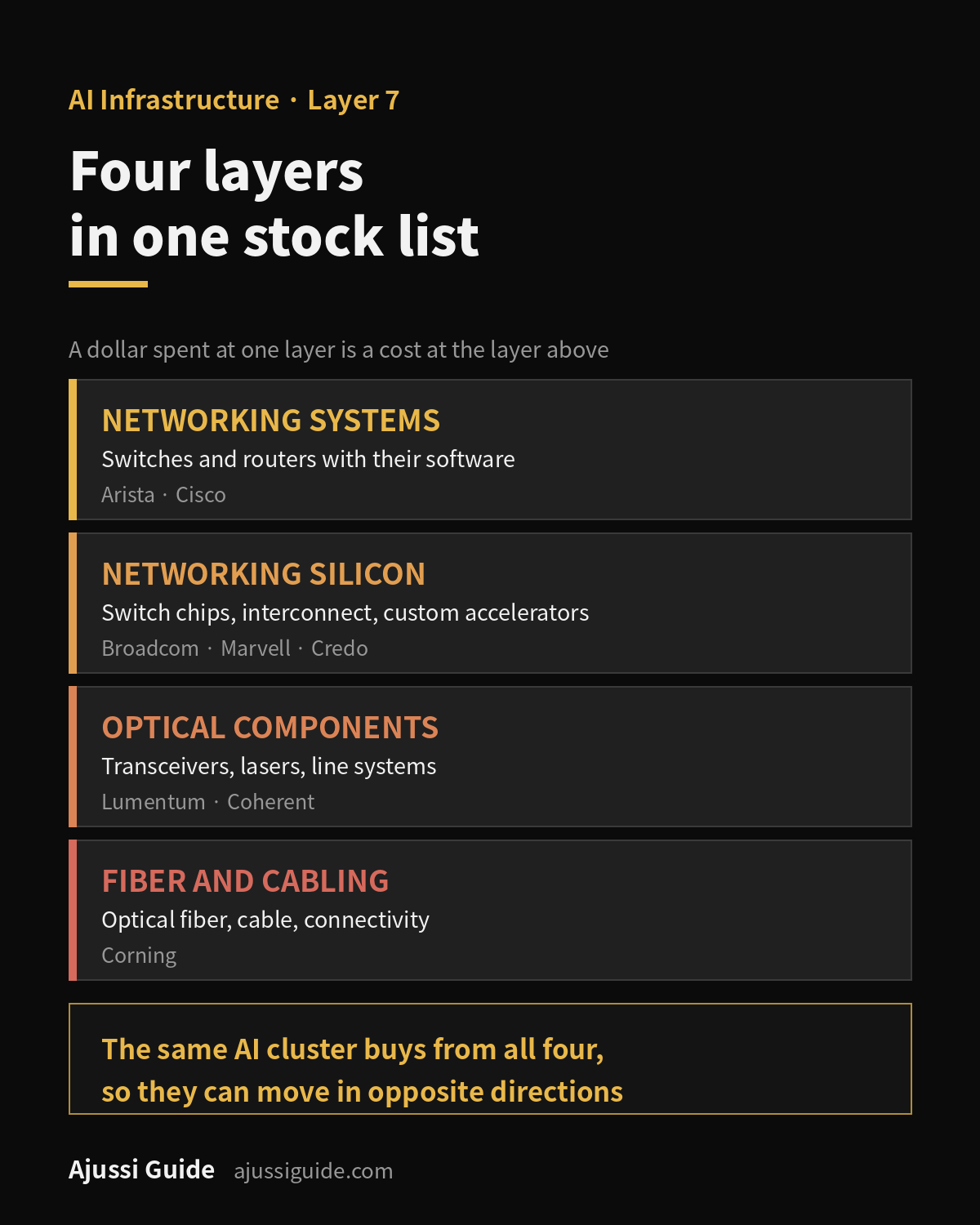
A single list of networking stocks usually mixes four different businesses. They sell different things, to different buyers, with different economics.
| Layer | What it sells | Examples |
|---|---|---|
| Networking systems | Switches, routers, the software on them | Arista, Cisco |
| Networking silicon | Switch ASICs, SerDes and DSPs, interconnect silicon | Broadcom, Marvell, Credo |
| Optical components | Transceivers, lasers, line systems | Lumentum, Coherent |
| Fiber and cabling | Optical fiber, cable, connectivity | Corning |
A systems company sells a finished box. A silicon company sells the chip that goes inside someone else’s box, sometimes including the buyer’s own box. An optical supplier sells the module that plugs into the front of it, though the co-packaged optics shift is starting to blur that line. A fiber company sells the glass that runs between buildings.
These four layers can move in opposite directions in the same quarter, because a switch maker’s cost is a silicon company’s revenue. Broadcom sells switching silicon to system vendors who compete with each other. Corning sells fiber and cabling into carrier and enterprise networks.
Why networking stock lists disagree
Different sources draw the boundary in different places, and the lists that result have little overlap. Even Cisco appears in only two of the three. This is measurable, so here is the measurement, taken on 2026-08-20.
| Names | Zacks | Investing.com | 24/7 Wall St. |
|---|---|---|---|
| Cisco | Yes | Yes | No |
| Arista | No | Yes | Yes |
| Optical (Lumentum, Ciena) | No | Yes | No |
| Silicon (Broadcom, Marvell) | No | No | Yes |
The three are not the same kind of document. Zacks is a classification holding 7 companies, Investing.com is a screener holding 82, and 24/7 Wall St. is an article that selects 3.
Zacks ranks first for this search with an industry called Computer – Networking. It contains seven companies. Arista is not one of them. Zacks files Arista under Internet – Software instead, while running headlines about Arista benefiting from AI networking demand on the same page.
The Investing.com screener takes the opposite approach. Its Communications and Networking list holds 82 companies sorted by market cap, with Cisco first and Arista second, and it includes Lumentum and Ciena. Broadcom, Marvell, Credo and Coherent are absent from all 82.
The article that ranks third and fourth, syndicated from 24/7 Wall St. to both Yahoo Finance and AOL, picks Arista, Broadcom and Marvell. It does not mention Cisco.
Note the rows. No single classification includes both the silicon vendors and the optical suppliers, yet Google’s own result page for this search spans all of them.
The companies move their own boundaries too
This is the part that is easy to miss. Three of the eight companies changed how they report in fiscal 2026.
Corning     FY2025  five reportable segments
            2026    four segments plus a separately reported group
                    product categories reclassified, comparatives recast

Lumentum    FY2025  two reportable segments: Cloud & Networking, Industrial Tech
            FY2026  one reportable segment as a single integrated enterprise

Coherent    FY2025  three segments: Networking, Materials, Lasers
            FY2026  two segments: Datacenter & Communications, Industrial
At Lumentum and Coherent, the axis that carried the word Networking is the one that disappeared. A revenue line that existed in last year’s filing does not exist in this year’s, and the prior periods have been restated to match. Comparing this year’s structure to a list built from last year’s filings will not reconcile.
What each company actually discloses
Here is the core finding for anyone comparing networking stocks on fundamentals. None of the eight companies reports AI networking revenue as a separate financial statement line. What they report instead varies so much that a like for like ranking is not possible.
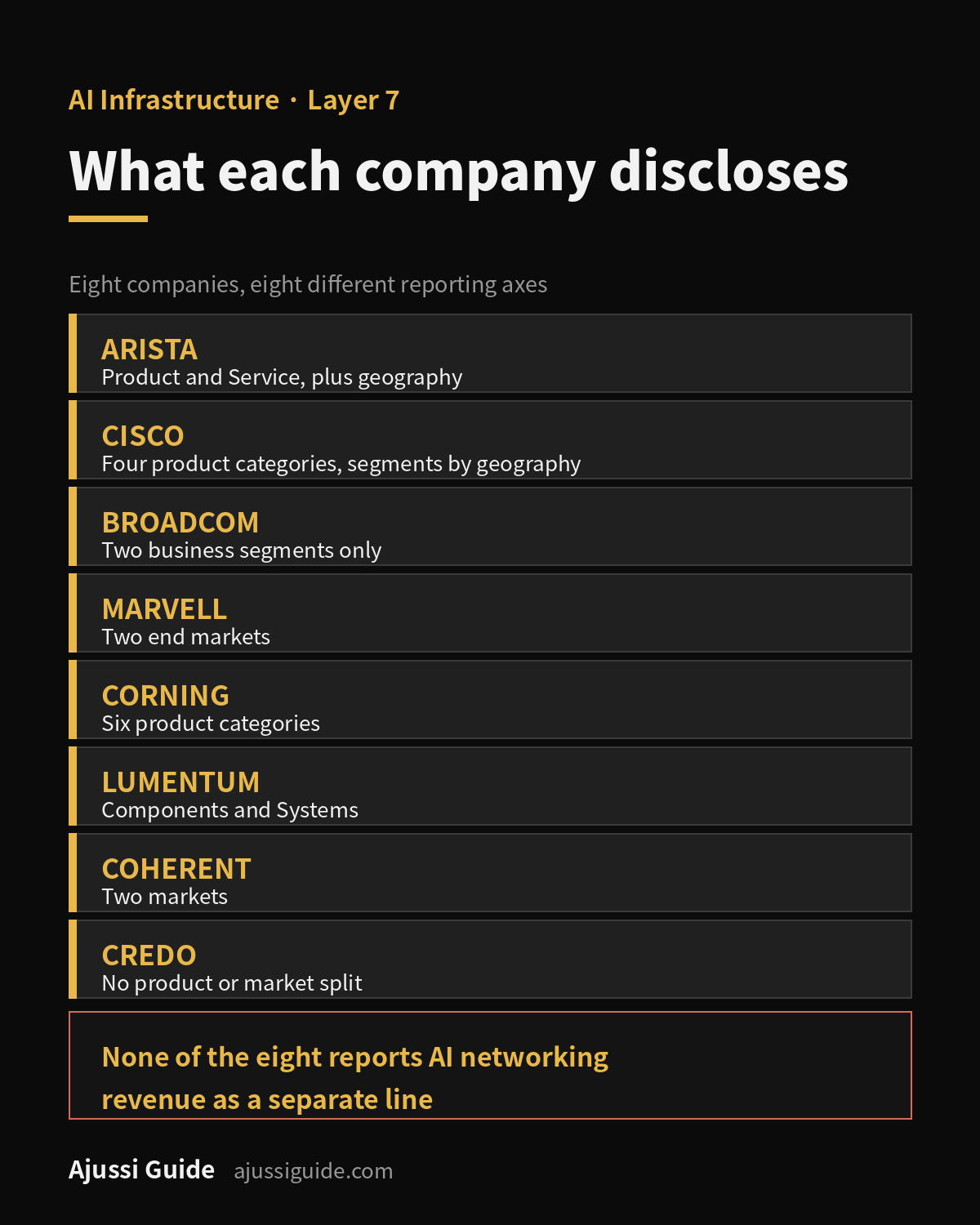
| Company | What it reports | Closest AI proxy |
|---|---|---|
| Arista | One segment; Product, Service, geography | Approximate customer and product mix in the 10-K |
| Cisco | Three geographic segments; four product categories | MD&A wording only |
| Broadcom | Two business segments; segment level only | A phrase inside the RPO note |
| Marvell | One segment; two end markets | MD&A wording only |
| Corning | Four segments; six product categories | None |
| Lumentum | One segment; Components and Systems | None |
| Coherent | Two segments; two markets | None |
| Credo | One segment; no product split | None |
Read down the second column and the problem becomes concrete. Cisco’s segments are geographic, so its Networking product category revenue of $8,815 million for the three months ended 2026-04-25 is a revenue disaggregation, not a segment result. Service revenue is not allocated across product categories, so that figure covers products only.
Arista reported $3,035.7 million for the three months ended 2026-06-30, split only into Product at $2,605.2 million and Service at $430.5 million. Its annual report adds an approximate mix in the business description, roughly 48% from Cloud and AI Titans and roughly 65% from a Core category the company defines as AI, cloud and data center networking together. Those are company approximations in prose, not audited segment figures, and Core bundles AI with two other things.
Broadcom reports two segments, semiconductor solutions at $15,009 million and infrastructure software at $7,178 million for the quarter ended 2026-05-03. Ethernet switching silicon sits inside the first one alongside wireless, storage and broadband. There is no networking line.
Marvell splits revenue into two end markets, with data center at $6,100.3 million or 74% of fiscal 2026 revenue. Marvell says data center growth was driven by electro-optics, custom, storage and switching, but it does not disclose the amounts for those drivers. The 74% total therefore cannot be treated as networking revenue.
Corning reports Optical Communications at $2,072 million for the three months ended 2026-06-30, up 32%. Watch the reconciliation here. Segment net sales across all reportable segments came to $4,738 million, while GAAP consolidated net sales were $4,505 million, because segment results include a $233 million adjustment for hedged exposures. The segment figure contains a non-GAAP currency adjustment that has to come out to reach GAAP.
Lumentum now splits fiscal 2026 revenue of $3,014.0 million into Components at $2,005.6 million and Systems at $1,008.4 million. Its own definition of Components names cloud data center operators, AI and ML infrastructure providers and network equipment makers as buyers of the same category, so AI cannot be separated out.
Coherent reports Datacenter & Communications at $5,274,629 thousand for fiscal 2026 against total revenue of $7,118,181 thousand. Data center and telecom sit in the same bucket. Coherent states explicitly that it does not present disaggregation by product type, customer, contract, contract duration, timing of transfer of control or sales channel, because its chief operating decision maker does not use that information to run the business.
Credo reported revenue of $1,335,116 thousand for fiscal 2026, up 205.7%, with no product or market split at all.
Customer concentration is disclosed on incompatible bases
Six of the eight give company wide figures, one gives segment level figures, and one says it has no customer above the threshold.
| Company | Basis | Disclosed |
|---|---|---|
| Credo | Contracting party; separate end customer table | 49% and 32% |
| Broadcom | Distributor plus end customers, quarter | 42%, top five end customers about 45% |
| Lumentum | End customer, annual | 26.6% and 15.0% |
| Arista | End customer, annual | 26% and 16% |
| Coherent | Customer, annual | 20% and 12% |
| Corning | Segment net sales | Optical Communications, two customers, 28% |
| Marvell | Direct and distributor, quarter | 16% and 45% |
| Cisco | Company wide | No customer at 10% or more |
Corning’s 28% is a share of that segment’s sales, not of company revenue, so it cannot sit in the same column as the others even though the number looks comparable. Credo discloses concentration twice, once by contracting party and once by end customer profile, and the letters used in the two tables do not map onto each other beyond one shared entry.
Orders, backlog and revenue are different signals
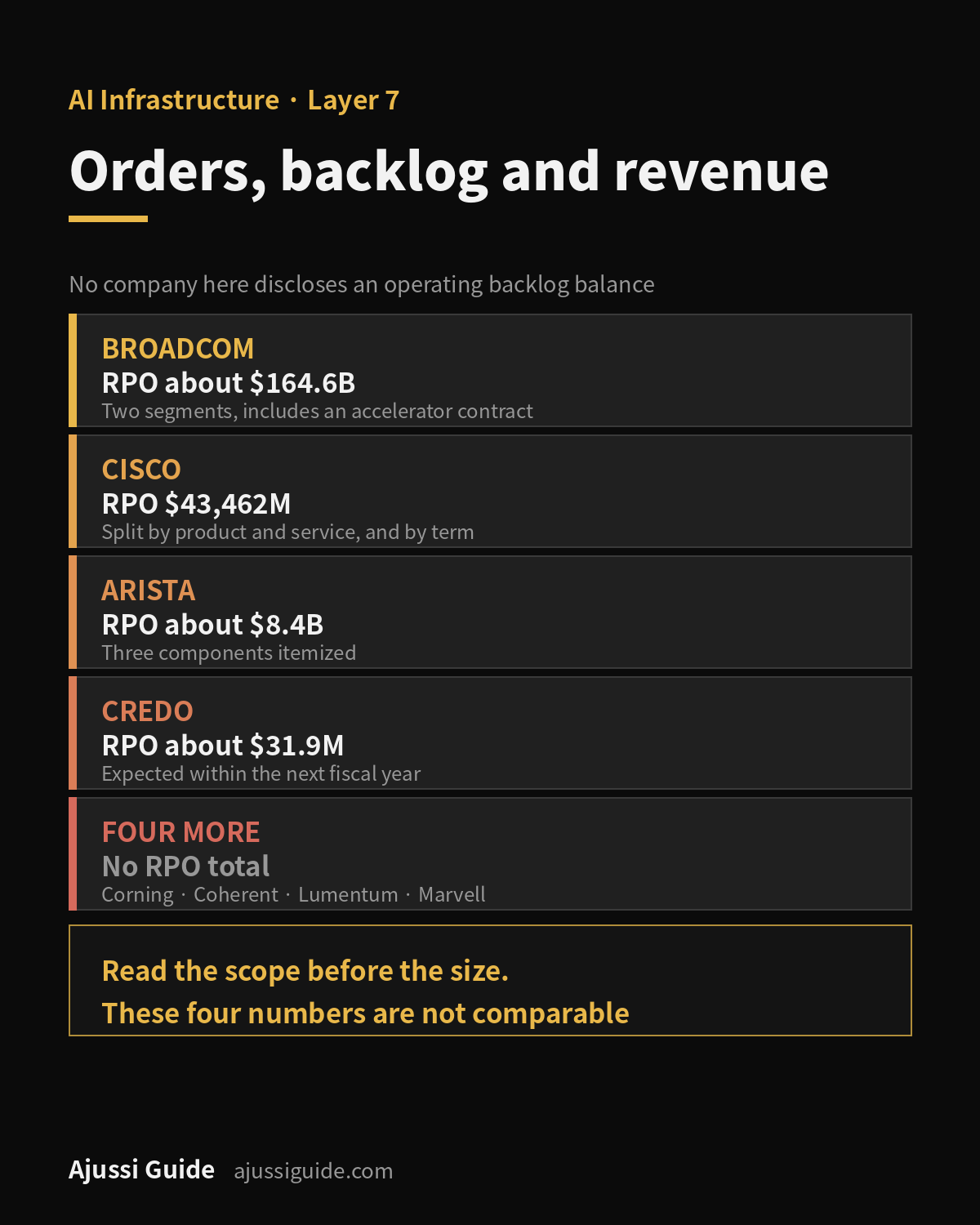
Networking stocks do not share a common order funnel to watch. Not one of the eight companies discloses a quantified operating backlog balance. What they publish instead is contract balance data in several different forms.
| Company | Contract balance disclosure |
|---|---|
| Broadcom | RPO about $164.6 billion at 2026-05-03, about 30% within 12 months |
| Cisco | RPO $43,462 million, split by product and service and by term |
| Arista | RPO about $8.4 billion, with its three components itemized |
| Credo | RPO about $31.9 million, expected within the next fiscal year |
| Corning | No RPO total, contract liabilities of $2.7 billion |
| Coherent | No RPO total, contract liabilities of $63 million |
| Lumentum | No RPO total, contract liabilities of $15.4 million and $1.4 million |
| Marvell | No RPO total, deferred revenue of $63.7 million |
The Broadcom figure needs care. It covers both segments, it includes obligations under a long term contract for custom AI accelerators, and accelerators are compute rather than networking. Broadcom also states directly that its remaining performance obligations “are not indicative of revenue for future periods,” because contracts with termination for convenience rights and short duration contracts are excluded. The same disclosure stood at about $33.3 billion at 2025-11-02.
Marvell discloses deferred revenue but no RPO total. Separately, it applies the disclosure practical expedient to contracts with an original expected duration of one year or less. That explains why those obligations are omitted, and it does not explain the absence of an overall RPO total. Lumentum defines remaining performance obligations as contract liabilities plus non cancellable backlog, then publishes only the contract liability piece.
One more trap. Searching a filing for the word backlog does not tell you whether a company discloses one. In Broadcom’s annual report the word appears twice, both times in the title and description of a VMware securities lawsuit. In Coherent’s it appears as the name of an acquired intangible asset category. Only Credo uses the word in an operational inventory context, referring to unfulfilled backlog and product ramps, but it neither defines nor quantifies the balance.
What to watch next quarter
A single checklist across networking stocks does not work, because the disclosures do not line up. Each company has its own first line to watch.
| Company | The line that moves first |
|---|---|
| Arista | Whether the Core category mix in the annual report gains a standalone AI figure |
| Cisco | Networking product category revenue, and whether AI Infrastructure ever gets a number |
| Broadcom | RPO balance and the 12 month recognition percentage |
| Marvell | Data center end market share of revenue, and distributor concentration |
| Corning | Optical Communications segment sales, and the hedged exposure adjustment |
| Lumentum | Components revenue and the top customer percentage |
| Coherent | Datacenter & Communications revenue against the Industrial market |
| Credo | RPO balance and whether a product split appears |
Two structural points are worth carrying forward. Period ends in the latest filings used for this comparison span 66 days, from Cisco’s 2026-04-25 to the 2026-06-30 period ends at Arista, Corning and Coherent, so periods labeled similarly are not the same window. All eight report in US dollars, which removes the currency translation problem that complicates the memory layer.
If you want the narrower cuts, the Arista and Cisco comparison goes deeper on those two, and the AI networking stock selection guide covers the picking question directly.
Frequently asked questions
What are the best networking stocks to invest in?
There is no single best, because the four layers are different businesses. Representative companies in this guide are Arista and Cisco in systems; Broadcom, Marvell and Credo in networking silicon; Lumentum and Coherent in optical components; and Corning in fiber and cabling. For the optical side specifically, I mapped what the filings claim in a separate photonics stocks evidence guide.
Comparing within a layer is possible. Comparing across layers is where lists go wrong, because purity of exposure, disclosure detail, customer concentration and valuation all differ by layer. Corning isolates the relevant exposure in one of four segments. Credo reports as one operating segment without a product or market split. That difference matters more than either company’s position on a list.
What is the biggest networking company?
Among networking stocks the answer changes with the definition, so fix the definition first.
Decide the universe. Pure networking systems companies only, or any company with networking exposure. If diversified companies are included, company level size also captures businesses outside networking, so it does not answer which company is biggest in networking.
Then decide the measure. Company market capitalization, total or networking related revenue, or AI networking revenue alone. On the first two, the answer depends on which universe you chose. On the third, no ranking can be built at all, because none of the eight companies discloses AI networking revenue separately.
Why do lists of networking stocks include different companies?
Because the sources use different boundaries. As of 2026-08-20, the Zacks Computer – Networking industry holds seven companies and excludes Arista, which it classifies under Internet – Software. The Investing.com Communications and Networking screener holds 82 and includes Arista, Lumentum and Ciena but not Broadcom or Marvell. A widely syndicated article names Arista, Broadcom and Marvell and skips Cisco.
Company reporting shifts too. Corning, Lumentum and Coherent all changed their segment structure in fiscal 2026, and at two of them the segment named Networking is the one that went away.
Do companies disclose AI networking revenue separately?
No. Across the eight filings checked, none reports an AI networking revenue line. The nearest proxies each bundle AI with something else. Arista’s Core category combines AI, cloud and data center networking. Marvell’s data center end market combines custom compute, storage and switching. Coherent’s Datacenter & Communications market combines data center with telecom. Cisco and Marvell describe AI demand in narrative text without attaching a figure.
Coherent states explicitly which disaggregations it does not provide, including by product type and by customer, because its chief operating decision maker does not use them.
What is the difference between networking systems, networking silicon, optical components, and fiber and cabling?
A systems company sells the switch or router as a finished product, with its own software. A silicon company sells the switching or interconnect chip that goes inside a system, including systems built by its own customers’ competitors. An optical component supplier sells the transceivers and lasers that convert electrical signals to light at the port. A fiber and cabling company sells the glass and cable that carries the light between racks and buildings.
The same AI cluster buys from all four, but a dollar spent at one layer is a cost at the layer above it.
How does AI networking demand move from orders to reported revenue?
There is no common funnel here, which is itself the answer. Four of the eight disclose a remaining performance obligation total, four do not, and none discloses a quantified operating backlog balance.
Where an RPO figure exists, read the scope before the size. Broadcom’s covers two segments and includes an accelerator contract, and the company says it is not indicative of future revenue. Credo’s about $31.9 million is expected within the next fiscal year and is a contracted but unsatisfied obligation, not a measure of total AI demand. Marvell states that it applies the disclosure practical expedient to contracts of one year or less, so part of its unsatisfied obligations is not quantified at all.
This article is for information only and is not investment advice. Company figures were read directly from filings on the date shown, and each carries its fiscal period end. Companies restate and reclassify, so check the latest filing before acting.
Last verified: August 20, 2026