Last checked: September 1, 2026. Figures below reflect company reports available as of that date.
If you have been looking at Schneider Electric stock as a way to own the AI power buildout, here is the short answer: it is a serious power distribution business riding AI-driven electricity demand, and the most useful way to judge it is next to its closest American rival, Eaton. Schneider Electric (SU, listed in Paris) is a French company with deep roots in Europe, Asia, and emerging markets, and it trades in the US as an ADR under the ticker SBGSY. Eaton (ETN) is listed in New York and generates the large majority of its revenue in North America. Choosing between them is partly a bet on geography, partly a bet on business mix, and partly a question of which currency and exchange you are comfortable holding. I will show my work below.
Why Power Distribution Stocks Matter Right Now in 2026
The buildout of AI data centers has collided with a power grid that was not designed for this load. Every hyperscaler campus needs switchgear, transformers, busway, and uninterruptible power systems before a single GPU can run. That is exactly the product set that Eaton and Schneider Electric sell into the electrical distribution market. If you own Schneider Electric stock or Eaton, this is the demand you actually own.
Unlike the chip supply chain, electrical distribution hardware has very long lead times. A large power transformer can take well over a year to deliver. That means companies with strong order books today have revenue visibility that extends well into the future, which is why institutional investors have paid close attention to backlog disclosures from both firms.
The demand is not only from data centers. Utility grid modernization, commercial building electrification, and industrial automation are all pulling on the same product lines. This diversification is a feature, not a bug, because it means a slowdown in one end market does not collapse the whole revenue picture.
Schneider Electric Stock vs Eaton: Where the AI Trade Actually Lives
When analysts talk about the AI infrastructure trade in electrical equipment, they almost always mean the electrical distribution segment specifically. For Eaton, this maps to the Electrical Americas and Electrical Global segments. For Schneider Electric, it maps to the Energy Management division, which is the company’s largest segment by revenue.
Both companies sell into the same hyperscaler customers, often competing directly for the same data center project. The product categories that matter most are medium-voltage switchgear, low-voltage power distribution units, busway systems, and cooling-adjacent power management. Schneider has historically had strong software integration through its EcoStruxure platform, which connects physical hardware to building management systems. Eaton competes on hardware reliability and its North American manufacturing and service footprint.
One thing I want to be clear about: neither company is a pure AI play. Both have substantial exposure to legacy industrial, utility, and commercial markets. Investors who price either stock as if it were entirely driven by data center demand are making an assumption the business mix does not support.
Three Ways to Buy Schneider Electric Stock
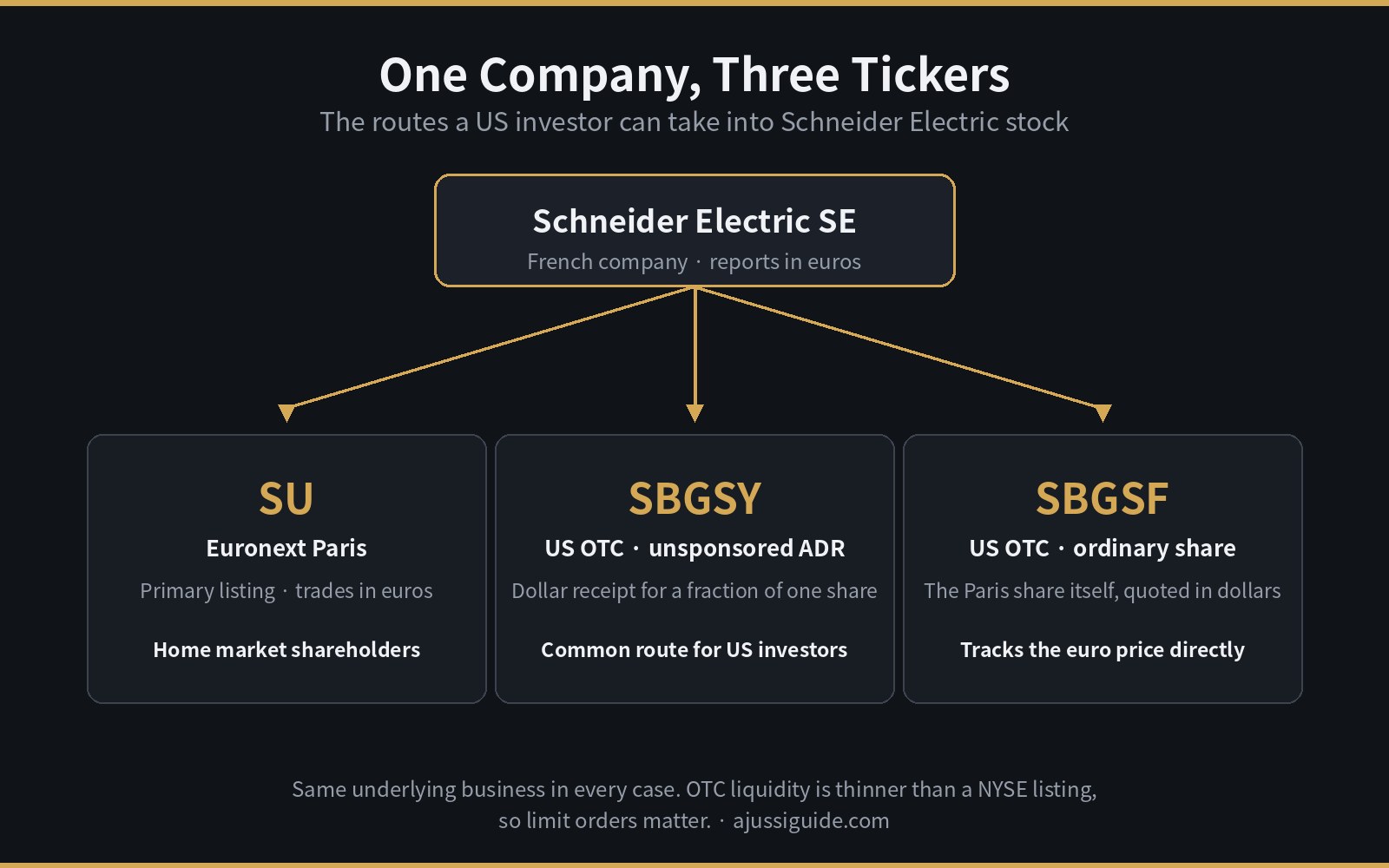
This is where most US investors get confused, because Schneider Electric stock shows up under three different symbols depending on where you look. The primary listing is on Euronext Paris under the ticker SU, priced in euros. In the US over-the-counter market there are two additional routes: SBGSY, an unsponsored American Depositary Receipt where each ADR represents a fraction of one ordinary Paris share, and SBGSF, which is the ordinary share itself trading over the counter in dollars.
For most self-directed US investors, SBGSY is the practical route because it trades in dollars at an ADR price point. SBGSF quotes simply track the Paris ordinary share converted to dollars. Liquidity in both OTC lines is thinner than for a NYSE-listed name like Eaton, so limit orders matter more here than they would with ETN. Whichever line you use, you own economic exposure to the same French company reporting in euros.
Geographic Exposure: The Hidden Difference Between the Two
This is where I think a lot of retail investors underweight the comparison. Eaton derives a large share of its electrical revenue from North America, which means it benefits directly from the US data center buildout and from domestic infrastructure spending. Its reporting currency is US dollars, which simplifies things if you are a US-based or dollar-denominated investor.
Schneider Electric is headquartered in France and reports in euros, and that fact follows Schneider Electric stock wherever you buy it. It has a genuinely global footprint, with meaningful revenue from Western Europe, Asia-Pacific, and the Middle East. That diversification is attractive when North American growth slows, but it also introduces currency translation risk and exposure to European regulatory and energy policy cycles, which have been volatile in recent years.
For a Korean investor like me, holding Schneider Electric stock means currency exposure in two directions: Korean won to euro, plus euro to dollar for any mental benchmarking I do. Eaton simplifies that to one conversion. Neither is wrong, but you should know what you are taking on.
Business Mix Beyond Electrical Distribution
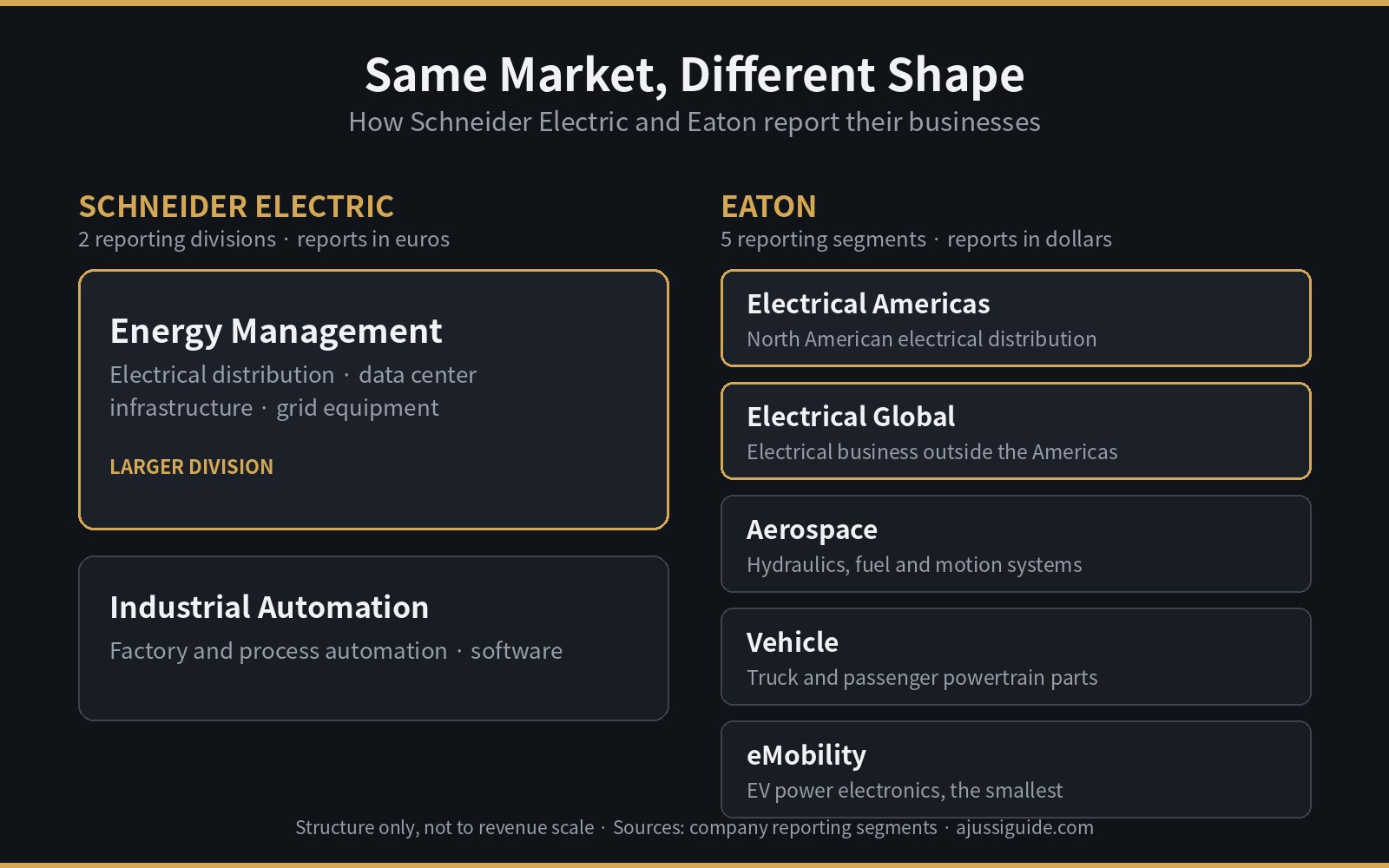
Eaton is not purely an electrical company. It operates a meaningful Aerospace segment supplying hydraulic, fuel, and electrical systems to commercial and military aircraft. It also operates a Vehicle segment supplying powertrain components for internal-combustion and hybrid drivetrains, and a smaller eMobility segment focused on vehicle electrification components. In Eaton’s most recent quarterly reporting the Vehicle segment was several times larger than eMobility by revenue. These segments diversify revenue but also mean that Eaton’s earnings are partly driven by aerospace cycle dynamics that have nothing to do with the power grid.
Schneider Electric is more concentrated in energy management and industrial automation. Its Industrial Automation segment, which includes the legacy AVEVA software business it took private, adds a software and services revenue layer that tends to carry higher margins than pure hardware. That software integration is a genuine competitive differentiator, though integrating large acquisitions always carries execution risk.
The practical implication is that if you want the cleanest exposure to electrical distribution and power infrastructure, Schneider’s business mix is somewhat more concentrated there. If you want aerospace as a partial hedge against a data center slowdown, Eaton provides that naturally.
| Factor | Eaton (ETN) | Schneider Electric (SU) |
|---|---|---|
| Primary Listing | NYSE, New York | Euronext Paris |
| Reporting Currency | US Dollar | Euro |
| Core Revenue Region | North America dominant | Global, Europe and Asia weighted |
| Key Power Distribution Products | Switchgear, busway, UPS, PDU | Switchgear, busway, UPS, EcoStruxure software |
| Software and Services Layer | Moderate, growing | Strong, anchored by AVEVA integration |
| Non-Electrical Diversification | Aerospace, eMobility segments | Industrial Automation segment |
| Data Center Customer Base | US hyperscalers, colocation providers | Global hyperscalers, European colocation |
| Dividend History | Long track record of increases | Consistent euro-denominated dividend |
How I Think About Valuation Without Quoting a Live Price
I will not quote a current price or market cap here because those numbers are stale within hours of publication. I think about both as growth-oriented electrical infrastructure businesses rather than traditional industrials, which means the durability of data-center and electrification demand matters heavily to how the market values Schneider Electric stock and Eaton alike. When a cyclical industrial company starts trading like a growth stock, the margin for error on execution narrows considerably.
The metric I watch most closely for both companies is order growth and backlog conversion. If new orders are still growing faster than revenue, the business has pricing power and demand is real. If backlog starts shrinking because revenue is converting but orders are not replacing them, that is the leading signal of a cycle peak. You can track this in quarterly earnings releases, which both companies publish on their investor relations pages.
For Schneider Electric’s investor relations disclosures, I go directly to the official Schneider Electric investor relations page. For Eaton, the equivalent is their IR site at eaton.com. I do not trust earnings summaries from aggregators when the actual filings are one click away.
Risks I Am Watching in the Second Half of 2026
The biggest risk for both companies is that hyperscaler capital expenditure plans get revised downward. Every major cloud provider has signaled aggressive spending, but technology capex cycles have surprised to the downside before. If data center buildout pauses, both stocks would feel it in order flow before they feel it in revenue, due to those long backlogs.
For Eaton specifically, I watch aerospace cycle health and eMobility adoption rates. If commercial aviation orders soften, that segment acts as a drag. For Schneider, the European energy policy environment matters. Regulatory uncertainty around building codes and grid investment in Germany and France has direct implications for the Energy Management segment’s European order pipeline.
Input cost inflation is a shared risk. Copper, steel, and specialized electrical components are all inputs to distribution hardware. Both companies have shown pricing power in recent years, but that pricing power is easier to maintain in a demand boom than in a slowdown. Margin sustainability is the question I keep coming back to.
My Current Thinking as a Self-Directed Investor
I hold positions in both the US electrical infrastructure theme and global industrial automation, so this comparison is not academic for me. My honest view is that Eaton is the simpler bet if you are based in North America or want dollar-denominated exposure to the US grid upgrade story. Schneider Electric stock is the more interesting bet if you believe the AI buildout is genuinely global and want software-layer margin expansion on top of hardware demand.
I do not think you have to choose only one. Many portfolios hold both precisely because the geographic and business mix diversification is real. The mistake I see most often is buying either stock purely on the AI headline without understanding how much of each company’s revenue actually flows from that theme versus legacy industrial and utility business. Do the segment math yourself before you commit capital.
What Changed Since Publication: Late Summer 2026 Check
Both companies have now reported first-half 2026 numbers, and the results sharpen the comparison rather than change it. Eaton posted record Q2 2026 results — roughly $8.5 billion in revenue with adjusted EPS of $3.15, its highest ever — and Baird initiated coverage in August with a market-outperform rating. The pushback arrived almost immediately: at least one late-August valuation analysis argued the AI data center narrative has pushed Eaton’s price meaningfully above fair value, with the stock trading around $404 at the end of August.
Schneider Electric answered with a record half of its own: H1 2026 revenue of €21.2 billion, 14% organic growth, and raised full-year organic growth guidance of 10–13%, with the Energy Management segment (the data center side) growing 15.4% organically. In other words, the operating story behind Schneider Electric stock is at least keeping pace with Eaton’s — the difference remains how each is priced and how you can buy them, which is exactly what the sections above walk through.
If this comparison sent you down the power-infrastructure rabbit hole, the adjacent maps I keep updated are the transmission and distribution stocks guide for the full grid supply chain, the AI power ETF comparison and data center ETF comparison if you would rather own the theme through a fund, the SMR vs uranium stocks breakdown on the generation side, and the Amazon off-grid data center teardown for a concrete example of who actually gets paid when a hyperscaler builds.
Frequently Asked Questions
Is Eaton or Schneider Electric the better stock overall?
Neither is simply better; they are different vehicles for the same electrification trend. Eaton offers cleaner US-listed access and heavier North American data center exposure, while Schneider Electric stock gives broader geographic reach and a larger software and automation layer — at the cost of buying an ADR (SBGSY) or foreign ordinary (SBGSF). As of the late-summer 2026 check above, both are executing on record results, so the choice comes down to listing convenience, geographic mix, and the valuation you are willing to pay.
Is Eaton or Schneider Electric more exposed to AI data centers?
Both have meaningful data center exposure through their electrical distribution product lines, but neither is a pure AI play. Eaton skews toward North American data center customers. Schneider serves global hyperscalers and has a stronger software integration layer through EcoStruxure. Schneider’s Energy Management segment is proportionally more concentrated in this theme relative to its total revenue mix.
Can US investors easily buy Schneider Electric stock?
Yes. Schneider Electric trades as an ADR on US over-the-counter markets under the ticker SBGSY, and you can also buy shares directly on Euronext Paris through most international brokerage accounts. The ADR is convenient but introduces a small tracking difference versus the Paris-listed shares. Currency conversion from euros to dollars affects your total return in US dollar terms.
What is the main risk of holding Eaton vs Schneider Electric stock?
The shared risk is a slowdown in data center and grid investment spending, which would compress order growth before it hits revenue. Eaton carries additional aerospace cycle risk. Schneider carries European regulatory risk and euro-dollar currency translation exposure. Both trade at premium valuations relative to traditional industrials, so any earnings miss on margin or order growth tends to be punished sharply.
Do both companies pay dividends?
Yes. Eaton has a long history of paying and growing its dividend in US dollars. Schneider Electric pays a euro-denominated dividend that has been consistent over time. For US investors holding Schneider, dividends may be subject to French withholding tax, while the ADR also introduces euro-to-dollar conversion. The final tax treatment depends on your residency, account type, treaty eligibility, and broker procedures. Check the current treatment with your broker or tax adviser.
How does power distribution connect to the AI infrastructure theme?
AI data centers require enormous amounts of reliable electrical power delivered at the point of use. Switchgear, transformers, busway, power distribution units, and uninterruptible power systems are all required before a single server rack can operate. These are exactly the products Eaton and Schneider Electric manufacture. Demand for this equipment has grown sharply as hyperscalers have accelerated data center construction globally through 2026.
Is Schneider Electric a better stock than Eaton for long-term holding?
There is no universal answer. Schneider offers broader geographic diversification and a stronger software revenue layer, which can support margins through hardware cycles. Eaton offers simpler dollar-denominated exposure and an aerospace segment that partially offsets electrical market cycles. Long-term performance depends on which end markets grow faster and how each company executes on its backlog over the next several years.
Where can I find official financial data for these companies?
Go directly to the investor relations sections of each company’s official website. Eaton publishes earnings releases, 10-K filings, and segment data at eaton.com. Schneider Electric publishes its Universal Registration Document and half-year results at se.com. For US regulatory filings, Eaton’s SEC submissions are available at sec.gov. Do not rely on third-party aggregators when primary sources are freely available.
How do I compare Eaton vs Schneider Electric stock on valuation without a broker terminal?
Focus on three publicly available metrics: revenue growth by segment in recent earnings releases, order intake growth versus revenue (which signals backlog health), and operating margin trends by division. Both companies break these out clearly in their quarterly results. Comparing the trajectory of these figures over the last four to six quarters tells you more than a single price-to-earnings ratio ever will.
What is the difference between SBGSY and SBGSF?
Both trade over the counter in the US, but they are different instruments. SBGSY is an unsponsored ADR, a dollar-denominated receipt representing a fraction of one ordinary share, created by a depositary bank rather than by Schneider Electric itself. SBGSF is the actual Paris-listed ordinary share trading over the counter, so its dollar price closely mirrors the euro price on Euronext. Practical differences come down to price per unit, liquidity, and how your broker handles each line.
Is Schneider Electric stock an AI stock?
Not in the sense of designing chips or training models. Schneider Electric sells the electrical distribution, cooling, and power management equipment that AI data centers cannot run without, plus the EcoStruxure software layer that manages it. That makes it an AI infrastructure beneficiary with a large non-AI business underneath, which cushions the stock if data center spending slows but also dilutes the upside compared to a pure play.
Which business drives Schneider Electric’s growth?
Energy Management, the larger of its two reporting divisions, which covers electrical distribution products, data center infrastructure, and grid equipment. Industrial Automation is the smaller division and has grown more slowly in recent quarters. When you read a Schneider earnings release, the Energy Management organic growth number is the single line that tells you most about how the data center story is progressing.
Last verified: 2026-08-23. This post reflects publicly available information as of that date. Business conditions, financial results, and market dynamics change. Verify all data through official company and regulatory sources before making any decision.
This is information, not investment advice. I am not recommending buying or selling any security. All investment decisions carry risk and are entirely your own responsibility.