Last checked 2026-10-03 · Data company monthly revenue pages (Aug 2026), 2Q26 IR decks and financial statements and FY2025 annual reports for five Taiwanese companies; 8-K, 10-Q, 10-K and company-posted transcripts for Celestica, Flex and Jabil (quarters ended June–August 2026) · Next update early-October Taiwan monthly revenue, then third-quarter results in November · Get update alerts ↗
What this checked — For eight server ODM stocks (Quanta, Wistron, Wiwynn, Inventec, Hon Hai, Celestica, Flex, Jabil): latest-quarter revenue and operating margin on a stated basis (IFRS or GAAP, with adjusted/core separately), August 2026 monthly revenue for the five Taiwanese companies, customer concentration for all eight from annual reports, 10-Qs and 10-Ks (anonymous labels), the type and period of each company’s own server or AI figure, and the Wistron–Wiwynn consolidation.
What it did not — Identify anonymous customers, isolate AI-server-only revenue or margin (no company reports it as a segment), locate call transcripts for the three press-quoted Taiwanese share statements, confirm current retail availability of any GDR, or rank the companies by profitability.
Watch next — September monthly revenue in early October reconciled against third-quarter statements, Hon Hai’s November 12 results, Flex’s CPI spin-off (targeted calendar Q1 2027), Jabil’s second hyperscaler crossing 10% in fiscal 2027, and the next customer-concentration tables in each annual report.
The companies that assemble AI servers are rarely the ones whose names are on the racks. Dell, HPE and Supermicro sell branded systems; ODM and EMS companies in Taiwan and North America provide design and manufacturing to those OEMs and, increasingly, directly to hyperscalers that specify their own racks. Hon Hai said its cloud and networking product category crossed half of its revenue in the second quarter of 2026. Search for server ODM stocks and the results are market-share commentary and Dell-versus-HPE articles; a company-by-company reading of what the ODMs themselves disclose is harder to find. This post takes eight listed ODM and EMS companies and records what each one reports — monthly revenue where it exists, a stated server or AI share, operating margin on a stated basis, and customer concentration — from their own releases and filings as of October 3, 2026.
What server ODM stocks have in common, and what the label hides
An ODM designs and manufactures a product that someone else sells under their brand. In servers the line is blurry: Quanta designs and builds for both brand OEMs and hyperscalers; Wiwynn’s single operating segment is hyperscale data-center equipment and related solutions; Hon Hai is the largest electronics manufacturer in the world and cloud and networking is one of four product categories; Celestica describes part of its business as “broadly characterized as ODM in nature” and the rest as EMS. What they share is a thin operating margin relative to the chip and memory suppliers above them, a concentrated customer base, and a revenue line that moves with hyperscaler capital spending.
What differs is disclosure. Taiwan-listed companies publish monthly revenue, so the ramp is visible within weeks. The share of that revenue that is AI servers is mostly a company statement rather than a reported segment, and the customers behind it are disclosed as percentages under anonymous labels. All eight companies do disclose customer concentration in the materials reviewed; the disclosures differ in period and denominator, and anonymous customer labels should not be treated as identified hyperscalers. The post sorts the eight by what kind of number each one gives.
Three groups of server ODM stocks, eight companies
| Group | How the company describes itself | What is disclosed about servers | Companies |
|---|---|---|---|
| ① Taiwan server-focused ODMs | Design and manufacturing of servers and racks for OEMs and hyperscalers | Monthly revenue; server or AI share as company statements quoted in press or IR | Quanta (TWSE 2382), Wistron (3231), Wiwynn (6669), Inventec (2356) |
| ② Taiwan diversified EMS | Electronics manufacturing across consumer, computing, components, cloud and networking | Monthly revenue; cloud & networking share of revenue as a quarterly company metric | Hon Hai / Foxconn (2317) |
| ③ North American EMS–ODM hybrids | EMS plus proprietary platform design or power and cooling products | Quarterly reportable segments; AI or hyperscaler figures as company metrics or call statements | Celestica (CLS), Flex (FLEX), Jabil (JBL) |
One structural note about these server ODM stocks before the company sections: Wistron consolidates Wiwynn. Wiwynn’s second-quarter 2026 financial statements name Wistron as its parent and ultimate controlling party, with a 35.27% stake at June 30. The two listed stocks therefore have overlapping revenue and customer exposure and should not be added together as independent businesses.
Group ①: Taiwan server ODMs — the monthly number
Taiwan-listed companies publish monthly revenue early in the following month, on dates that vary by company. August 2026 is the latest month available for all five; September figures arrive in early October, and the quarterly financial statements that follow are the figures to reconcile them against.
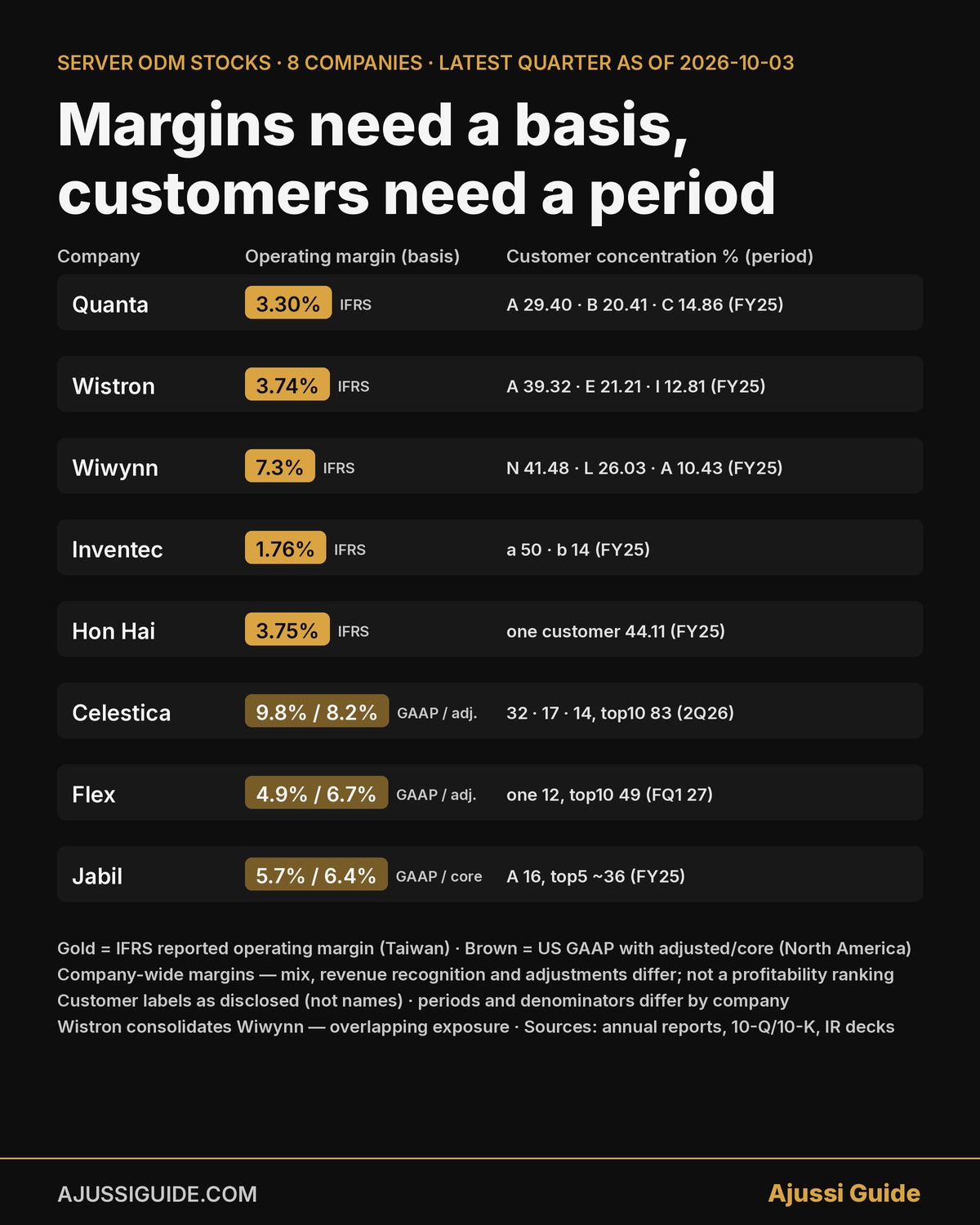
Quanta Computer (TWSE 2382) reported August 2026 revenue of NT$423.97 billion, up 15.8% from July and 177.5% from a year earlier; January–August was NT$2,636.06 billion, up 102.6%. Second-quarter 2026 consolidated revenue was NT$1,036.59 billion, operating income NT$34.24 billion (3.30% operating margin), gross margin 5.02%, net income attributable NT$28.65 billion and EPS NT$7.43. On server mix, Taiwanese press reports of company statements have put AI servers at 75–80% of server revenue in 2026 with an 80% full-year view, and servers at about 80% of total revenue; these are company statements quoted in press, not segment data, and the period and denominator of each should be read from the report cited. Customer concentration from the FY2025 annual report: Customer A 29.40%, B 20.41%, C 14.86% of consolidated revenue (the annual report was checked through an externally archived copy of the company’s PDF because the company site blocked direct download).
Wistron (TWSE 3231) reported August revenue of NT$460.07 billion, up 49.3% from July and 166.5% year on year; January–August was NT$2,510.03 billion, up 98.9%. Second-quarter revenue was NT$895.44 billion, operating income NT$33.45 billion (3.74%), gross margin 5.56%, net income attributable NT$14.83 billion and EPS NT$4.72. On August 4 the company said AI server demand continued to exceed supply and that it expected second-half AI server shipments and revenue to grow over the first half. A July press report quoted the company putting AI servers at about 70% of revenue in the first two months of 2026; whether that is on a consolidated basis including Wiwynn was not stated. FY2025 annual report customer concentration: Customer A 39.32%, E 21.21%, I 12.81% of total revenue. The board approved a GDR issuance plan of up to 250 million shares.
Wiwynn (TWSE 6669) operates a single segment, hyperscale data-center equipment and related solutions, so its total revenue is the closest thing in this post to a disclosed server revenue figure. Its FY2025 annual report (published 2026) states that AI-related products exceeded 50% of 2025 revenue. August revenue was NT$144.31 billion, up 22.6% from July and 50.4% year on year; January–August was NT$816.66 billion, up 42.8%. Second-quarter revenue was NT$278.15 billion, up 26.0% year on year and 0.6% quarter on quarter, with gross margin 9.3%, operating income NT$20.22 billion (7.3%), net income attributable NT$14.97 billion and basic EPS NT$80.43. The company said that from April memory procurement for certain customers shifted to an agency model, which removes those memory purchases from both revenue and cost, and that NRE income from new products increased. Geographic revenue was 80% Americas. FY2025 customer concentration: Customer N 41.48%, L 26.03%, A 10.43% of revenue; separately, 99.18% of accounts receivable at June 30, 2026 were concentrated in three customers, a credit-risk disclosure that should not be assumed to be the same three customers. The board approved US$942 million of second-half capex, up to NT$15 billion of convertible bonds and a US$1.5 billion syndicated loan.
Inventec (TWSE 2356) reported August revenue of NT$83.27 billion, down 7.7% from July and up 35.8% year on year; January–August was NT$643.63 billion, up 40.1%. Second-quarter revenue was NT$269.86 billion, operating income NT$4.74 billion (1.76%), gross margin 4.23%, net income attributable NT$3.90 billion and EPS NT$1.09. Press reports of company guidance put server revenue above 50% of 2026 total, up from more than 40% in 2025. FY2025 customer concentration: Customer a 50%, b 14% of net revenue, disclosed as whole numbers. The annual report states no GDR program.
Group ②: Hon Hai — the largest, with the broadest mix
Hon Hai Precision Industry (TWSE 2317), Foxconn, reported August revenue of NT$921.77 billion, up 52.0% year on year and down 2.6% from July; January–August was about NT$6,511.1 billion, up 39.7%. Second-quarter consolidated revenue was NT$2,525.89 billion, operating income NT$94.80 billion (3.75%), gross margin 6.12%, net income attributable NT$59.97 billion and EPS NT$4.27.
Cloud and networking products accounted for 51% of second-quarter revenue, up from 48% in the first quarter and above half for the first time. This category is broader than AI servers, while the remaining revenue spans several product categories: smart consumer electronics 29%, computing 15%, components and other 5%. On August 12 the company said it expected Vera Rubin racks to enter mass production in the third quarter and full-year AI rack shipments to more than double — an outlook as of that date, not a confirmation of mass production. FY2025 customer concentration: one customer, labeled 戊 in the Chinese-language annual report, was 44.11% of revenue; the post does not attribute that label to any company. Hon Hai’s investor calendar lists September monthly revenue on October 5 and third-quarter results on November 12.
Group ③: Celestica, Flex, Jabil — quarterly segments
The North American companies report quarterly rather than monthly. Their reportable segments and customer notes are structured differently from the Taiwan filings, not necessarily more fully.
Celestica (NYSE/TSX: CLS) reported second-quarter 2026 revenue of $4.70 billion, up 62%, with GAAP operating margin of 9.8% and adjusted operating margin of 8.2%, GAAP EPS of $3.17 and adjusted EPS of $2.54 (reported July 27). The GAAP figure exceeds the adjusted figure because the adjustment removes a $104.1 million mark-to-market gain on the total return swap that hedges share-based compensation; the reconciliation in the 10-Q runs $458.3 million GAAP operating earnings plus $19.3 million stock-based compensation, minus the $104.1 million TRS gain, plus $9.9 million amortization and $2.9 million restructuring, to $386.3 million adjusted. The Connectivity & Cloud Solutions segment was $3.81 billion, up 84%, at an 8.7% segment margin; Advanced Technology Solutions was $0.89 billion. Hardware Platform Solutions revenue inside CCS was about $1.9 billion in the quarter, up 58%, and about 41% of revenue; HPS is a company metric, not a reportable segment, includes networking as well as compute, and is described in the 10-K as “broadly characterized as ODM in nature.” HPS was also 41% of full-year 2025 revenue. Customer concentration in the 10-Q: three customers were 32%, 17% and 14% of second-quarter total revenue, and the top ten were 83%; the customers sit in CCS but the percentages are of total revenue. Full-year 2026 guidance was raised to $20.5 billion of revenue and $11.30 adjusted EPS, and the company said it expected 2027 growth to accelerate beyond the 65% anticipated for 2026. A new Fort Worth, Texas site of over 1 million square feet was announced in May.
Flex (Nasdaq: FLEX) reported fiscal first-quarter 2027 revenue (quarter ended June 26, 2026) of $7.93 billion, up 21%, with GAAP operating margin of 4.9%, adjusted operating margin of 6.7% and adjusted EPS of $1.00 (reported July 29). Flex created Cloud and Power Infrastructure as a reportable segment in fiscal fourth-quarter 2026 and recast prior periods: CPI was $2,202 million against $1,626 million a year earlier, up 35.4%, beside Integrated Technology Solutions at $3,056 million and Regulated Manufacturing Solutions at $2,670 million. CPI is a broad segment that includes Flex’s own power and cooling products, not a pure AI-server line. In May the company announced its intention to spin off CPI into a separate public company, targeted for calendar first-quarter 2027 and subject to approvals and other conditions; fiscal 2027 guidance of $33.7–35.2 billion revenue and $4.42–4.74 adjusted EPS does not reflect the spin-off. Customer concentration in the 10-Q: one customer was 12% of quarterly sales, mostly within CPI, and the top ten were 49%; for fiscal 2026 the 10-K showed no customer above 10% and the top ten at 45%.
Jabil (NYSE: JBL) reported fiscal fourth-quarter 2026 revenue (year ended August 31) of about $10.6 billion, with GAAP operating margin of 5.7%, core operating margin of 6.4%, GAAP EPS of $3.76 and core EPS of $4.40; fiscal 2026 revenue was about $36.0 billion (reported September 30). In the company-posted call transcript, Intelligent Infrastructure segment revenue was about $5.8 billion in the quarter, up 56%, and the company’s own AI-related revenue metric was about $14.4 billion for fiscal 2026 with an outlook of about $22.1 billion for fiscal 2027, up 54%; that metric is company-defined and its denominator differs from the Intelligent Infrastructure segment. Jabil ended fiscal 2026 with four customers above $1 billion in annual AI-related revenue. For fiscal 2027 it expects six customers above $1 billion across Intelligent Infrastructure, and a second hyperscaler to exceed 10% of total revenue. The fiscal 2025 10-K showed Customer A at 16% of total revenue, with that revenue mainly in Intelligent Infrastructure, and the top five at about 36%. Fiscal 2027 guidance is $44.5 billion of revenue, 6.1% core operating margin and $17.55 core EPS.
The disclosure table
Latest reported period for each of the eight server ODM stocks as of October 3, 2026. Monthly figures are from the five Taiwanese companies’ own monthly revenue pages; quarterly figures from results releases, IR decks and filings. Fiscal periods, currencies and accounting bases differ, so amounts are not ranked by size.
| Company (ticker) | Group | Latest revenue line | Reported operating margin (basis) | Adjusted / core margin | Stated server / AI figure (type, period) | Customer concentration (period, denominator) |
|---|---|---|---|---|---|---|
| Quanta (2382) | ① | Aug 2026 NT$423.97B, +177.5% YoY | 3.30% (IFRS, 2Q26) | — | AI 75–80% of server revenue; servers ~80% of revenue (company statements quoted in press, 2026 view) | A 29.40% / B 20.41% / C 14.86% (FY2025, consolidated revenue) |
| Wistron (3231) | ① | Aug 2026 NT$460.07B, +166.5% | 3.74% (IFRS, 2Q26) | — | AI servers ~70% of revenue, Jan–Feb 2026 (press-quoted statement; consolidation basis not stated) | A 39.32% / E 21.21% / I 12.81% (FY2025, total revenue); consolidates Wiwynn |
| Wiwynn (6669) | ① | Aug 2026 NT$144.31B, +50.4% | 7.3% (IFRS, 2Q26) | — | Single segment: hyperscale DC equipment & related solutions; AI-related >50% of 2025 revenue (FY2025 annual report) | N 41.48% / L 26.03% / A 10.43% (FY2025, revenue); AR 99.18% in 3 customers (2026-06-30, receivables) |
| Inventec (2356) | ① | Aug 2026 NT$83.27B, +35.8% | 1.76% (IFRS, 2Q26) | — | Servers >50% of 2026 revenue (press-quoted guidance) | a 50% / b 14% (FY2025, net revenue) |
| Hon Hai (2317) | ② | Aug 2026 NT$921.77B, +52.0% | 3.75% (IFRS, 2Q26) | — | Cloud & networking 51% of 2Q26 revenue (company product-category metric) | 戊 44.11% (FY2025, revenue) |
| Celestica (CLS) | ③ | 2Q26 $4.70B, +62% | 9.8% (GAAP) | 8.2% adjusted | HPS ~$1.9B, ~41% of 2Q26 revenue (company metric; incl. networking) | 32% / 17% / 14%, top 10 = 83% (2Q26, total revenue) |
| Flex (FLEX) | ③ | FQ1 27 $7.93B, +21% | 4.9% (GAAP) | 6.7% adjusted | CPI segment $2,202M, +35.4% (reportable segment incl. power & cooling) | One customer 12%, top 10 = 49% (FQ1 27, net sales) |
| Jabil (JBL) | ③ | FQ4 26 ~$10.6B; FY26 ~$36.0B | 5.7% (GAAP) | 6.4% core | AI-related revenue ~$14.4B FY26 → ~$22.1B FY27 outlook (company-defined metric, call) | A 16%, top 5 ~36% (FY2025, net revenue) |
These are company-wide margins. Product mix, gross-versus-net revenue recognition and adjustment items differ, so the figures do not rank AI-server assembly profitability; compare each company against its own history on the same basis first. Read down the customer column: every company discloses concentration, but the periods run from fiscal 2025 annual reports to the latest quarter, the denominators are variously consolidated revenue, net sales and receivables, and no label is a company name.
What a list of server ODM stocks gets wrong
First, “ODM” is not one business model. Wiwynn’s single segment is hyperscale data-center equipment; Hon Hai’s cloud and networking category sits beside consumer electronics, computing and components; Celestica splits its own revenue into “ODM in nature” and EMS; Flex includes its own power and cooling products in the same segment as compute integration and plans to spin that segment off. A list that puts all eight in one row is averaging different exposures, and two of the eight are parent and subsidiary.
Second, the AI figures are not comparable. Jabil’s $14.4 billion is a company-defined AI-related revenue metric stated on a call. Celestica’s $1.9 billion is HPS, a design-led subset of one segment that includes networking. Hon Hai’s 51% is a product category. Flex’s $2.2 billion is a reportable segment that includes power products. Quanta’s 80% is a share of a share, quoted in press. Each belongs inside its own company’s time series, not in a cross-company ranking.
Third, margins on different bases do not rank design capability. Taiwan IFRS operating margins, US GAAP margins and adjusted or core margins answer different questions; The gap between Celestica’s GAAP and adjusted margins in the second quarter primarily reflects the removal of TRS fair-value gains, alongside other reconciliation items, and does not measure server-assembly profitability. Wiwynn attributed the higher gross margin to two factors: excluding certain memory purchases from reported sales and costs under its agency arrangements, and increased NRE income. Monthly revenue growth and quarterly margins also cover different periods.
Fourth, anonymous customers are disclosed, not hidden. Quanta’s Customer A at 29.40%, Wistron’s at 39.32%, Wiwynn’s Customer N at 41.48%, Inventec’s at 50%, Hon Hai’s 戊 at 44.11%, Celestica’s 32%, Flex’s 12%, Jabil’s 16% — all are in the filings. Press reports attach hyperscaler names to them; the filings do not, and this post keeps the labels.
Before choosing
Three checks before buying any of these server ODM stocks. One, find the company’s own server or AI figure and write down what kind it is: reportable segment, company metric, or a statement quoted in press — and the period it covers. Two, read the operating margin on one stated basis against the same company’s prior quarters before putting it next to another company’s. Three, check the customer concentration table in the annual report or 10-K for the period and denominator, and treat any hyperscaler name attached to a lettered customer as a press attribution unless the company itself named it.
Check the five Taiwanese companies’ September monthly revenue announcements in early October, then reconcile against the third-quarter financial statements when they are released; Hon Hai lists October 5 and November 12.
Frequently asked questions
Which server ODM stocks report AI or server revenue directly?
None reports AI server revenue as a separate reportable segment. Wiwynn’s single segment is hyperscale data-center equipment and related solutions, so its total revenue is the closest proxy. Flex’s Cloud and Power Infrastructure is a reportable segment that also includes power and cooling products. Hon Hai gives a quarterly cloud & networking share (51% in 2Q26) as a product-category metric; Jabil gives a company-defined AI-related revenue figure (about $14.4 billion for fiscal 2026); Celestica gives HPS revenue (about $1.9 billion in 2Q26) as a company metric.
Why do Taiwan ODMs report revenue every month?
Taiwan-listed companies publish monthly revenue early in the following month under exchange rules. For AI server ODMs this has become the fastest public read on hyperscaler spending, but it carries no margin or mix information and is reconciled only when the quarterly financial statements follow.
Can server ODM stocks’ operating margins be compared?
Only with the basis stated. The table separates reported margins (IFRS for Taiwan, GAAP for the US) from adjusted or core margins. The gap between Celestica’s 9.8% GAAP margin and 8.2% adjusted margin in 2Q26 primarily reflects the removal of TRS fair-value gains, alongside other reconciliation items; it does not measure server-assembly profitability. Within one company on one basis, quarter-to-quarter comparison is sound; across companies it is not a ranking of AI-server profitability.
Can US investors buy Quanta, Wistron, Wiwynn or Hon Hai?
The five Taiwanese companies are primarily listed in Taiwan. Wistron’s annual report records a Luxembourg GDR program; Wiwynn’s records a Luxembourg 144A/Reg S program with a zero outstanding balance at March 31, 2026; Inventec reports no GDR; Hon Hai’s investor page lists a London GDR code, HHPD. A historical GDR program does not establish current retail availability through a US brokerage. Celestica, Flex and Jabil trade on the NYSE or Nasdaq.
Is Supermicro a server ODM stock?
No. Supermicro sells servers under its own brand, so it is an OEM; it is covered with Dell and HPE in our server stocks hub. Celestica is the boundary case, describing part of its business as ODM in nature.
Who are the customers behind server ODM stocks?
All eight companies disclose customer concentration in the materials reviewed, under anonymous labels: Quanta A/B/C 29.40/20.41/14.86% (FY2025), Wistron A/E/I 39.32/21.21/12.81% (FY2025), Wiwynn N/L/A 41.48/26.03/10.43% (FY2025), Inventec a/b 50/14% (FY2025), Hon Hai 戊 44.11% (FY2025), Celestica 32/17/14% (2Q26), Flex one customer 12% (FQ1 27), Jabil Customer A 16% (FY2025). The disclosures differ in period and denominator, and the labels are not company names.
Related: Server Stocks hub · Super Micro vs Dell AI Server Stocks · Enterprise SSD Stocks · 서버 ODM 관련주 (Korean)
This article is for information only and is not investment advice or a recommendation on any security. Last checked: 2026-10-03
Last checked 2026-10-03 · Data: Quanta monthly revenue·2Q26 IR (MOPS)·FY2025 annual report list·archived copy of FY2025 consolidated financial statements (note 14(d), customer concentration)·server share (Taiwan News, 2026-04-25)·AI share (uanalyze, 2026-08), Wistron monthly revenue·2Q26 release (2026-08-04)·2Q26 financial statements·FY2025 annual report (4.2.4 B Key Buyers)·AI ~70% (Taipei Times, 2026-07-11)·GDR plan (ctee, 2026-08-05), Wiwynn IR (monthly revenue, quarterly table)·2Q26 press release·2Q26 financial statements (note 7(a) parent; note 6 receivables)·FY2025 annual report, published 2026 (major customers; AI-related >50%; GDR balance), Inventec monthly revenue·2Q26 IR·FY2025 annual report (3.2.4 B Major Clients; GDR none)·server share (Taipei Times, 2026-07-11), Hon Hai monthly revenue·2Q26 release·2Q26 IR deck (product mix p10, results p6)·FY2025 annual report (Chinese; customer 戊)·investor calendar·share price page (GDR HHPD), Celestica 2Q26 press release (8-K Ex. 99.1, 2026-07-27)·10-Q (customers; TRS; GAAP-to-adjusted reconciliation; HPS)·FY2025 10-K·Fort Worth (company, 2026-05-13), Flex FQ1 2027 press release (2026-07-29)·10-Q·FY2026 10-K (segment recast)·CPI spin-off announcement (2026-05-05), Jabil FQ4 2026 press release (8-K Ex. 99.1, 2026-09-30)·company-posted call transcript (p.4, 7, 8, 14)·FY2025 10-K · Method: latest reported period per company; operating margin shown on its reported basis (IFRS or GAAP) with adjusted/core separately; server and AI figures labeled by type (reportable segment / company metric / press-quoted statement) and period; customer concentration kept under disclosed labels with period and denominator; amounts not ranked across fiscal periods and currencies; Wistron–Wiwynn consolidation noted · Next update: early-October Taiwan monthly revenue, then November third-quarter results