Server stocks are often grouped with companies that power, cool, connect or store data for them. Those are different business exposures. In this guide, AI server stocks means the narrower group tied directly to AI-accelerated servers, rack-scale systems and the manufacturing chain that builds them. The guide separates brand OEMs, platform designers, manufacturing partners and rack integrators, and labels adjacent infrastructure for what it is.
What Server Stocks Actually Are (and What SERV Is Not)
A server stock, in the sense used here, is a listed company that sells complete servers or rack systems, designs and manufactures servers for a customer, or integrates at rack level. One of those three has to be documented in the company’s own material.
That definition does two things. It keeps out companies that supply parts into a server without building the system, and it keeps out the facility layers around the rack. It also means a company can appear in more than one layer of the AI infrastructure map, because the layers classify business exposure, not entire companies.
One thing to clear up early. Searching for server stocks will surface Serve Robotics, which trades as SERV. That is an autonomous delivery company. The ticker looks close to the word, the businesses are not related, and nothing else in this guide refers to it.
Where Servers Sit in the AI Infrastructure Map
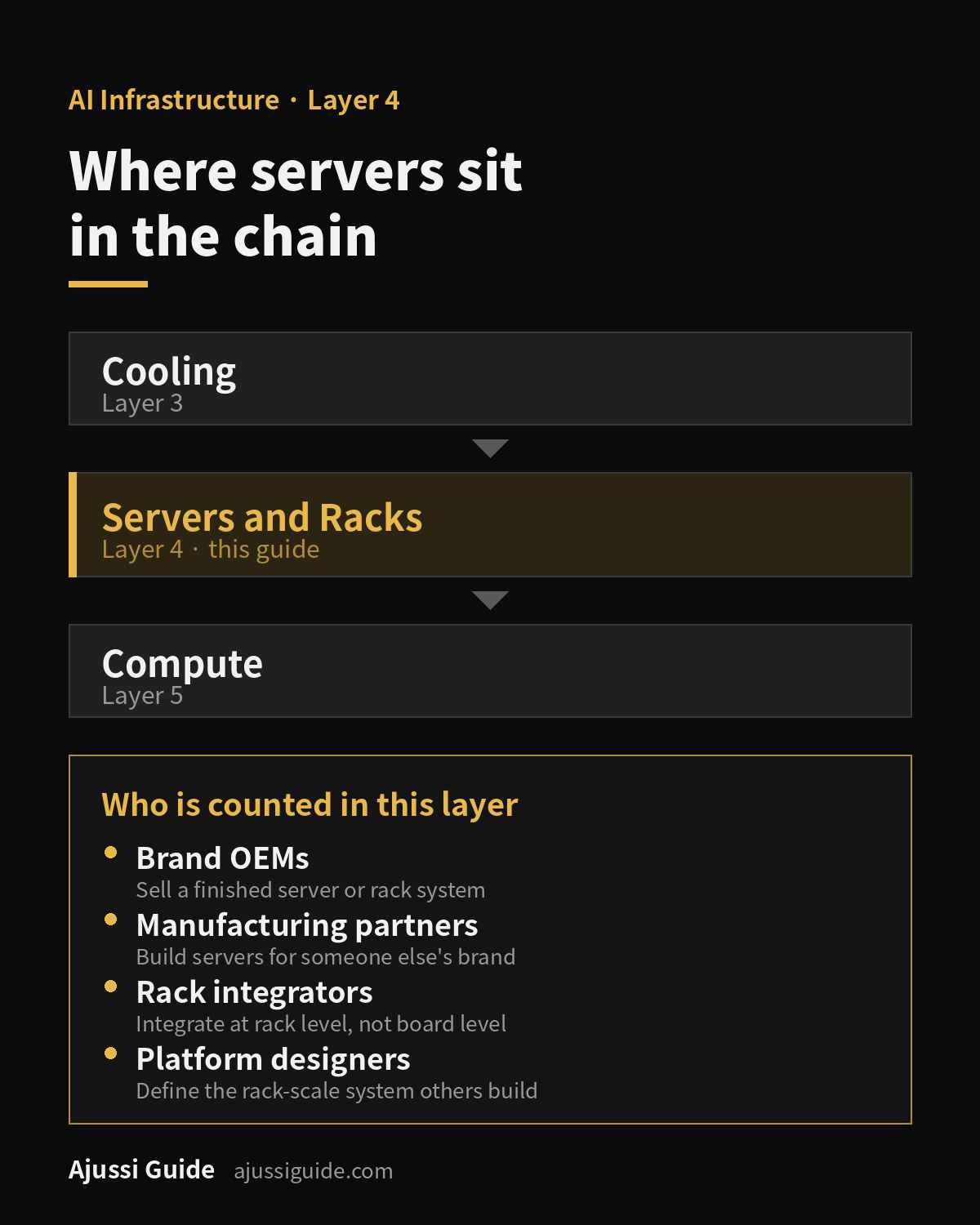
In Ajussi Guide’s seven-layer map, servers and racks form the fourth layer between cooling and compute. Power has to be generated and delivered before a rack draws anything. Once the rack runs, almost all of that power becomes heat that the cooling layer has to remove. The server and rack layer sits between those facility layers and the silicon inside.
Each of those layers has its own suppliers, its own disclosure habits and its own cycle. This guide covers the server layer only. Where the electricity comes from is covered in Power Grid Stocks, how it reaches the site in Transmission and Distribution Stocks, how the heat leaves in Liquid Cooling Stocks, and what the silicon inside the rack is in Semiconductor Stocks.
Who Actually Builds an AI Server
Four questions separate the companies more cleanly than any product list. Does it sell a finished server or rack system? Does it design and manufacture servers for someone else’s brand? Does it integrate at rack level? And can any of that be confirmed in the company’s own documents rather than in coverage about the company?
The roles below are applied per company and per product, not as a single label for the whole business.
Role codes
OEMDesigns and sells servers under its own brand.ODMDesigns and manufactures under a customer brand.EMS / CONTRACT MANUFACTURERHandles manufacturing and assembly.SYSTEM DESIGNER / MANUFACTURERDesigns and manufactures systems directly.SYSTEM PARTNERSupplies systems under an official partner status.RACK INTEGRATORIntegrates compute and supporting systems at rack level. Some also test and ship complete racks.SYSTEM / PLATFORM INTEGRATIONIntegrates compute, storage and networking platforms.PLATFORM / RACK-SCALE SYSTEM DESIGNERDesigns and supplies the architecture and components partner systems use.NVIDIA-BRANDED SYSTEM PROVIDEROffers NVIDIA-branded systems directly.
SYSTEM PARTNERis a status rather than a manufacturing method, so it can sit alongside OEM, ODM or EMS.EMSis used where manufacturing is documented but customer-brand design is not, which is why it is not raised to ODM.JDMis left out of this list because no primary document confirming a joint design agreement was found for any company here.
| Company | Role and boundary |
|---|---|
| Dell Technologies | OEM RACK INTEGRATOR. Sells the PowerEdge XE9680L as its own branded AI server and configures rack-scale systems through Dell AI Factory with NVIDIA. |
| Hewlett Packard Enterprise | OEM RACK INTEGRATOR. Sells ProLiant and Cray AI systems under its own brand and configures NVIDIA-based AI factory solutions at system level. |
| Super Micro Computer | OEM RACK INTEGRATOR. Designs and builds its own branded servers, storage and racks, and states rack-scale integration expertise in official releases. |
| Lenovo Group | OEM RACK INTEGRATOR. Sells ThinkSystem servers under its own brand and integrates compute, cooling and management at rack level. |
| Hon Hai Precision Industry brand Foxconn, subsidiary Ingrasys | EMS / CONTRACT MANUFACTURER RACK INTEGRATOR. Builds and integrates NVIDIA GB200 NVL72, MGX and HGX systems at Ingrasys sites. |
| Quanta Computer subsidiary brand QCT | ODM OEM RACK INTEGRATOR. Quanta describes an ODM base while QCT sells its own branded data center products, including NVIDIA MGX, HGX and 72-GPU racks. |
| Wiwynn | SYSTEM DESIGNER / MANUFACTURER RACK INTEGRATOR. States server design, system integration and L10/L11 rack delivery for the Vera Rubin NVL72 platform. |
| Inventec | OEM RACK INTEGRATOR. Presents its own server line and NVIDIA HGX B200 and B300 systems, including Artemis rack-scale configurations. |
| Wistron | EMS / CONTRACT MANUFACTURER SYSTEM PARTNER RACK INTEGRATOR. Manufactures, assembles and tests NVIDIA AI systems in the United States and is listed as an NVIDIA-Certified Systems provider. |
| GIGABYTE Technology server business sits in wholly owned Giga Computing | OEM RACK INTEGRATOR. Giga Computing designs and sells GIGABYTE branded servers, and GIGAPOD is a pre-integrated rack built on NVIDIA GB300 NVL72. |
| ASUSTeK Computer | OEM RACK INTEGRATOR. Sells ASUS branded servers and describes AI POD with NVIDIA GB200 NVL72 as a full-rack platform. |
| NVIDIA boundary case | PLATFORM / RACK-SCALE SYSTEM DESIGNER NVIDIA-BRANDED SYSTEM PROVIDER. Designs and supplies the HGX, MGX and NVL platforms partner systems use, and offers DGX GB300 under its own brand. Not a traditional general-purpose server OEM. |
| Cisco Systems boundary case | OEM SYSTEM PARTNER. Sells UCS E-Series servers under its own brand and combines UCS with NVIDIA accelerated computing in Secure AI Factory. The servers are real, but disclosure and revenue center on networking. |
| Celestica boundary case | EMS / CONTRACT MANUFACTURER SYSTEM / PLATFORM INTEGRATION. Hardware Platform Solutions covers compute, storage and networking platforms. No Celestica-branded complete AI server rack was confirmed. |
Manufacturing and rack integration are documented for Hon Hai, Wiwynn, Wistron and Inventec, but the scope of brand design work inside individual customer contracts is not disclosed, so ODM and JDM are not applied to them. The three boundary cases are kept out of any ranking for different reasons. NVIDIA overlaps with the compute layer. Cisco needs its server exposure separated from its networking exposure. Celestica shows mixed hardware platform and manufacturing services exposure.
Three pairs also need the listed entity kept apart from the product brand: Hon Hai and Foxconn and Ingrasys, Quanta and QCT, GIGABYTE and Giga Computing. None of those product brands has separately listed shares. Investors access the listed parent.
The Companies, and What You Can Actually Buy
Knowing who builds a rack is only half of it. The other half is whether a US investor can hold the company at all, and through what instrument.
Access codes
US EXCHANGEListed on a US primary exchange.ADR / GDRDepositary receipt. State the trading venue and ratio when confirmed.FOREIGNDirect listing on a non-US exchange.SUBSIDIARYA subsidiary of a listed company, with no separate shares.
| Company | Investor access |
|---|---|
| Dell Technologies | US EXCHANGE NYSE: DELL |
| Hewlett Packard Enterprise | US EXCHANGE NYSE: HPE |
| Super Micro Computer | US EXCHANGE Nasdaq: SMCI |
| NVIDIA | US EXCHANGE Nasdaq: NVDA |
| Cisco Systems | US EXCHANGE Nasdaq: CSCO |
| Celestica | US EXCHANGE NYSE: CLS. FOREIGN Toronto Stock Exchange: CLS |
| Lenovo Group | FOREIGN HKEX: 992. ADR on OTC: LNVGY, twenty ordinary shares per ADR |
| Hon Hai Precision Industry | FOREIGN TWSE: 2317. GDR on London Stock Exchange: HHPD |
| Wistron | FOREIGN TWSE: 3231. GDR on Luxembourg Stock Exchange: 3231.q.l, ten ordinary shares per GDR |
| Quanta Computer | FOREIGN TWSE: 2382. The board approved a GDR issue on 16 June 2026, but completion of the listing was not confirmed. |
| Wiwynn | FOREIGN TWSE: 6669 |
| Inventec | FOREIGN TWSE: 2356 |
| ASUSTeK Computer | FOREIGN TWSE: 2357 |
| GIGABYTE Technology | FOREIGN TWSE: 2376. Giga Computing is a SUBSIDIARY with no separate listed shares. |
A symbol page on OTC Markets and a US investor being able to place an order today are not the same thing. Sponsorship, live quotation status, broker support and liquidity were not confirmed in company or exchange documents for HNHPF, HNHAF, QUCCF, WICOF, ASUUY or ASUUF. Where a non-US route is stated above, it comes from the company’s own investor relations page.
What Sits Outside This Scope
IBM with Power, Oracle with x86 and Exadata, and Fujitsu with PRIMERGY all still sell servers. The core scope here is AI accelerated servers, rack-scale systems and the supply chain that builds them, so these three are separated into a distinct scope rather than dropped. Oracle is held in a data center supply chain ETF. Keeping it out of the core list is a scope decision, and this is where that decision is stated.
No complete server system was confirmed in the official portfolios reviewed for a second group. NetApp, Seagate and Western Digital are storage. Arista is networking. nVent is electrical and cooling. Bloom Energy is on-site power. That does not mean those companies do no server-related business at all. It means the systems themselves were not found in their own material.
Inspur’s server products are confirmed, but the listed issuer and the investment access path could not be established from the sources this review accepts, so it is left out of the list of verifiable investment targets. That is not a statement that Inspur does not build servers.
Current Snapshot
Number labels and disclosure levels
revenueRecognized in the income statement for that period.ordersCustomer commitments newly secured in that period.pipelineA sales opportunity figure the company presents. Neither a contract nor revenue.guidanceCompany outlook, not confirmed revenue.
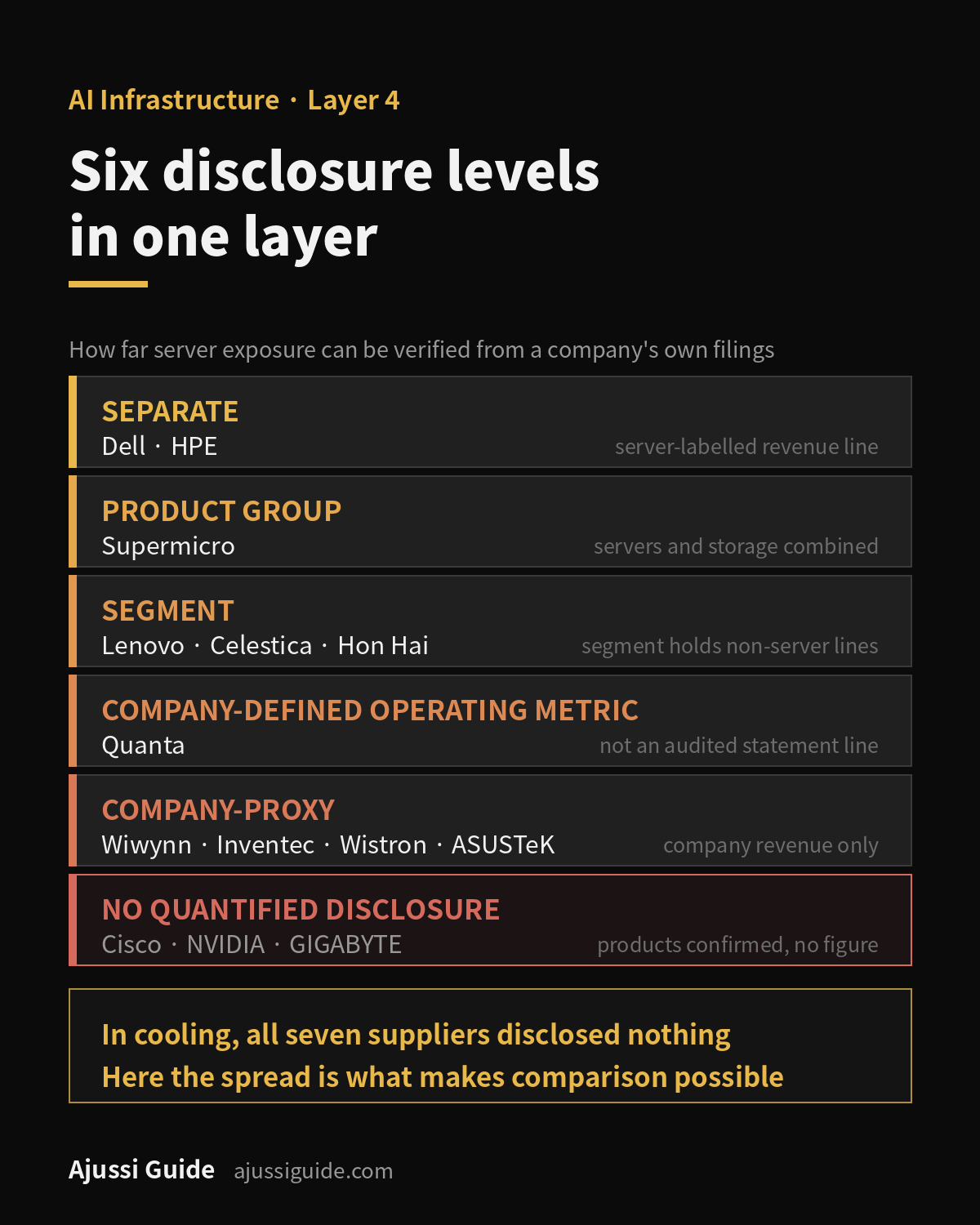
SEPARATEServer or AI server revenue disclosed as its own line.PRODUCT GROUPA product group containing servers is disclosed separately, with storage, services or software included.SEGMENTOnly a wider segment containing servers is disclosed.COMPANY-DEFINED OPERATING METRICAn operating figure the company presents, not a line in audited financial statements.COMPANY-PROXYOnly company revenue is disclosed, usable as a proxy for server exposure.NO QUANTIFIED DISCLOSUREProducts are confirmed but no server-related revenue figure is.
Time-sensitive figures are kept in this section only. The rest of the article is written to hold even when these numbers change. Check the label before comparing anything. SEGMENT and COMPANY-PROXY figures are not server revenue on their own. Dell and HPE are the only companies classified SEPARATE in this review. Within Dell, AI-optimized servers is a server-only line, while traditional servers and networking are reported together. HPE’s Server line is server-only.
| Company or metric | Current figure and disclosure level |
|---|---|
| Dell, AI-optimized servers | US$16,132M. revenue. SEPARATE. FY2027 Q1 ended 1 May 2026, released 28 May, unaudited. |
| Dell, traditional servers and networking | US$8,543M. revenue. Same period, servers and networking reported together.Total ISG was US$29,009M, of which storage was US$4,334M. That figure is the reason ISG cannot be read as server revenue, not a measure of server exposure. |
| HPE, Server | US$5.5B. revenue. SEPARATE. FY2026 Q2 ended 30 April 2026, released 1 June, audit status not stated.The Cloud and AI segment at US$7.7B is broader than Server. |
| Supermicro, server and storage systems | US$21,311.6M, 97.0% of net sales. PRODUCT GROUP. FY2025 annual, Form 10-K.Not server revenue alone, and the company reports a single operating segment. |
| Supermicro, net sales | US$10,243.0M. revenue, company level. FY2026 Q3 ended 31 March 2026, preliminary and unaudited. |
| Lenovo, Infrastructure Solutions Group | US$19.2B. revenue. SEGMENT. FY2025/26 annual, released 22 May 2026.Includes storage, software and services alongside servers. |
| Celestica, Hardware Platform Solutions | About US$1.9B. revenue. SEGMENT. Q2 2026 ended 30 June, unaudited.Mixes compute, storage and networking. Company revenue was US$4,698.6M. |
| Hon Hai, Cloud and Networking | Close to 50% of company revenue in Q1 2026. SEGMENT.Not server revenue on its own. Company revenue was NT$2.12 trillion. |
| Quanta Computer | COMPANY-DEFINED OPERATING METRIC.The official ESG page describes server revenue as more than 50% of 2024 company revenue. This is not a separate line in audited financial statements. |
| Wiwynn, Inventec, Wistron, ASUSTeK | COMPANY-PROXY.Company revenue is published, but no server-only revenue line was confirmed. |
| Cisco, NVIDIA, GIGABYTE | NO QUANTIFIED DISCLOSURE.Server products are confirmed, but no server-related revenue figure was confirmed. |
Five widely quoted numbers are not what they look like.
- Dell’s US$24.4B in AI server orders is
orders. The same release separates it from US$16.1B of recognized revenue. - Dell’s roughly US$60B AI server figure for full-year FY2027 is
guidance, not confirmed revenue. - Lenovo’s US$21B AI server figure is
pipeline. The word in the source is pipeline. It is neither backlog nor revenue. - NVIDIA’s US$75.2B Data Center figure is
revenuebut not server revenue. It is compute at US$60.4B and networking at US$14.8B, within company revenue of US$81,615M. - Cisco’s US$8,815M Networking figure is also
revenuebut not server revenue, within company revenue of US$15,841M.
How to Compare Server Stocks by Disclosure
The disclosure column above is the most useful thing in this guide, and it is worth saying why.
In the cooling layer, none of the seven listed suppliers reported liquid cooling revenue separately. The absence was uniform, which made it a finding but not a way to tell companies apart. Servers behave differently. Two companies disclose dedicated server-labelled lines. One discloses a combined server-and-storage product group. Three disclose wider segments. The rest provide company-level figures or no quantified server disclosure.
That spread is what makes comparison possible. A quarter that moves Dell’s AI-optimized servers line can be read directly. A quarter that moves Lenovo’s Infrastructure Solutions Group cannot, because storage, software and services move inside the same number. A change in Hon Hai’s company revenue cannot be read as a server result on its own.
So the practical question is not which company is best positioned. It is how far you can verify a company’s server exposure from its own filings, and how much of your view has to rest on inference instead. The higher the disclosure level, the less inference is required.
The Risks
Four things could weaken any thesis built on this layer, and none of them are company-specific.
Customer concentration sits at the top. A small number of hyperscale buyers can move a segment result in either direction within one quarter, and the companies in this guide generally do not name them.
Conversion timing is the second. Orders and backlog may convert into revenue over time, while pipeline may never convert at all. Delivery, acceptance and buyer schedules affect when recognized revenue appears. That is why orders, pipeline, guidance, backlog and revenue are labeled separately above.
Margin structure is the third. Shipping more racks does not automatically mean more profit. Product mix, pricing, utilization and component cost decide the result, and a contract manufacturer, a brand OEM and a rack integrator carry different versions of that risk.
Corporate structure is the fourth. Several names here are reached through a listed parent rather than the business doing the work, and the parent’s other businesses can be larger than the server exposure being bought.
What to Check Before the Next Earnings
Do not write down earnings dates. Companies move them. Write down the metric and where it is published.
For Dell, track AI-optimized server revenue and the gap between orders and recognized revenue. For HPE, track the Server line within Cloud and AI. For Supermicro, check whether the product-group split remains available in the next annual filing. For Lenovo and Celestica, check whether either company begins separating server revenue within its segment. For the Taiwan manufacturers, monthly and quarterly company revenue is what exists, so treat it as a proxy and say so. For Cisco, NVIDIA and GIGABYTE, check whether a quantified server-related disclosure appears at all.
Across all groups, compare revenue growth with operating cash flow, receivables and inventory to see whether reported growth is converting into cash or remaining in working capital.
Related Research
Servers are the fourth layer of seven. The layers on either side are linked in the map section above. A direct comparison of two brand OEMs, one selling servers as its main business and one selling them inside a much larger company, is in Super Micro vs Dell AI Server Stocks. Every guide on this site, layer by layer, is listed on the site map. The storage that goes inside these servers is covered on the memory layer in Enterprise SSD Stocks, which sorts NAND makers, controller vendors and storage-system companies by what each one reports. The manufacturing partners in the table above are compared company by company — monthly revenue, stated AI share, margin basis and customer concentration — in Server ODM Stocks.
Frequently Asked Questions
What are server stocks?
Listed companies that sell complete servers or rack systems, design and manufacture servers for a customer, or integrate at rack level. At least one of those has to be documented in the company’s own material. That definition excludes data center REITs, cloud operators, and companies that supply parts or facility equipment without building the system.
Are server stocks the same as SERV stock?
No. SERV is Serve Robotics, an autonomous delivery company. The ticker resembles the word server, and it surfaces in searches for the term, but the businesses are unrelated.
Which public companies manufacture AI servers?
Brand systems come from Dell, HPE, Super Micro and Lenovo. Manufacturing and rack integration exposure sits with Hon Hai, Quanta, Wiwynn, Inventec, Wistron, GIGABYTE through Giga Computing, and ASUSTeK. NVIDIA, Cisco and Celestica are boundary cases for reasons set out above.
What is the difference between a server OEM and an ODM?
An OEM designs and sells servers under its own brand. An ODM designs and manufactures under a customer’s brand. Where manufacturing is documented but customer-brand design is not, this guide uses EMS instead of raising the label to ODM.
Is NVIDIA a server stock?
NVIDIA is treated here as a boundary case rather than a pure server stock. It designs and supplies the platform and rack-scale architecture that partner systems use, and it offers DGX systems under its own brand, but it is not a traditional general-purpose server OEM. It also does not disclose a server or DGX revenue line.
Can US investors buy Quanta, Wiwynn, or Foxconn shares?
The verified routes are non-US listings, and actual access depends on the investor’s broker and market permissions. Hon Hai, the listed company behind Foxconn, trades in Taiwan and has a London GDR. Quanta and Wiwynn trade in Taiwan. Quanta’s board approved a GDR issue, but completion of the listing was not confirmed. OTC symbol pages exist for several names, but official tradability was not confirmed.
How are server stocks different from data center stocks?
Data center stocks usually means the facility: REITs that own the buildings, operators that run them, and the power and cooling suppliers around them. Server stocks means the systems inside. Mixing the two is what produces lists where a REIT, a fuel cell company and a server maker sit in one table.
Is there a server stocks ETF?
There is no pure-play server ETF identified in this review. VanEck RACK covers the broader data-center supply chain, including power, cooling, semiconductors, networking, storage, and servers.
Sources and Update Log
Last verified: 18 August 2026
Company roles, tickers and listing routes are linked inline above, from company product pages and investor relations material. Rack specifications come from NVIDIA or the relevant system vendor’s official documentation.
Core disclosures used for the Current Snapshot section:
- Dell Technologies, first quarter fiscal 2027 results
- HPE, fiscal 2026 second quarter results
- Super Micro Computer, 2025 Form 10-K
- Super Micro Computer, third quarter fiscal 2026 results
- Lenovo, FY2025/26 results
- Celestica, second quarter 2026 results
- Hon Hai, first quarter 2026 results
- NVIDIA, first quarter fiscal 2027 results
- Cisco, third quarter fiscal 2026 results
First published 19 August 2026. The Current Snapshot section is refreshed as each company reports.
For the ETF route, the data center ETF comparison sorts every holding of NCLD, DTCR, SRVR, IDGT and RACK into operators, REITs, connectivity and supply chain.
This article is for information only. It is not a recommendation to buy or sell any security mentioned, and investment decisions and their results are the reader’s own.