What this checkedSuper Micro runs thinner margins with higher execution variance while Dell brings diversified revenue and cash flow, and Super Micro’s Q4 FY2026 GAAP gross margin came in at 17.5% (Aug 11, preliminary).
What it did notthe Aug 20 investigation findings are the company’s own account, and neither the open government investigations nor the durability of that margin is settled.
Watch nextSMCI’s FY27 Q1 results in early November, and whether the adverse internal-control opinion in the FY2026 10-K is remediated.
When investors ask about Super Micro vs Dell AI server stocks, they usually want to know one thing: which one gives better exposure to the GPU rack buildout without taking more risk than intended. The short answer is that Super Micro (SMCI) offers concentrated, high-beta exposure to AI infrastructure with historically thinner margins and more execution risk, while Dell Technologies (DELL) offers broader, more diversified AI server revenue inside a larger enterprise business with steadier cash flow. Neither is obviously better. They serve different investor temperaments, and understanding why requires looking at how each company actually makes money from a GPU rack.
Super Micro vs Dell AI Server Stocks: The Core Business Model Difference
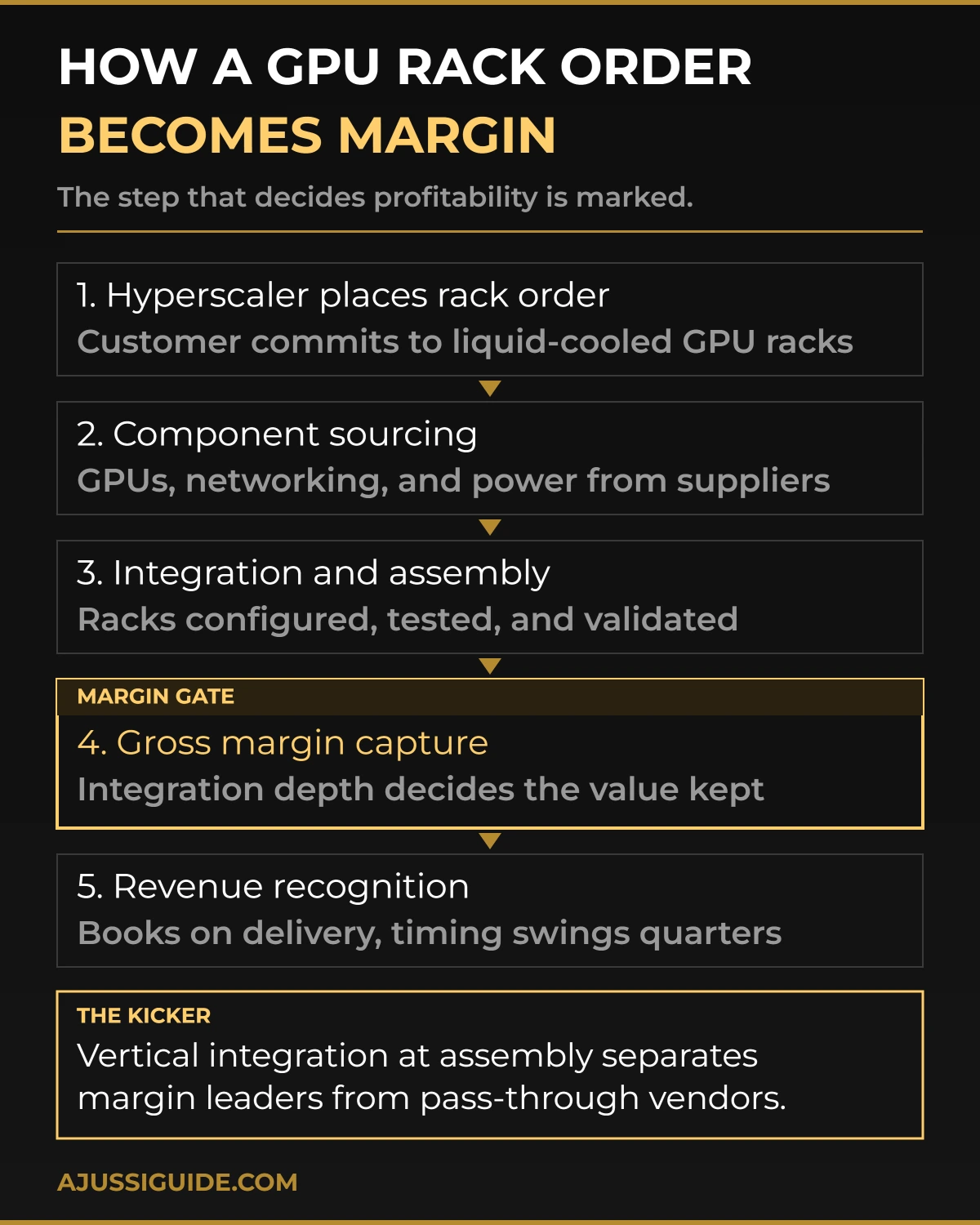
Super Micro’s entire identity is built around fast, flexible server design. The company engineers its own motherboards, power supplies, and chassis, then assembles them into complete rack-scale systems for hyperscalers and AI cloud customers. That vertical integration is the reason SMCI can ship a new GPU configuration faster than almost anyone else in the industry.
Dell’s AI server business sits inside its Infrastructure Solutions Group (ISG). Dell does not manufacture its own silicon or many core components at the same depth SMCI does. Instead, Dell leverages its massive enterprise sales force and existing relationships with Fortune 500 companies, government agencies, and telecom providers to sell complete AI infrastructure solutions.
The practical result is that SMCI’s revenue is more directly tied to GPU rack unit volumes, while Dell’s AI server revenue is bundled with services, storage, and networking that smooth out the quarterly swings somewhat. One company offers more concentrated exposure to AI server and rack-scale infrastructure; the other embeds that exposure inside a much broader enterprise technology portfolio.
Margin Structure: Where the Money Actually Goes
Gross margins in AI servers are a recurring surprise for new investors. These are not software margins. When a company ships a rack full of expensive GPUs, the GPU cost flows through cost of goods sold, which compresses reported gross margin percentages even when absolute dollar profit is rising.
Super Micro has historically operated at gross margins that are lean relative to traditional enterprise IT vendors. Super Micro emphasizes rapid configuration, in-house platform design, and high-volume rack-scale deployment. Its historically lean gross margins suggest that speed and execution have mattered more to the model than premium pricing, although that is an interpretation of the results rather than a strategy the company states in those words. Either way, the model is more sensitive to input cost pressure than a premium-priced one.
Dell’s ISG segment blends AI server revenue with higher-margin storage and services. This broader mix can moderate quarter-to-quarter margin volatility, although Dell’s fast-growing AI business has introduced customer concentration and working-capital pressures of its own. The tradeoff is that a surge in GPU rack demand benefits Dell’s top line but does not lift margins as dramatically as investors sometimes expect.
That structural picture just got a live test. In late July 2026, Super Micro issued a preliminary fiscal fourth-quarter update that raised its gross margin guidance to the 15 to 17 percent range, far above its earlier guidance near 8 percent, citing a favorable customer and product mix. The company also reported more than 60 billion dollars in new quarterly orders and a record backlog. Those are orders, not recognized revenue, and one guided quarter does not rewrite a margin history. But it shows how fast the gap between these two margin stories can move, and it is exactly why this comparison stays qualitative: check the latest quarterly filings before anchoring on either company’s margin profile. At the time, those figures were preliminary and unaudited, revenue was guided near the low end of the prior range, and the company cautioned that some of the 60 billion dollars in orders may not be firm commitments and could be delayed or canceled. The same update also disclosed the export-control review covered in the risk section below. Super Micro then reported fiscal fourth-quarter results in its August 11, 2026 release: revenue of about $11.1 billion and GAAP gross margin of 17.5% (non-GAAP 17.6%), above the top of the July preliminary range. Those release figures were preliminary and unaudited, and should be read separately from the audited annual statements in the Form 10-K filed on August 31. One improved quarter does not establish a lasting margin level.
GPU Rack Strategy: Liquid Cooling and the Density Race
The shift to liquid cooling is one of the most important structural changes in AI server infrastructure right now. High-density GPU clusters generate heat loads that air cooling cannot handle efficiently at scale, so hyperscalers are increasingly specifying liquid cooling for their highest-density next-generation deployments.
Super Micro has made liquid-cooled, high-density rack architecture a central part of its product roadmap. The company offers direct liquid cooling solutions designed around the latest GPU generations from NVIDIA and AMD. This positions SMCI early in what is expected to be a multi-year infrastructure replacement cycle.
Dell has also expanded its liquid-cooled rack offerings through its PowerEdge server line and through partnerships with rack solution providers. Dell’s advantage here is its ability to bundle cooling infrastructure with its broader data center modernization services, which appeals to enterprise customers who want a single vendor relationship rather than a best-of-breed assembly approach.
Revenue Concentration and Customer Mix
Super Micro’s customer list is heavily weighted toward hyperscalers and large AI cloud operators. A relatively small number of customers can represent a significant portion of quarterly revenue. That concentration amplifies upside when those customers are in a heavy spending cycle, and it amplifies downside when a single large customer delays an order or shifts suppliers.
Dell’s customer base is broader than Super Micro’s, but it is not free of concentration risk. Dell disclosed that one customer accounted for 12 percent of its fiscal 2026 consolidated revenue, with substantially all of that revenue tied to ISG. Super Micro’s concentration is higher still: four customers each represented at least 10 percent of fiscal 2025 net sales. For a risk-conscious investor, the difference is a matter of degree, not category.
Investors should read the customer concentration disclosures in each company’s 10-K filings directly. The SEC’s EDGAR database at sec.gov/cgi-bin/browse-edgar lets you pull the latest annual reports for both SMCI and DELL without any paywall. I do this before every position review.
Risk Profile: Where Super Micro vs Dell AI Server Stocks Actually Differ
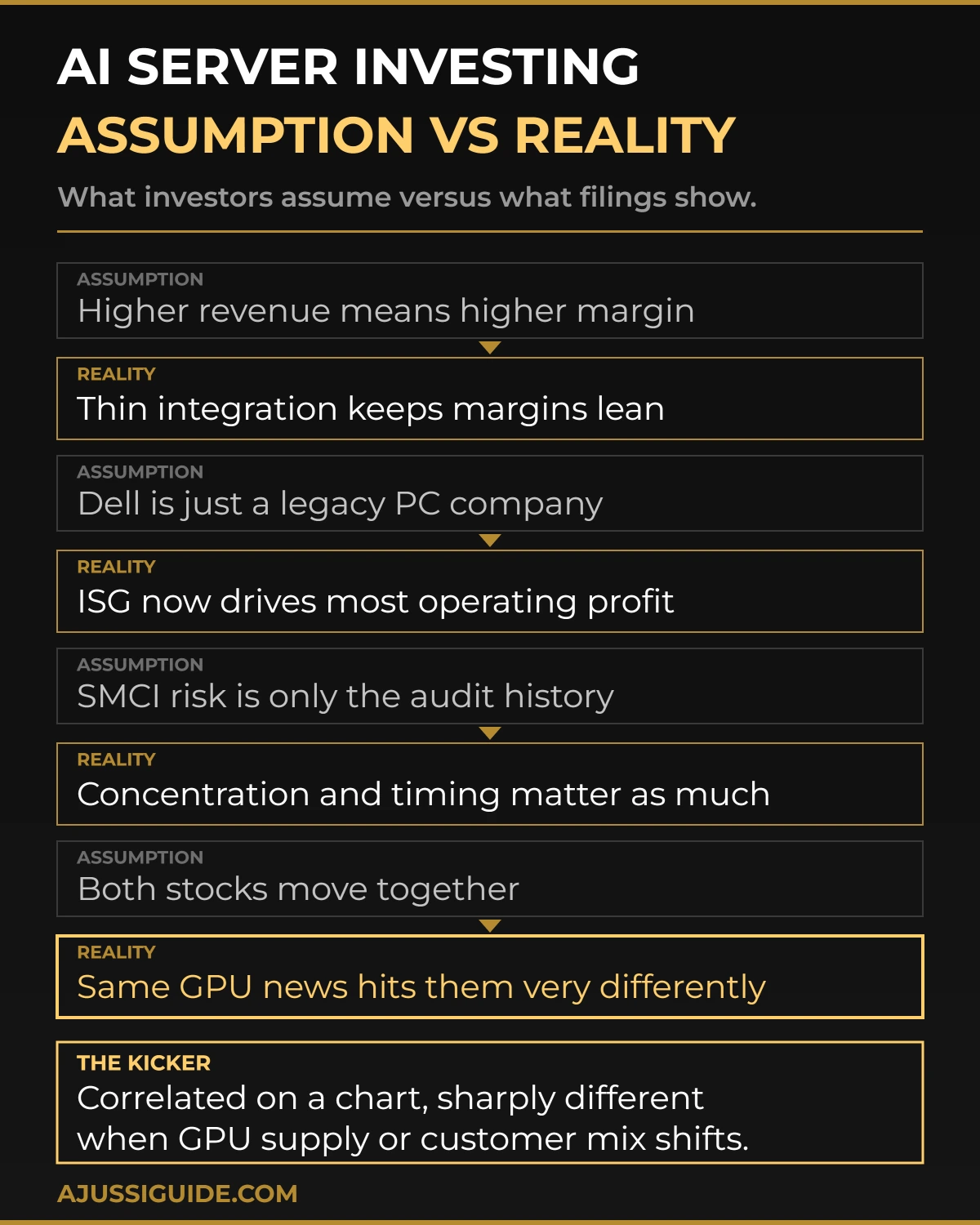
Super Micro’s risk profile has layers that go beyond the normal cyclical risk of hardware spending. Super Micro delayed its fiscal 2024 Form 10-K and its first two fiscal 2025 quarterly filings, changed auditors, and faced a Nasdaq reporting-compliance process. The company later filed the delinquent reports, but the episode remains relevant when assessing financial-reporting and governance risk.
Separately from those earlier filing delays and the auditor transition, Super Micro disclosed on July 21, 2026 that an independent review by its board was underway into certain transactions connected to alleged export-control issues, and on August 20, 2026 announced that the investigation led by its independent directors was complete. According to the company, the investigation found no evidence that any current member of senior management knew of the alleged diversion scheme, and no evidence that potential diversion of restricted products made previously issued financial statements unreliable. In its August 20 announcement, the company said it continued to cooperate with ongoing government investigations. The FY2026 Form 10-K filed on August 31 carries an unqualified opinion on the financial statements but an adverse opinion on internal control over financial reporting. Completion of the company’s own investigation does not mean the regulatory and control risk has ended.
Operational risk at SMCI also includes supply chain timing. When NVIDIA releases a new GPU generation, Super Micro needs to qualify its platforms quickly and get inventory positioned ahead of customer demand. If qualification slips or component supply is constrained, revenue can shift by a full quarter, which hits a small-cap stock hard.
Dell’s risks are different in character. Dell carries a sizable debt load, including financing-related debt tied to Dell Financial Services. Interest expense and refinancing costs are real line items that compete with earnings, and the balance should not be read as purely a leftover from the historical EMC and VMware transactions. Additionally, Dell’s PC and peripherals business, while smaller as a share of profit than it once was, can create noise in earnings that obscures the AI server story for investors focused on that segment.
Side-by-Side Comparison
Here is the Super Micro vs Dell AI server stocks picture in one table.
| Factor | Super Micro (SMCI) | Dell Technologies (DELL) |
|---|---|---|
| Business focus | AI-focused server and rack-scale infrastructure specialist | Diversified infrastructure: servers, storage, services, PCs |
| AI server exposure | High concentration, primary revenue driver | Significant but within a larger portfolio |
| Vertical integration | Deep: own motherboards, chassis, power | Moderate: relies more on partner components |
| Gross margin profile | Historically lean; Q4 FY2026 GAAP gross margin 17.5% (Aug 11 preliminary, unaudited release) | Blended; services and storage lift overall mix |
| Customer concentration | High: four customers each 10%+ of FY2025 sales | Lower than SMCI; one customer was 12% of FY2026 revenue |
| Liquid cooling position | Core product line, aggressive expansion | Growing capability through PowerEdge line |
| Key risk type | Execution, audit history, concentration | Debt load, PC segment noise, margin mix |
| Risk structure | Customer concentration and execution volatility dominate | Broader diversification, but debt and mix risk remain |
How I Think About Position Sizing as a Self-Directed Investor
From a risk-analysis perspective, the two names are structured differently. SMCI’s greater customer concentration, margin variability, and reporting history make position size more consequential, because the same headline moves it further. Dell’s broader business mix can reduce company-specific volatility, but it also dilutes the concentration of the AI-server exposure.
These are different risk structures, not instructions about how large either position should be. SMCI represents more concentrated exposure to AI-server execution and demand. Dell combines AI-server exposure with storage, services, financing, and PCs.
The relevant question is not which position should be larger, but which set of risks is already overrepresented in the rest of your portfolio. Both readings of the same theme can be right at the same time depending on your time horizon.
Frequently Asked Questions
Is Super Micro or Dell better for AI server stock exposure?
It depends on your risk tolerance. Super Micro gives concentrated, high-beta exposure to GPU rack demand, with more upside in strong cycles and more downside in slowdowns. Dell gives broader AI infrastructure exposure inside a diversified enterprise business. In the Super Micro vs Dell AI server stocks decision, investors who want more concentrated exposure lean toward SMCI, while those who want diversification lean toward DELL.
Why does Super Micro have lower gross margins than Dell?
Super Micro has historically run thinner gross margins, reflecting intense competition for large hyperscaler rack deals rather than any stated pricing strategy. Dell’s margins benefit from a product mix that includes higher-margin storage, software, and services alongside the server hardware. Recent quarters can deviate sharply from that pattern, as Super Micro’s 17.5% gross margin in fiscal Q4 2026 showed, so treat the structural difference as a starting point rather than a fixed gap.
Does Dell actually compete with Super Micro in AI servers?
Yes, directly. Dell’s PowerEdge AI server line competes for the same hyperscaler and enterprise GPU rack contracts that Super Micro targets. Dell also competes through its liquid-cooled rack solutions. The two companies overlap most in large enterprise and cloud customer deployments, though Super Micro competes partly on speed-to-deployment.
What is the biggest risk specific to Super Micro stock?
Customer concentration is the operational risk that shows up most often in SMCI’s results. A small number of hyperscaler customers drive a large share of revenue, so a single order delay or supplier shift can move quarterly results significantly. The company’s audit and filing history from prior periods, the government export-control investigations it described as ongoing in its August 20, 2026 announcement after its own review closed, and the adverse internal-control opinion in the FY2026 Form 10-K also remain part of the valuation context.
What is the biggest risk specific to Dell stock?
Dell carries a meaningful debt load that creates interest expense pressure on earnings. When interest rates are elevated, this reduces the earnings benefit from AI server revenue growth. Additionally, Dell’s PC and client solutions segment can drag on overall reported results even when the infrastructure business is performing well, creating a mixed earnings signal.
How do I find the latest financial filings for SMCI and DELL?
Both companies file annual 10-K and quarterly 10-Q reports through the SEC’s EDGAR system at sec.gov. You can search by ticker symbol and access full filings without a subscription. Reading the risk factors section and the segment revenue breakdown directly from the filing is more reliable than relying on summarized data from financial news sites.
Are Super Micro vs Dell AI server stocks correlated to NVIDIA?
Both stocks tend to react to NVIDIA’s results, GPU supply, and AI infrastructure demand news, since NVIDIA GPUs are the primary compute inside most AI racks both companies ship. However, the correlation is not identical. SMCI reacts more sharply because GPU rack revenue is a larger share of its business. Dell’s reaction is somewhat buffered by its other segments.
Can I own both SMCI and DELL in the same portfolio?
Holding both would broaden company-specific exposure, but it would not create full diversification, because both names remain tied to AI-server demand, GPU availability, and hyperscaler spending. The useful step is to measure how much thematic overlap the two positions would add to the rest of a portfolio, rather than treating Dell as an automatic hedge against SMCI.
Original data verified: 2026-08-06. SMCI results, investigation and audit status updated: 2026-09-15. Market values and Dell figures retain their original reference dates.
This post is information only, not investment advice. I am not recommending buying or selling any security. Every investor carries their own decision and must assess their own risk tolerance and financial situation before acting.