Updated 2026-09-28 — Added a new section with the complete holdings (310 rows) of 15 Korea-listed semiconductor and memory ETFs, including the four launched on September 15, plus SMH and SOXX: how much each pair overlaps, and how much of each is Samsung, SK hynix and Micron. The original three-fund comparison from late August is unchanged.
Search “HBM ETF” and most of the first page is quote pages for a single Korean fund, PLUS Global HBM Semiconductor (442580), which has been listed in Seoul since 2022. What those pages do not show is that several U.S.-listed memory ETFs launched in 2026, and that the funds hold very different portfolios. One is 75% Samsung, SK hynix and Micron. One reached $26 billion in assets in under five months. One does not hold Samsung at all.
This post compares Roundhill’s DRAM, Tuttle Capital’s HBMX and Korea’s 442580 on expense ratio, assets, holdings and structure, using each issuer’s own page (Roundhill, Tuttle, Hanwha PLUS) on August 25 and 26, 2026. Among U.S. listings it covers only the two unleveraged, non-income equity funds, DRAM and HBMX. DRMP, a weekly-income options strategy, and RAM, a 2x daily leveraged product on DRAM, are structurally different and left out. It also answers the question most readers actually have, which is whether a broad semiconductor ETF like SMH already gives them memory exposure. It does not pick a winner. For the individual companies behind these funds, see memory stocks, HBM memory stocks and Micron vs SK hynix.
The three funds
| Fund | Ticker · Launched · Expense |
|---|---|
| Roundhill Memory ETF | DRAM · Apr 2026 · 0.65% |
| Tuttle Capital Concentrated Memory Stack | HBMX · Jun 2026 · 0.95% |
| PLUS Global HBM Semiconductor (Hanwha) | 442580 (KRX) · Sep 2022 · 0.50% |
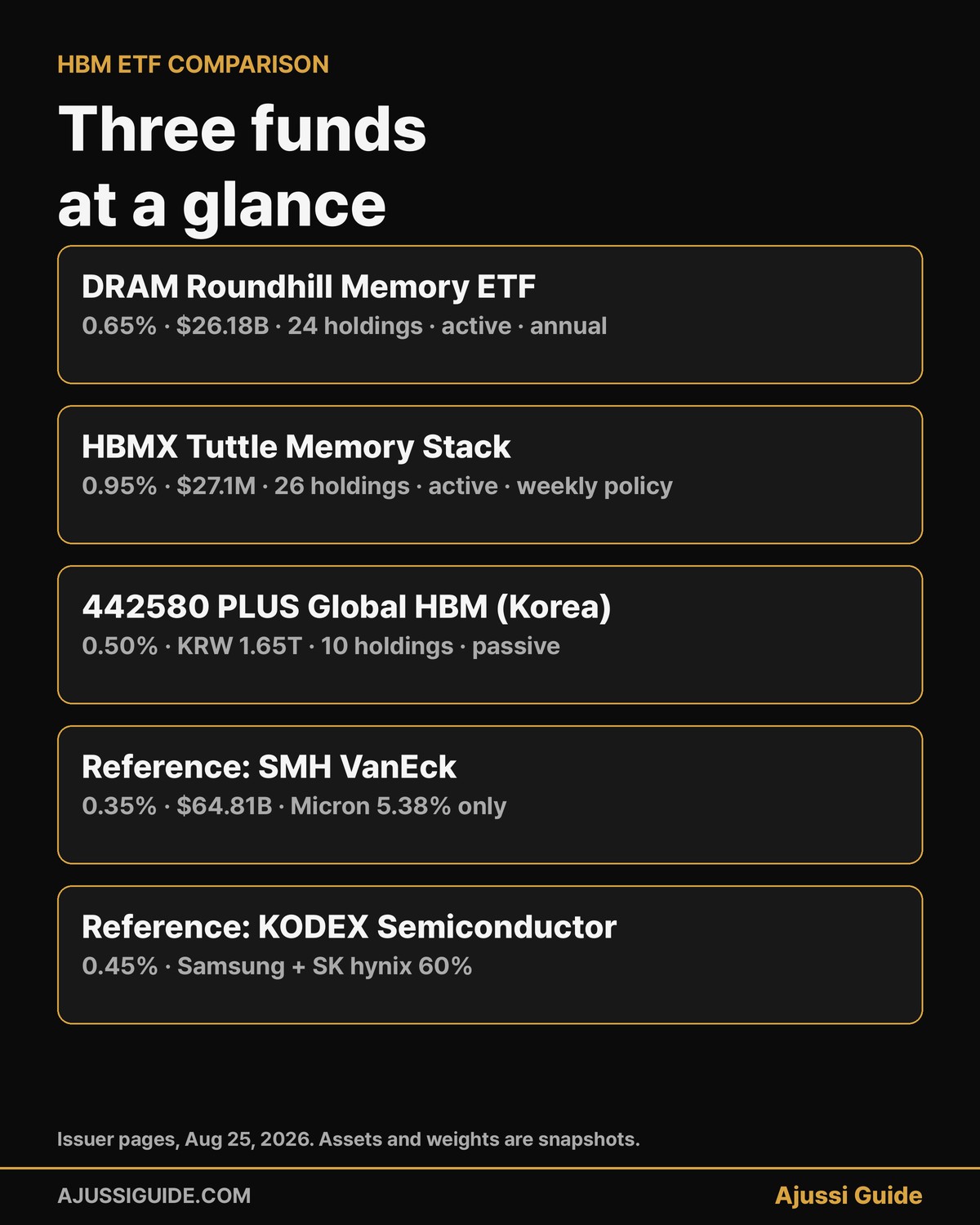
Assets as of August 25: DRAM $26.18 billion, HBMX $27.1 million, 442580 KRW 1.649 trillion (roughly $1.2 billion). Three funds share the HBM ETF label, and the spread between the largest and smallest is close to a thousand to one. DRAM and HBMX are both actively managed; HBMX describes itself as concentrated, with 20 to 35 holdings. 442580 is a passive fund tracking the iSelect Global HBM Semiconductor Index calculated by NH Investment & Securities. DRAM lists on Cboe BZX and pays annually; HBMX lists on Cboe BZX and its prospectus states a weekly distribution policy, with a possible year-end special distribution and actual amounts to be checked separately; 442580 trades in won on the Korea Exchange.
What each fund actually holds
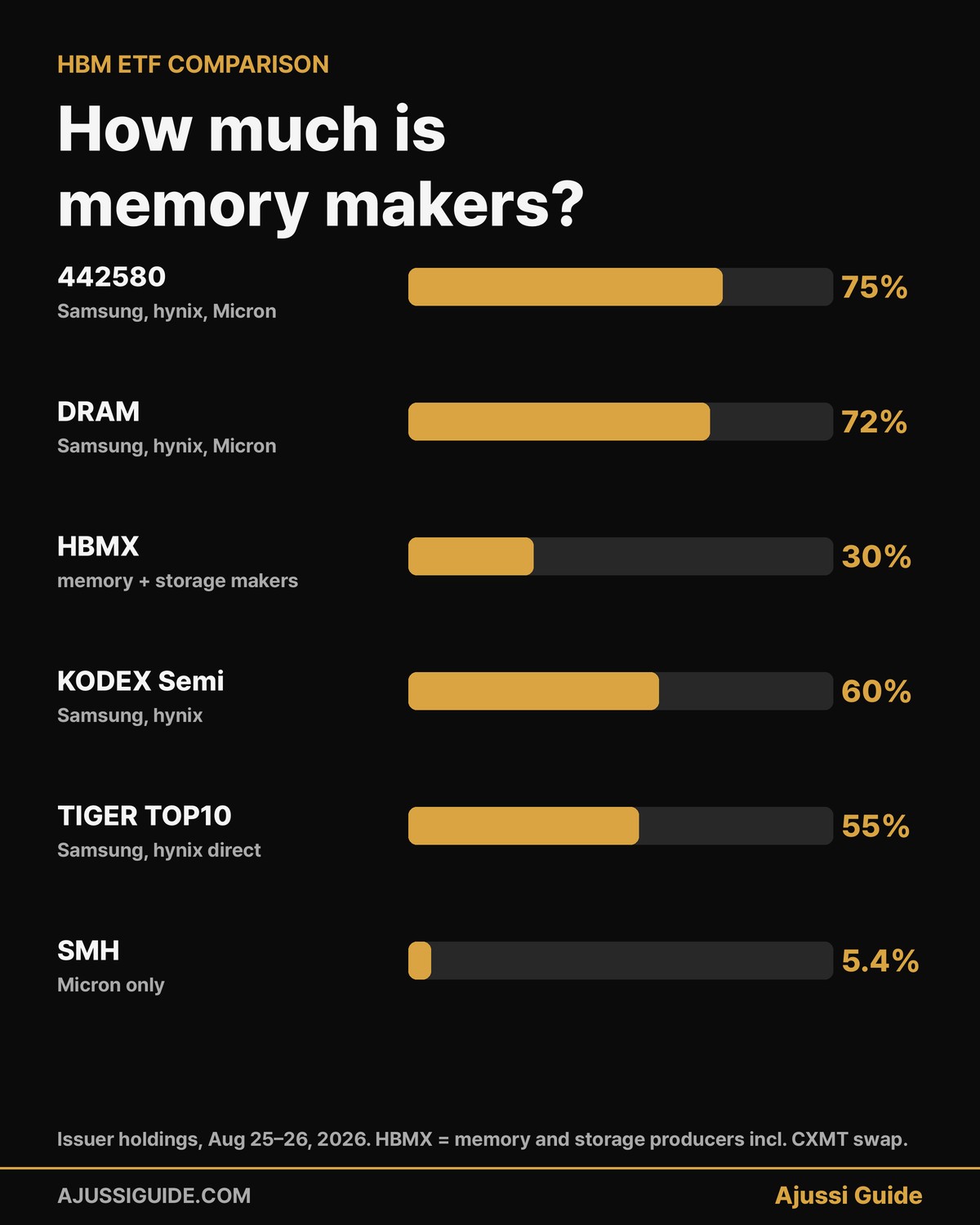
DRAM (Aug 25, 24 holdings): Micron 25.21%, Samsung Electronics 25.12%, SK hynix 22.02%, CXMT 4.79%, Seagate 4.61%, Sandisk 4.36%, Western Digital 3.91%, Kioxia 3.29%, Nanya 2.65%, Winbond 1.24%. The top ten is 97.2% of the fund. The big three memory makers are 72.35%; the rest is NAND (Sandisk, Kioxia), hard drives (Seagate, Western Digital), China’s CXMT and Taiwan’s Nanya and Winbond. There is no equipment maker in the top ten. This is a memory-and-storage producer-focused fund. CXMT exposure is held through a total return swap, and the issuer notes that weights combine stock positions with positions held via total return swaps, meaning some other names are partly swap-based as well. The $26.18 billion figure is on both the issuer page and Morningstar, and 468.31 million shares at the $55.90 NAV reproduce it.
HBMX (Aug 25, 26 holdings): Micron 9.25%, Advantest 7.36%, Onto Innovation 6.35%, Penguin Solutions 5.69%, Camtek 5.50%, ASML 5.31%, SK hynix 5.05%, Lam Research 4.74%, Sandisk 4.47%, Applied Materials 4.15%. The top ten is only 57.87%, the widest spread of the three. Across all 26 holdings, directly held memory makers (Micron, SK hynix, Kioxia 3.85%, Everspin 0.72%) are 18.87%; adding the CXMT swap at 3.82% brings economic memory-maker exposure to 22.69%; adding Sandisk, Western Digital and Seagate brings memory-and-storage producer exposure to 29.97%. The other 70% mixes test equipment (Advantest, Onto, Camtek), lithography (ASML), deposition and etch (Lam, Applied), packaging (Amkor), IP (Rambus), modules (Penguin) and cash. The ticker says HBM, the portfolio says memory ecosystem with a capex tilt. Samsung is absent from the August 25 holdings. HBMX excludes securities listed directly on the Korea Exchange and holds SK hynix through its Nasdaq-listed ADR (SKHY); because the fund may also take exposure through derivatives, the listing rule alone does not fully explain Samsung’s absence. Net assets are $27.1 million, NAV return since inception is -11.40% and the past month is -29.14% (Aug 25).
442580 (holdings PDF, Aug 25, 10 holdings): Samsung Electronics 25.74%, SK hynix 25.01%, Micron 24.62%, Lam Research 8.55%, Applied Materials 8.47%, Sandisk 4.58%, Teradyne 1.26%, DI Corp 0.62%, TechWing 0.61%, Hanmi Semiconductor 0.54%. Ten names, 100%. The big three are 75.37%, the four memory makers including Sandisk are 79.95%, which the issuer describes as “about 81% core memory companies (as of Jul 31).” U.S. equipment is 18%; the three Korean HBM back-end names combined are 1.77%, far smaller than the fund’s Korean branding suggests. The index rebalances four times a year (first business day of Feb, May, Aug, Nov); Sandisk, Teradyne and TechWing were added in May. Country split is roughly 55% Korea, 45% U.S. per the issuer’s May report. For U.S. investors it is a Korea-listed, won-denominated fund and is not available on U.S. exchanges; it appears here because it is the fund most “HBM ETF” searches actually land on.
Does SMH already give you memory exposure?
Only a little, which is why an HBM ETF search is worth running in the first place. VanEck’s SMH, the largest U.S. semiconductor ETF at $64.81 billion with 25 stocks (26 total holdings including cash), has Micron at 5.38% as its only memory manufacturer in the top holdings (Aug 24–25); NVIDIA is 21.94% and TSMC 9.59%. A semiconductor ETF and a memory ETF overlap, but they are not the same product. For comparison, Korea’s two flagship semiconductor ETFs, KODEX Semiconductor and TIGER Semiconductor TOP10, hold 60.10% and 55.27% in Samsung plus SK hynix directly (TIGER also holds 20.43% in SK Square, SK hynix’s holding company, which is related exposure but cannot simply be added as hynix exposure), which is why Korean investors debate whether they need 442580 at all.
The practical point is duplication. An investor who already holds Micron directly, or a Korea fund heavy in Samsung and SK hynix, would be buying the same three names again with DRAM or 442580. HBMX carries only 14% in those three, so it duplicates less, but it takes on equipment-stock volatility instead.
Three HBM ETF types under one label
Memory and storage producers (active): DRAM. Big three at 72%, then NAND, hard drives, China and Taiwan. No equipment. Assets under management reached $26.18 billion as of August 25, 2026, a measure of how much money this theme attracted, not a forecast.
Memory ecosystem (active, concentrated): HBMX. Memory and storage producers about 30%, the rest equipment, test, packaging and IP. Tilted toward memory capital spending rather than memory prices, so it can move differently from the other two. No Samsung.
Big-three index (passive, Korea-listed): 442580. Samsung, SK hynix and Micron at 75%, U.S. equipment at 18%, ten holdings. Trades in won.
September Update: 15 Korea-Listed Funds Plus SMH and SOXX, Full Holdings, Actual Overlap
In the month since this was first published, four more semiconductor and memory ETFs listed in Korea, all on September 15: PLUS Korea HBM Semiconductor (0239Y0), PLUS AI Semiconductor Equipment Active (0239Z0), KODEX US AI Memory TOP2 Plus (0238F0) and HANARO US Agentic AI TOP2+ (0227L0). Different names, but how different is what’s inside? To answer that I went beyond the three-fund comparison above and pulled the complete holdings (310 rows, not top ten) of 15 Korea-listed funds plus SMH and SOXX straight from each issuer’s official portfolio deposit file, then computed the overlap.
One rule first. Issuers use different denominators. KODEX and KoAct report weights against the equity value excluding cash, HANARO against the creation-unit cash amount, and PLUS Global HBM and the two ACE funds publish no cash line at all. Mixing those and calling the result “share of net assets” would be wrong. So every number below is the weight within each fund’s cash-equity sleeve: stock weights rescaled to sum to 100, with cash, futures and swaps removed. As-of dates also differ, Korea 28 Sep, HANARO 23 Sep, SMH 24 Sep, SOXX 25 Sep, so these are snapshots from different days. DRAM carries total-return-swap exposure on top of its physical holdings, so it is kept out of the overlap table and shown separately.
How much of each equity sleeve is Samsung, SK hynix and Micron
| ETF (code) | Stocks | Samsung | SK hynix | Samsung + hynix | Micron |
|---|---|---|---|---|---|
| TIGER Semiconductor TOP10 (396500) | 10 | 28.2 | 23.6 | 51.8 | 0 |
| PLUS Global HBM Semiconductor (442580) | 10 | 25.7 | 24.9 | 50.6 | 26.3 |
| ACE AI Semiconductor TOP3+ (469150) | 20 | 25.9 | 24.5 | 50.4 | 0 |
| PLUS Korea HBM Semiconductor (0239Y0) new | 10 | 24.6 | 25.0 | 49.5 | 0 |
| SOL AI Semiconductor TOP2 Plus (0167A0) | 10 | 25.5 | 22.5 | 48.0 | 0 |
| KODEX Semiconductor (091160) | 21 | 19.0 | 18.0 | 37.1 | 0 |
| RISE Non-Memory Semiconductor Active (388420) | 17 | 20.9 | 12.8 | 33.8 | 0 |
| KoAct Global AI Memory Semiconductor Active (0174B0) | 28 | 14.1 | 15.9 | 29.9 | 17.3 |
| RISE AI Semiconductor TOP10 (0093A0) | 10 | 13.8 | 11.4 | 25.2 | 0 |
| ACE Global Semiconductor TOP4 Plus (446770) | 10 | 3.6 | 19.1 | 22.8 | 3.7 |
| HANARO US AI Memory Semiconductor TOP4+ (0181B0) | 10 | 0 | 0 | 0 | 17.2 |
| KODEX US AI Memory TOP2 Plus (0238F0) new | 10 | 0 | 0 | 0 | 25.6 |
| KODEX US AI Semiconductor TOP3 Plus (0151S0) | 10 | 0 | 0 | 0 | 7.6 |
| PLUS AI Semiconductor Equipment Active (0239Z0) new | 20 | 0 | 0 | 0 | 0 |
| HANARO US Agentic AI TOP2+ (0227L0) new | 10 | 0 | 0 | 0 | 0 |
| SMH | 25 | 0 | 4.5 | 4.5 | 5.1 |
| SOXX | 30 | 0 | 3.2 | 3.2 | 8.0 |
| Roundhill DRAM (economic exposure) | 12 + TRS | 25.2 | 22.8 | 48.0 | 26.3 |
Regardless of the name on the label, the funds fall into three groups. First, the “Korean big-two” type, where Samsung and SK hynix are half the sleeve: TIGER, PLUS Global HBM, ACE AI Semiconductor TOP3+, PLUS Korea HBM and SOL all sit at 48 to 52%. The new PLUS Korea HBM is essentially 442580 with Micron removed and Korean equipment names added, so its shared weight with 442580 is 50 points. Second, the “US memory” type with zero Samsung and hynix, built on Micron, Sandisk, Seagate and Western Digital: KODEX US AI Memory TOP2 Plus and HANARO US AI Memory TOP4+, which share 67 points with each other. Third, the “global” type that holds all three of Samsung, hynix and Micron: 442580 and KoAct, sharing 62 points.
All 17 against each other
Overlap between two funds is measured as shared weight (Σmin, in percentage points): for every stock, take the smaller of the two weights and add them up. 100 means identical portfolios, 0 means no common holdings.
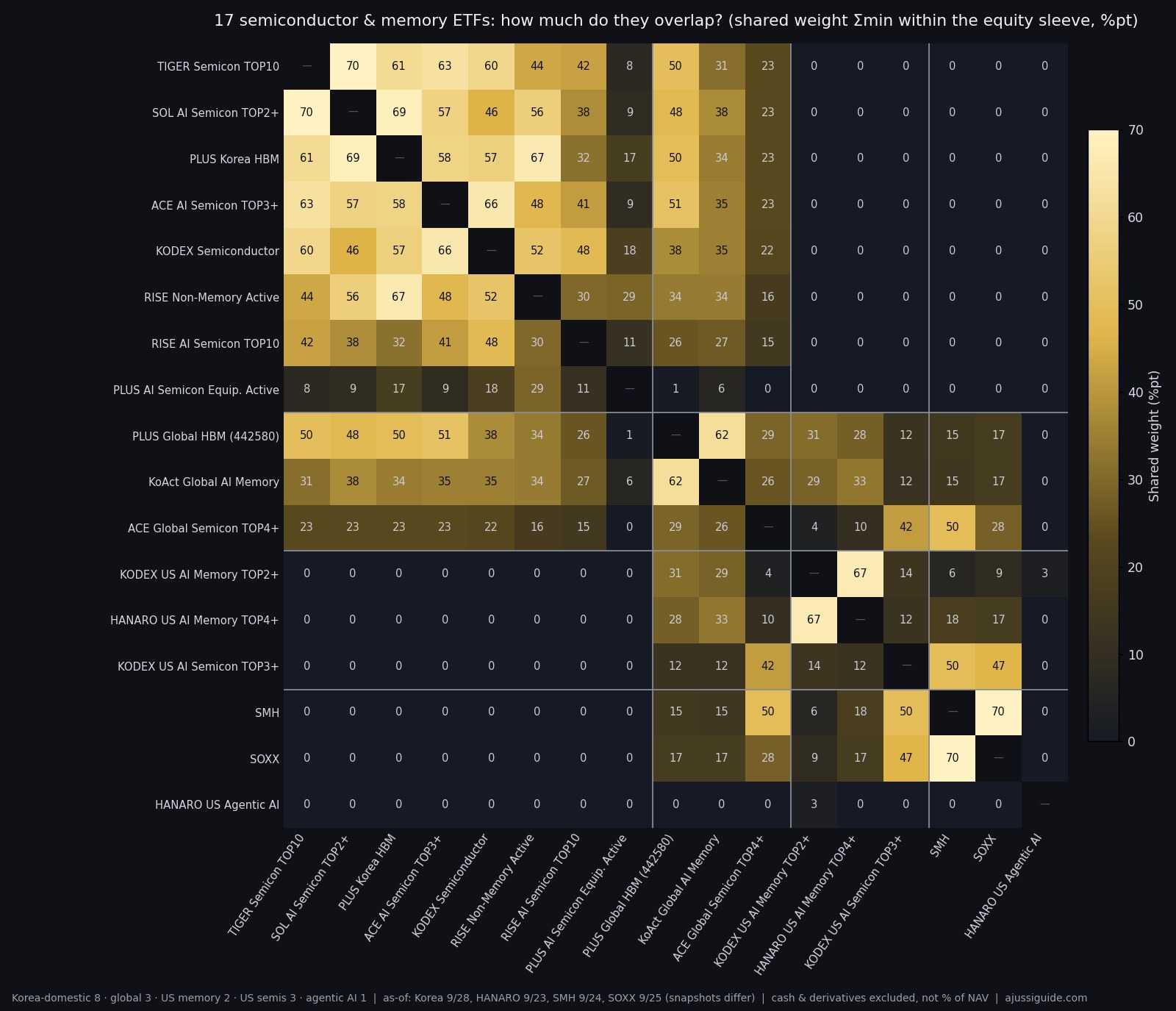
| # | ETF A | ETF B | Shared weight (%pt) | Jaccard (names) |
|---|---|---|---|---|
| 1 | SMH | SOXX | 70.0 | 0.72 |
| 2 | SOL AI Semiconductor TOP2 Plus | TIGER Semiconductor TOP10 | 69.8 | 0.33 |
| 3 | PLUS Korea HBM Semiconductor | SOL AI Semiconductor TOP2 Plus | 68.7 | 0.67 |
| 4 | KODEX US AI Memory TOP2 Plus | HANARO US AI Memory TOP4+ | 67.0 | 0.33 |
| 5 | PLUS Korea HBM Semiconductor | RISE Non-Memory Semiconductor Active | 66.8 | 0.50 |
| 6 | KODEX Semiconductor | ACE AI Semiconductor TOP3+ | 66.0 | 0.58 |
| 7 | TIGER Semiconductor TOP10 | ACE AI Semiconductor TOP3+ | 63.4 | 0.36 |
| 8 | PLUS Global HBM Semiconductor | KoAct Global AI Memory Active | 62.2 | 0.27 |
| 9 | PLUS Korea HBM Semiconductor | TIGER Semiconductor TOP10 | 61.0 | 0.33 |
| 10 | KODEX Semiconductor | TIGER Semiconductor TOP10 | 59.6 | 0.35 |
Reading it is simple. Pick any two Korea-domestic funds and 50 to 70 points overlap. SOL and TIGER share only one name in three, yet 70 points of weight, because the three common names are Samsung, SK hynix and SK Square. Between Korea-domestic and US-oriented funds (KODEX US AI Semiconductor TOP3 Plus, the two US memory funds, SMH, SOXX) the overlap is mostly zero. Only the two global funds, 442580 and KoAct, straddle both sides: 30 to 50 with the domestic group, 28 to 33 with the US group. So if diversification is the goal, one domestic fund plus one US memory fund actually buys different things; two domestic funds buy the same thing twice. Samsung and SK hynix appear in 10 of the 15 Korea-listed funds, followed by Wonik IPS and TES (7 each) and Micron (6).
One more note. HANARO US Agentic AI TOP2+ has AI in its name but is built on Microsoft, Alphabet, Meta and Amazon, so its overlap with the other 16 is effectively zero. It is not a memory fund and is included for reference only. The raw CSV and calculation rules are in the appendix at the end. To pick any two funds and compute the overlap yourself, there is a semiconductor ETF overlap calculator (Korean interface) in the Lab section.
What to check before choosing
First, current holdings of whichever HBM ETF you are looking at. Two of the three are active and the third rebalanced in early August; open the issuer’s holdings file rather than trusting an August snapshot, including this one.
Second, swap exposure. DRAM uses total return swaps for CXMT and part of some other positions, and HBMX also holds a CXMT swap at 3.82%, so counterparty, liquidity, valuation and regulatory variables that come with swaps are not unique to DRAM.
Third, size and liquidity at HBMX. At $27 million and two and a half months old, the fund is small; the issuer’s own premium/discount table shows 22 days at a premium and 16 at a discount since launch. Spreads and closure risk matter more here than the expense ratio.
Risks
Memory is a cyclical industry, every HBM ETF rides that cycle, and 2026 has already shown both sides: HBMX lost 29% in the month to August 25 and 442580 fell about 8% over the same period. Funds concentrated in three manufacturers move with three earnings reports. Funds heavy in equipment names can be sensitive to the memory makers’ capex cycle. Every asset and weight figure here is a dated snapshot and will have changed by the time you read it.
FAQ
Is there an HBM ETF in the U.S.?
There is no U.S. ETF with HBM alone as its mandate. The two unleveraged, non-income memory equity ETFs compared in this post are Roundhill Memory ETF (DRAM, April 2026, 0.65%) and Tuttle Capital Concentrated Memory Stack ETF (HBMX, June 2026, 0.95%); the income-focused DRMP and the 2x leveraged RAM are excluded. Korea’s PLUS Global HBM Semiconductor (442580) is the only fund with HBM in its name and is listed in Seoul.
What does the DRAM ETF hold?
As of August 25, 2026: Micron 25.21%, Samsung 25.12%, SK hynix 22.02%, then CXMT, Seagate, Sandisk, Western Digital, Kioxia, Nanya and Winbond. Twenty-four holdings, no equipment makers in the top ten, $26.18 billion in assets.
Why doesn’t HBMX hold Samsung?
Samsung is not in the August 25 holdings. HBMX excludes securities listed directly on the Korea Exchange and holds SK hynix at 5.05% through its Nasdaq-listed ADR (SKHY). Because the fund may also take exposure through derivatives, the listing rule alone does not settle why Samsung is absent.
How much of 442580 is Samsung?
25.74% as of the August 25 holdings file, with SK hynix at 25.01% and Micron at 24.62%. Ten holdings total.
Which HBM ETF has the lowest expense ratio?
442580 at 0.50%, then DRAM at 0.65% and HBMX at 0.95%. The Korean fund is not tradable on U.S. exchanges, so for U.S. accounts the comparison is DRAM versus HBMX.
How much do Korea-listed semiconductor ETFs overlap with each other?
Using complete holdings as of September 28, 2026, the Korea-domestic funds that hold Samsung and SK hynix share 50 to 70 percentage points of weight with one another: SOL AI Semiconductor TOP2 Plus and TIGER Semiconductor TOP10 at 69.8, PLUS Korea HBM and SOL at 68.7. Between those and the US memory funds (KODEX US AI Memory TOP2 Plus, HANARO US AI Memory TOP4+) the overlap is zero.
Appendix. The same data powers the semiconductor ETF overlap calculator (Korean interface). The raw data behind the September update is semi-etf-holdings-20260928.csv: 18 ETFs, 310 rows, original issuer weights and source URLs. Overlap uses only row_type=stock rows, rescales each fund’s stock weights to sum to 100, then adds the per-stock minimum (shared weight); name Jaccard is |A∩B|/|A∪B|. SK hynix Korean shares versus ADSs, and Samsung common versus preferred, are kept separate at the security level and combined only in the issuer-exposure table. Cash, futures, swaps and money-market positions are excluded.
This article is for informational purposes only. It is not a recommendation to buy or sell any security mentioned, and investment decisions and their outcomes are your own responsibility.
Last verified: 2026-09-28 (September update: 15-fund overlap and big-three exposure added)