
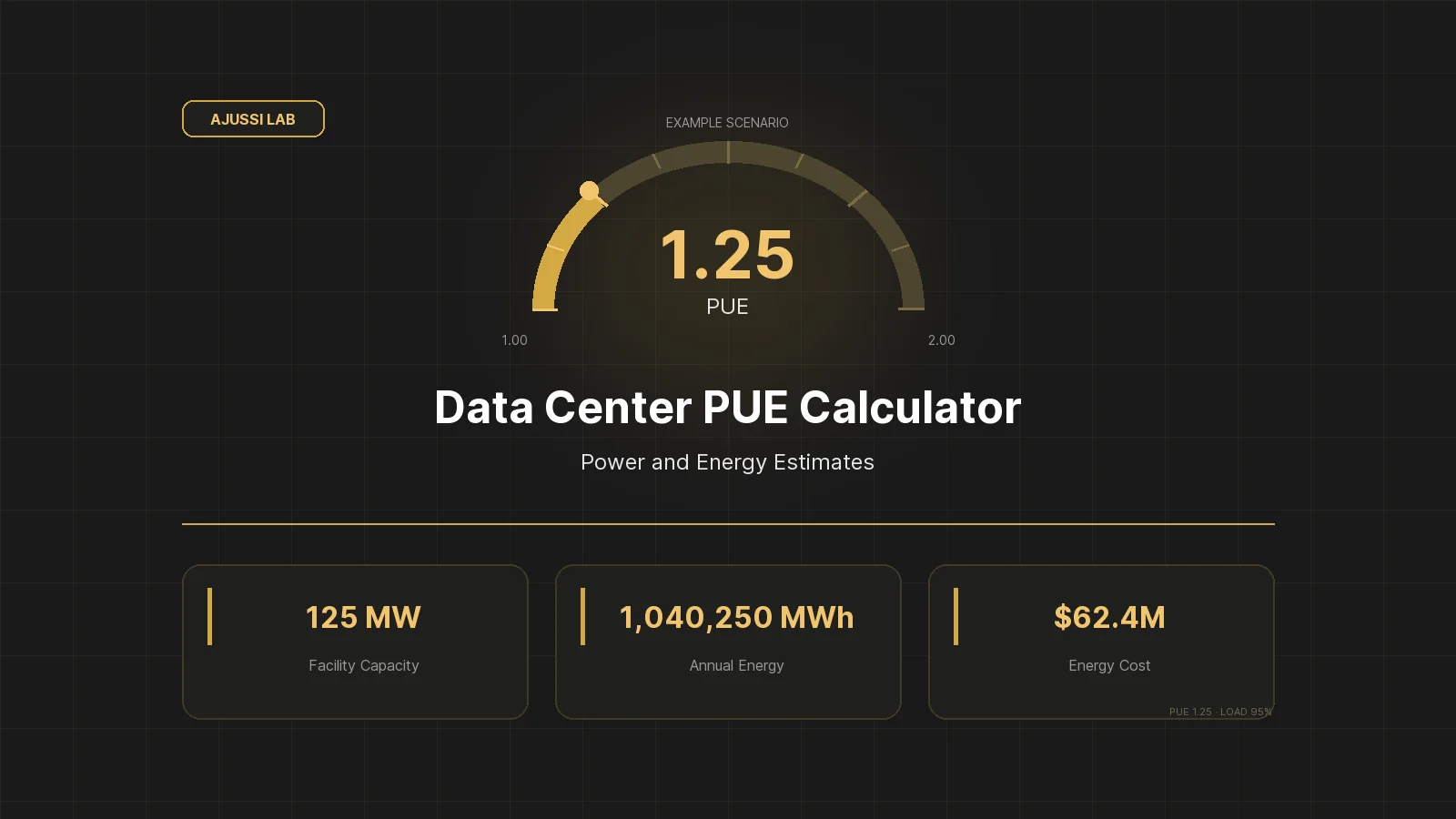
This data center PUE calculator turns an IT load and a PUE target into the facility-level numbers that downstream infrastructure has to support: total site power, the non-IT overhead, annual energy consumption and an energy-only cost estimate. It runs entirely in your browser with no data sent to any server.
There are two modes. Plan from IT load takes your IT capacity, a target PUE and an average IT load factor, then works out what the facility requires. Calculate measured PUE takes total facility energy and IT equipment energy you already have and returns the resulting PUE, non-IT consumption and overhead percentage.
What to enter
Plan from IT load asks for four inputs. IT load is the rated capacity of the IT equipment in kW, MW or GW. Planned PUE is the facility-efficiency scenario you want to test. The data center PUE calculator accepts values from 1.00 to 5.00.
Average IT load factor is the fraction of that rated IT capacity that actually draws power, expressed as a percentage. Energy price is optional: enter a per-kWh rate in any currency and the calculator will estimate an annual energy charge.
If you are not sure where to start, click “Load example: 100 MW AI campus” to fill the form with a representative scenario.
Calculate measured PUE asks for two energy readings in the same period: the total energy consumed by the entire facility and the energy consumed by IT equipment alone. Both accept kWh, MWh, GWh or TWh. The calculator divides facility energy by IT energy to produce the measured PUE.
Reading the results
Facility capacity (full IT load) is the total site power capacity when all IT draws its rated load, including IT and all supporting systems. Non-IT capacity (full IT load) is the difference: cooling, power distribution, lighting, security and everything else the facility runs besides the computing hardware itself.
Annual facility energy converts the power figure into a full-year energy consumption at the entered IT load factor. Annual energy charge multiplies that energy by the per-kWh price you entered; it covers energy consumption only, not the full utility bill.
In measured-PUE mode this data center PUE calculator shows simpler results. Calculated PUE is the ratio of facility energy to IT energy. Non-IT energy is the absolute amount of energy the supporting systems consumed. Energy overhead shows that non-IT portion as a percentage of IT energy.
Example
A 100 MW AI campus targeting PUE 1.25 with a 95% average IT load factor requires 125 MW of facility capacity at full IT load. Its average IT demand is 95 MW, average facility demand is 118.75 MW, and average non-IT demand is 23.75 MW. Over a year, that equals about 1,040,250 MWh of facility energy.
At $0.06 per kWh, the energy-only cost would be about $62.4 million. The actual bill may differ and can be higher once demand charges, capacity fees, transmission, taxes and contract terms are applied.
How this data center PUE calculator works
PUE, or Power Usage Effectiveness, is defined as total facility energy divided by IT equipment energy. It is specified in ISO/IEC 30134-2 and used by ENERGY STAR as the standard data-center energy-efficiency metric.
A PUE of 1.00 is the theoretical lower bound. It would mean every watt entering the building powers IT equipment with zero overhead. Real facilities always exceed 1.00 because cooling, power distribution, lighting and physical security also consume energy.
The Uptime Institute’s 2024 global survey reported an industry average PUE of 1.56. More recent Uptime Institute analysis puts the figure at 1.52, a number that has drifted only slowly since 2020. New and increasingly large facilities with modern power and cooling systems routinely report PUEs of 1.3 or lower.
Hyperscale operators have published lower figures in recent sustainability reports: Google 1.09 (2025), AWS 1.14 (2025), Microsoft 1.17 (FY 2025). Each company’s measurement boundary and regional mix differs, so direct ranking comparisons across operators are not meaningful.
Planning mode assumes the entered PUE stays constant across the selected IT load factor. In practice, PUE often worsens at partial load because cooling towers, chillers and UPS systems do not scale down in perfect proportion to IT demand. The estimate is most accurate near the load factor the PUE target was designed for.
The energy-cost result covers the energy-usage charge only. Actual utility bills typically add demand charges (billed on peak power draw, not energy), transmission and distribution charges, capacity fees, power-factor penalties, taxes and contract-specific surcharges. This data center PUE calculator does not include any of these.
This calculator is a scenario-estimation tool. It does not measure real-time power, does not predict utility bills with billing-grade accuracy and is not a substitute for engineering design or utility tariff analysis.
FAQ
What is a good PUE target for a new data center?
There is no single PUE target that applies to all new data centers. Recent Uptime Institute analysis shows that new and increasingly large facilities with modern power and cooling systems routinely report PUEs of 1.3 or lower. In this data center PUE calculator, try 1.30 as a baseline for a new build and compare against 1.20 and 1.10 to see the impact of more aggressive efficiency targets. Always confirm the measurement boundary and reporting period when comparing PUE figures across sites.
Why does the calculator not include demand charges?
Demand charges are billed on the highest power draw in a billing period, not on total energy consumed. They depend on the utility’s rate structure, the facility’s load profile and contract terms that vary by geography and customer class. Including them would require inputs this calculator does not ask for.
Can I use this for a single server rack?
A rough scenario calculation is possible at any scale, but the result should not be interpreted as the rack’s own PUE. PUE is a facility-boundary metric that includes shared cooling and power distribution infrastructure. Attributing facility overhead to a specific rack requires additional assumptions this calculator does not make.
Does IT load factor mean the same thing as server CPU load?
No. Here, average IT load factor means average IT power draw divided by the entered IT capacity. A powered-on idle server contributes only its actual electrical draw, not its full rated capacity. If your facility has 100 MW of installed IT capacity and 80 MW is drawing power, the IT load factor is 80%.
Why does PUE get worse at partial load?
Many supporting systems, especially cooling towers, chillers and UPS units, have a fixed energy floor regardless of IT load. When IT demand drops, that fixed overhead becomes a larger share of total facility energy, pushing PUE up. This is why the calculator includes a notice about partial-load behavior.
Sources
PUE is defined in ISO/IEC 30134-2:2026 (Data centres key performance indicators, Part 2: Power usage effectiveness). ENERGY STAR uses PUE as the primary efficiency metric for its data-center certification program. Industry average PUE and facility-size analysis are from the Uptime Institute 2024 Global Data Center Survey and related Uptime Institute analysis. Hyperscaler PUE figures are from each company’s sustainability reporting: Google, AWS, Microsoft.
Disclaimer
This data center PUE calculator provides scenario estimates for informational purposes only. It is not engineering design advice, not a utility bill projection and not a substitute for professional power or energy analysis. Actual facility performance depends on equipment selection, climate, load profile, cooling architecture and utility tariff structure. Do your own due diligence.
Related
See also: Hyperscaler Capex Tracker for the spending that drives these builds, Market Desk for rates and indexes, and our deep dive on data-center electricity demand and utility stocks.