When it comes to Arista vs Cisco AI networking stocks, the short answer for 2026 is this: Arista Networks offers the more concentrated exposure to cloud and AI networking spending, while Cisco Systems offers broader diversification but slower AI-driven revenue growth. Both are real businesses with real moats. The question is not which company is better in general, but which kind of exposure fits a given portfolio, risk tolerance, and time horizon. I will compare the two exposures and how I read each one.
Why AI Networking Became the Hottest Infrastructure Trade
GPU clusters do not run on goodwill. Every AI training job moves enormous amounts of data between thousands of accelerators, and the network fabric carrying that data has become a serious capital expenditure line item for hyperscalers. Ethernet-based spine-and-leaf switching has become a major and growing option for AI scale-out fabrics, partly because it is open, partly because the silicon has caught up to the bandwidth requirements.
AI clusters have sharply increased the cost and strategic importance of back-end networking, although hyperscalers generally do not break out network switching as a separate capex category; our Hyperscaler Capex Tracker follows the budgets that fund it. That is the macro tailwind behind the entire Arista vs Cisco AI networking stocks conversation.
The companies that make the switches, the ASICs, and the software running those fabrics are direct beneficiaries. Arista and Cisco are the two publicly traded pure-infrastructure names most investors reach for first. For the wider field beyond these two, our AI networking stocks guide covers the supporting cast.
How AI Infrastructure Actually Selects a Network Vendor
Hyperscalers do not pick a switch vendor the way a small business picks a router. The evaluation process starts at the silicon layer, moves through software programmability, and only then considers vendor relationship and price. The switching ASIC matters because it determines buffer size, latency, and the ability to handle the bursty traffic patterns that AI workloads produce.
Software is the second lock-in point. Arista’s EOS operating system is known for its single-image consistency across the entire product line, which simplifies automation at scale. Cisco’s IOS-XE and NX-OS are deeply embedded in enterprise environments, but hyperscalers have historically preferred Arista’s programmability story.
Once a vendor wins a cluster design, the relationship tends to be sticky. Ripping out a switching fabric mid-program is expensive and risky. This is why the initial design win matters so much, and why both companies invest heavily in early engagement with hyperscaler network architects.
Arista Networks: The More Concentrated Cloud and AI Networking Bet
Arista’s business is centered on data center and cloud networking, with campus, routing and software businesses built around that core. It does not sell collaboration tools or a broad enterprise security portfolio the way Cisco does. That focus is its biggest strength and its biggest risk at the same time.
The company’s revenue from cloud titan customers, a customer group it discusses on every earnings call, has grown sharply as AI cluster builds have accelerated. Arista’s 400G and 800G Ethernet switching platforms are the products showing up in the AI fabric designs that matter most right now. The transition toward even higher port speeds keeps the upgrade cycle moving.
The risk side is real. Arista’s top customers represent a large share of total revenue. If a single hyperscaler pauses its AI buildout for a quarter, Arista feels it immediately in the numbers. That concentration risk is the main thing I watch in every earnings call.
Arista’s Competitive Position in AI Fabrics
Arista has made a deliberate bet on Ethernet as the fabric for AI scale-out networks. Several hyperscalers have published reference architectures built on standard Ethernet, which supports that bet, while InfiniBand and proprietary scale-up interconnects remain important in performance-sensitive deployments. The direction has been favorable for Arista, but calling the debate settled would be premature.
Arista’s relationships with its merchant-silicon partners, combined with its EOS software and system-level engineering, give it flexibility to stay competitive as bandwidth requirements increase. Arista also benefits from a large installed base of operators who already know EOS, which lowers the training cost of adding AI fabric nodes to existing data centers.
Cisco Systems: The Diversified Incumbent
Cisco is a different kind of bet. It earns revenue across enterprise networking, security, collaboration, and observability. AI networking is a meaningful and growing part of the story, but it is not the whole story the way it is for Arista.
Cisco’s AI infrastructure play in 2026 runs through its data center switching portfolio and its Silicon One ASIC program. Silicon One is Cisco’s attempt to build a single programmable silicon architecture that spans routing and switching, from the edge to the hyperscale core. It is an ambitious program and the early wins in large-scale deployments have been real.
The enterprise refresh cycle is Cisco’s other lever. As enterprises start building their own private AI infrastructure, Cisco’s existing relationships in IT departments give it a distribution advantage that Arista does not have at the same scale.
Cisco’s Software and Security Overlay
Cisco has been deliberately shifting toward software and subscription revenue for several years. This matters for investors because software revenue is higher margin and more predictable than hardware revenue. A networking vendor that sells you the switch and then charges annually for the management platform is a fundamentally better business model than one that only earns on hardware refreshes.
The security business, anchored by the Splunk acquisition completed in 2024, gives Cisco a data and AI security angle that Arista simply does not have. For investors who want AI infrastructure exposure with a risk-management layer underneath, this is worth considering.
Arista vs Cisco AI Networking Stocks: The Core Strategic Difference
The clearest way I frame Arista vs Cisco AI networking stocks is this: Arista is a concentrated bet on one outcome, Cisco is a diversified bet on several outcomes. Neither is wrong. They serve different portfolio functions.
Arista wins bigger if Ethernet-based AI fabrics continue to take share and hyperscaler capex stays elevated. Cisco’s path looks steadier on paper if enterprise AI buildouts accelerate and its subscription mix keeps growing, though neither outcome is guaranteed. The scenarios are not mutually exclusive, but the stock behavior in a downturn will be very different.
| Dimension | Arista Networks | Cisco Systems |
|---|---|---|
| Primary AI exposure | Hyperscaler AI fabric switching | Hyperscaler + enterprise AI networking |
| Revenue diversity | Concentrated in data center networking | Broad: networking, security, collaboration |
| Key silicon strategy | Merchant silicon + partner ecosystem | Proprietary Silicon One ASIC program |
| Software revenue mix | Growing but hardware-led | Significant and growing subscription base |
| Customer concentration risk | High: top cloud titans are large share | Lower: spread across enterprise and cloud |
| Upside scenario | Ethernet wins AI fabric wars decisively | Enterprise AI refresh accelerates broadly |
| Downside scenario | Hyperscaler pause hits revenue hard | Enterprise cycle stays slow, security growth disappoints |
What the Latest Earnings Actually Showed (August 2026)
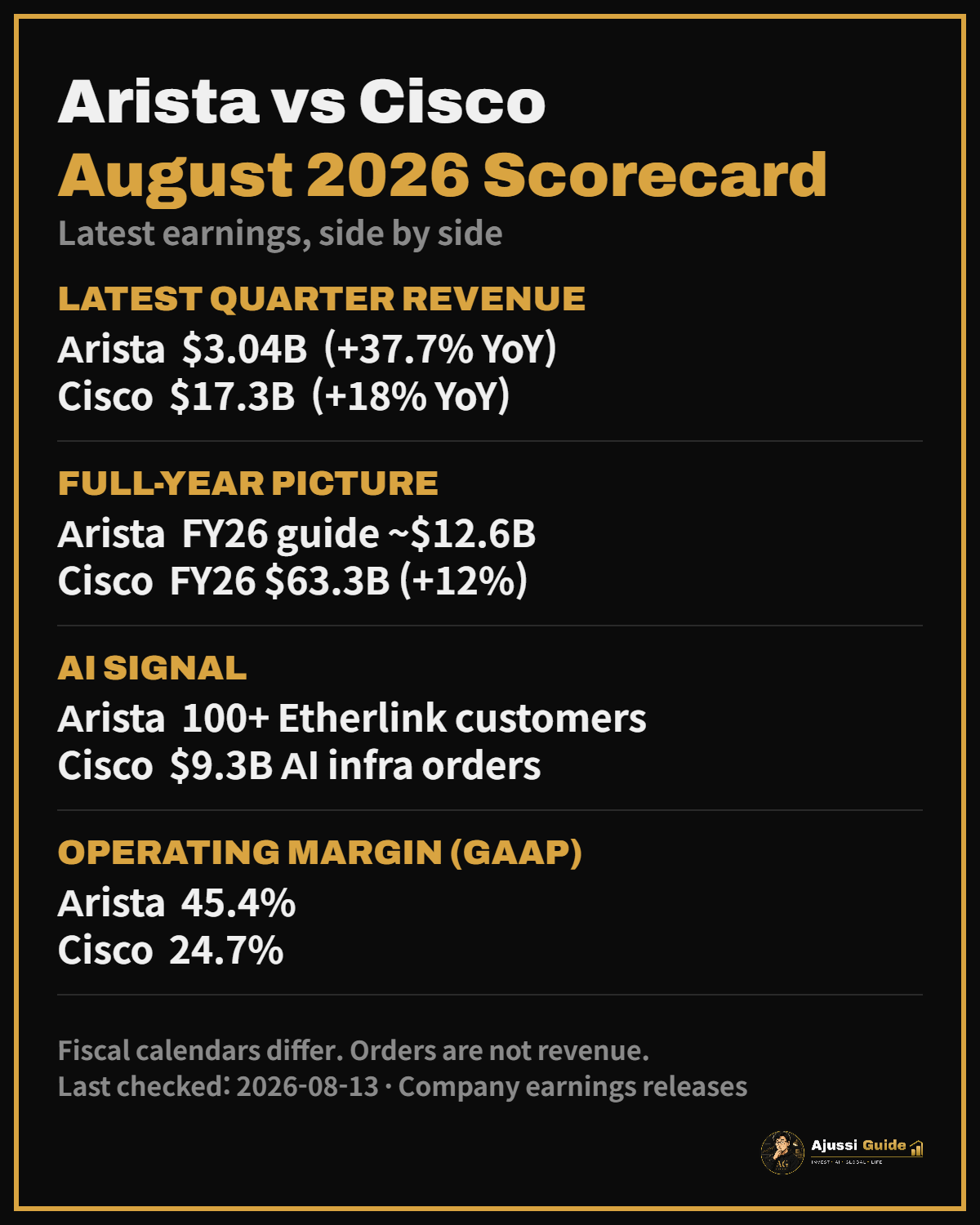
Both companies reported within the last two weeks, so the freshest numbers are worth pinning down before any qualitative argument. Arista reported its June quarter on August 4 and Cisco closed its fiscal year 2026 with results on August 12.
| Metric (latest report) | Arista Networks | Cisco Systems |
|---|---|---|
| Latest quarter revenue | $3.04B, up 37.7% YoY (Q2 CY2026) | $17.3B, up 18% YoY (FQ4 FY2026) |
| Full-year picture | FY2026 revenue guidance raised to about $12.6B (~40% growth) | FY2026 revenue $63.3B, up 12%; FY2027 guidance $72.2B to $73.4B (midpoint $72.8B) |
| AI-specific signal | More than 100 cumulative 800G Etherlink customers, a milestone previously disclosed by management; 7060XE7 1.6 Tbps platforms announced, with initial availability expected in Q4 2026 | AI infrastructure orders $9.3B in FY2026; AI revenue about $4B in FY2026, with $7.5B expected in FY2027 |
| Operating margin (latest quarter) | GAAP 45.4%; non-GAAP 49.9% | GAAP 24.7%; non-GAAP 35.9% |
| Business momentum | Q3 revenue guidance of roughly $3.3B | Networking revenue $9.79B, up 28% in FQ4 |
Two cautions when reading that table. The fiscal calendars do not line up: Arista reports on calendar quarters while Cisco’s fiscal year ends in late July, so the growth rates cover different windows. And orders are not revenue: Cisco’s $9.3 billion in AI infrastructure orders is a demand signal, while its recognized AI revenue for fiscal 2026 was roughly $4 billion. Figures come from each company’s earnings releases and conference-call commentary. Last checked: 2026-08-13.
What I Watch Each Quarter Instead of Picking a Winner
I do not treat these as an either-or verdict, and nothing here is a recommendation to weight one over the other. They are simply different exposures: Arista’s results are driven mainly by data center and AI fabric spending, while Cisco’s results blend enterprise networking, security and software with its newer AI infrastructure business. How much of either kind of exposure belongs in a portfolio, if any, is a personal decision that depends on your goals and risk tolerance.
What I actually monitor each quarter: Arista’s disclosed customer concentration, management’s cloud and AI commentary and the gross margin trend, and Cisco’s Silicon One design win announcements plus its software ARR growth. Those are the two signals that tell me whether the thesis for each name is intact or deteriorating.
I also watch the port speed transition closely. The move from 400G to 800G to 1.6T is not just a product refresh, it is a pricing and margin event. Higher-speed transitions create revenue opportunities for both companies, but pricing, product mix and the declining price per bit determine the actual margin effect.
Primary Source for Your Own Research
Before you make any decision, read the actual filings. Both companies file 10-K and 10-Q reports with the SEC. You can access them directly at the SEC EDGAR full-text search system, or start from each company’s investor relations site: Arista IR and Cisco IR. Cisco’s product-category revenue, Arista’s customer-concentration and business-mix disclosures, and the management discussion sections are where the real information lives, not in press releases.
The same filings, read side by side across eight networking companies rather than two, are laid out in the networking stocks guide.
Frequently Asked Questions
Is Arista or Cisco better for AI networking exposure in 2026?
Arista offers more concentrated AI networking exposure because most of its revenue comes from data center and cloud networking, though it is not a pure-play AI company. Cisco offers broader exposure that includes enterprise, security, and collaboration. Neither is objectively better: they are different kinds of exposure, and which one fits a given portfolio is a personal decision that depends on goals and risk tolerance, not something an article can decide for you.
What is the biggest risk with Arista stock right now?
Customer concentration is the primary risk. A small number of hyperscaler customers represent a large share of Arista’s revenue. If any one of those customers pauses or slows its AI infrastructure build, Arista’s quarterly results can miss expectations sharply. This is not a theoretical risk; it has caused volatile earnings reactions in past cycles.
Does Cisco have a serious AI networking product in 2026?
Yes. Cisco’s Silicon One ASIC program is a real competitive effort in high-performance switching for AI fabrics. Cisco has announced design wins in large-scale deployments. It is not purely a legacy enterprise play. However, AI networking remains a smaller share of Cisco’s total revenue compared to Arista, where cloud and AI networking make up a much larger share of the business.
How do Arista vs Cisco AI networking stocks perform during a capex slowdown?
Arista typically shows more volatility during hyperscaler capex slowdowns because of its concentration in that customer segment. Cisco tends to be more resilient because enterprise networking, security subscriptions, and collaboration revenue provide a buffer. In a broad tech downturn, Cisco’s broader revenue mix may provide some business-level cushioning, but neither company’s stock downside is limited or guaranteed by that mix.
What should I actually read before investing in either stock?
Read the most recent 10-K and 10-Q filings on SEC EDGAR for both companies. Pay attention to segment revenue breakdowns, customer concentration disclosures, and the management discussion of competitive dynamics. Also listen to earnings call transcripts, which are available free through both companies’ investor relations pages. Primary sources beat analyst summaries every time.
Is Ethernet really winning the AI fabric debate over proprietary interconnects?
The evidence in 2026 leans toward Ethernet gaining ground, particularly as hyperscalers publish reference architectures using standard Ethernet switching. Proprietary interconnects like InfiniBand still have a strong position in certain high-performance computing environments. The scale economics of Ethernet and its open ecosystem are expanding the market where Arista and Cisco compete, though a growing Ethernet market does not automatically translate into wins for either vendor.
Can I hold both Arista and Cisco at the same time?
There is no rule against it, and the two companies do have different risk profiles and return drivers. Holding both gives you exposure to hyperscaler AI spending through Arista and enterprise AI networking plus software growth through Cisco. Keep in mind that both can still fall together when sentiment on AI capex turns, so owning both is not automatic diversification, and whether either belongs in a portfolio is a personal decision. To see how much of a portfolio sits on that shared exposure, run it through the AI infrastructure exposure checker.
What is Silicon One and why does it matter for Cisco’s AI story?
Silicon One is Cisco’s proprietary programmable ASIC designed to run across its entire routing and switching portfolio from edge to hyperscale core. It matters because it gives Cisco greater control over architecture and hardware-software integration. Design wins using Silicon One in AI data center deployments are a key indicator of whether Cisco can compete directly with Arista in the hyperscaler segment.
Last verified: 2026-08-13. Company business descriptions reflect publicly available information as of this date.
This post is for informational purposes only. It is not investment advice and does not constitute a buy or sell recommendation for any security. All investment decisions are yours alone, and you carry the full responsibility for any outcome.