Searches for co-packaged optics stocks, or CPO stocks, have jumped this year, and the trade has a very particular shape: everyone agrees the technology is coming, and the entire fight is about when. CPO moves the optical components that link AI systems out of pluggable modules and into the same package as the switch silicon itself. That single packaging decision decides who in the optical supply chain keeps selling what they sell today, and on what schedule. This post lays out what CPO actually is, which companies claim it in their own filings and product pages, what NVIDIA has and has not said, and why the timing question is where the money is won or lost.
What Co-Packaged Optics Actually Changes
Today, most optical connections in a data center terminate in pluggable transceiver modules: small, swappable units that slot into the faceplate of a switch. Co-packaged optics integrates those optical engines directly beside the switch chip, inside the same package. The point is physics: shorter electrical paths between the switch silicon and the optics can reduce signal loss and I/O power while supporting higher bandwidth density, which matters enormously as AI clusters scale.
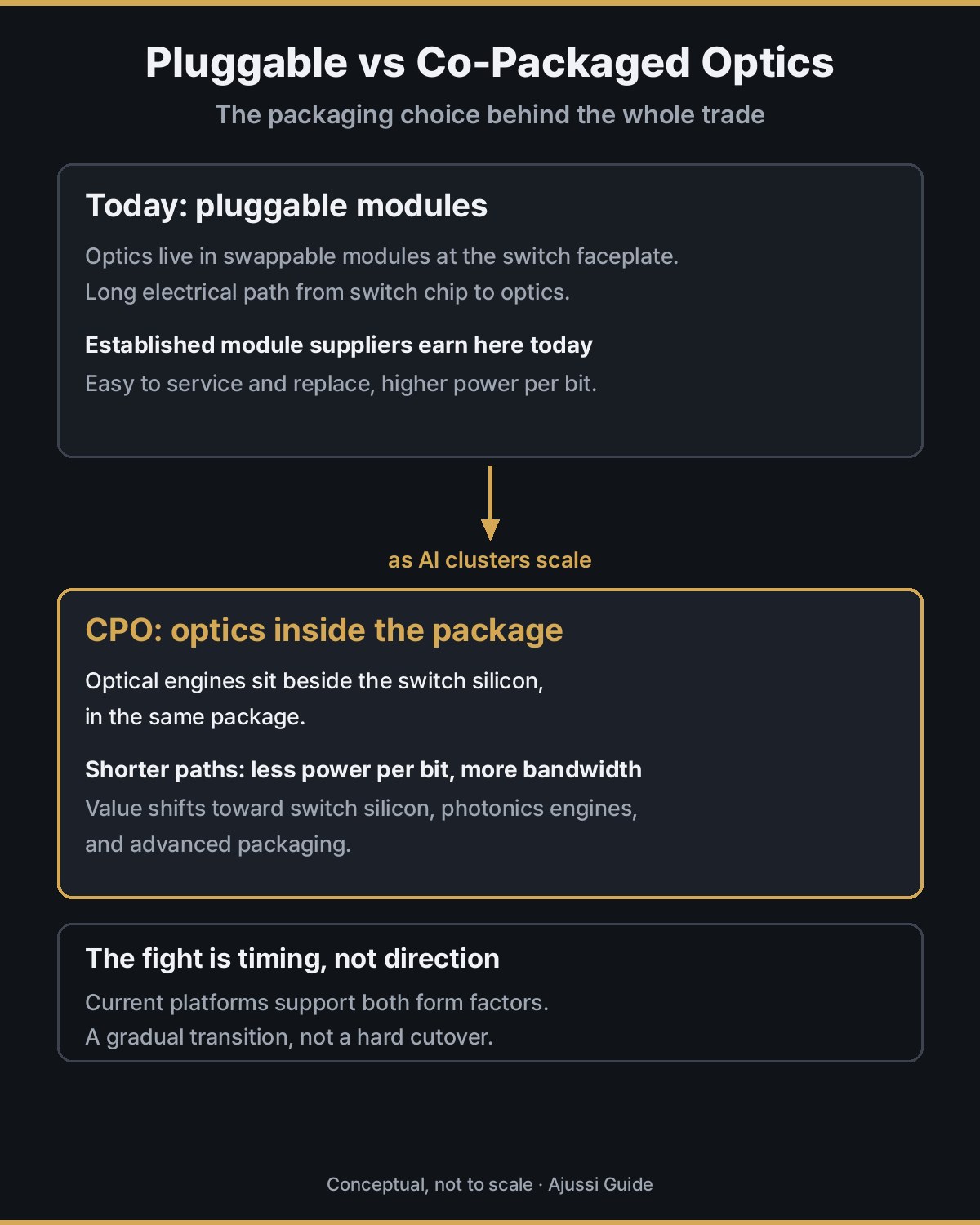
The investment consequence is just as structural. Pluggable modules are a large, established market with their own suppliers. If CPO ramps, part of that value shifts from module vendors toward the companies that own the switch silicon, the silicon photonics engines, and the advanced packaging. That is why the same headline can be good news for one optical company and a threat to another.
Who Claims CPO, in Their Own Words
I prefer claims a company makes in its own filings and product pages over lists compiled by third parties, and on that standard the CPO roster looks like this.
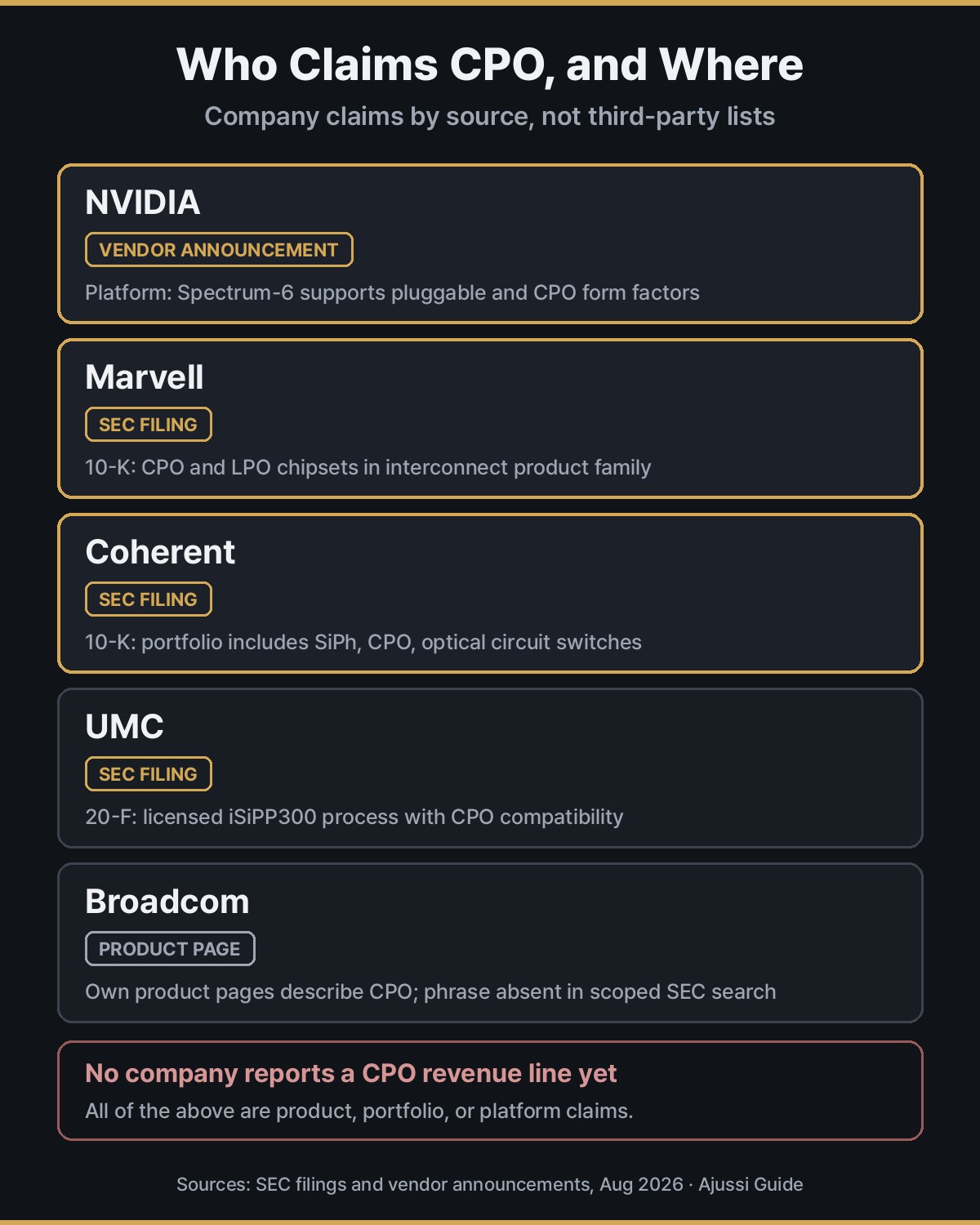
Marvell (MRVL) lists CPO and LPO chipsets inside its interconnect product family in its 10-K, alongside PAM DSPs, laser drivers, and silicon photonics, which it also names among its own intellectual property. Coherent (COHR) states in its fiscal 2026 10-K that its portfolio includes silicon photonics, CPO, and optical circuit switches supporting AI datacenter architectures. Broadcom (AVGO) describes its CPO technology on its own product pages as an integration of optics and silicon built on silicon photonics, even though the exact phrase silicon photonics did not appear in my scoped SEC filing search of the company, a gap I read as a difference in disclosure channels rather than an absence of business. On the manufacturing side, UMC’s 20-F discloses a licensing agreement for imec’s iSiPP300 silicon photonics process with CPO compatibility, intended to bring a 12-inch platform to market.
Two things are worth noticing about that list. First, it is the same cast as the broader silicon photonics story, which I mapped filing by filing in my photonics stocks evidence guide: CPO is not a separate industry, it is the packaging step of the same transition. Second, none of these disclosures is a CPO revenue line. They are product, portfolio, and platform claims, which is exactly the stage this market is at.
What NVIDIA Has Actually Said
NVIDIA sits at the center of the CPO debate because its platforms set the pace for everyone else. Here is what its own announcements establish. In August 2026, NVIDIA introduced its Spectrum-6 Ethernet switch as part of the Vera Rubin platform and stated that Spectrum-6 supports both pluggable and co-packaged optics form factors. Earlier, in May 2026, NVIDIA and Corning (GLW) announced a multiyear partnership under which Corning will expand its US optical connectivity manufacturing capacity roughly tenfold with three new plants.
Read the Spectrum-6 wording carefully, because it is the most informative sentence in this whole trade: both form factors. NVIDIA is not flipping a switch from pluggables to CPO; it is shipping a platform that can take either. That is what a transition actually looks like from the inside, and it is why absolutist takes in either direction, CPO is here or CPO is years away, tend to be wrong about the same announcement.
The Timing Fight Is the Whole Trade
In June 2026, a research report questioning the CPO rollout timeline was widely cited during a sharp one-day selloff in optical networking stocks, with module-linked names leading the decline. Subsequent reports quoted an NVIDIA networking executive as saying its CPO delivery schedule remained on track, though I could not independently review the original research note or a primary-source NVIDIA rebuttal. I am not in a position to referee that dispute, and neither is most of the market, which is precisely the point: prices in this group are moving on rollout-schedule beliefs, not on reported CPO revenue, because reported CPO revenue barely exists yet in anyone’s disclosures.
For an investor, that reframes the question. Instead of asking which co-packaged optics stocks are best, ask which companies win in each timing scenario. If CPO ramps fast, the advantage tilts toward switch-silicon and photonics-engine owners and the foundries packaging them. If pluggables persist longer than expected, the incumbent module suppliers keep earning through the transition, and companies positioned in both camps, which several of the names above are, carry the least schedule risk. The schedule is the bet.
How I Track CPO Claims Without Guessing
My method here is the same one I used for the photonics survey: exact-phrase searches on SEC EDGAR, then reading the actual sentence in context, then separating product claims from money claims. Co-packaged optics stocks are still early in disclosure terms: CPO shows up today mostly as product-family and portfolio language in filings, supplier announcements, and platform support statements from NVIDIA. What it does not yet show up as, anywhere I have read, is a separately disclosed revenue line. When that changes, in a 10-K rather than a press release, that will be the single most important signal this theme has produced.
Until then, the practical checklist is short: watch whether platform announcements name CPO as the default rather than an option, watch whether module makers start disclosing CPO-related design wins of their own, and watch the foundry side, where capacity claims like UMC’s platform licensing and Tower’s photonics capacity reservations show whether the manufacturing base is being booked ahead of demand.
Frequently Asked Questions
What are CPO stocks?
In the AI infrastructure context, CPO stocks are companies exposed to co-packaged optics: the integration of optical engines into the same package as switch silicon. The group spans switch and interconnect silicon vendors, optical component makers, silicon photonics platform owners, and the foundries and packagers that build the parts.
Does CPO also mean crude palm oil?
Yes, and it confuses stock screens. CPO is a long-standing abbreviation for crude palm oil in commodity markets, and CPO also appears as an unrelated stock ticker, such as Culpeo Minerals, which currently trades under CPO on the ASX. If you search the bare acronym, expect palm oil futures and unrelated quote pages mixed into the results; co-packaged optics is the meaning this article covers.
Which co-packaged optics stocks are the best buys?
I do not rank buys. What the disclosures support is a map: who claims CPO products and IP in their own filings, who supplies the manufacturing base, and who carries module-replacement risk on the other side. Because this trade is priced on rollout timing rather than reported revenue, any confident ranking is really a confident schedule prediction in disguise.
Is there a co-packaged optics ETF?
As of August 24, 2026, I had not found a dedicated CPO-only ETF, and given how young the theme is, most fund exposure comes through broader optical networking, semiconductor, or AI infrastructure funds. Check current listings yourself before assuming a themed product exists, and read what it actually holds if one does.
How is CPO different from silicon photonics?
Silicon photonics is the chip technology: optical functions built on silicon. CPO is a packaging architecture that uses it: placing those optical engines inside the switch package instead of in pluggable modules. A company can do silicon photonics without CPO, and CPO depends on silicon photonics to work at scale.
Did the CPO rollout get delayed?
That is disputed, and the dispute itself coincided with a sharp selloff in optical networking stocks in June 2026. What the primary record shows is narrower: NVIDIA’s current platform supports both pluggable and co-packaged optics, which is consistent with a gradual transition rather than a hard cutover. Treat any confident delay or acceleration claim as an opinion about an undisclosed schedule.
How can I verify CPO claims myself?
Start with the company’s own documents: annual reports on SEC EDGAR for product and IP claims, and vendor announcements for platform support. Check whether a sentence describes the company’s own product or its market, and whether any number attached is revenue, a plan, or a partnership. The gap between press-release language and filing language is where most bad takes in this theme are born.
Last verified: 2026-08-24. Company claims reflect filings on SEC EDGAR and vendor announcements available as of that date, including NVIDIA’s Spectrum-6 and Corning partnership announcements. Verify all claims against primary documents before making any decision.
This is information, not investment advice. I am not recommending buying or selling any security. All investment decisions carry risk and are entirely your own responsibility.