For where these custom programs sit in the wider industry, and how design, foundry, memory and equipment differ in what they disclose about AI, see Semiconductor Stocks.
Every few months a headline says custom silicon is about to end NVIDIA’s run. The claim is not invented. Hyperscalers really are designing their own accelerators, and Broadcom, the partner with the largest disclosed AI semiconductor line, grew that reported line faster year over year than NVIDIA grew Data Center in a comparable quarter. But custom AI chips vs NVIDIA is a comparison people keep making with adjectives instead of numbers, and the numbers say something more specific than “the king is falling.”
The short answer: custom chips have not already won. Broadcom’s reported AI semiconductor line grew faster year over year, while NVIDIA’s Data Center revenue stayed roughly seven times larger, and the two figures do not measure the same scope.
This page lays out the structure underneath the custom AI chips vs NVIDIA headline: how big each side actually is, what the reported numbers do and do not contain, why hyperscalers buy both, and where the money splits inside the supply chain. Figures live in one table near the bottom with a checked date, so the structure here should still read correctly after the next earnings round changes the digits.
Custom AI chips vs NVIDIA starts with one number
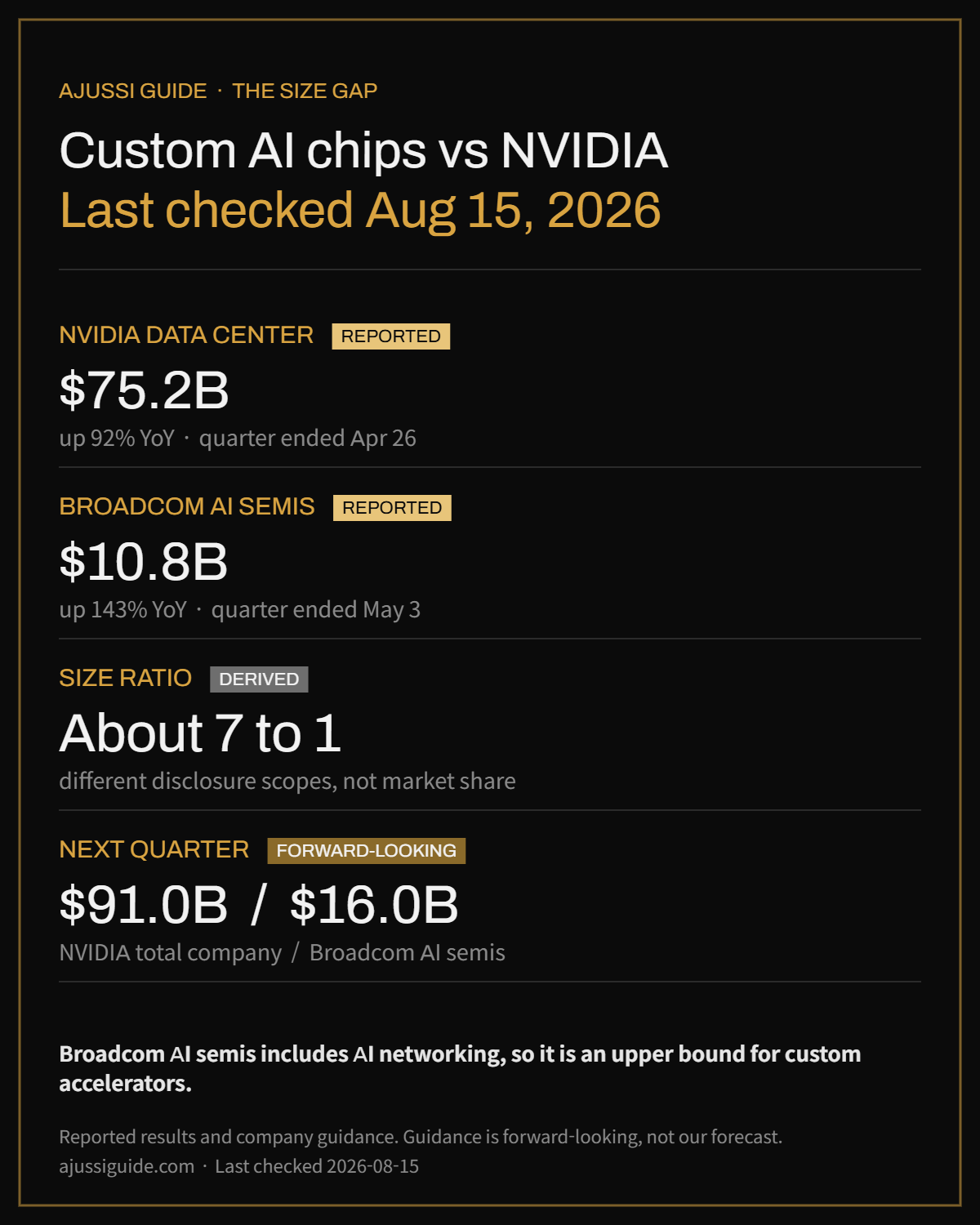
NVIDIA reported Data Center revenue of $75.2 billion in the quarter ended April 26, 2026, up 92% from a year earlier. Broadcom, a major custom accelerator partner, reported $10.8 billion of AI semiconductor revenue in the quarter ended May 3, 2026, up 143%.
Those two quarters end one week apart. On that basis one reported line is about seven times the other, though the two are not the same scope: NVIDIA reports a full Data Center segment while Broadcom reports AI semiconductors. Growth ran the other way, with the smaller line growing faster year over year in that quarter, and Broadcom guided the following quarter to $16.0 billion.
So both statements are true at once. Broadcom’s reported AI semiconductor line grew faster, and that line is still a fraction of the incumbent’s reported quarter. Neither figure is a market share number, because the two disclosures cover different scopes. Most coverage picks one of those facts and drops the other.
What “AI revenue” actually contains
Broadcom reports a line called AI semiconductor revenue. It is not a custom-accelerator line. The company attributes it to both custom AI accelerators and AI networking, and Broadcom is also a major supplier of the Ethernet switching silicon that connects those accelerators to each other.
That matters for anyone building a custom AI chips vs NVIDIA thesis on the custom side specifically. Part of the growth in that line is the networking layer, which competes with a different set of companies and follows different economics. If you want to size custom accelerators on their own, the reported figure is an upper bound, not the number itself. We keep the two apart in our networking comparison for the same reason.
NVIDIA’s Data Center line also includes networking, since the company sells the interconnect around its GPUs. The disclosure differs, though. For the quarter, NVIDIA separated Data Center compute revenue of $60.4 billion from Data Center networking revenue of $14.8 billion under its prior sub-market reporting. Broadcom did not separate custom accelerators from AI networking. So on the custom side there is still no way for an outsider to size accelerators alone. The lesson is the same either way. Segment labels are drawn for reporting convenience, not for the comparison you happen to be making.
Why hyperscalers buy both instead of choosing
The custom AI chips vs NVIDIA choice is not binary. The two designs answer different questions, which is why the largest buyers run both rather than switching.
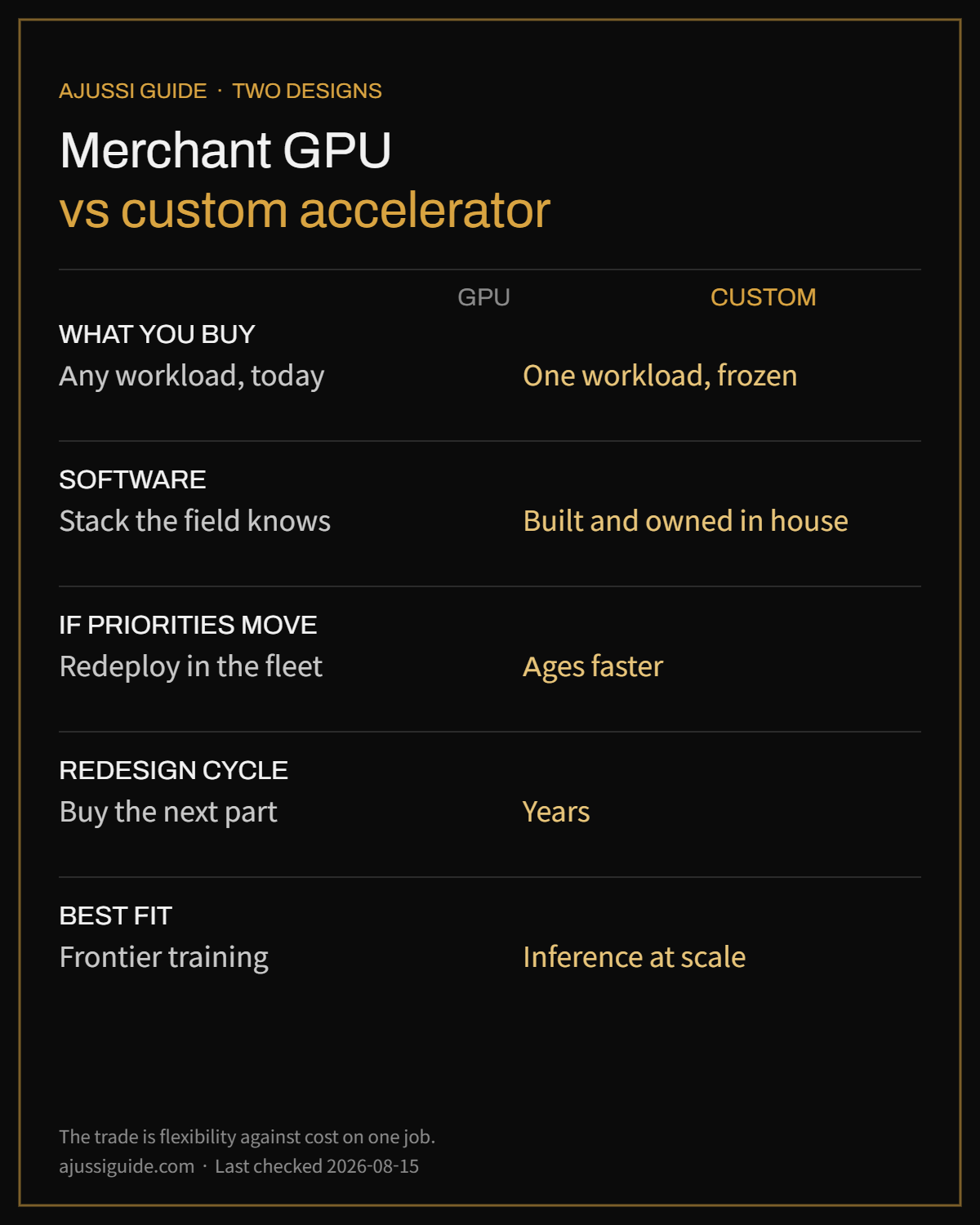
A merchant GPU is a general instrument. It runs whatever the research team invents next month, it arrives with a software stack the industry already knows, and it can be resold or repurposed inside the fleet when priorities move. That flexibility is the product.
A custom accelerator is a bet that a narrower workload family will stay stable long enough to be worth committing to silicon. When the bet lands, the operator gets a better cost and power profile on that specific job and stops paying a merchant margin. When the workload shifts, the chip ages faster than a GPU would, and the design cycle to replace it runs in years rather than weeks.
Inference at scale is the case most often cited, but the split is not clean. Google describes its TPUs as serving both large-scale training and inference, and AWS runs separate families for training and inference. Frontier research, where model shapes change fastest, is where general-purpose hardware keeps the clearest advantage.
| Program | Current role, and what it shows |
|---|---|
| Google TPU | Large-scale training and inference Custom silicon is not limited to inference |
| AWS Trainium and Inferentia | Separate purpose-built families for training and for inference Operators can divide workloads by economics rather than by one chip |
| Meta MTIA | Inference first, with a roadmap extending toward training and generative workloads A custom program can broaden over time rather than staying fixed |
Where the money splits inside the compute layer
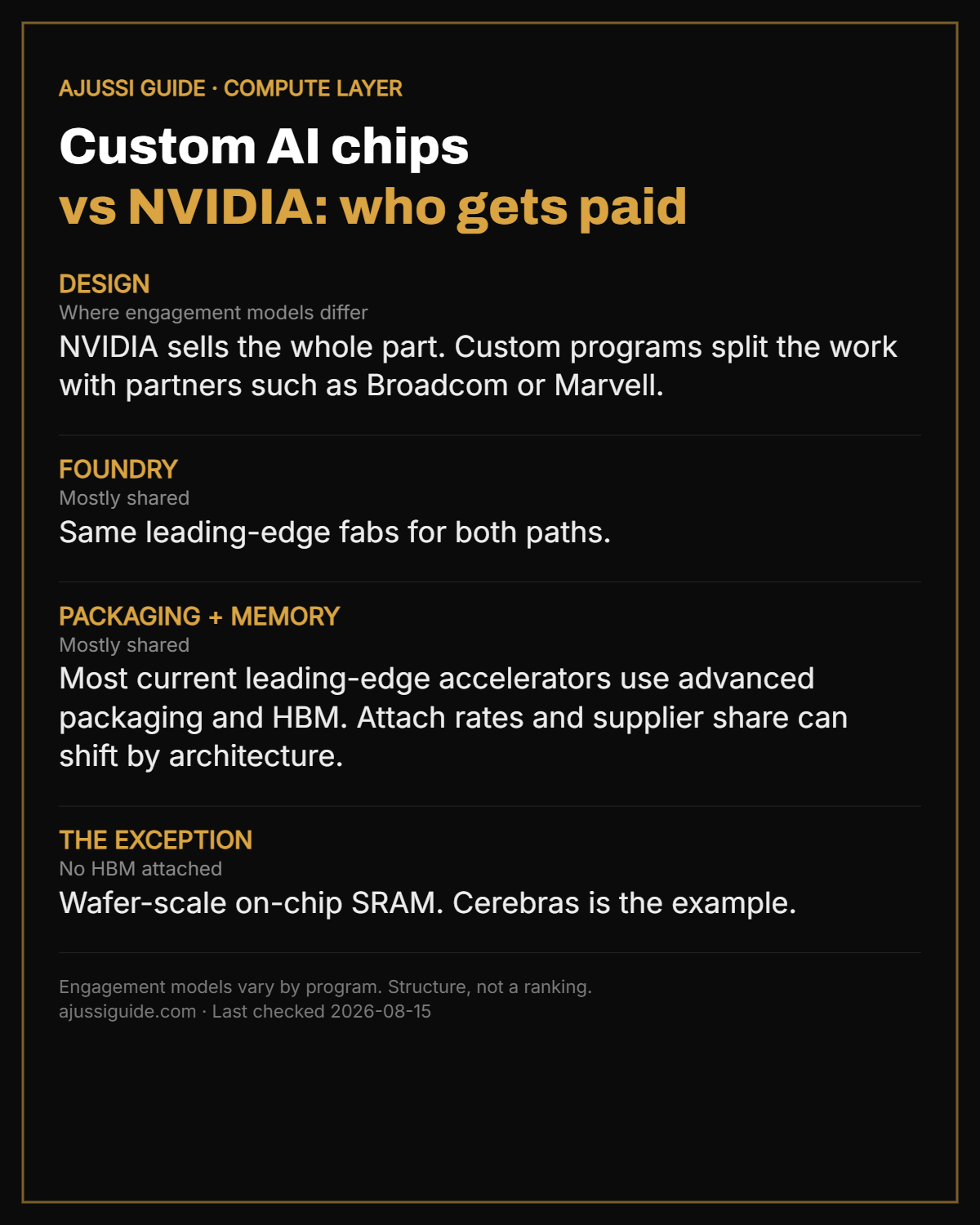
“Custom versus merchant” describes who owns the design. It does not describe who gets paid, because the two paths share most of the supply chain below the design step.
Design and IP. This is the layer that actually differs. NVIDIA designs and sells the whole part. On the custom side, engagement models vary. Some hyperscalers retain more of the architecture and physical design, while partners such as Broadcom or Marvell may provide co-development, IP, implementation, packaging, networking, or a turnkey path. Their results are read as a proxy for custom demand because they sit in that layer either way.
Foundry. Both paths are manufactured at leading-edge nodes by the same small set of foundries. A shift from merchant to custom moves margin between designers. It does not move the wafer order to a different industry.
Advanced packaging and memory. Most current leading-edge data center accelerators use high-bandwidth memory and the packaging that binds it to logic, though attach rates and supplier share can shift by architecture. That is the part of the chain least sensitive to which design wins, which is why we track it separately in the HBM supply guide.
The exception. Some architectures do not depend on external high-bandwidth memory at all. Cerebras, listed on Nasdaq as CBRS, uses large on-chip SRAM on a wafer-scale compute die as accelerator-local memory rather than attaching HBM stacks, which is why it is worth watching as a break from the shared-memory assumption.
The practical takeaway is that custom AI chips vs NVIDIA is a fight over the design layer, while the layers underneath depend more on total volume than on which design wins.
Custom AI chips vs NVIDIA: four things to check next
NVIDIA reported on August 26, 2026 and Broadcom on September 2 — the results are summarized in the new section below. These four disclosures remain the checklist for every coming earnings season.
1. The gap, measured the same way each time. Compare Data Center revenue against AI semiconductor revenue and watch the ratio, not the individual figures. A ratio that compresses over several quarters is the signal. One quarter is noise.
2. Whether the custom line gets broken out. As long as accelerators and networking are reported together, nobody outside the company can size the custom accelerator business precisely. A separate disclosure would change what the market can actually verify.
3. China. NVIDIA disclosed a specific China exclusion in its guidance, assuming no Data Center compute revenue from that market. Broadcom did not disclose an equivalent exclusion in the same form. A policy variable disclosed on one side and not the other can move the reported gap without anything changing in the technology.
4. Program count versus shipped volume. Design wins are announced years before racks are installed. A new program tells you about revenue in 2028. Shipment and capacity language tells you about revenue now. Headlines routinely blend the two.
The answers came in: what September’s reports did to the four checks
Broadcom reported its quarter ended August 2, 2026 on September 2. AI semiconductor revenue reached $16.7B, up 221% year over year, with next-quarter AI guidance of $21.7B (up 236%). Total revenue was $29.6B, up 86%. CEO Hock Tan said demand for custom AI accelerators and networking “continues to be very strong.” The stock still fell about 6% after hours; press coverage pointed at guidance landing at the low end of expectations. Growth alone does not move the price — the gap against expectations does, which is the framing this article started from.
Against the checklist: (1) the ratio — NVIDIA Data Center at $89.0B for the July quarter versus Broadcom AI semis at $16.7B for the August quarter puts it near 5.3 to 1, down from about 7 to 1 at the prior check (quarter ends differ, so this is not a same-period comparison). (2) The custom line was again not broken out — accelerators and networking stayed on one line in the release. (3) NVIDIA again assumed no China Data Center compute revenue in its outlook; Broadcom’s release carried no equivalent exclusion — the asymmetry holds. (4) The table below carries the updated figures.
Numbers in one place
Everything above is structural. Everything below decays. Last checked: 2026-09-05.
| Item | Latest figure and status |
|---|---|
| NVIDIA Data Center revenue | $89.0B, up 117% YoY REPORTED · quarter ended 2026-07-26, released 2026-08-26 |
| NVIDIA total revenue | $96.2B, up 106% YoY REPORTED · same quarter |
| NVIDIA next-quarter guidance | $108.0B, plus or minus 2% FORWARD-LOOKING · total company revenue, not Data Center. Assumes no China Data Center compute revenue |
| Broadcom AI semiconductor revenue | $16.7B, up 221% YoY REPORTED · quarter ended 2026-08-02, released 2026-09-02. Includes custom accelerators and AI networking |
| Broadcom total revenue | $29.6B, up 86% YoY REPORTED · same quarter |
| Broadcom next-quarter AI guidance | $21.7B, up 236% YoY FORWARD-LOOKING · AI semiconductors only, not total company. Company forecast, 2026-09-02 |
| Marvell total revenue | $2.418B, up 28% YoY REPORTED · quarter ended 2026-05-02. Custom silicon reported inside data center, not separately |
| Ratio, Data Center to AI semis | About 5.3 to 1 (about 7 to 1 at the prior check) DERIVED · from the two reported rows above. A size comparison between two different disclosure scopes, not market share |
My read
Custom silicon is not replacing NVIDIA in one move. It is taking selected workloads where specialization is worth the design cost. NVIDIA still captures the much larger reported revenue pool, while custom programs redistribute some of the economics to operators and their design partners. The useful signal is not a single design win. It is whether deployment and revenue trends persist across several quarters, measured the same way each time.
FAQ
Are custom AI chips replacing NVIDIA?
Not on the reported numbers. In quarters ending one week apart, NVIDIA’s Data Center line was roughly seven times Broadcom’s AI semiconductor line, and that Broadcom line also contains networking. What is true is that Broadcom’s reported AI semiconductor line grew faster from a smaller base, so the custom AI chips vs NVIDIA gap is closing in percentage terms while remaining wide in dollars. That line includes networking, so it is not a growth rate for custom accelerators alone.
Why would a company design its own chip instead of buying one?
To stop paying a merchant margin on a workload that is large and stable, and to tune power and cost for that one job. The trade is flexibility: a custom part is worth less if the workload changes, and redesign takes years.
Who actually makes custom AI chips?
Engagement models vary. Some hyperscalers retain more of the architecture and physical design, while partners such as Broadcom or Marvell may provide co-development, IP, implementation, packaging, networking, or a turnkey path. Manufacturing happens at the same leading-edge foundries that produce merchant GPUs. Marvell’s interconnect side, including silicon photonics, is covered in a separate photonics stocks filings guide.
Does a shift to custom silicon hurt memory and packaging suppliers?
Most current leading-edge accelerators use high-bandwidth memory and advanced packaging, so a shift between them does not by itself remove that demand, though attach rates and supplier share can shift by architecture. The exception is an architecture that does not attach HBM at all, such as a wafer-scale design relying on large on-chip SRAM.
Why is Broadcom’s AI revenue not the same as custom accelerator revenue?
Because the company reports custom accelerators and AI networking in one line. Until those are separated, the figure is an upper bound for the custom accelerator business rather than a measurement of it.
What would make custom AI chips vs NVIDIA look different in a year?
A ratio that compresses across several consecutive quarters, a separate disclosure of custom accelerator revenue, or a policy change that restores or removes a large regional market on one side of the comparison.
Is a design win the same as revenue?
No. Announced programs describe capacity years out. Revenue follows deployment, and deployment schedules slip. Read shipment and capacity language rather than program counts when you want to know about the current quarter.
Sources: NVIDIA quarterly results, Broadcom quarterly results and Marvell quarterly results. Program descriptions from Google Cloud TPU documentation, AWS Trainium and Meta MTIA.
If you would rather hold the theme through a fund than pick names, the AI semiconductor ETF comparison maps the dedicated and broad options.
Last checked: 2026-08-15. Company statements reflect public disclosures as of that date. This article is for information only. It is not a recommendation to buy or sell any security, and investment decisions and their results belong to the reader.