Vertiv stock (ticker: VRT) has become one of the most talked-about names in the AI infrastructure wave — and honestly, for good reason. I’m Ajussi, and today I want to sit down with you like we’re having coffee and walk through everything you need to know before you decide whether to own this one.
I’ve been watching power management and thermal companies for years. Most retail investors ignored them. Then AI exploded, and suddenly everyone wants to know about the company that keeps data centers from melting down. Let me tell you what I see.
What Does Vertiv Actually Do?
Before we talk about Vertiv stock price targets and growth rates, let’s make sure we understand the business. Vertiv Holdings (NYSE: VRT) designs and manufactures critical digital infrastructure — we’re talking power distribution, thermal management, and IT infrastructure solutions for data centers, communication networks, and industrial facilities.
Think about it this way: every AI chip from NVIDIA burns enormous amounts of electricity and generates tremendous heat. Somebody has to manage that power delivery and cool those chips down. That’s Vertiv’s job. They’re not the sexy chip maker — they’re the unsexy but absolutely essential plumber of the AI buildout.
The company operates three main segments: Americas, Asia Pacific, and Europe/Middle East/Africa (EMEA). Their product lines include uninterruptible power supplies (UPS), power distribution units, precision cooling systems, and integrated rack systems. For more on the company’s investor relations and official filings, you can visit the Vertiv Investor Relations page.
Vertiv Stock Performance: How Did We Get Here?
VRT went public via SPAC in early 2020 at around $10. For most of its early life as a public company, it struggled — debt was high, margins were thin, and nobody cared about data center infrastructure the way they do now.
Then 2023 happened. ChatGPT lit the world on fire, hyperscalers started announcing massive capex plans, and suddenly every serious analyst started drawing a straight line from AI compute demand to power and cooling demand — right to Vertiv’s front door.
By early 2024, Vertiv stock had become a multi-bagger from those SPAC lows. The stock ran from under $20 to well above $100 at its peak, making it one of the best-performing large-cap stocks in the AI infrastructure theme. That kind of run attracts both excitement and fear of heights.
Key Financial Metrics to Know
Here’s where Ajussi gets serious. A stock that runs 5x needs earnings to eventually catch up. Let’s look at where Vertiv stands fundamentally. Note that figures below are based on publicly reported data and Vertiv’s reported full-year 2025 results (announced February 2026) — always verify with current filings.
| Metric | FY 2022 | FY 2023 | FY 2024 | FY 2025 (Actual) |
|---|---|---|---|---|
| Revenue (USD B) | ~$5.7B | ~$6.9B | ~$8.0B | ~$10.2B |
| Adjusted Operating Margin | ~9% | ~15% | ~19% | ~20% |
| Adjusted EPS (approx.) | ~$0.53 | ~$1.77 | ~$2.85 | ~$4.21 |
| Revenue YoY Growth | ~14% | ~21% | ~17% | ~28% |
| Net Debt (approx.) | High (~$3B+) | Declining | Meaningfully Reduced | Continued Paydown |
Note: These figures are approximations based on publicly available reports and analyst estimates. Always check Vertiv’s official SEC filings for precise numbers before making any investment decision. For 2026, management guides to adjusted diluted EPS of roughly $6 at the midpoint — another year of 40%+ expected earnings growth.
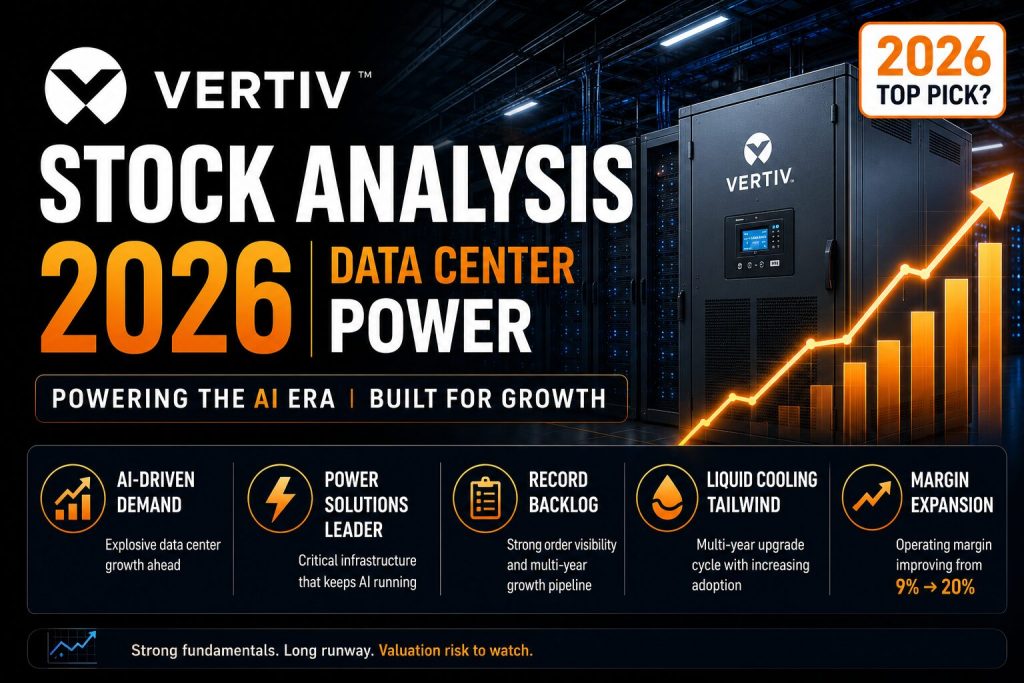
What I love about this table is the margin expansion story. Going from 8% operating margins to approaching 19% is not a small thing. That tells me management has pricing power and operating leverage. When revenue grows and margins expand at the same time, that’s a beautiful business dynamic.
Why the Bull Case for Vertiv Stock Is Still Compelling
Let me give you the three reasons I think the long-term thesis here is intact, even after a massive run-up.
1. AI power demand is not slowing down. The International Energy Agency (IEA) projects that global data center electricity consumption will more than double to around 945 TWh by 2030. You can read their full report at the IEA website. More power consumption means more need for power management and cooling — Vertiv’s core business.
2. Liquid cooling is a structural tailwind. The shift to liquid cooling for AI chips (especially GPUs running at 700–1,000W+ per chip) is a multi-year upgrade cycle. Traditional air cooling simply cannot handle the heat density of modern AI server racks. Vertiv has been investing heavily in liquid cooling solutions and is well-positioned to capture this transition. This isn’t a one-quarter story.
3. Backlog and order visibility. Vertiv has consistently reported a strong and growing backlog, which gives investors visibility into future revenue. When a company’s backlog is growing faster than revenue, that’s a forward-looking signal that demand is accelerating, not slowing.
The Competitive Landscape Around Vertiv Stock
Vertiv doesn’t operate in a vacuum. Competitors include Eaton Corporation (ETN), Schneider Electric, and emerging players in liquid cooling. Here’s the thing though — the market is large enough that it isn’t necessarily winner-take-all. Hyperscalers are diversifying their vendor relationships for supply security, which means multiple companies can win simultaneously.
Eaton is a strong, well-diversified competitor and I respect them. But Vertiv is more purely exposed to data center infrastructure than Eaton’s broader electrical products business. That concentration cuts both ways — more upside leverage to the AI theme, but also more downside if data center capex ever rolls over.
The Bear Case and Real Risks You Shouldn’t Ignore
Ajussi didn’t get old by ignoring risks. Here’s what keeps me honest about Vertiv stock.
Valuation is not cheap. After the multi-year run, VRT trades at a significant premium to the broader market on most traditional metrics. You are paying for growth and margin expansion that must materialize. If either misses expectations, the stock can fall hard and fast — growth stocks with high multiples are unforgiving.
Customer concentration risk. A meaningful portion of Vertiv’s revenue comes from large hyperscaler customers — think the major cloud companies. If one of those customers decides to in-source more of their power/cooling solutions or significantly reduces capex, Vertiv would feel the pain disproportionately.
Supply chain and component availability. Vertiv sources components globally. Tariff changes, geopolitical tensions (especially around China), and component shortages could squeeze margins or delay deliveries. In 2022, Vertiv had a rough stretch due to exactly these issues — it’s a reminder that execution risk is real.
Interest rate sensitivity. The company still carries meaningful debt. In a higher-for-longer interest rate environment, debt servicing costs pressure free cash flow. They’ve been paying down debt, which is the right move, but it’s worth monitoring.
My Take: How Should a Retail Investor Think About VRT?
Here’s how I think about it. Vertiv stock is not a value stock. You’re not buying this because it’s cheap — you’re buying it because you believe AI data center infrastructure spending has a long runway, Vertiv is a best-in-class operator within that space, and the company’s margin improvement story still has room to run.
If those three things are true three to five years from now, VRT bought at today’s levels could still generate solid returns. But if AI capex disappoints, or if a recession causes hyperscalers to pause spending, this stock could correct significantly from elevated valuation levels.
My personal approach with stocks like this is to size them appropriately — don’t bet the farm on any single name, even a good one. If you believe in the AI infrastructure theme broadly, consider whether you want pure Vertiv exposure or whether a mix including Eaton, data center REITs, and cooling-focused names gives you better risk-adjusted exposure.
I am not chasing momentum here. But for someone with a 3-5 year horizon who understands the risks, Vertiv stock remains one of the more interesting picks in the AI infrastructure universe.
Frequently Asked Questions About Vertiv Stock
Is Vertiv stock a buy in 2026?
Vertiv stock offers a compelling long-term thesis tied to AI data center power and cooling demand. However, the valuation is elevated after a significant multi-year run. Whether it’s a “buy” depends heavily on your time horizon, risk tolerance, and entry price. Do not buy simply because the stock has gone up — understand the business fundamentals first.
What is Vertiv’s ticker symbol?
Vertiv Holdings Co. trades on the New York Stock Exchange under the ticker symbol VRT. Do not confuse it with other similar-looking tickers. Always double-check your brokerage’s stock lookup before placing an order.
How does AI growth benefit Vertiv stock specifically?
AI model training and inference requires dense server clusters running at very high power draw. This creates enormous demand for Vertiv’s power distribution and thermal management products, especially liquid cooling systems designed for high-density GPU racks. More AI compute = more power and cooling infrastructure needed = more revenue potential for Vertiv. The link is direct and structural, not just a marketing story.
🖥️ Ajussi’s Trading Desk Gear
Watching this sector means watching a lot of charts. The gear guides I actually researched for my own desk:
📊 Best Monitors for Stock Trading (2026)
🦾 Best Dual Monitor Arms for a Clean Setup
🔌 Thunderbolt 5 & USB-C Docks — One-Cable Desk
💡 Best Monitor Light Bars — Save Your Eyes at Night
Disclaimer: This article is for informational purposes only and is not financial advice. Do your own research.