
The AI capex boom is the biggest capital spending story in a generation — and right now, every investor I talk to is asking the same thing: is this the dot-com bubble all over again, or is it the real deal?
I’ve been around long enough to remember 1999. I watched companies with no revenue get billion-dollar valuations because they had a website. I also watched people who called everything a bubble miss Amazon, Apple, and Google on the way up. So let me give you my honest take — no hype, no doom.
What Is the AI Capex Boom, Exactly?
The AI capex boom refers to the massive wave of capital expenditure being poured into AI infrastructure — data centers, GPUs, networking gear, power systems, and cooling. We’re not talking about billions. We’re talking about hundreds of billions.
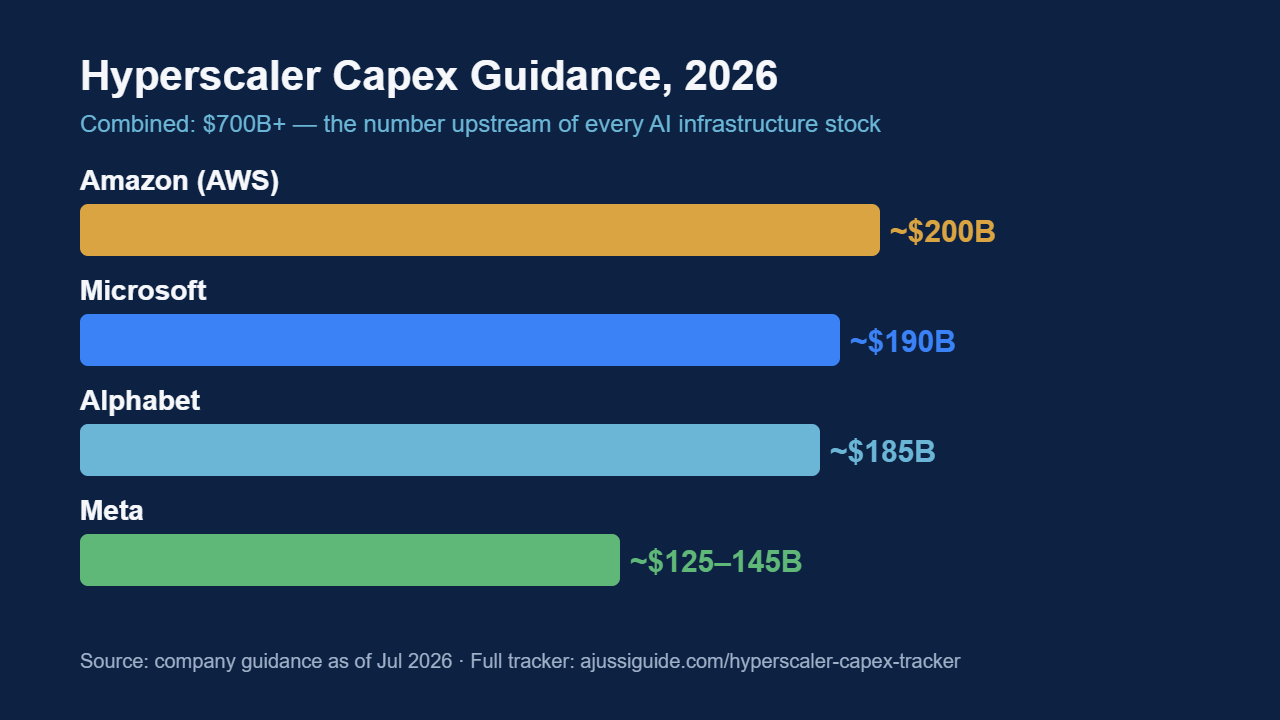
In 2026, the four big hyperscalers — Microsoft, Alphabet, Amazon, and Meta — have guided to a combined $700+ billion in capex, the overwhelming majority aimed at AI infrastructure. Amazon alone is running at roughly $200 billion, and Microsoft around $190 billion for the calendar year. These are real numbers, from real earnings calls, not analyst fantasies. These are real numbers, from real earnings calls, not analyst fantasies.
And it’s not just the tech giants. Utilities are scrambling to build new power plants. Electrical equipment makers like Eaton (ETN) and Vertiv are backlogged for years. The AI capex boom has its tentacles in every corner of the industrial economy.
The 5 Signs That Feel Bubble-Like
I want to be honest with you — there are warning signs. A responsible investor looks at both sides.
1. Revenue Hasn’t Caught Up With Spending
The hyperscalers are spending like drunk sailors, but the monetization of AI is still early. ChatGPT-style products are cool, but enterprise AI adoption is slower than the spending curves suggest. There is a real risk of overcapacity if revenue doesn’t scale fast enough.
2. Nvidia’s Valuation Implies Perfection
Nvidia (NVDA) has been the poster child of this cycle. At peak valuations near 40x forward earnings, the stock prices in flawless execution forever. That’s not a bubble by itself, but it leaves zero margin for error.
3. Everyone Is Suddenly an AI Expert
When my neighbor asks me which AI stock to buy, I get nervous. Retail euphoria is a classic late-cycle signal. The AI capex boom narrative is everywhere — on CNBC, in retirement accounts, and in meme stock forums. That kind of unanimity is always a yellow flag.
4. Competition Is Intensifying Fast
AMD is closing the GPU gap. Chinese firms like Huawei are building competitive AI chips despite US export restrictions. If Nvidia’s pricing power erodes, the entire capex math changes. Supply catching up to demand is what pops cycles.
5. Power and Land Are Real Constraints
You can order GPUs, but you can’t instantly build a gigawatt of power capacity. Data center projects are being delayed by grid connection wait times measured in years. Spending commitments are easy; delivery is hard. Some of that capex will slip into future years, distorting near-term expectations.
3 Reasons the AI Capex Boom Is NOT a Bubble
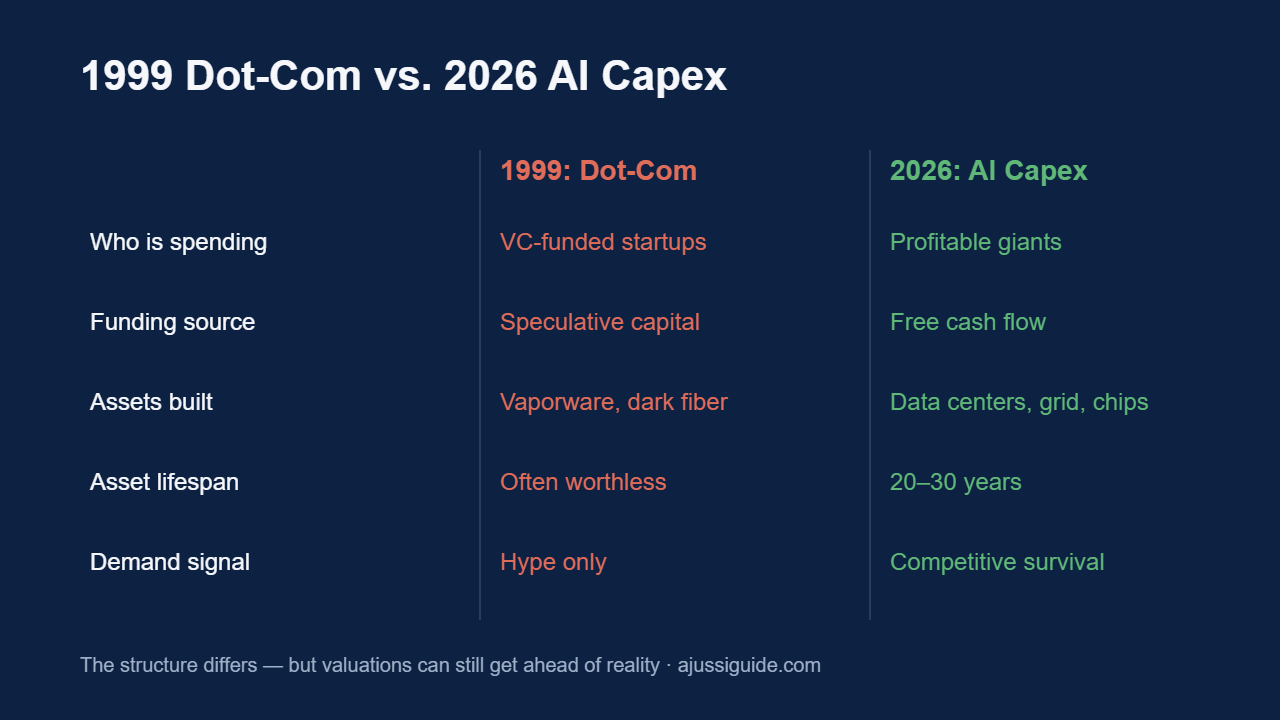
Here’s where it gets interesting. The biggest difference between today and 1999 is one word: cash flow.
1. The Buyers Are Profitable Giants
In the dot-com era, money-losing startups were burning venture capital on fiber optic cables nobody needed. Today, the entities spending on the AI capex boom — Microsoft, Alphabet, Amazon, Meta — generate combined free cash flow in the hundreds of billions of dollars annually. They can afford this. They are not borrowing against speculative future revenues.
2. The Demand Signal Is Real (and Competitive)
Every major corporation on earth is now budgeting for AI tools, copilots, and automation. More importantly, the hyperscalers are terrified of being left behind by each other. Even if the ROI is uncertain, the competitive cost of not spending is existential. That’s a structural demand floor, not a speculative one.
3. Physical Infrastructure Has Long Lifespans
A data center built today will run for 20-30 years. A power substation upgrade benefits the grid for decades. Unlike dot-com-era spending on vaporware, the AI capex boom is creating real, depreciable, long-lived assets. Even if AI hype cools, these assets serve cloud computing, streaming, and enterprise workloads.
For a broader view on the electricity demand surge driven by data centers, the International Energy Agency (IEA) has published detailed forecasts worth reading before you make any infrastructure-related investments.
AI Capex Boom: Key Players and What They’re Spending
Let me lay it out simply. Here’s a snapshot of the major spenders and the infrastructure beneficiaries you should know:
| Company | Ticker | Role in AI Capex | 2026 Capex Guidance (Approx.) |
|---|---|---|---|
| Microsoft | MSFT | Hyperscaler / AI cloud buyer | ~$190B (CY2026) |
| Meta Platforms | META | Hyperscaler / AI infrastructure buyer | $125–145B |
| Nvidia | NVDA | GPU supplier / AI compute backbone | N/A (revenue beneficiary) |
| Eaton Corporation | ETN | Power management / data center electrical | N/A (order backlog beneficiary) |
| Vertiv Holdings | VRT | Data center cooling & power systems | N/A (infrastructure pick-and-shovel) |
Note: Capex guidance figures are approximate and based on company earnings calls and public filings. For the latest numbers on all four hyperscalers, see our AI Capex Tracker, updated after every earnings season.
What Ajussi Is Actually Watching
I don’t try to call the top of cycles. I’ve seen too many smart people get ruined doing that. What I watch instead are inflection signals.
First, I watch hyperscaler commentary on AI monetization. The day Microsoft or Google starts walking back capex guidance because enterprise AI adoption disappointed — that’s when I reduce exposure. Right now, they’re accelerating, not retreating.
Second, I watch the pick-and-shovel plays more than the headline names. Nvidia gets all the attention, but the power and cooling infrastructure companies have more predictable revenue streams and less valuation risk. The AI capex boom has to run through copper wire and cooling towers before it reaches a GPU.
Third, I watch the utilities. If power demand growth from data centers starts missing projections, that’s a leading indicator that real AI deployment is softer than the spending suggests. Conversely, if grid operators keep upgrading their long-term load forecasts, the AI capex boom is tracking as real.
And fourth — I maintain position sizing discipline. No single theme, no matter how compelling, should dominate a retail portfolio. The AI capex boom is real, but so was the fiber optic boom of the late 1990s. Corning made great fiber cable. They just went from $100 to $1 on the way down.
My Bottom Line on the AI Capex Boom
Is the AI capex boom a bubble? My answer is: partially. The valuations of certain AI-adjacent stocks have bubble-like characteristics. The narrative is frothy and retail euphoria is elevated. Those are real risks.
But the underlying spending is being done by cash-generative companies building real assets for competitive survival — not by startups burning VC money on a dream. That’s a fundamentally different structure than 1999.
The risk isn’t that the spending stops. The risk is that the stocks pricing in perfection get repriced when reality turns out to be merely excellent. There’s a difference between a correction and a bubble pop — and I think that’s where we’re more likely headed if things go wrong.
Stay diversified. Don’t chase the names that have already tripled. And look at the infrastructure layer — power, cooling, grid — where the AI capex boom creates durable demand regardless of which AI model wins the software race.
That’s how this ajussi plays it.
🚀 Ajussi’s Trading Desk Gear
Watching this sector means watching a lot of charts. The gear guides I actually researched for my own desk:
📊 Best Monitors for Stock Trading (2026)
🤾 Best Dual Monitor Arms for a Clean Setup
🔌 Thunderbolt 5 & USB-C Docks — One-Cable Desk
💡 Best Monitor Light Bars — Save Your Eyes at Night
Frequently Asked Questions
Q: Is the AI capex boom comparable to the dot-com bubble?
A: Partially, but with key differences. The dot-com bubble was driven by money-losing companies spending speculative capital. Today’s AI infrastructure spending is funded by profitable giants like Microsoft and Meta with massive free cash flow. The valuation risk in certain stocks is real, but the structural spending foundation is far more solid than 1999.
Q: Which stocks benefit most from the AI capex boom?
A: The most direct beneficiary is Nvidia (NVDA) as the dominant GPU supplier. But pick-and-shovel plays in power and cooling infrastructure — like Eaton (ETN) and Vertiv (VRT) — offer exposure with potentially lower valuation risk. Utilities with data center exposure are another angle worth researching.
Q: What would signal that the AI capex boom is turning into a real bubble pop?
A: Watch for hyperscalers cutting or pausing capex guidance, enterprise AI adoption metrics disappointing, Nvidia’s gross margins compressing due to competition, and power demand forecasts from grid operators being revised downward. Any combination of these signals would suggest the spending cycle is cracking.
Whether or not this is a bubble, the first practical step is knowing how much of your portfolio depends on the same capex cycle. They may all depend on the same infrastructure layer. The AI infrastructure exposure checker shows which of the eight layers a portfolio actually owns.
Disclaimer: This article is for informational purposes only and is not financial advice. Do your own research.