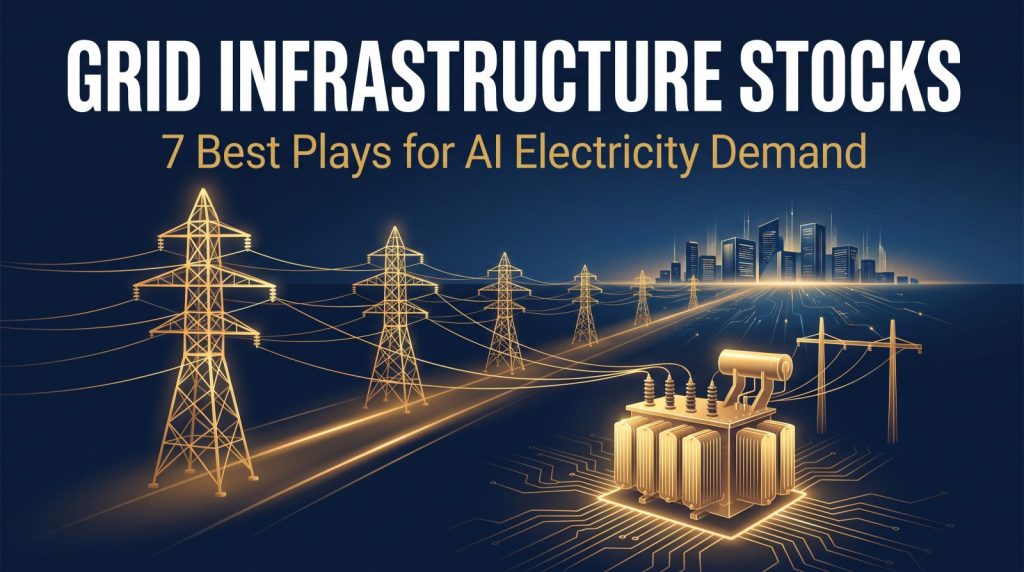
Grid infrastructure stocks are having their moment — and if you are sleeping on this sector, you might be missing one of the most straightforward infrastructure plays of the decade.
My name is Ajussi. I have been watching markets through the dot-com bust, the 2008 crisis, and more cycles than I care to count. And I will tell you plainly: the electricity angle on AI is the most underappreciated mega-trend I have seen in years. Let me walk you through it like a trusted uncle would.
Why AI Electricity Demand Is Breaking Every Forecast
Here is the simple truth. Every time someone runs a large language model query, estimates suggest it can use roughly ten times the electricity of a standard web search. Data centers are multiplying fast, and the existing power grid was not built for this.
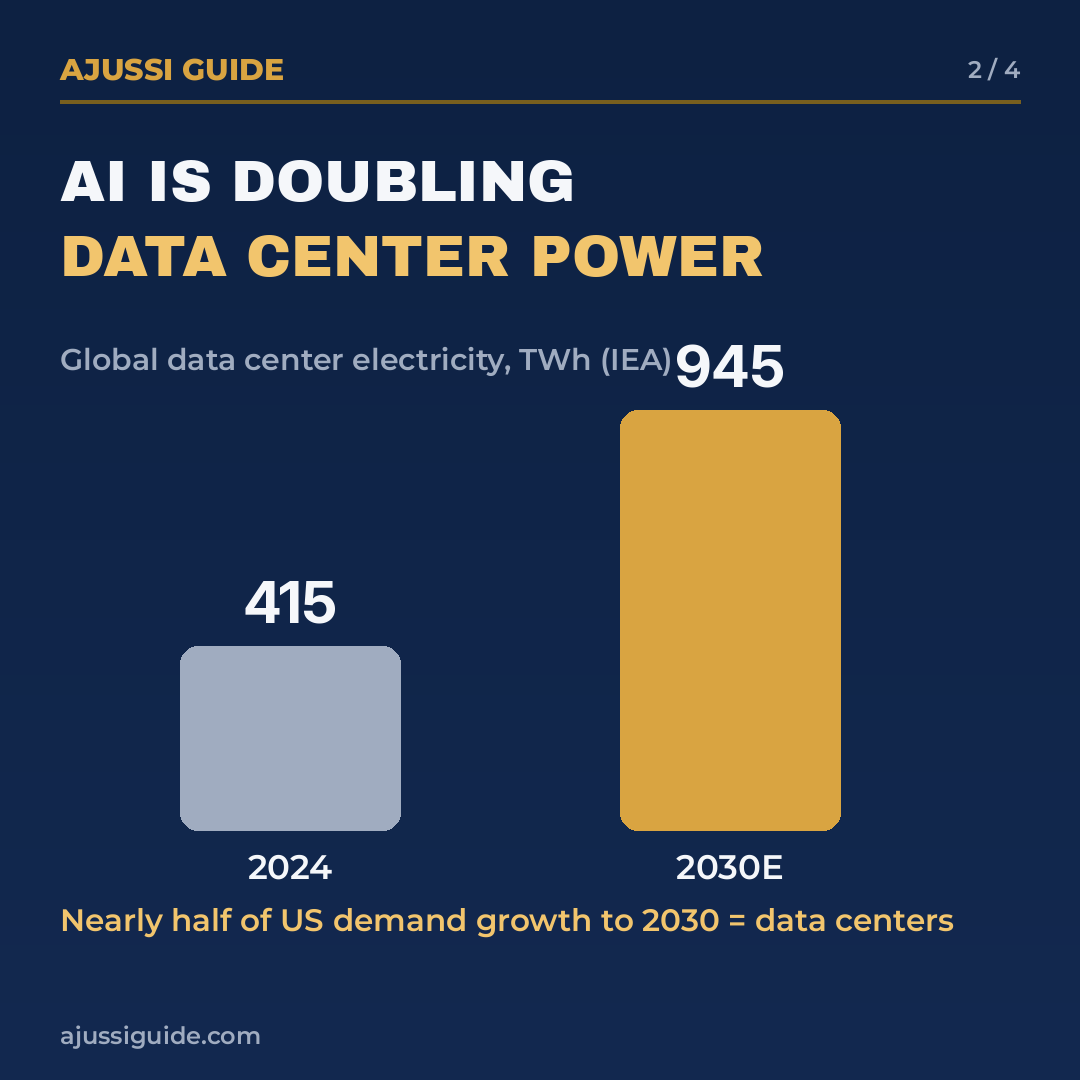
The International Energy Agency’s Energy and AI report projects that global data center electricity consumption will roughly double from about 415 TWh in 2024 to around 945 TWh by 2030 — and the United States accounts for the largest share of that growth, with data centers expected to drive nearly half of all US electricity demand growth through 2030. Utilities and grid operators are already scrambling.
I always say: when everyone is rushing to build AI, ask yourself who sells the shovels. In this gold rush, the shovels are transformers, switchgear, transmission cables, and the companies that install and manage them. That is where grid infrastructure stocks come in.
The Four Pillars of the Grid Upgrade Story
1. Transmission & Distribution Equipment
The backbone of any grid upgrade is the hardware — high-voltage transformers, circuit breakers, and switchgear. Demand for large power transformers in the US has surged so sharply that lead times have stretched to 2-3 years in some cases. Companies making this equipment have serious pricing power right now.
Eaton Corporation (ETN) is one I keep coming back to. They make electrical components across the full power chain — from data center power distribution units all the way up to utility-scale switchgear. Their backlog has grown meaningfully, and management has flagged AI data centers as a primary demand driver.
Hubbell Incorporated (HUBB) is a quieter name that deserves attention. They focus on electrical products for utility and commercial markets, and grid modernization orders have been accelerating. Not as flashy as the big names, but solid execution.
2. Engineering & Construction for Grid Projects
Building new transmission lines and substations requires engineering muscle. Quanta Services (PWR) is essentially the largest specialty contractor for electric power infrastructure in North America. When utilities need new transmission corridors built, they call Quanta.
Their revenue has grown steadily as grid investment ramps up. The Infrastructure Investment and Jobs Act is funneling billions into grid upgrades, and companies like Quanta are direct beneficiaries on the execution side.
3. Utilities With Strategic Grid Positioning
Not all utilities are equal here. The ones positioned near major data center corridors — Virginia, Texas, Georgia — are seeing load growth that most analysts did not model even three years ago.
Dominion Energy (D) serves northern Virginia, which is arguably the data center capital of the world. Vistra Corp (VST) operates a large generation fleet in Texas, which is seeing explosive AI-driven power demand. These are not sleepy dividend stocks anymore — they are infrastructure plays with real growth catalysts.
4. Grid Software & Automation
A smarter grid needs software. Itron (ITRI) and Ameresco (AMRC) operate in grid intelligence and energy efficiency — areas that become critical when you are trying to squeeze more capacity out of aging infrastructure. These are smaller-cap names with higher volatility, so position size accordingly.
Grid Infrastructure Stocks Comparison Table
| Company | Ticker | Sub-Sector | AI Grid Exposure | Risk Level |
|---|---|---|---|---|
| Eaton Corporation | ETN | Electrical Equipment | Very High | Medium |
| Quanta Services | PWR | Grid Construction | High | Medium |
| Hubbell Incorporated | HUBB | Electrical Products | High | Medium-Low |
| Dominion Energy | D | Regulated Utility | High (Virginia) | Low-Medium |
| Vistra Corp | VST | Power Generation | High (Texas) | Medium-High |
| Itron | ITRI | Grid Software/Metering | Medium | Medium-High |
This table is a starting framework, not a buy list. Always check current financials and your own risk tolerance before investing.

The equipment makers sell into this build. The regulated utilities are the ones who own the result and earn a return on it. If you want that side of the trade, I wrote separately about which utilities actually capture data center electricity demand, and why regulatory approval is the gate.
What Ajussi Actually Worries About
I would not be doing my job if I only told you the good news. Here are the real risks I think about with grid infrastructure stocks.
Regulatory lag. Transmission projects in the US can take 5-10 years to permit and build. The demand is here now; the new supply is not. That gap creates opportunity — but also means the grid stress could get worse before it gets better, and project timelines can slip.
Valuation has already moved. Many of these names — particularly ETN and PWR — have had strong runs. You are not buying at 2022 prices. Patience with entry points matters. I prefer accumulating on pullbacks rather than chasing momentum at all-time highs.
Interest rate sensitivity. Utilities in particular carry a lot of debt and are sensitive to rate movements. If rates stay higher for longer, regulated utilities face higher financing costs on their massive capital programs. Watch the Fed carefully.
Technology risk. AI efficiency is improving. If future models require dramatically less compute per query, the electricity demand growth story could slow. This is a tail risk, not a base case — but it is worth keeping in mind.
How I Would Think About Sizing This
I am not a financial advisor and this is not a recommendation. But as your Ajussi, here is how I think about it personally.
The grid infrastructure theme touches multiple sub-sectors. Rather than concentrating in one stock, I think about building a small basket — equipment makers, contractors, and a utility or two. Some investors prefer a thematic ETF approach. The iShares U.S. Infrastructure ETF (IFRA) or Global X U.S. Infrastructure Development ETF (PAVE) offer broader exposure to infrastructure including grid-related names, though they also include roads and airports. Check the holdings carefully.
For individual stock pickers, I lean toward the equipment and construction side — ETN and PWR — because they have the pricing power and backlog visibility that gives me conviction. Utilities I hold more lightly given rate sensitivity.
You can read Quanta Services’ own investor relations materials at quantaservices.com to get a sense of their backlog and pipeline commentary straight from management.
The Long View: Grid Infrastructure Stocks Are a Decade Play
The US grid is aging. Per US Department of Energy assessments, the average transformer in service is around 40 years old — and many are well past that. AI is accelerating a problem that already existed — we were going to have to rebuild this infrastructure anyway for electrification of transportation and heating.
AI demand just moved up the urgency and the spending. That means the investment cycle for grid infrastructure stocks is not a 12-month trade. It is a structural, multi-year capital deployment story. I find those easier to hold through volatility because the thesis does not depend on a single earnings quarter.
My generation in Korea watched the country build its entire industrial infrastructure from scratch in a generation. We know what infrastructure build-outs look like when they are serious. America is at the beginning of a serious one. The electricity grid is the foundation of everything that comes next.
Be patient. Buy quality. Do not let short-term noise shake you out of a long-term position. That is what Ajussi would say.
🚀 Ajussi’s Trading Desk Gear
Watching this sector means watching a lot of charts. The gear guides I actually researched for my own desk:
📊 Best Monitors for Stock Trading (2026)
🤾 Best Dual Monitor Arms for a Clean Setup
🔌 Thunderbolt 5 & USB-C Docks — One-Cable Desk
💡 Best Monitor Light Bars — Save Your Eyes at Night
Frequently Asked Questions
Q: Are grid infrastructure stocks different from regular utility stocks?
Yes, meaningfully so. Traditional utility stocks are regulated businesses with slow, predictable growth and high dividend yields. Grid infrastructure stocks in the equipment and construction space — like Eaton or Quanta — are industrials with cyclical growth characteristics. They benefit from the spending utilities and corporations do on infrastructure, rather than being the utilities themselves. Different risk profiles, different return drivers.
Q: How does AI actually drive electricity demand for the grid?
AI model training and inference — the computing that powers chatbots, image generators, and recommendation engines — runs on GPU clusters in data centers that consume enormous amounts of electricity 24 hours a day. Unlike consumer electronics that power down, data centers run constantly at high load. A large hyperscale data center can consume as much power as a small city. As hundreds of new AI data centers are built globally, the electricity demand placed on the grid compounds rapidly.
Q: Is there an ETF that focuses specifically on grid infrastructure stocks?
The First Trust Nasdaq Clean Edge Smart Grid Infrastructure Index Fund (GRID) is the closest thing to a dedicated grid ETF — it holds grid equipment, smart-meter and network names. Beyond that, broader infrastructure ETFs like PAVE (Global X U.S. Infrastructure Development ETF) or IFRA (iShares U.S. Infrastructure ETF), which hold many grid-related names alongside other infrastructure companies. Some utilities ETFs like the Utilities Select Sector SPDR Fund (XLU) capture the utility side but not equipment makers. Most investors who want targeted grid exposure build a small basket of individual stocks.
Disclaimer: This article is for informational purposes only and is not financial advice. Do your own research.