⚡ Ajussi Market Watch — July 23, 2026
Trending now: “kimi k3 selloff” — China’s open-weight AI push just knocked chip stocks into a bear market, and Washington is threatening sanctions.
This story hits every layer of our cluster at once: model economics → GPU demand → semiconductor capex → regulation.
Today’s Lens: AI Infrastructure. This card does not cover model benchmark debates or the politics of a ban — only what the transmission channel looks like for infrastructure investors.
What Happened: The Kimi K3 Selloff in One Week
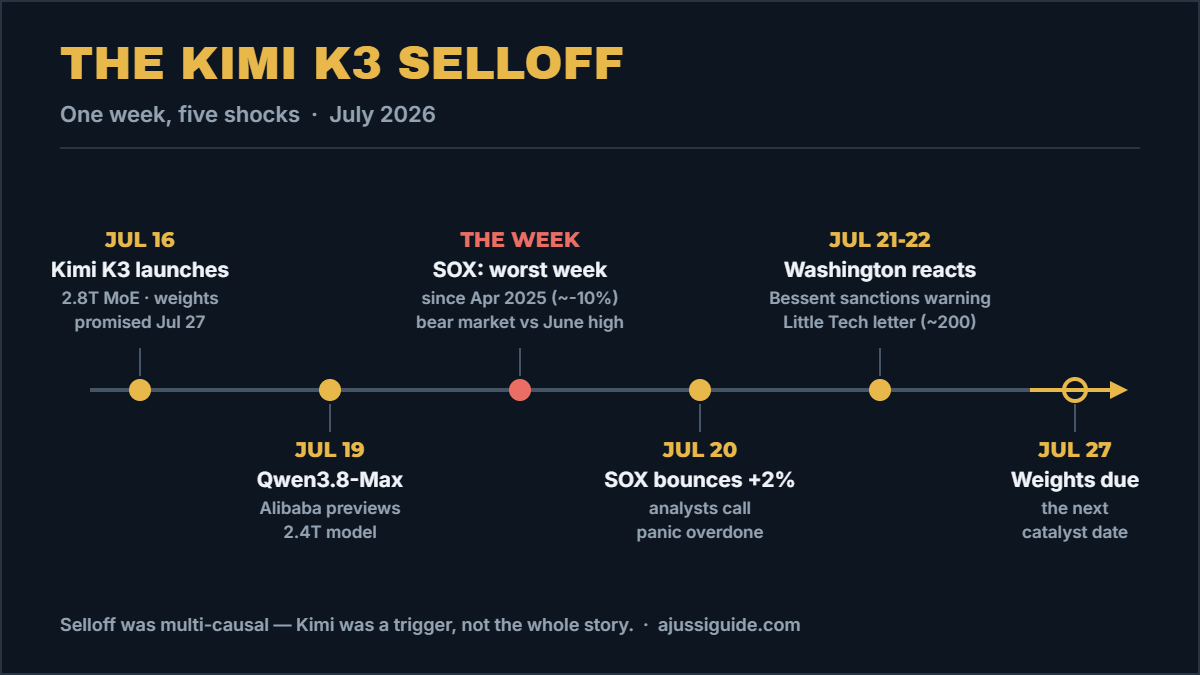
On July 16, China’s Moonshot AI released Kimi K3 at the World AI Conference in Shanghai — a 2.8-trillion-parameter mixture-of-experts model that tops several coding leaderboards, with full open weights promised by July 27. Three days later, Alibaba previewed Qwen3.8-Max (2.4T parameters), claiming near-frontier performance; its open-weight release date is still unannounced.
Markets flashed back to the 2025 DeepSeek moment: the Philadelphia Semiconductor Index fell nearly 10% in its worst week since April 2025, dropped more than 20% from its June high into bear-market territory, and media tallies put the global chip market value erased at roughly $3.3 trillion. One caveat we insist on: the selloff was multi-causal — soft Netflix and TSMC earnings reactions, Middle East risk, and rate jitters were already in the tape. Kimi was a trigger, not the whole story.
Then came the regulatory layer. On July 21–22, Treasury Secretary Scott Bessent warned that Chinese AI firms conducting “industrial-scale distillation attacks” on U.S. models could face sanctions and Entity List designations, saying officials found U.S. model watermarks inside several Chinese systems.
This follows Anthropic’s June accusation that Alibaba’s Qwen unit ran a massive distillation campaign against its Claude models — reports cite 28.8 million exchanges through roughly 25,000 fraudulent accounts. On July 22, the newly formed Little Tech Association — nearly 200 venture-backed startups, backed by Y Combinator and Proton — sent a letter urging the White House not to impose a blanket ban on Chinese open-weight models.
Why It Matters for AI Infrastructure Investors
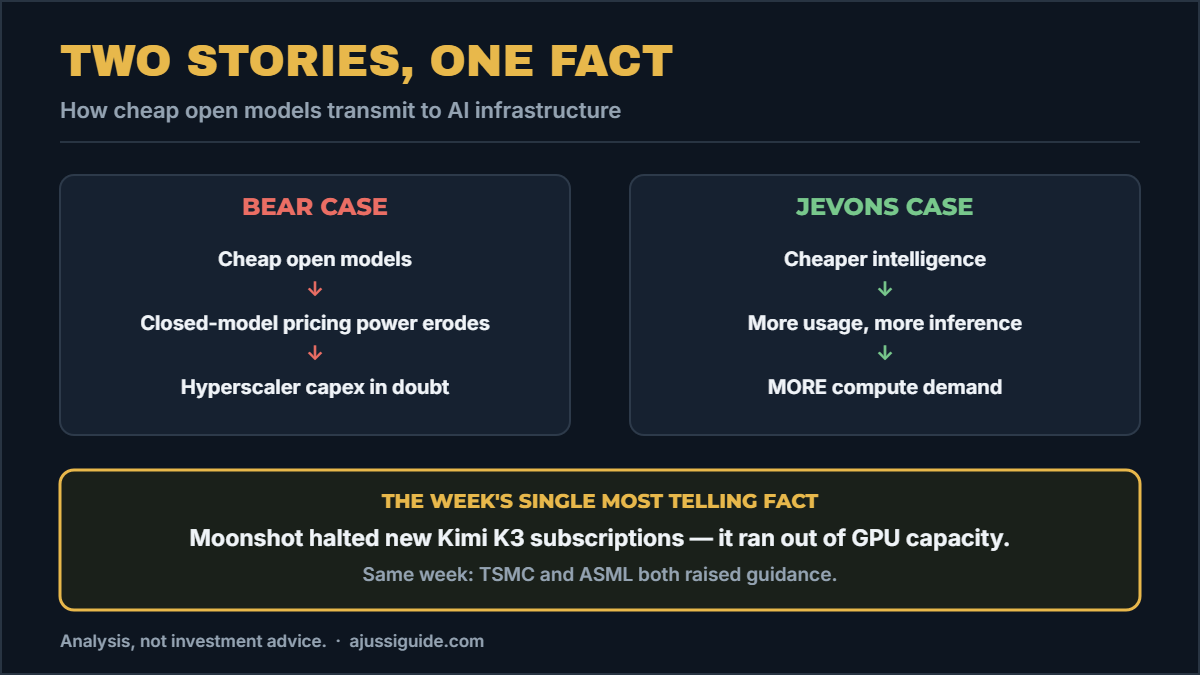
The bear case says cheap, capable open models destroy the pricing power that justifies hyperscaler capex. But the single most telling fact of the week points the other way: Kimi K3’s demand surged so fast that Moonshot halted new subscriptions because it ran out of GPU capacity. Cheaper intelligence appears to mean more usage, not less compute — the Jevons paradox playing out in real time.
It is also worth noting that in the same week the Kimi K3 selloff raged, TSMC and ASML both raised guidance, and the SOX bounced back over 2% on July 20 as analysts called the panic overdone. Nvidia’s Jensen Huang told Axios the market “misunderstood the impact of DeepSeek the first time” and has “misunderstood the impact of Kimi again, this time.”
| Status | What we know |
|---|---|
| Confirmed | Kimi K3 launch (7/16, weights promised 7/27); Qwen3.8-Max preview (7/19); SOX bear market and worst week since April 2025; Bessent sanctions warning (7/21–22); Little Tech letter (~200 startups, 7/22); Moonshot subscription pause on GPU limits; TSMC/ASML guidance raises |
| Likely transmission | Margin pressure on closed-model pricing; near-term volatility premium on AI-linked semis; inference demand growth if open models proliferate |
| Scenario | If distillation sanctions land, U.S. open-source ecosystem and startups relying on Chinese weights face cost resets; if weights ship 7/27 as promised, a second sentiment wave is possible |
| Unknown | Whether Commerce actually drafts Entity List designations; Qwen 3.8 open-weight timing; how much of the $3.3T loss reverses as attribution gets sorted |
Key Names to Watch (not a buy list)
Nvidia (NVDA) — the representative case for the whole kimi k3 selloff debate: sold off on demand-destruction fears while its biggest customers kept buying compute. Micron (MU) — if cheap models drive inference volume, memory demand is the quiet beneficiary; it also sits inside the separate memory bear market we covered this week.
Cadence (CDNS) — the market briefly questioned whether open Chinese models threaten EDA moats; the disagreement itself is worth watching as a sentiment gauge. Exposure here is indirect and sentiment-driven for most infrastructure names — the physical buildout (power, cooling, networking) did not change this week.
Ajussi’s Strategy (a watching frame, not advice)
Short term: three dates matter — July 27 (do Kimi K3 weights actually ship?), upcoming hyperscaler earnings (does capex guidance blink?), and any Commerce Department follow-through on Bessent’s warning. Longer term: track token prices versus inference volume. If prices fall but volume rises faster, the infrastructure trade survives cheaper models — that is the single ratio this whole episode turns on.
Risk path: a broad U.S. ban on Chinese open weights would hit American startups using them first, and a second wave of the Kimi K3 selloff on the 7/27 weights release cannot be ruled out.
Related Reading
More context on the cluster this kimi k3 selloff runs through:
- Why Are Memory Stocks Falling Despite Record Earnings? — this week’s other selloff, same sentiment engine
- AI Capex Tracker — the hyperscaler spending this debate is really about
- Grid Infrastructure Stocks: 7 Plays for AI Electricity Demand — the physical layer that does not care which model wins
Prices and figures as of July 23, 2026. Market-loss tallies and exchange counts are as reported by media and company statements, not independently verified. This is analysis for educational purposes, not investment advice. Do your own research.