⚡ Ajussi Market Watch — July 24, 2026
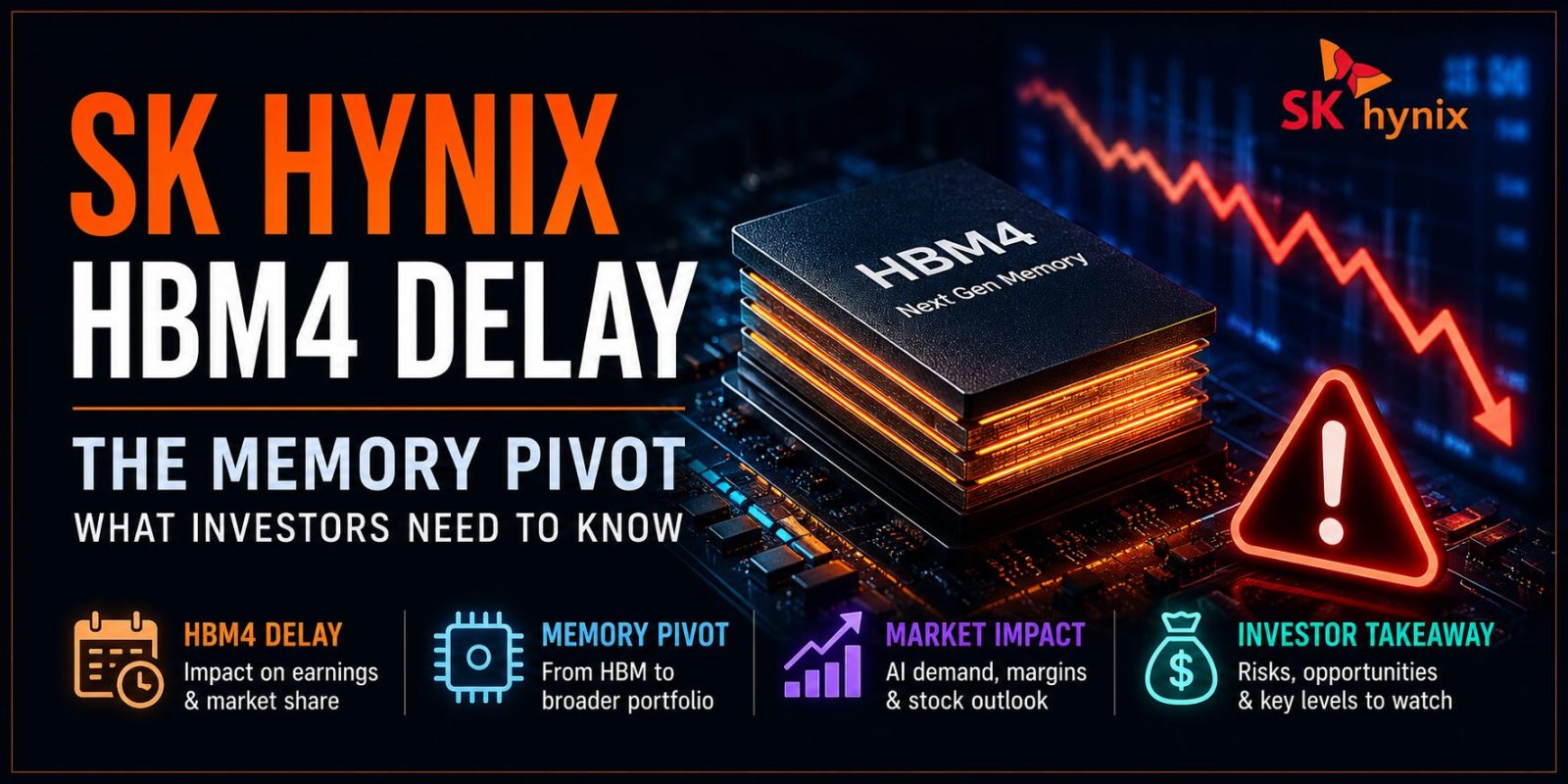
Trending now: “sk hynix hbm4 delay” — two weeks after its +13% Nasdaq debut, the world’s HBM leader is slowing its next-generation AI memory ramp. The market read it as weakness. The numbers say something closer to the opposite.
Today’s Lens: Semiconductor (Memory). This card does not cover NAND industry dynamics or Korean macro — only what the sk hynix hbm4 delay means for AI infrastructure investors.
What Happened: The SK Hynix HBM4 Delay, Explained
On June 23, industry sources reported that SK Hynix was delaying the conversion of some fifth-generation HBM (HBM3E) production lines to HBM4, redirecting that capacity to general-purpose DDR5 instead. The reason is unusual: commodity DRAM margins have caught up with — and by some analyst estimates, overtaken — HBM margins, with DDR5 operating margins projected to approach 90% amid a severe server-memory shortage, according to DigiTimes and TrendForce reporting.
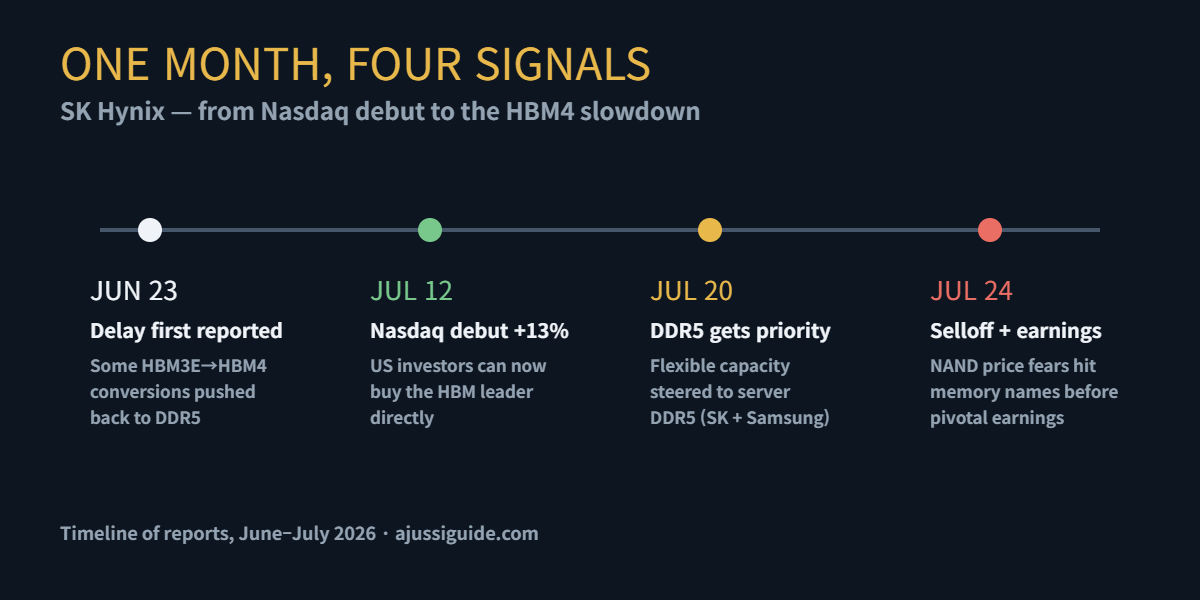
Then came the July sequence. On July 12, SK Hynix listed on the Nasdaq and jumped 13% on debut — giving US retail investors direct access to the HBM leader for the first time. On July 20, reports said both Samsung and SK Hynix were steering flexible DRAM capacity toward server DDR5 while holding existing HBM commitments. And this week, NAND price fears dragged memory names lower just as a pivotal earnings season approaches — with HBM4 prices forecast to run roughly 2.5× higher in 2027 than this year.
Why the HBM4 Delay Is a Margin Story, Not a Demand Story
The bearish read says: if SK Hynix is slowing HBM4, AI demand must be cracking. But the mechanics point the other way. The company is not walking away from HBM — it is harvesting a commodity DRAM shortage so extreme that ordinary DDR5 now rivals its premium AI product on margin. That is what an overheated memory market looks like, not a cooling one.
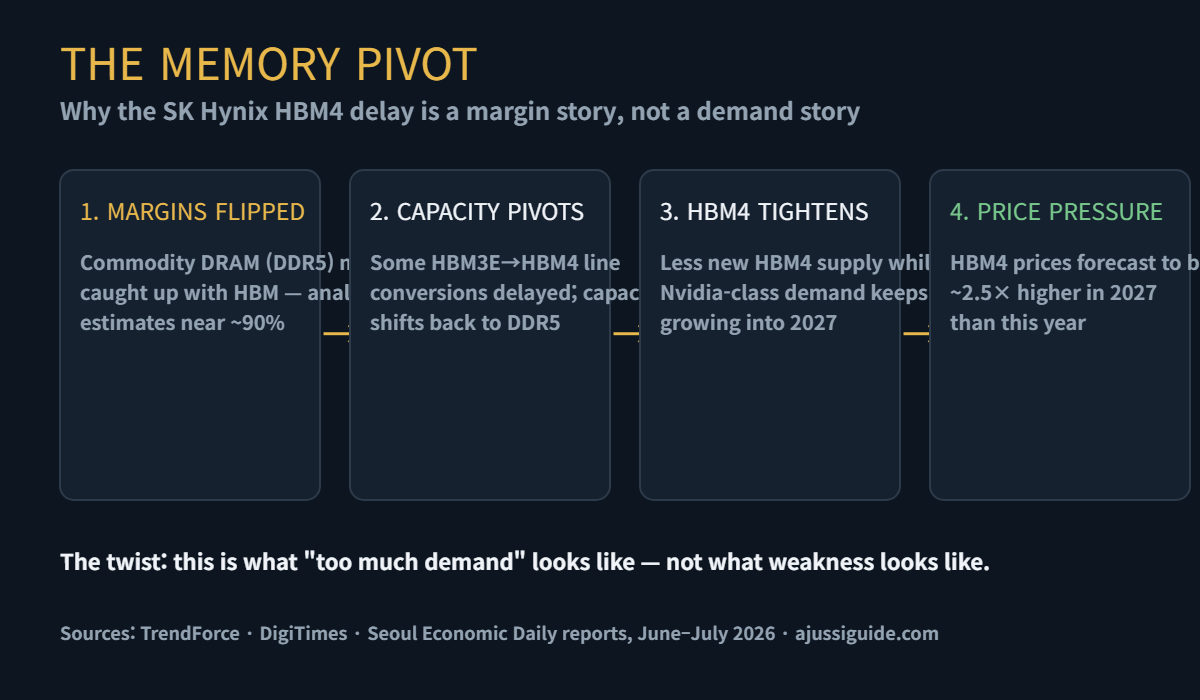
The transmission channel matters for everything downstream: less new HBM4 supply into 2027 while Nvidia-class demand keeps growing means tighter HBM4 pricing — which flows into AI accelerator costs and, ultimately, the hyperscaler budgets we follow in our AI Capex Tracker. It also rhymes with the pattern we flagged in why memory stocks were falling despite record earnings: the memory cycle and the AI trade are now the same story told in two languages.
Fact Check: Confirmed vs. Scenario
| Label | Statement |
|---|---|
| Confirmed | SK Hynix Nasdaq debut +13% (Jul 12); memory names sold off this week on NAND price fears; earnings season imminent |
| Likely Transmission | HBM3E→HBM4 conversion delays and DDR5 reprioritization (multiple industry reports, not formal disclosure); DDR5 margins near HBM levels |
| Scenario | HBM4 prices ~2.5× in 2027; a tighter HBM market lifting the whole memory complex through 2027 |
| Unknown | Official SK Hynix confirmation; impact on Nvidia Rubin timelines; Samsung’s HBM4 response |
Key Names to Watch (not a buy list)
SK Hynix — the direct actor, now tradable on Nasdaq; its earnings call is the single best source of confirmation. Micron (MU) — a tighter HBM4 market and rising DDR5 prices are both tailwinds, though it sits inside the same volatile cycle. Samsung Electronics — the swing factor: if it fills the HBM4 gap, the supply story softens. Nvidia (NVDA) — watches from the cost side: pricier HBM4 pressures next-generation accelerator margins, echoing the demand questions from the Kimi K3 selloff.
Ajussi’s Strategy (a watching frame, not advice)
Short term, three things to watch: ① memory earnings guidance this season — do companies confirm the DDR5 pivot? ② any official SK Hynix statement on HBM4 cadence, ③ HBM4 contract-price reports for 2027. Longer term, track the ratio of commodity DRAM margin to HBM margin — as long as they stay close, capacity keeps sloshing between them and memory pricing stays firm. The risk path: if NAND weakness spreads into DRAM pricing, the margin-flip thesis unwinds and this becomes an ordinary cycle top.
Frequently Asked Questions
Why is SK Hynix delaying HBM4?
Reports point to economics, not weakness: commodity DDR5 margins have risen to near-HBM levels amid a server-memory shortage, so delaying some HBM3E→HBM4 line conversions lets SK Hynix capture record general-DRAM profits while keeping existing HBM commitments.
Does the sk hynix hbm4 delay mean AI demand is slowing?
The evidence suggests the opposite — overall memory demand is so strong that even commodity chips earn premium margins. The delay tightens future HBM4 supply into growing AI demand, which is why 2027 HBM4 prices are forecast sharply higher.
Who benefits from the HBM4 delay?
Potential beneficiaries include memory makers exposed to rising DDR5 and HBM pricing (SK Hynix itself, Micron, Samsung). Potential cost pressure lands on accelerator makers that buy HBM4, led by Nvidia. This is an observation frame, not a buy list.
This article is for information only and is not investment advice. Markets move fast — verify current prices and disclosures before acting.