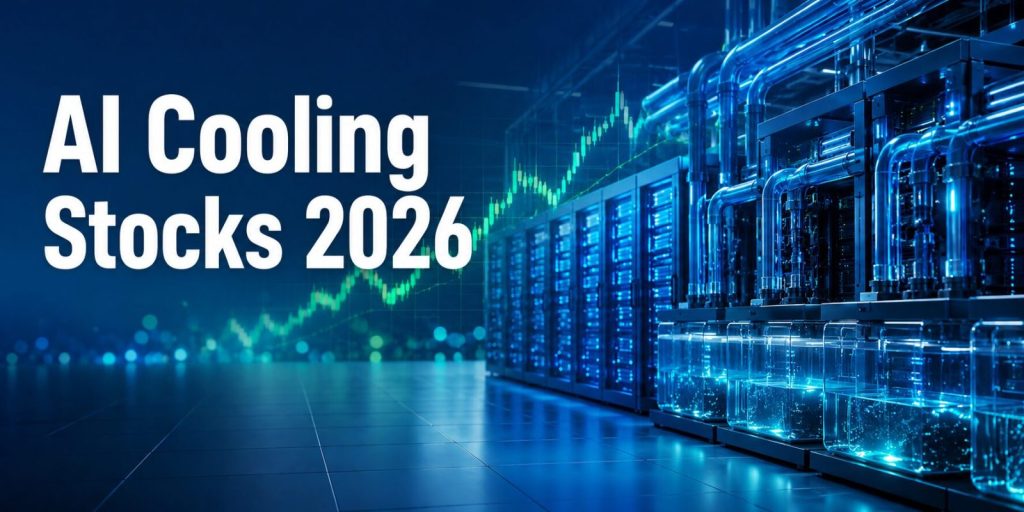
AI data center cooling stocks may be the most overlooked corner of the entire AI infrastructure trade right now, and I’ve been watching this sector quietly heat up (pun intended) for the past two years from my desk in Seoul and my brokerage account in the US.
My name is Ajussi. I’ve been investing for over 30 years, through the dot-com crash, the 2008 meltdown, and the COVID whipsaw. I don’t chase hype. But when I see a structural, unavoidable problem that every tech company on the planet has to solve, I pay very close attention.
The problem right now? AI chips run hot. Extremely hot. And the data centers housing them are running out of ways to keep up using old-school air cooling. That creates a real, durable investment opportunity, if you know where to look.
Why AI Data Center Cooling Stocks Deserve Your Attention Right Now
Let me give you the simple version. NVIDIA’s latest GPU chips, the Blackwell generation, consume dramatically more power per rack than anything data centers were designed to handle even five years ago. We’re talking about racks that now require 60 to 100 kilowatts or more of power, versus the 10 to 20 kilowatts that older rack designs assumed.
Traditional air cooling simply cannot remove that much heat fast enough. The physics don’t work. That’s forcing every hyperscaler, including Microsoft, Google, Amazon and Meta, to retrofit existing facilities and build brand-new ones with advanced thermal management baked in from day one.
According to the International Energy Agency’s Electricity 2024 report, the agency projected in 2024 that global data center electricity consumption could roughly double between 2022 and 2026. Cooling is one of the larger non-IT loads in that total, and the share varies widely by site and climate. What matters for this layer is the direction: more power delivered means more heat to remove, on multi-year contracts.
This isn’t speculative. The capex is already committed. The hyperscalers have announced hundreds of billions in data center spending for the next few years. The cooling companies are the picks-and-shovels play inside the picks-and-shovels.
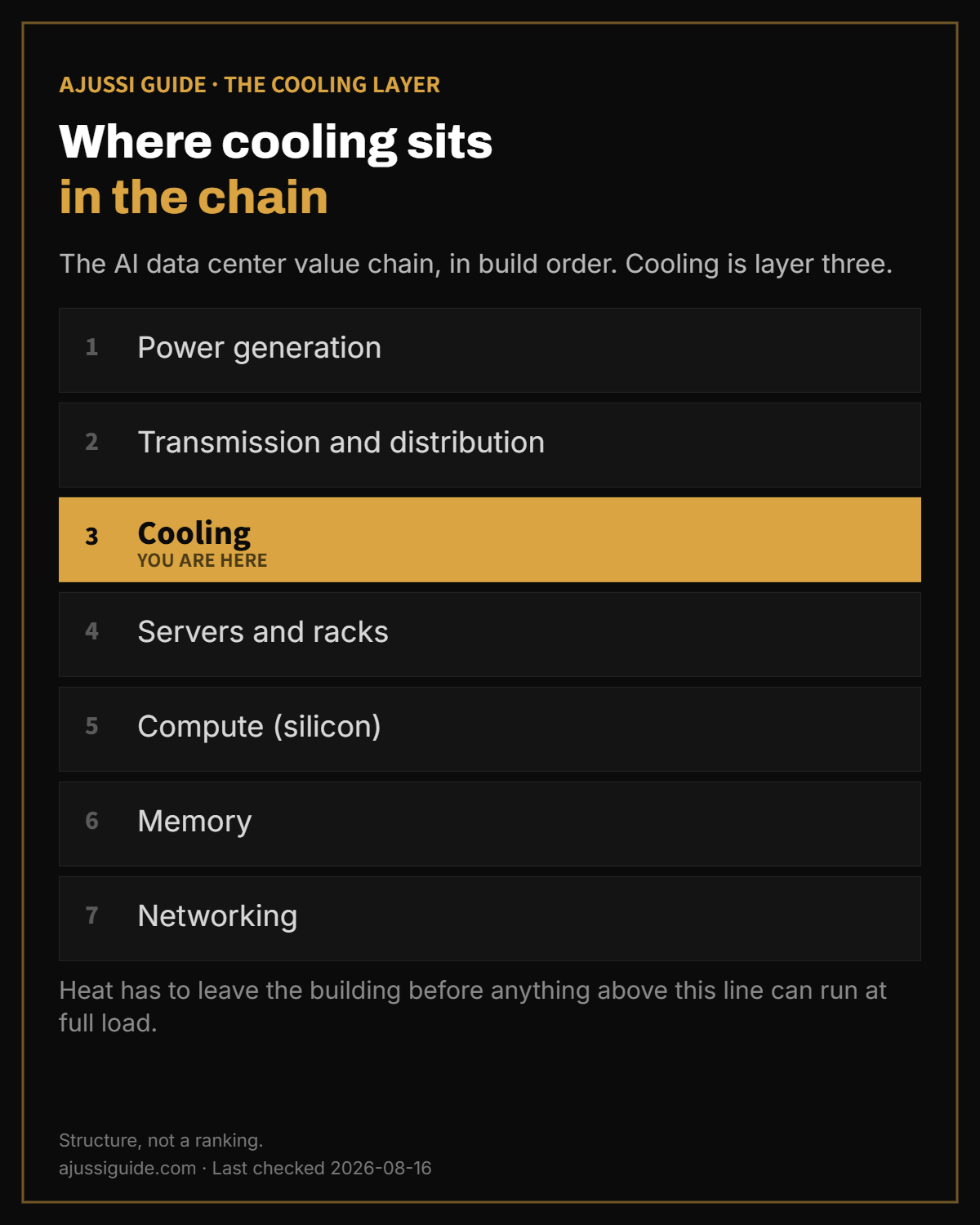
The Two Main Technologies You Need to Understand
Air Cooling: The Old Guard Still Has a Role
Precision air conditioning and computer room air handling units aren’t going away overnight. Legacy data centers, meaning older enterprise facilities and colocation buildings, will continue to rely on air-based systems for years. Companies serving this segment still generate strong, recurring revenue from maintenance contracts and retrofits.
The key is understanding that air cooling is a slow-decay business, not a dying one. Companies that also have a liquid cooling roadmap are better positioned than those that are purely air-focused.
Liquid Cooling: Where the Growth Is
This is the segment I’m most interested in. There are two primary flavors: direct liquid cooling (DLC), where cool liquid runs directly through cold plates attached to chips, and immersion cooling, where servers are submerged in a dielectric fluid bath. Both are far more efficient than air at extreme power densities.
The industry consensus, backed by commentary from major chip and server manufacturers, is that liquid cooling will become effectively mandatory for AI training clusters within the next few years. That’s not a guess. It is an engineering constraint.
The AI data center cooling stocks landscape, by technology zone
Before the individual names, it helps to see where each company actually operates. Cooling is not one business, and it is not three neat boxes either. It is three technology zones, and a single company often works in more than one of them. Sorting names into exclusive tiers is what trips up new investors, because it hides the overlap.
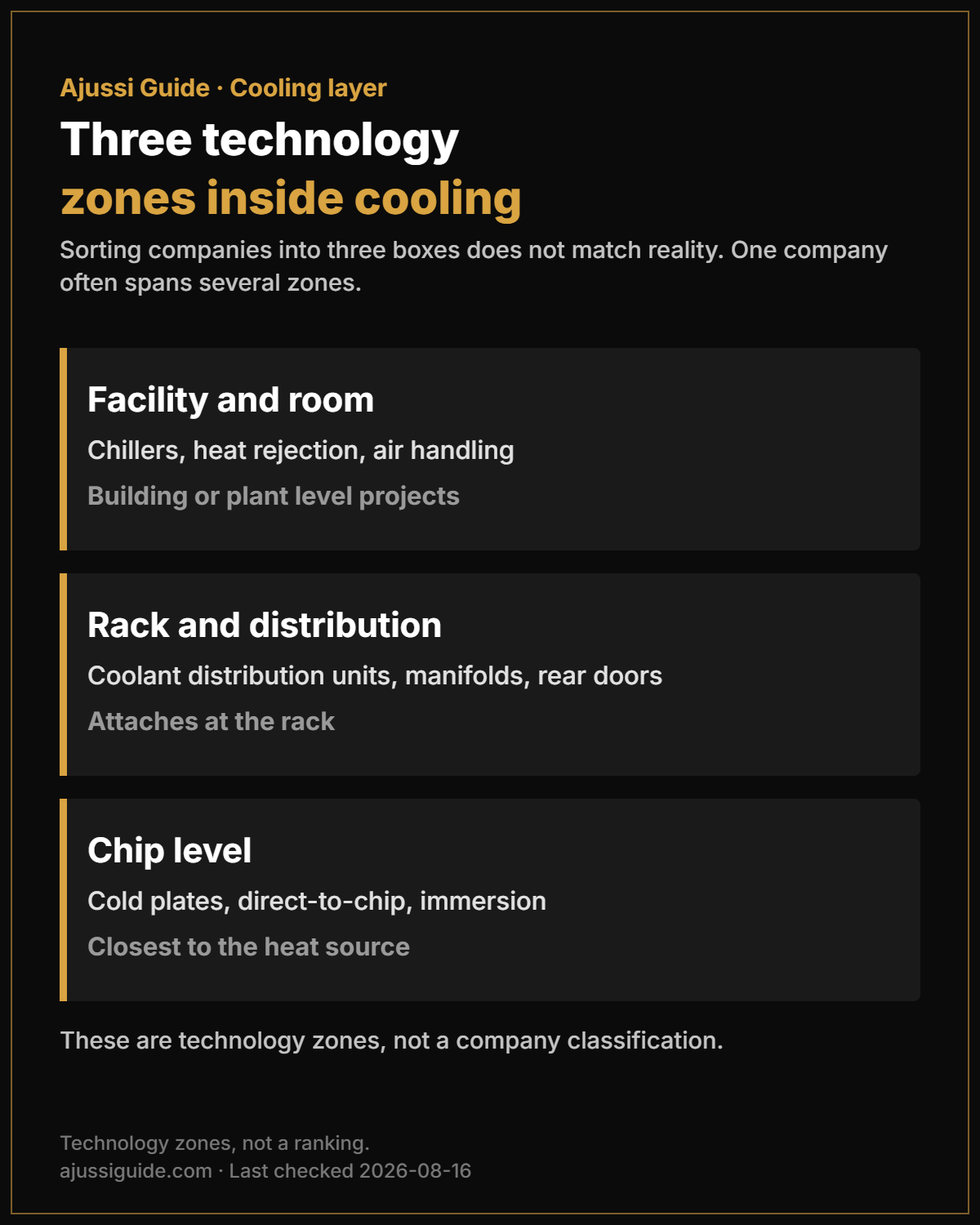
Facility and room zone
Chillers, heat rejection, indoor air handling. Work here lands as building or cooling plant level projects, and several pieces of equipment are often supplied together as one system. Order sizes are the largest in this layer.
Rack and distribution zone
Coolant distribution units, manifolds, rear door heat exchangers. This equipment attaches at the rack rather than at the building, so the volumes track rack deployments rather than construction contracts. The revenue rhythm is different even when the end demand is identical.
Chip level zone
Cold plates, direct-to-chip liquid cooling, and full immersion. This is the zone closest to the heat source and the loudest story in the layer. It is also the hardest to buy directly, because the immersion specialists are mostly private.
| Company | What it does here, and how the business is disclosed |
|---|---|
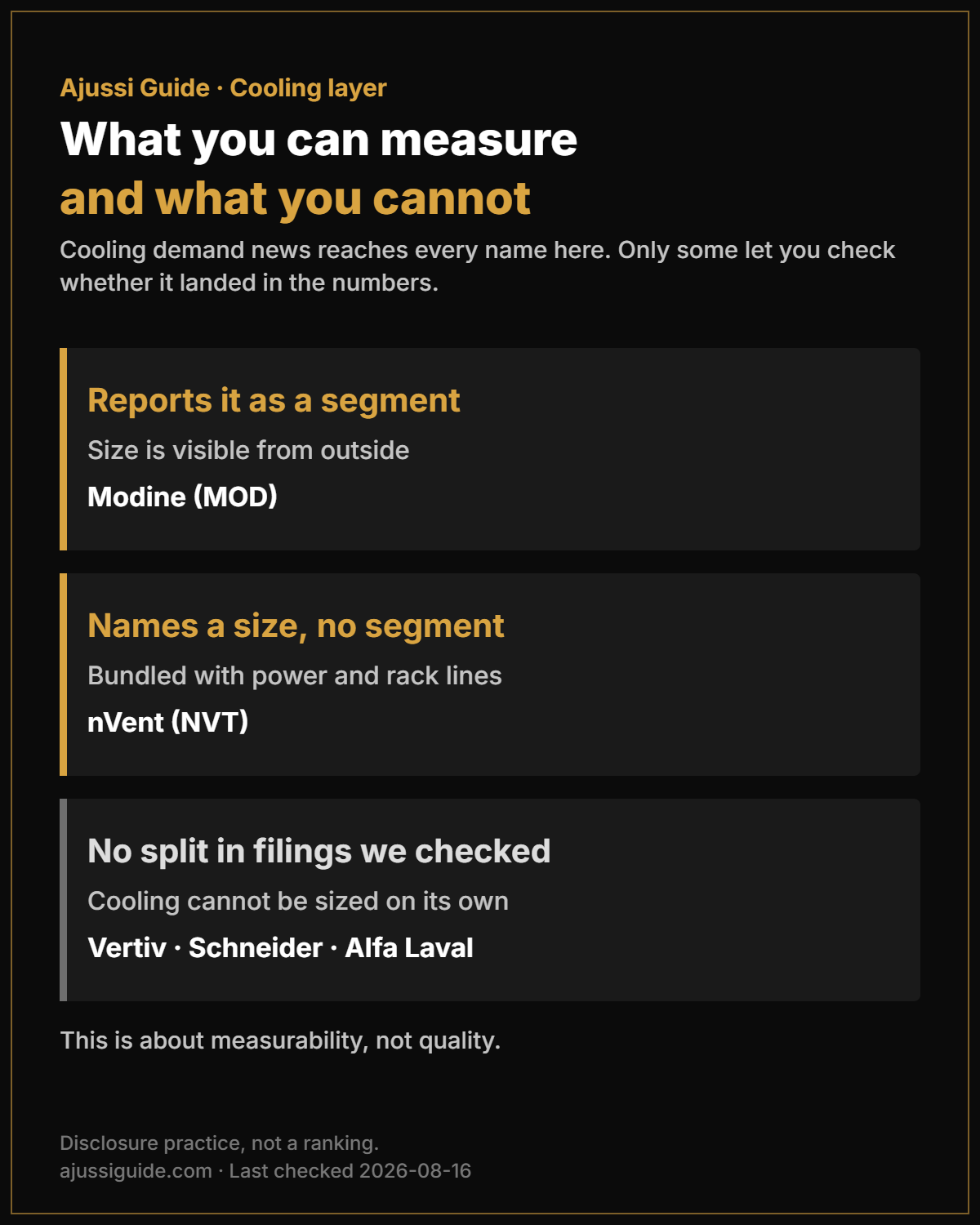
| Vertiv (VRT) | Room and rack level thermal systems, sold to operators as a package No standalone cooling split in the filings we checked |
| Schneider Electric (SBGSY) | Data center power and cooling systems, ADR of a large European group No standalone cooling split in the filings we checked |
| Modine (MOD) | Heat exchange, including data center coils and coolant loops Breaks out data center revenue in its reporting, so the size is visible from outside |
| Alfa Laval (ALFVY) | Heat exchangers, ADR of a Swedish industrial group No standalone cooling split in the filings we checked |
| nVent (NVT) | Data center liquid cooling and high density power enclosures Names a size for the business but does not report it as a standalone segment. This is not the old Thermal Management segment, which the company divested in January 2025 |
| Immersion specialists | Full immersion tanks and fluids Mostly private, so there is nothing to check from outside |
The second column is the part worth reading twice. Two companies can both be correctly described as cooling companies while one lives or dies on data center demand and the other barely moves on it. Buying the second one as an AI cooling position is a common and expensive mistake.
7 Categories of AI Data Center Cooling Stocks Worth Researching
I’m not going to tell you to buy any specific stock at a specific price. Markets change, valuations shift, and you need to do your own homework. What I will do is map out the landscape so you know where to dig.
1. Vertiv Holdings (VRT)
Vertiv is the name I hear most often in professional circles when the topic of data center thermal management comes up. They make power management and cooling infrastructure for data centers, and they’ve been growing their liquid cooling product line aggressively. Their management has spoken extensively about AI-driven demand on recent earnings calls. Check their investor relations page for the latest guidance.
2. Modine Manufacturing (MOD)
Modine is a smaller, less-followed name that has been pivoting its data center cooling segment toward high-density AI applications. It now markets its data center cooling under the “Airedale by Modine” brand, with products like the TurboChill and EdgeDX series aimed at hyperscale and colocation customers. Smaller cap means more volatility, but also potentially more upside if execution is strong.
3. Schneider Electric (SBGSY)
The French industrial giant has a massive data center infrastructure division, including cooling systems. US retail investors can access it via the OTC-listed ADR. Schneider is the slow-and-steady option here: large, diversified, and with a long history of serving enterprise data center customers.
4. Alfa Laval (ALFVY)
A Swedish engineering company with a strong heat transfer and thermal management business increasingly targeting data centers. Their liquid cooling products are gaining traction with European hyperscalers, but their technology is globally applicable. Another ADR option for US investors wanting international exposure.
5. nVent Electric (NVT)
nVent has become a notable liquid cooling beneficiary. Its electrical connection and protection portfolio now includes liquid cooling solutions for data centers, and management has highlighted surging orders tied to AI data center demand. It’s a more direct cooling play than many diversified industrials. Review their recent earnings for the latest data center order momentum.
6. Pure Play Immersion Cooling (Private Watch List)
Companies like GRC (Green Revolution Cooling) and LiquidStack are private as of this writing. Keep them on your radar for potential IPOs. When they do go public, the AI data center cooling investment thesis will likely be front and center in their S-1 filings.
7. Data Center REITs with Cooling Infrastructure Exposure
Equinix (EQIX) and Digital Realty (DLR) are not cooling companies. They are landlords who are spending on next-generation cooling to attract AI workload tenants, which means their link to this layer runs through leasing decisions rather than equipment sales. Worth knowing where they sit before treating a REIT headline as a cooling signal.
What to Watch: Key Risk Factors
I’ve been burned enough times to take risk seriously. Here are the main ones for this sector.
Technology transition risk: If a new cooling technology emerges that makes current liquid cooling approaches obsolete sooner than expected, smaller companies could be caught flat-footed. This is a fast-moving engineering space.
Hyperscaler capex cycles: These companies can and do cut spending during economic downturns. A prolonged recession could slow data center buildouts, even if AI demand remains structurally intact. Watch quarterly capex guidance from Microsoft, Google, Amazon, and Meta closely. They are the demand signal for this entire ecosystem.
Valuation risk: Some of these names have already re-rated significantly as the AI infrastructure trade has gained mainstream attention. Buying at the wrong point in the valuation cycle is a real risk. As of recent reporting, several cooling-adjacent stocks trade at premiums to historical multiples. Be patient, use dollar-cost averaging, and don’t chase.
Execution risk: Smaller companies in this space are scaling manufacturing rapidly to meet demand. Supply chain issues, production delays, or customer concentration risk (one or two big hyperscaler contracts) can create significant earnings volatility.
For more detail on the hyperscaler capex trends driving this demand, Reuters Technology covers this beat consistently and is a reliable source for earnings reaction and capex announcement news.
Ajussi’s Honest Take
I hold a position in this theme. I am not all in, and I am not going to tell you what to do with yours. What I can tell you is what I check before adding to it: whether the cooling line is actually large enough inside that company to move the whole business, and whether the demand behind it is contracted or merely announced.
What I am saying is that the structural demand for AI data center cooling is not going away. Every new AI chip generation runs hotter. Every new hyperscaler cluster requires more sophisticated thermal management. The engineering problem is getting harder, not easier, and that is a tailwind that should persist for years.
The companies that solve this problem reliably, at scale, with strong customer relationships, will compound nicely over the next decade. Find them, understand them, and be patient. That’s the Ajussi way.
Frequently Asked Questions
What are AI data center cooling stocks?
AI data center cooling stocks are shares in companies that manufacture, sell, or deploy thermal management and cooling infrastructure specifically for data centers running AI workloads. This includes makers of liquid cooling systems, precision air conditioning units, heat exchangers, and related equipment. As AI chips generate more heat per rack, demand for advanced cooling solutions has grown significantly.
Is liquid cooling better than air cooling for AI data centers?
For high-density AI computing environments, particularly those using the latest GPU clusters, liquid cooling is generally more efficient and effective than traditional air cooling. Air cooling struggles to remove heat fast enough at power densities above roughly 20–30 kilowatts per rack, while liquid cooling systems can handle 60 kilowatts per rack and beyond. That said, air cooling remains cost-effective for lower-density workloads and legacy facilities.
How do I invest in AI data center cooling as a US retail investor?
US retail investors can access this theme through US-listed stocks like Vertiv (VRT) and Modine (MOD), through ADRs of international companies like Schneider Electric (SBGSY) and Alfa Laval (ALFVY), or indirectly through data center REITs like Equinix (EQIX) and Digital Realty (DLR). ETFs focused on AI infrastructure or data center themes may also provide diversified exposure. Always review a company’s latest SEC filings or annual reports before investing.
🖥️ Ajussi’s Trading Desk Gear
Watching this sector means watching a lot of charts. The gear guides I actually researched for my own desk:
📊 Best Monitors for Stock Trading (2026)
🦾 Best Dual Monitor Arms for a Clean Setup
🔌 Thunderbolt 5 and USB-C Docks: one cable desk
💡 Best Monitor Light Bars: save your eyes at night
Disclaimer: This article is for informational purposes only and is not financial advice. Do your own research.
Last checked: 2026-08-16. Company roles are reviewed quarterly; next review due November 2026.
Related posts
- Liquid Cooling Stocks: where the money is concentrating inside this layer
- Immersion vs Direct Liquid Cooling: the two methods compared, and who sells each
- Liquid Cooling Suppliers: the parts vendors sitting behind the rack builders
- Data Center Water Stocks: the water side of cooling, and why it is a separate constraint
- Data Center Cooling ETF: if you would rather not pick a single name
- Transformer Stocks: the layer next door, getting power to the room in the first place