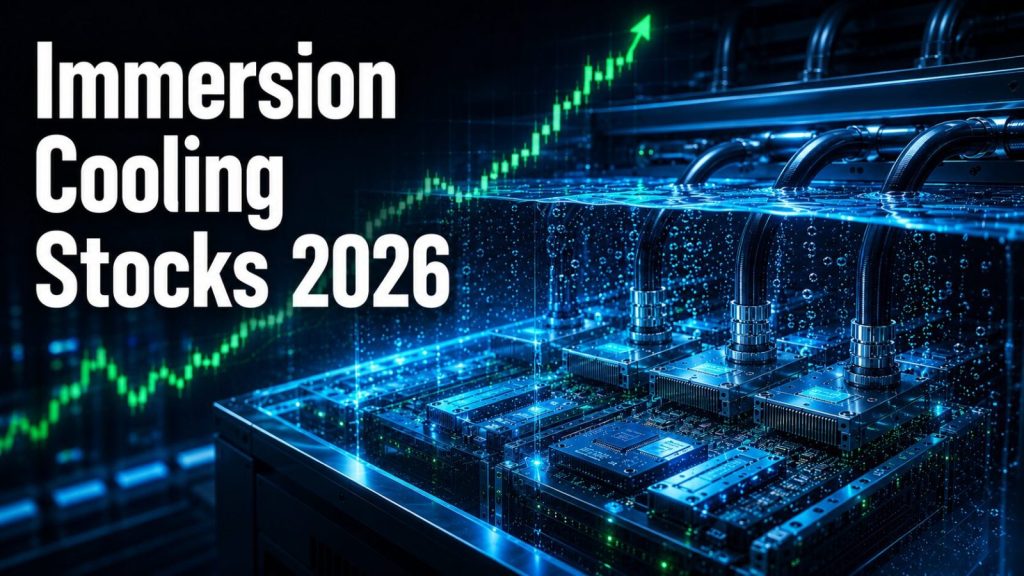
Immersion cooling stocks are quietly becoming one of the most compelling infrastructure plays in the AI era — and if you’ve been sleeping on them, Ajussi is here to shake you awake before the crowd arrives.
I’ve watched a lot of market cycles over the years. The railroad boom, the fiber-optic bubble, the cloud buildout. Every time a transformative technology scales up, the companies that handle the boring-but-essential infrastructure end up printing money for patient investors. Right now, that boring-but-essential layer is thermal management for AI data centers.
Let me explain why immersion cooling matters, which companies are worth watching, and how to think about this sector without getting burned by hype.
Why Immersion Cooling Stocks Are Heating Up in 2026
Modern AI accelerators — think NVIDIA’s H100 and B100-series GPUs — generate enormous amounts of heat. Traditional air cooling simply cannot keep up at scale. A single AI server rack today can draw 60 to 120 kilowatts of power, compared to the 5–10 kW that old-school enterprise racks consumed. You can blow all the cold air you want; physics eventually wins.
Immersion cooling solves this by submerging servers directly in a thermally conductive, electrically non-conductive dielectric fluid. Heat transfers from the chips into the liquid far more efficiently than air allows. According to the International Energy Agency’s Electricity 2024 report, data centers already account for roughly 1–1.5% of global electricity demand, and that figure is projected to grow sharply as AI workloads multiply. Cooling is a giant slice of that energy budget.
When hyperscalers like Microsoft, Google, and Amazon need to squeeze more compute into the same square footage — while also hitting sustainability targets — immersion cooling moves from a niche curiosity to a strategic necessity. That’s why the capital is starting to flow into this corner of the market.
Two Main Types of Immersion Cooling You Should Understand
Before we talk about specific immersion cooling stocks, you need to know the difference between the two primary technologies. They’re not the same investment risk profile.
Single-Phase Immersion Cooling
In single-phase systems, the dielectric fluid stays liquid the whole time. It absorbs heat, gets pumped out to a heat exchanger, cools down, and cycles back. This is simpler and more mature technology. Companies like Vertiv Holdings (VRT) and Submer (private) operate here. Single-phase is easier to retrofit into existing data centers.
Two-Phase Immersion Cooling
Two-phase systems use a fluid that actually boils at low temperatures, turns to vapor (carrying heat away), condenses back to liquid at the top of the tank, and drips back down. It’s more thermally efficient but also more complex and costly. 3M used to dominate this space with its Novec fluid line before exiting the market, which reshuffled the competitive landscape. Engineered Fluids and startups like GRC (Green Revolution Cooling) have been gaining share as alternatives.
For publicly traded investors, two-phase exposure is harder to get in pure-play form right now. Most pure-play two-phase companies are still private. That’s actually important context for evaluating your options.
Immersion Cooling Stocks and Related Plays Worth Watching
Let me be honest with you the way a good uncle should be: there is no perfect, pure-play publicly traded immersion cooling stock in the US market right now that trades on a major exchange with high liquidity. The pure plays are mostly still private or small. What you can do is build exposure through a mix of direct and adjacent positions. Here’s my current watchlist.
Vertiv Holdings (VRT)
Vertiv is probably the most accessible name for US retail investors seeking thermal management exposure. The company makes data center power and cooling infrastructure, and it has been actively expanding its liquid cooling portfolio, including immersion solutions. As of recent reporting, Vertiv has cited strong order growth tied to AI infrastructure demand. It’s not a pure-play, but it’s a liquid, large-cap way to participate.
Modine Manufacturing (MOD)
Modine is a thermal management specialist that has been pivoting its data center cooling segment aggressively. Their Climate Solutions division sells liquid cooling and hybrid cooling systems to hyperscalers. Management has publicly highlighted data centers as a key growth engine on recent earnings calls. Smaller cap than Vertiv, more torque on the upside — and more risk, too.
Schneider Electric (SBGSY) — ADR
Schneider is a French industrial giant that trades as an ADR in the US. They offer integrated data center cooling solutions including immersion systems through their EcoStruxure platform. Schneider has the enterprise relationships and global scale that smaller players lack. The ADR adds currency risk, so keep that in mind.
NVIDIA (NVDA) — Indirect Beneficiary
Yes, Ajussi knows NVDA isn’t a cooling company. But here’s the logic: the more NVIDIA GPUs get deployed, the more immersion cooling infrastructure gets ordered. NVIDIA has also been an advocate for liquid cooling standards through its partnerships with ODMs and hyperscalers. It’s an indirect but real connection. You probably already own it. Just understand this part of the thesis.
Smaller Thermal Plays
Watch the smaller OEM and component space carefully. Companies supplying pumps, heat exchangers, dielectric fluids, and tank systems to integrators will benefit even if no single name dominates. This is where doing your own research on private-to-public transitions matters most — several well-funded private cooling startups are potential IPO candidates.
Comparison Table: Key Immersion Cooling Stocks and Related Infrastructure Plays
| Company | Ticker | Market Cap Category | Cooling Exposure Type | Pure-Play? | Key Risk |
|---|---|---|---|---|---|
| Vertiv Holdings | VRT | Large Cap | Liquid & Immersion Cooling Systems | No (diversified) | Valuation stretch at peak AI hype |
| Modine Manufacturing | MOD | Small/Mid Cap | Liquid Cooling, Data Center Thermal | Partial | Execution risk in pivot; smaller liquidity |
| Schneider Electric | SBGSY | Large Cap (ADR) | Integrated Cooling & Power Solutions | No (industrial conglomerate) | Currency risk; slower growth profile |
| NVIDIA | NVDA | Mega Cap | Indirect — GPU demand drives cooling demand | No | Regulatory, competition, concentration risk |
| GRC / Submer / Asperitas | Private | Private / VC-backed | Two-Phase & Single-Phase Immersion | Yes | Not accessible to retail; illiquid |
How Ajussi Is Thinking About This Sector Right Now
I’ll give you my honest framework. This sector is real — the underlying demand driver (AI compute scaling) is genuine and documented. But you need to separate the structural trend from the current valuation.
Several thermal management names ran hard in 2023 and 2024 as AI hype swept through the market. Some pulled back. Others are still pricing in years of perfect execution. That doesn’t mean you avoid them — it means you size your positions accordingly and watch for entry points on market-wide pullbacks rather than chasing momentum.
For a name like Vertiv, I’d encourage you to read their investor relations materials directly at Vertiv’s Investor Relations page to understand their backlog and guidance before building a position. Revenue backlog and book-to-bill ratios matter enormously in capital equipment businesses like this.
My personal approach: I hold a small core position in names with real cooling revenue today (not just promises), I watch the private company landscape for IPO candidates, and I revisit the sector every quarter when earnings roll in. Patience and position sizing are everything in infrastructure plays.
Frequently Asked Questions
Q: Are there any pure-play immersion cooling stocks I can buy on a US exchange today?
Not in a clean, large-cap form — not yet. The most direct publicly traded exposure in the US comes through diversified infrastructure companies like Vertiv (VRT) and Modine (MOD), which have meaningful but not exclusive cooling businesses. Pure-play immersion cooling companies of scale are mostly still private. This may change as the sector matures and consolidation or IPOs occur.
Q: How big is the immersion cooling market expected to get?
Multiple market research firms have published estimates projecting the global immersion cooling market to grow at compound annual growth rates in the high double digits through the late 2020s, driven by AI data center buildout. Specific figures vary by source and methodology, so treat any single number with appropriate skepticism. The directional trend — strong growth — is broadly consistent across reputable analysts. Always check the date and methodology of any market sizing report you cite to yourself.
Q: Is immersion cooling actually better than air cooling or direct liquid cooling (cold plates)?
Immersion cooling offers superior thermal density and can be more energy-efficient in the right deployment scenarios, but it comes with higher upfront costs, more complex fluid management, and supply chain considerations (dielectric fluid sourcing, for example). Cold-plate direct liquid cooling is often seen as an easier stepping stone for hyperscalers transitioning away from air. In practice, many large data centers will use a mix of technologies. For investors, this means the market is big enough for multiple winners — it’s not winner-take-all.
🖥️ Ajussi’s Trading Desk Gear
Watching this sector means watching a lot of charts. The gear guides I actually researched for my own desk:
📊 Best Monitors for Stock Trading (2026)
🦾 Best Dual Monitor Arms for a Clean Setup
🔌 Thunderbolt 5 & USB-C Docks — One-Cable Desk
💡 Best Monitor Light Bars — Save Your Eyes at Night
Disclaimer: This article is for informational purposes only and is not financial advice. Do your own research.