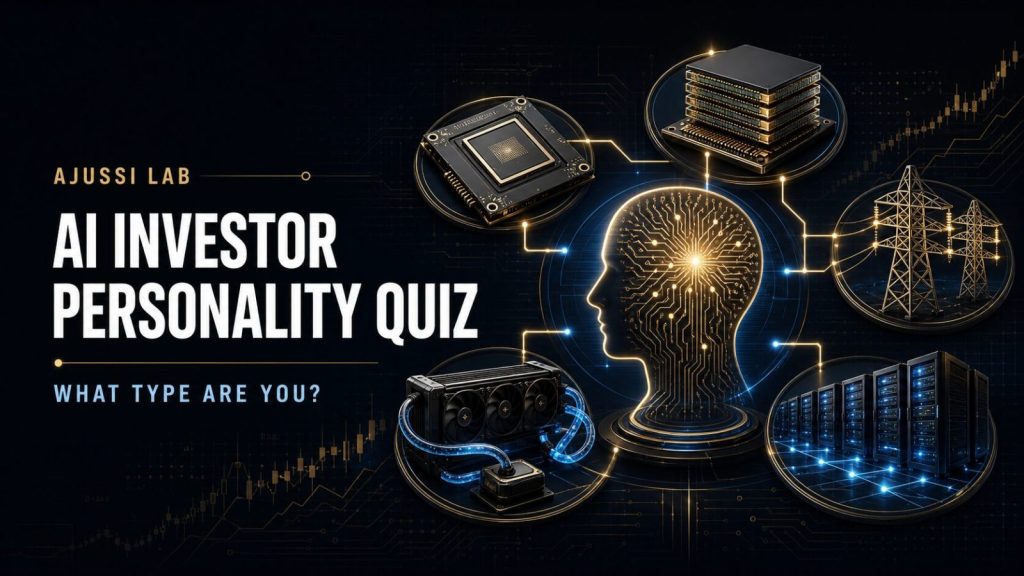
An AI investor personality quiz cannot tell you which stock will outperform next. What it can reveal is how you naturally interpret the AI infrastructure market—and which risks you may be inclined to overlook.
Some investors begin with computing platforms and technical leadership. Others follow memory, networking and semiconductor suppliers. A third group searches for physical bottlenecks such as electricity, cooling and data-center capacity, while valuation-focused investors concentrate on earnings expectations and the price already being paid for future growth.
This free quiz uses 15 scenario-based questions to identify those preferences. It takes about three minutes, requires no registration, and your answers never leave your browser or get stored anywhere.
Your result includes four affinity scores and one of five AI infrastructure investor profiles. You will also receive a summary of your natural research advantage, a potential blind spot, metrics worth monitoring and Ajussi Guide articles matched to your profile.
There are no correct answers. Choose the response that most closely reflects what you would actually investigate or do—not the answer that sounds most sophisticated.
15 questions • About 3 minutes
Discover how you approach compute, supply chains, physical bottlenecks and valuation discipline.
No sign-up required. Your answers stay in your browser.
Your AI investor profile
Metrics to watch
Questions to ask before investing
This profile is educational and reflects your quiz responses. It is not individualized investment advice, a regulated risk-tolerance assessment or a recommendation to buy or sell any security.
What Does the AI Investor Personality Quiz Measure?
The AI investor personality quiz measures four research preferences: Compute Conviction, Supply-Chain Preference, Physical Bottleneck Focus and Valuation Discipline.
Each answer contributes to a primary preference and a related secondary preference. The result converts those responses into four affinity scores on a 20–100 scale. These numbers do not represent investing ability, expected returns or financial risk capacity. They show which parts of an AI infrastructure thesis tend to receive most of your attention.
A relatively even set of scores may produce the Diversified AI Builder profile. A clear leading score points toward one of the four more specialized profiles. When two preferences are close but the overall profile is not balanced, the result may also display a secondary tendency.
Compute Conviction
Compute-oriented investors begin with processing performance, accelerator demand, platform adoption and software ecosystems. They often believe that the strongest computing platform can capture a disproportionate share of the value created by AI.
Their research advantage is recognizing durable technical leadership. Their challenge is separating a great technology from an attractive investment price and accounting for the physical infrastructure required to deploy it.
Supply-Chain Preference
Supply-chain investors look for the essential components and equipment required by multiple AI platforms. Memory, advanced packaging, networking, semiconductor equipment and specialized components are common areas of interest.
This approach can reduce dependence on a single platform winner. It can also introduce customer concentration, inventory corrections and oversupply risk when manufacturers expand capacity too aggressively.
Physical Bottleneck Focus
Bottleneck-focused investors examine the constraints that can delay or limit AI deployment. Their attention often moves toward electricity generation, grid connections, transformers, cooling systems, construction timelines and data-center capacity.
Scarcity can create pricing power and long order visibility. However, planned capacity is not the same as operating capacity, and capital-intensive projects remain exposed to permitting, financing and execution risk.
Valuation Discipline
Valuation-focused investors compare market expectations with earnings, margins, cash flow and realistic growth assumptions. They may adjust position sizes as prices and estimates move through an industry cycle.
This discipline can help prevent enthusiasm from becoming an oversized investment. Its potential weakness is waiting too long for an ideal entry price while durable businesses continue compounding.
The Five AI Infrastructure Investor Profiles
Your AI investor personality quiz result identifies the research perspective you use most naturally. It is not a permanent label. Investors can display characteristics from several profiles, and their preferences may change with experience, market conditions and portfolio objectives.
The Compute Conviction Investor
The Compute Conviction Investor begins with the platforms where AI intelligence is created. This investor follows accelerator performance, utilization, developer adoption and the strength of the surrounding software ecosystem.
The natural advantage of this profile is an ability to recognize technical leadership and platform effects. When a computing architecture becomes deeply embedded in customer workflows, its competitive position may become stronger than hardware specifications alone suggest.
The blind spot is assuming that technology leadership automatically produces an attractive investment. Valuation, customer concentration, competing architectures and physical deployment constraints can all weaken the return from an otherwise excellent business.
Compute-oriented investors can test their assumptions by examining how cheaper models affect inference demand in the Kimi K3 selloff analysis and tracking upstream spending through the Hyperscaler Capex Tracker.
The Picks-and-Shovels Builder
The Picks-and-Shovels Builder prefers the suppliers that multiple AI platforms require. Instead of relying on a single model or accelerator winner, this investor studies memory, advanced packaging, semiconductor equipment, networking and specialized components.
The profile’s advantage is value-chain awareness. Picks-and-shovels investors often trace a capital-spending announcement through the suppliers likely to receive actual orders. They look for confirmed customers, design wins, content growth and components that are difficult to replace.
Their blind spot is underestimating how cyclical an essential supplier can be. Customer concentration, inventory corrections, falling lead times and excessive capacity expansion can damage earnings even when long-term AI demand remains intact.
A useful starting point is Ajussi Guide’s map of AI infrastructure pick-and-shovel stocks. Investors focused on the memory layer can also compare manufacturers and cycle risks in the HBM memory stocks guide.
The Bottleneck Hunter
The Bottleneck Hunter looks for the physical constraints that AI expansion cannot avoid. Electricity, transformers, grid connections, cooling systems, construction timelines and available data-center capacity are central to this investor’s research.
This profile’s advantage is recognizing that AI is not only a software or semiconductor story. Computing equipment cannot generate revenue until facilities have sufficient power, cooling, networking and physical space to operate it.
The blind spot is treating current scarcity as permanent. High prices encourage competitors and new capacity, while efficiency improvements can reduce demand for a particular solution. Capital-intensive projects also face financing, permitting, construction and regulatory risks.
Bottleneck Hunters can examine the equipment and contractors behind rising electricity demand in the guide to grid infrastructure stocks. The comparison of SMR stocks and uranium stocks illustrates how two investments connected to the same power theme can carry very different execution risks.
The Cycle-Aware Strategist
The Cycle-Aware Strategist separates business quality from investment price. This investor compares revenue expectations, margins, free cash flow and valuation before deciding whether a promising AI company offers an acceptable risk-and-reward balance.
The profile’s advantage is expectation awareness. Cycle-oriented investors are less likely to assume that a strong industry automatically makes every entry price reasonable. They look for changes in earnings estimates, inventory, capacity utilization and investor positioning.
Their blind spot is excessive patience. Durable companies can remain expensive while earnings grow into their valuations, and waiting for a historically normal multiple may leave an investor underexposed to a structural expansion.
The recent memory stocks selloff offers a practical example of separating price movement from thesis movement. Investors can also evaluate competing evidence around the AI capital-spending boom rather than assuming that every large investment cycle is either completely sustainable or an obvious bubble.
The Diversified AI Builder
The Diversified AI Builder seeks exposure across the full infrastructure stack. This investor combines compute, memory, networking, power, cooling and data-center businesses instead of requiring one company or technology to capture the majority of AI’s economic value.
The profile’s advantage is systems thinking. Diversified Builders understand that each infrastructure layer depends on the others and that leadership can rotate as spending moves through the value chain.
Their blind spot is confusing the number of holdings with genuine diversification. Several AI funds may own the same large semiconductor companies, while apparently different infrastructure stocks may depend on the same hyperscaler customers and capital-spending cycle.
Diversified investors can compare fund focus, expenses and overlapping holdings in the guide to AI infrastructure ETFs. They can then consider whether data-center REITs add a meaningfully different source of exposure through buildings, power capacity and cooling.
Why Investor Personality Matters in AI Infrastructure
Investor personality influences which evidence receives attention and which risks remain invisible.
A Compute Conviction Investor may interpret a new accelerator architecture as evidence of a widening competitive advantage. A Picks-and-Shovels Builder may ask which memory, networking and equipment suppliers will receive the orders. A Bottleneck Hunter may focus on whether sufficient power and cooling exist to deploy the equipment. A Cycle-Aware Strategist may ask whether the expected growth is already reflected in the stock price.
None of these questions is sufficient by itself. A stronger research process combines the investor’s natural perspective with deliberate checks from the other profiles.
Investor personality is also different from financial risk capacity. An individual may enjoy researching concentrated technology investments while still needing a diversified portfolio because of income requirements, time horizon or financial obligations. The SEC’s Investor.gov resources explain why risk tolerance and asset allocation should be evaluated in the context of personal circumstances.
Use your AI investor personality quiz result as a prompt for better questions—not as permission to take more risk.
How the AI Infrastructure Stack Fits Together
AI infrastructure operates as an interconnected system:
Compute → Memory and Networking → Power and Cooling → Data Centers
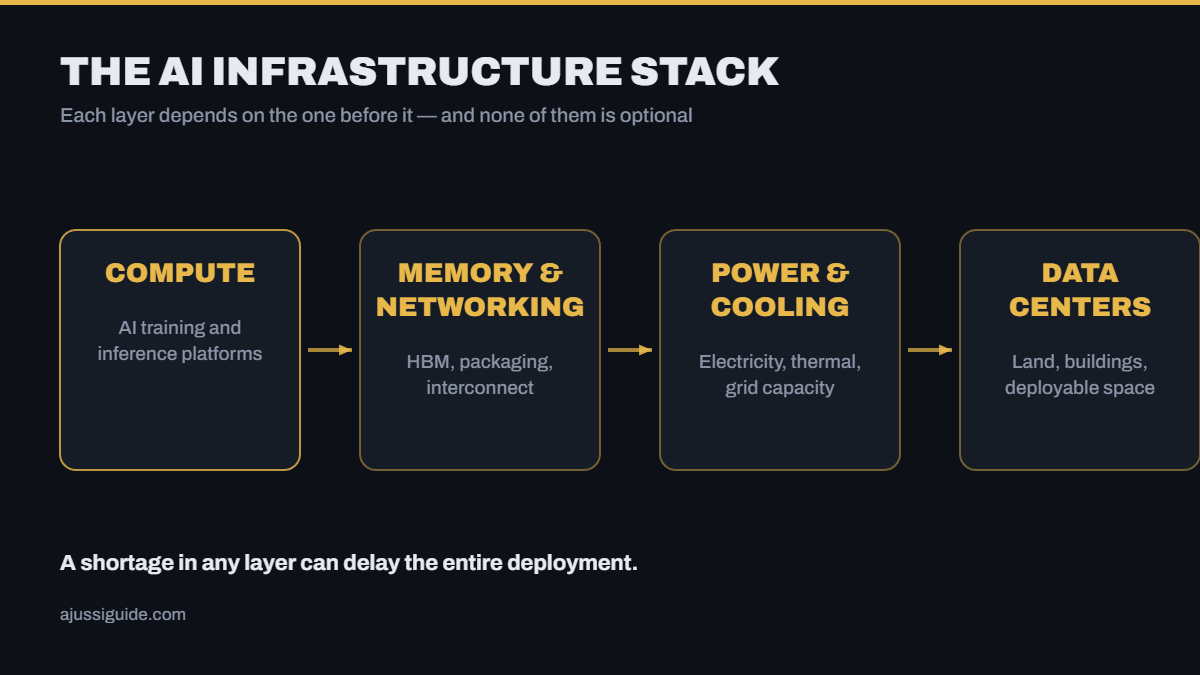
Compute platforms perform AI training and inference, but processors cannot operate effectively without high-bandwidth memory and fast network connections. Dense clusters require electricity distribution, backup systems and increasingly sophisticated cooling. Those systems must then be installed inside data centers with sufficient land, grid access and construction capacity.
A shortage in any layer can delay the entire deployment.
This is why an investor following only accelerator shipments may miss changes in transformer lead times, memory supply or facility energization dates. It is also why a bottleneck investment should be tested against progress elsewhere in the system. New capacity, improved efficiency or a change in architecture may move the constraint from one layer to another.
The International Energy Agency’s Energy and AI analysis provides useful context for understanding how data-center expansion connects digital demand with electricity systems and physical infrastructure.
The strongest research process follows both the technology and the chain of resources required to operate it.
How to Use Your Quiz Result
Start with the edge and blind spot shown in your AI investor personality quiz result.
Your edge identifies the type of evidence you may interpret especially well. Your blind spot identifies a category of risk that deserves a deliberate second review before you invest.
Next, compare your four affinity scores. A high score does not mean you are skilled in that area, and a lower score does not indicate poor judgment. The scores describe attention and preference, not ability or expected performance.
Use the recommended articles to investigate your strongest profile. Then read at least one resource associated with your weakest axis. A Compute Conviction Investor, for example, may benefit from studying grid constraints or valuation cycles before increasing a platform position.
Finally, verify investment claims using current company filings, investor presentations, fund documents and official sources. The quiz should improve the questions you ask; it should never make the investment decision for you.
Frequently Asked Questions
What is an AI investor personality quiz?
An AI investor personality quiz is an educational tool that identifies how an investor naturally approaches AI-related research. This quiz focuses on four preferences: compute platforms, supply-chain businesses, physical infrastructure bottlenecks and valuation discipline. It does not measure intelligence, predict investment returns or determine whether a specific security is suitable for you.
How is my AI investor profile calculated?
Each of the 15 answers contributes three points to a primary research preference and one point to a related preference. Raw totals are converted into four affinity scores displayed on a 20–100 scale. The leading score normally determines the profile, while a sufficiently balanced set of scores produces the Diversified AI Builder result.
Is this the same as a risk-tolerance assessment?
No. The quiz identifies research preferences within AI infrastructure investing. It does not assess your financial capacity for loss, investment horizon, income requirements, liquidity needs or regulated suitability factors.
Does the quiz recommend AI stocks or ETFs?
No. Companies, sectors, articles and funds are presented for education and further research. A result does not recommend buying, selling or holding any security.
What are the main layers of AI infrastructure?
The principal layers include compute processors, memory, advanced packaging, networking, power generation and distribution, cooling systems and physical data-center capacity. Some companies participate in several layers.
Are my quiz answers stored?
No. Your answers never leave your browser and are not stored in a database, cookie or local storage. They exist only in the page’s temporary browser memory and disappear when the page is refreshed or closed.
Can my AI investor personality change over time?
Yes. Research preferences can change as investors gain experience, study different industries or respond to new market conditions. The result should be treated as a current snapshot rather than a permanent identity.
This quiz and article are provided for educational and informational purposes only. They do not constitute personalized investment, tax or financial advice, a regulated risk-tolerance assessment or a recommendation to buy or sell any security. Investment decisions should be based on your objectives, financial circumstances, independent research and, where appropriate, advice from a qualified professional.
👉 Related: AI Stocks Brokerage: 5 Best Platforms for Beginners — Pick a platform once you know your type
👉 Related: Ajussi Market Desk · your type is one half, today’s tape is the other