HBM4 stocks are one of the most talked-about semiconductor plays of 2026 — and if you’ve been following AI hardware spending at all, you already know why. The HBM4 era isn’t coming anymore. As of this summer, it’s here.
I’m Ajussi. I’ve been watching Korean chipmakers since before most American retail investors could spell DRAM. The transition from HBM3E to HBM4 is not a minor upgrade — it’s a platform shift, the kind that reshuffles the leaderboard. One thing before we start: this is a map of the players, not a buy list. Memory is the most cyclical corner of semiconductors, and this very week memory names sold off hard on NAND price fears. That tension — supercycle narrative, brutal cyclicality — is exactly why the details below matter.
Let me walk you through what I know, what I’m watching, and where I’d think twice before putting my money.
This one is about HBM4 specifically. For the layer around it, the memory stocks guide sets out how conventional DRAM, NAND and HBM differ and what each maker discloses.
What Is HBM4 and Why Does It Matter for Stocks?
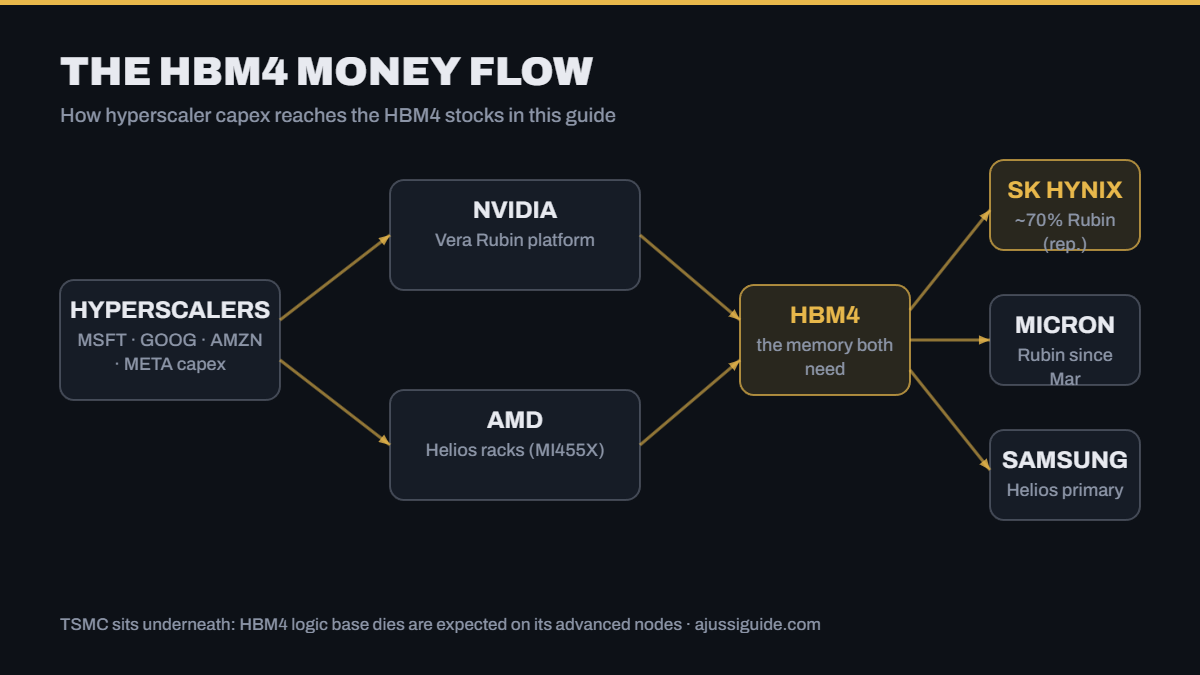
High Bandwidth Memory, or HBM, is the specialized DRAM that gets stacked and placed directly beside AI accelerator chips — Nvidia’s new Vera Rubin platform, AMD’s Helios racks, and the custom silicon hyperscalers are building. Every major AI training cluster needs it. There’s no substitute right now.
HBM3E, the previous generation, offers roughly 1.15 terabytes per second of memory bandwidth per stack. HBM4 roughly doubles that — the JEDEC specification targets up to 2 TB/s per stack — with improved power efficiency and a new base-die architecture that uses logic process nodes instead of plain DRAM nodes. That last part is huge. It means memory makers need deeper logic foundry partnerships, which changes who can actually make this stuff competitively.
For investors, this matters because the switching costs go up. Qualifications take 12–18 months. Whoever gets certified first on HBM4 with Nvidia, AMD, and the hyperscalers locks in revenue that competitors simply cannot steal overnight — which is why the ranking of HBM4 stocks is stickier than most tech leaderboards. And in 2026, those certifications stopped being hypothetical — they turned into orders.
The Core HBM4 Stocks to Know
SK Hynix — The King, Now on Nasdaq
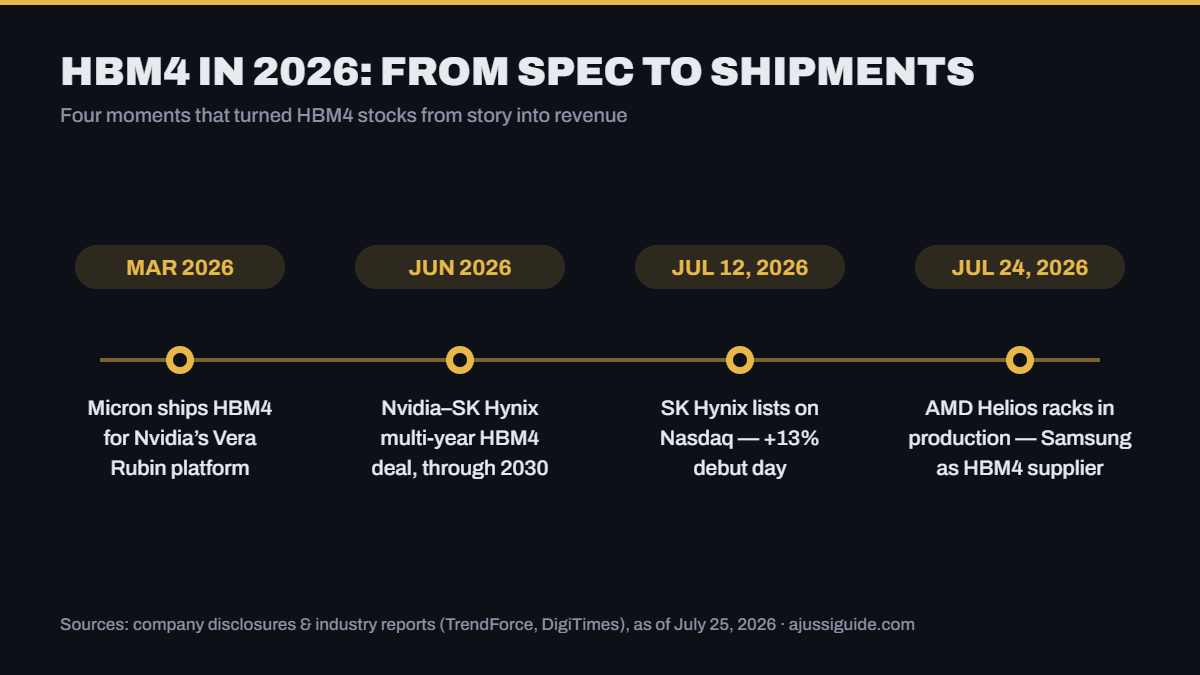
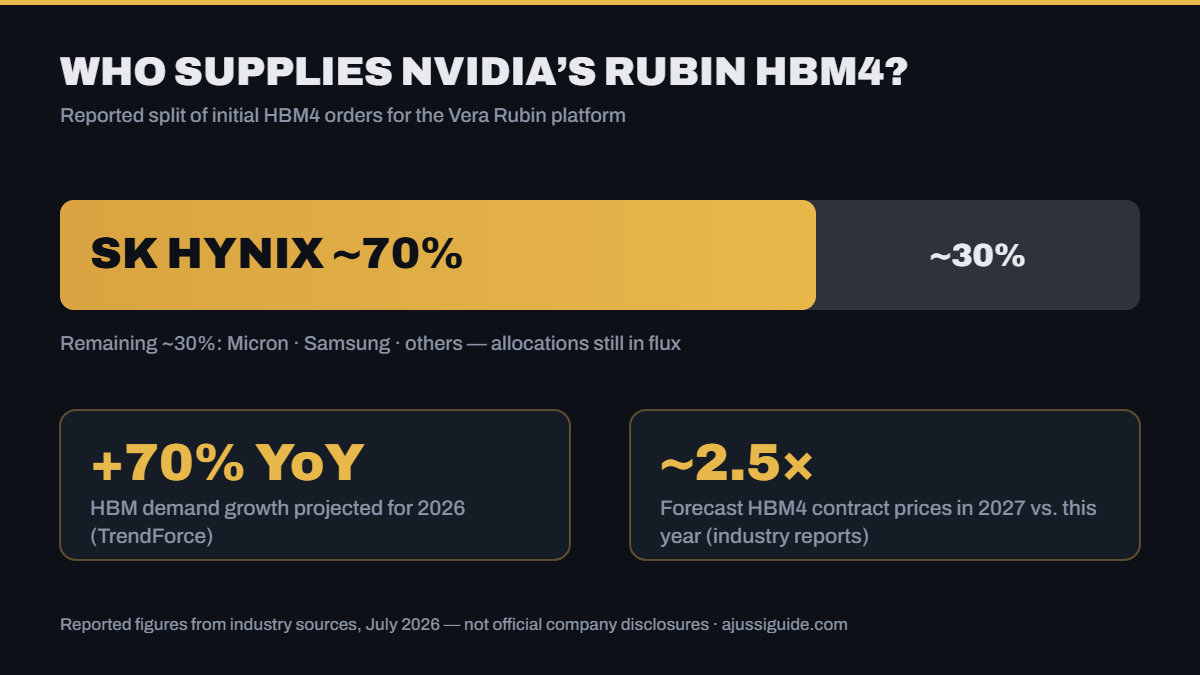
SK Hynix is the undisputed HBM leader — roughly 62% of the HBM market by recent industry estimates — and 2026 has been its coronation year. Jensen Huang said Nvidia would be the first customer for HBM4, and SK Hynix has reportedly locked up about 70% of the HBM4 orders for Nvidia’s Vera Rubin platform, backed by a multi-year co-development agreement signed in June 2026 that runs through 2030. And the ties keep deepening: on July 25, Nvidia and SK Group unveiled a $500-billion-plus initiative spanning AI data centers and next-generation memory — including a planned 2-gigawatt data center running Vera Rubin chips on SK Hynix HBM4, targeted to come online in 2027.
The access story changed completely this month, too: SK Hynix listed on the Nasdaq on July 12, 2026, jumping 13% on its debut. US retail investors no longer need OTC workarounds or ETF proxies — the HBM4 market-share leader is now a one-click buy. (The Korea Exchange listing, 000660.KS, remains primary, so won exposure still flows through.)
One nuance the headlines miss: SK Hynix has been delaying some HBM3E-to-HBM4 line conversions to harvest record commodity DDR5 margins — a margin story, not a demand problem. I broke down why in my SK Hynix HBM4 delay analysis; the short version is that less new HBM4 supply flowing into growing demand points to tighter pricing through 2027.
Micron Technology (MU) — The American Bet, Ramping Fast
Micron (ticker: MU) is the only US-headquartered company with a real HBM4 business — and it’s no longer just “in development.” Micron began shipping HBM4 into Nvidia’s Vera Rubin platform in March 2026, has already booked over $1 billion in HBM4 revenue, and says its 12-high HBM4 ramp is progressing roughly twice as fast as the HBM3E generation did, with yields maturing faster as well.
Management has also stated that its entire 2026 HBM capacity is sold out under multi-year agreements, and a 16-high, 48GB HBM4 product has been sampled for the next wave. Micron remains behind SK Hynix in scale, but the gap is closing faster than most models assumed a year ago. Watch the quarterly earnings calls — management keeps getting more specific about HBM revenue contribution.
Samsung Electronics — The Comeback Is No Longer Hypothetical
Samsung (005930.KS in Korea, SSNLF over the counter in the US) struggled visibly through the HBM3E era, losing significant Nvidia business to SK Hynix on well-documented yield issues. HBM4 — with its logic base die and Samsung’s own leading-edge foundry — was always the comeback vehicle. In July 2026, the comeback found its anchor customer: AMD.
AMD’s Helios AI racks entered production with Samsung as the primary HBM4 supplier for the MI455X accelerators inside them, with shipments scheduled to build from late Q3 into Q4 2026. Lisa Su said this week that a final long-term HBM4 procurement agreement is “almost there.” Samsung is still fighting for larger Nvidia allocations — that remains the swing factor for the stock — but the execution question now has an answer: a flagship customer qualified them.
TSMC (TSM) — The Picks-and-Shovels Angle
TSMC (ticker: TSM) doesn’t make HBM itself, but HBM4’s logic base die is widely expected to be manufactured on advanced TSMC nodes for several of the memory makers’ products. That positions TSMC as an indirect but highly reliable beneficiary: as HBM4 volumes ramp through the Rubin and Helios generations, TSMC’s advanced-node utilization gets a meaningful boost on top of already strong AI accelerator demand.
Among HBM4 stocks broadly defined, TSMC is the steadiest hand in this group from a business quality standpoint, though the geopolitical Taiwan premium is always present in the price.
HBM4 Stocks 2026 Comparison at a Glance
| Company | Ticker | HBM4 Role | US Accessibility | Key Risk |
|---|---|---|---|---|
| SK Hynix | Nasdaq (Jul 2026) / 000660.KS | ~70% of Nvidia Rubin HBM4 orders (reported) | Direct Nasdaq listing | Korean won exposure, DDR5-vs-HBM4 capacity trade-offs |
| Micron Technology | MU | Shipping HBM4 into Rubin since Mar 2026 | Direct Nasdaq | Scale gap vs. SK Hynix |
| Samsung Electronics | SSNLF (OTC) / 005930.KS | Primary HBM4 supplier for AMD Helios | Limited (OTC) | Nvidia qualification still pending at scale |
| TSMC | TSM | Logic base-die foundry partner | Direct NYSE (ADR) | Taiwan geopolitical premium |
HBM Stock Forecast: What Demand Looks Like Into 2027
The honest answer is: AI capital expenditure by hyperscalers is still accelerating. Microsoft, Google, Amazon, and Meta have all guided infrastructure spending higher in their most recent disclosures — we keep the running totals in our AI Capex Tracker. For HBM4 stocks, the demand side now rests on two pillars in actual production: Nvidia’s Vera Rubin platform and AMD’s Helios racks.
TrendForce projects HBM demand growing roughly 70% year over year in 2026, and reporting across the supply chain points to sharply higher HBM4 contract prices into 2027 — some forecasts put them around 2.5 times this year’s level — because, for once, the three manufacturers are adding supply with discipline. I’d take any specific number with a grain of salt; this industry has been wrong in both directions before. But the direction is hard to argue with.
You can sanity-check the macro picture through resources like the Semiconductor Industry Association, which publishes monthly global sales data.
Risks Ajussi Is Watching Closely
I’d be doing you a disservice if I only talked about the upside. Here’s what keeps me up at night on HBM4 stocks.
Oversupply cycles. Memory is historically the most cyclical sector in semiconductors. HBM has stayed tight because it requires specialized equipment, long qualification cycles, and heavy capital investment. Right now the discipline argument holds — SK Hynix redirecting capacity to DDR5 instead of flooding HBM4 is the proof — but discipline in memory has a short shelf life. If all three players ramp HBM4 simultaneously and AI capex growth slows even slightly, you get a glut. It has happened before. It will happen again eventually.
Customer concentration. A meaningful share of HBM revenue runs through Nvidia — by some reports, around 90% of SK Hynix’s HBM supply. If Nvidia’s growth trajectory stumbles — say, US export restrictions tightening further on AI chips to China — that demand signal weakens fast. Reuters covers the US-China chip policy beat closely; worth monitoring.
Technology substitution. This one is longer-dated but real. Some hyperscalers are developing custom silicon that integrates memory differently. If compute architectures evolve away from the current GPU-plus-HBM stack, the TAM assumptions change. I don’t think this is a 2026 story, but keep it in the back of your mind.
How I’m Thinking About Position Sizing
For US retail investors building exposure to HBM4 stocks, the menu got simpler this month. MU gives you the fast-ramping American pure-play, TSM gives you the picks-and-shovels foundry angle — and since July 12, SK Hynix’s Nasdaq listing gives one-click access to the market-share leader itself, with the caveat that you’re effectively taking on Korean won exposure and Korea-market dynamics when you hold it.
If single-name HBM4 stocks feel too spicy, semiconductor ETFs like VanEck Semiconductor ETF (SMH) or iShares Semiconductor ETF (SOXX) give you diversified exposure with built-in rebalancing, though your HBM4-specific weight gets diluted across many names. Better for conservative sizing; less efficient if you have a strong conviction view.
My personal rule: in a sector this cyclical, I size positions so that if the stock drops 40% — which memory stocks absolutely can and do — I’m uncomfortable but not ruined. Position sizing is risk management. Don’t let the excitement of a supercycle narrative override that discipline.
🚀 Ajussi’s Trading Desk Gear
Watching this sector means watching a lot of charts. The gear guides I actually researched for my own desk:
📊 Best Monitors for Stock Trading (2026)
🤾 Best Dual Monitor Arms for a Clean Setup
🔌 Thunderbolt 5 & USB-C Docks — One-Cable Desk
💡 Best Monitor Light Bars — Save Your Eyes at Night
Frequently Asked Questions
Q: What is the difference between HBM3E and HBM4?
HBM3E offers roughly 1.15 TB/s of bandwidth per stack. HBM4 roughly doubles that — the JEDEC specification targets up to 2 TB/s per stack — and critically introduces a logic-process base die rather than a standard DRAM base die. The change improves power efficiency and performance but raises manufacturing complexity and foundry partnership requirements significantly.
Q: Does Nvidia use HBM4?
Yes. Nvidia is the first customer for HBM4, which powers its Vera Rubin AI platform. SK Hynix reportedly supplies about 70% of those initial HBM4 orders under a multi-year agreement signed in June 2026, with Micron shipping HBM4 into the same platform and Samsung competing for larger allocations.
Q: Can US retail investors buy SK Hynix stock directly?
Yes, as of July 2026. SK Hynix listed on the Nasdaq on July 12, 2026 — jumping 13% on its debut — so US investors can now buy it directly without OTC workarounds. The primary listing remains on the Korea Exchange (000660.KS), so won-dollar currency dynamics still flow through results.
Q: Does Micron make HBM?
Yes. Micron is in volume production on HBM — it began shipping HBM4 for Nvidia’s Vera Rubin platform in March 2026, has booked over $1 billion in HBM4 revenue, and says its 2026 HBM capacity is fully sold out under multi-year agreements.
Q: Is Micron a good proxy for HBM4 stocks in 2026?
Micron is the most accessible US-headquartered pure-play on HBM4, already shipping into Nvidia’s Rubin platform with a ramp management says is running about twice as fast as its HBM3E generation. The key question is whether it can close the scale gap with SK Hynix in time to capture meaningful HBM4 revenue share. Its quarterly earnings calls and investor disclosures are the best tracker.
A memory supercycle basket is, by definition, a single-layer bet. They may all depend on the same infrastructure layer. The AI infrastructure exposure checker shows which of the eight layers a portfolio actually owns.
Disclaimer: This article is for informational purposes only and is not financial advice. Do your own research.