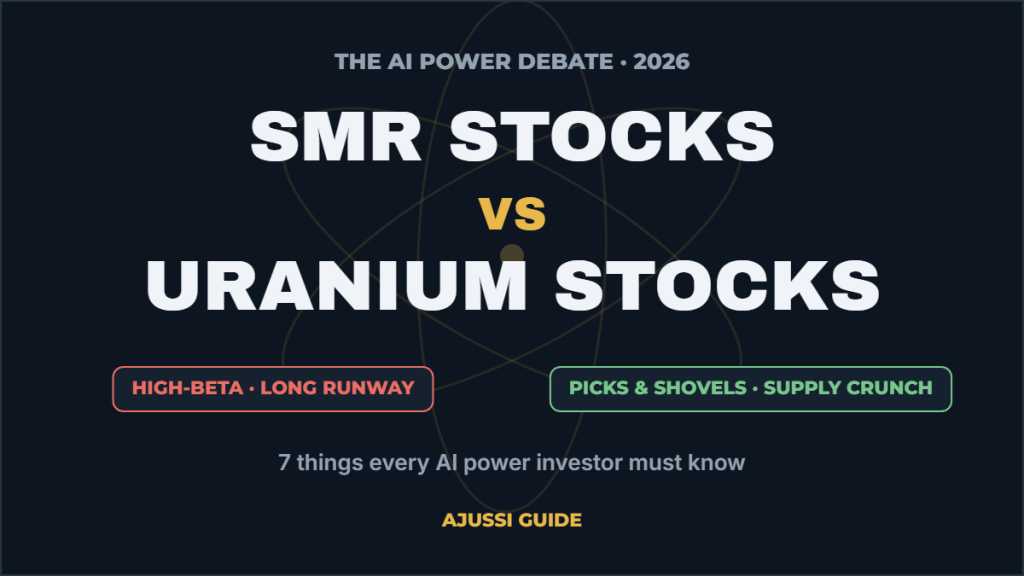
SMR stocks vs uranium stocks — that’s suddenly the hottest debate in energy investing — and if you’ve been watching what the big AI hyperscalers are doing with their power procurement strategies, you already know why.
I’m Ajussi. I’ve been in these markets long enough to remember when people laughed at solar. And I’m here to tell you: the race to power AI data centers is creating one of the most interesting sector splits I’ve seen in years — SMR plays on one side, uranium miners on the other.
Both are legitimate ways to bet on the nuclear renaissance. But they are very different animals. Let me walk you through how I think about each one.
Why AI Power Demand Is Driving Nuclear Back Into the Spotlight
Data centers are electricity hogs. A single large AI training cluster can consume as much power as a small city. Companies like Microsoft, Google, and Amazon have all signed nuclear power agreements in the past two years — that’s not a coincidence.
The problem with wind and solar for data centers is intermittency. You can’t run a 24/7 GPU cluster on power that disappears when the sun sets. Nuclear — and specifically the new generation of small modular reactors — offers always-on, carbon-free electricity that fits neatly into a hyperscaler’s sustainability narrative.
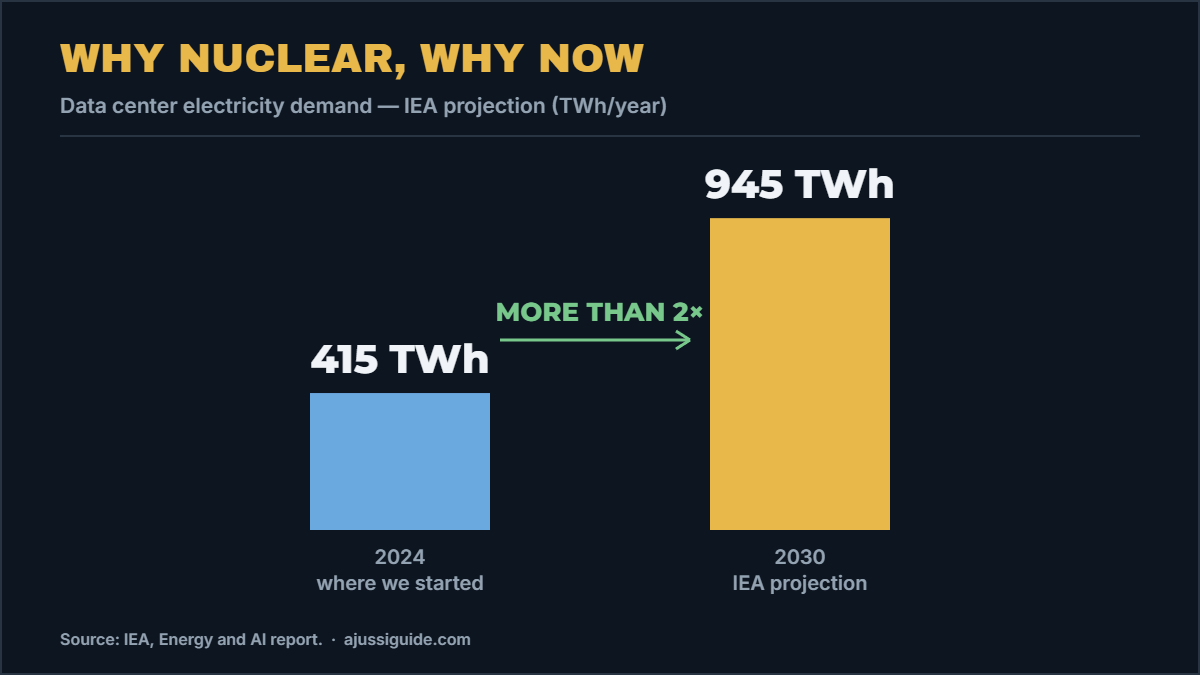
According to the International Energy Agency (IEA), global electricity demand from data centers could more than double by 2030. That statistic is the foundation of every nuclear energy investment thesis right now.
SMR Stocks: The High-Beta, Long-Runway Play
SMR stocks represent companies building or licensing small modular reactors — factory-built nuclear units typically under 300 megawatts. The pitch is elegant: modular design, faster construction, lower upfront capital, and siting flexibility near data centers.
The most-discussed pure-play name in this space is NuScale Power (SMR on NYSE). NuScale got a lot of retail attention as the first SMR design to receive NRC design approval in the US. But investors need to know the company has faced real commercial headwinds — its flagship Utah project was cancelled in 2023, and revenue generation remains in the future.
Oklo Inc. is another name drawing serious interest. Backed by Sam Altman and listed on the NYSE, Oklo is developing a fast fission microreactor. It’s pre-revenue and highly speculative, but the OpenAI connection keeps it in headlines.
TerraPower — Bill Gates’ nuclear venture — remains private, so retail investors can’t access it directly. But it’s worth knowing as context for how serious the technology is taken at the highest levels.
The honest truth about SMR stocks? Most of these companies are burning cash, have no operating reactors, and face regulatory timelines measured in years, not quarters. The upside is enormous if the technology commercializes. The downside is binary — execution risk is extreme.
What Makes SMR Stocks Attractive Right Now
- Direct leverage to the AI power narrative
- Government support — the US DOE has backed multiple SMR programs
- Corporate offtake agreements starting to emerge (Microsoft + Constellation’s Three Mile Island restart showed the template)
- Sentiment can move these stocks 20-30% on a single news headline
Uranium Stocks: The Picks-and-Shovels Approach
Here’s where I personally feel more comfortable putting real money to work — uranium stocks. Whether SMRs succeed or traditional large reactors dominate, every nuclear reactor needs uranium fuel. That’s the picks-and-shovels logic.
The uranium market has its own structural story completely separate from AI. Global uranium supply has been constrained since the Fukushima era, when mines were shuttered and production investment dried up. Now demand is recovering — both from existing reactor restarts and new builds — while supply catch-up takes years.
Key publicly traded uranium names US investors can access:
- Cameco Corporation (CCJ) — The largest publicly traded uranium producer in the world, headquartered in Canada. This is the blue-chip of the sector.
- Uranium Energy Corp (UEC) — A US-based in-situ recovery uranium producer with operations in Wyoming and Texas.
- Sprott Physical Uranium Trust — Traded in Canada (U.UN on TSX), this is a trust that holds physical uranium. US investors can access it through some brokers or via Sprott Uranium Miners ETF (URNM) on NYSE Arca.
Uranium stocks are volatile, no question. But compared to pre-revenue SMR companies, uranium miners are businesses with actual production, actual revenue, and actual earnings (in Cameco’s case). That’s a meaningful distinction for risk management.
The Uranium Supply Crunch You Need to Understand
As of mid-July 2026, uranium trades near $85 per pound, and Kazatomprom has cut its 2026 production guidance by roughly 10% — OPEC-style supply discipline that keeps the crunch thesis very much alive.
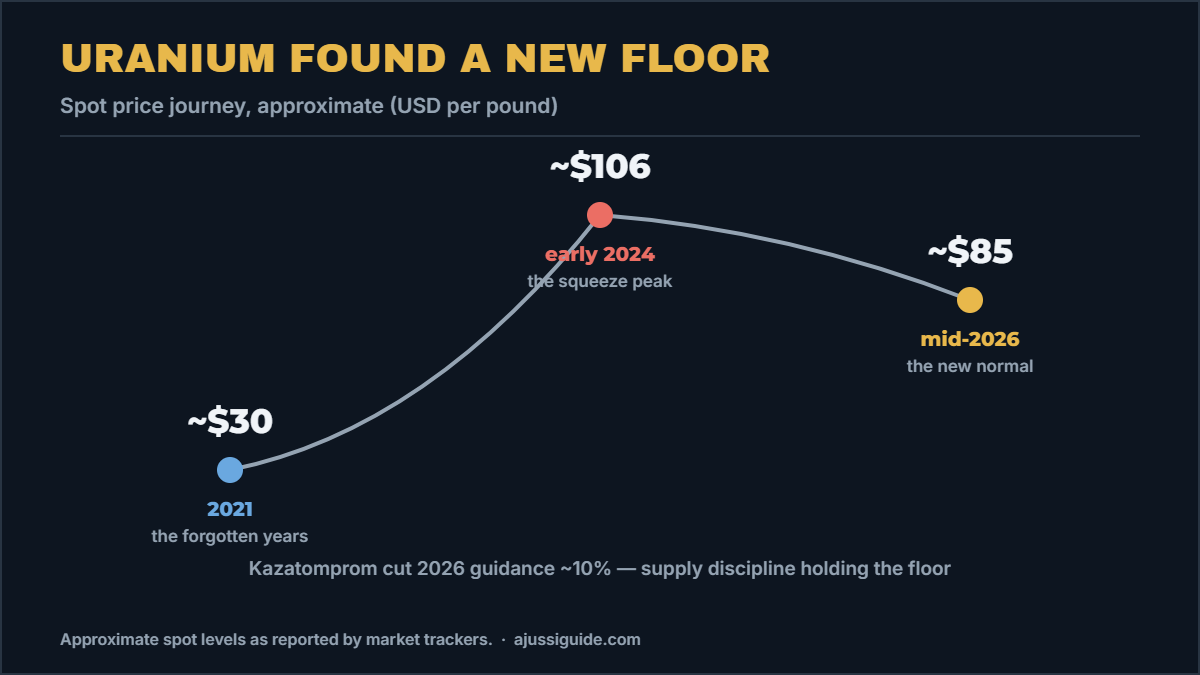
Kazakhstan’s Kazatomprom — the world’s largest uranium producer — has been flagging production shortfalls due to sulfuric acid supply issues. This isn’t a trivial detail. Kazatomprom supplies roughly 40% of global primary uranium production.
Meanwhile, US utilities are scrambling to secure domestic or allied-nation uranium supply after Congress restricted Russian uranium imports in 2024. That structural tailwind is real and multi-year in nature.
SMR Stocks vs Uranium Stocks: Side-by-Side Comparison
Let me put the two categories next to each other so you can see the tradeoffs clearly.
| Factor | SMR Stocks | Uranium Stocks |
|---|---|---|
| Revenue today | Mostly pre-revenue | Yes (major producers) |
| Technology risk | High — unproven at scale | Low — mining is mature |
| Regulatory timeline | 5-15+ years to first power | Mines can open in 3-7 years |
| AI power narrative fit | Direct, headline-driven | Indirect but fundamental |
| Volatility | Extreme (sentiment-driven) | High but fundamentally anchored |
| Suitable for | Speculative allocation only | Core + speculative positions |
My personal framework: I treat SMR stocks as a small speculative sleeve — maybe 2-3% of a portfolio — and uranium miners as a larger thematic position I can size more confidently.
How I’m Thinking About Portfolio Construction
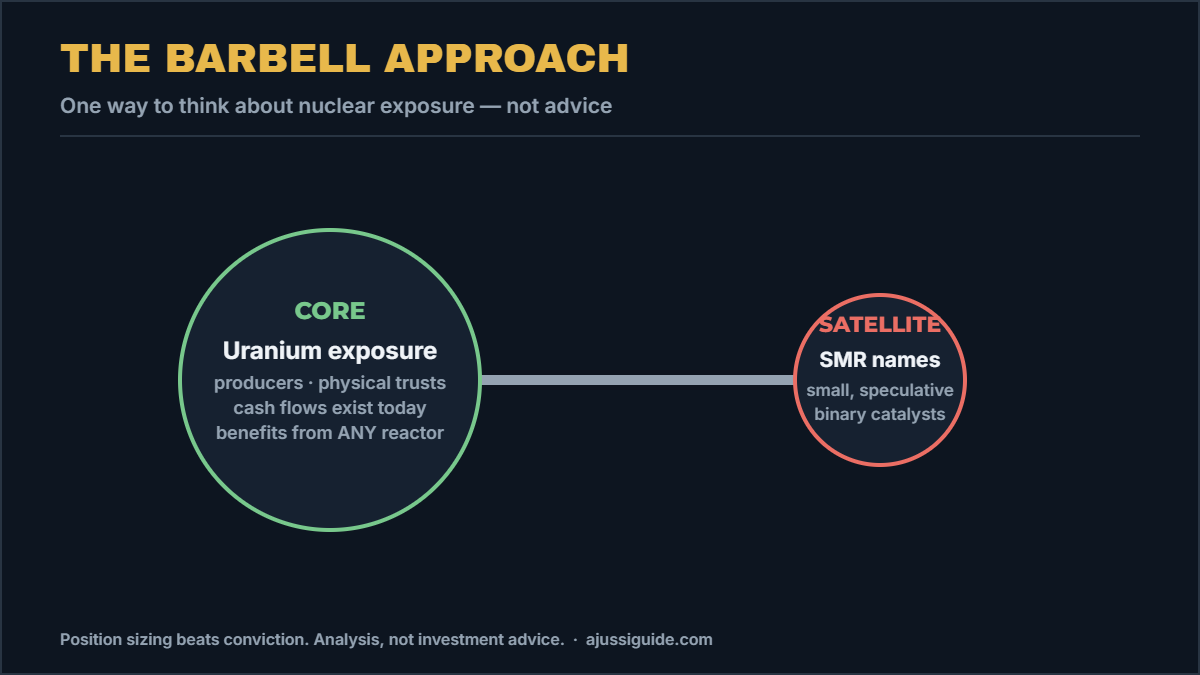
I am not a financial advisor. But I can tell you how Ajussi thinks about this stuff for his own money.
First, I want exposure to uranium as a commodity, because the supply/demand thesis is solid regardless of which reactor technology wins. Cameco (CCJ) is my anchor. URNM gives me diversified miner exposure without picking too many individual names.
Second, I keep a small speculative position in the SMR space — but I am extremely conscious of position sizing. These are lottery tickets with serious downside. I don’t add to them on dips without re-examining the fundamentals.
Third, I pay attention to the broader nuclear enablers — companies that don’t get the headlines but benefit from nuclear’s expansion. Think engineering firms, nuclear fuel fabricators, and grid infrastructure players. These are less sexy but often better businesses.
You can read more about the broader nuclear supply chain from Reuters Energy coverage, which has been tracking corporate nuclear procurement deals in real time.
Risks Neither Camp Talks About Enough
And 2026 has been the proof test: by mid-year, SMR names had pulled back hard — NuScale is down roughly 46% year-to-date — as the market shifted from announcements to execution. Analysts opening coverage with Hold ratings reflect that mood: the story is respected, the timeline is not yet trusted.
Both SMR stocks and uranium stocks carry risks that get glossed over in the bull case narratives.
For SMR companies: regulatory approval is not a formality. The NRC process is thorough, slow, and expensive. A company can have a great design and still spend a decade waiting. Cost overruns on nuclear projects are historically severe — large reactors have consistently come in 2-3x over budget in the West.
For uranium stocks: commodity prices are cyclical and can fall hard. The uranium price rallied sharply from 2021 to 2024. If reactor build programs slow or efficiency improvements reduce fuel demand, the bull thesis weakens. Geopolitical concentration risk in Kazakhstan is also real.
And for both: the AI data center build-out is real, but corporate power procurement deals take years to translate into actual electricity demand. Don’t confuse signed letters of intent with construction starts.
Frequently Asked Questions
Are SMR stocks a good investment for 2026?
SMR stocks can be part of a speculative allocation in 2026 if you understand the risks. Most SMR companies are pre-revenue and carry extreme execution and regulatory risk. They are better suited as a small, high-conviction bet rather than a core holding. Position sizing is critical.
What is the difference between SMR stocks and uranium stocks?
SMR stocks vs uranium stocks is really a question of technology risk versus commodity risk.
SMR stocks are companies building small modular reactor technology — they profit if and when those reactors are built and operated. Uranium stocks are companies that mine and sell uranium fuel — they benefit whenever nuclear power expands, regardless of which reactor design wins. Uranium stocks generally have more established business models and actual revenue today.
Which uranium ETF gives the best exposure for US investors?
The Sprott Uranium Miners ETF (URNM) is one of the most widely referenced pure-play uranium miner ETFs available to US investors on NYSE Arca. It holds a basket of uranium mining and royalty companies. As always, review the ETF’s holdings, fees, and concentration risk before investing.
Ajussi’s Bottom Line
The SMR stocks vs uranium stocks decision ultimately comes down to your risk budget, not your conviction about nuclear itself.
The AI power theme is real. Nuclear is having a genuine policy and commercial moment. But within the nuclear trade, you have a spectrum from speculative-to-the-bone SMR startups all the way to established uranium producers with real cash flows.
Know where you are on that spectrum before you put money in. The narrative is exciting. The volatility will test you. And the timelines are longer than most retail investors expect.
Do your homework. Size your positions appropriately. And don’t let a good story trick you into a bad position size.
— Ajussi
Disclaimer: This article is for informational purposes only and is not financial advice. Do your own research.
🚀 Ajussi’s Trading Desk Gear
Watching this sector means watching a lot of charts. The gear guides I actually researched for my own desk:
📊 Best Monitors for Stock Trading (2026)
🤾 Best Dual Monitor Arms for a Clean Setup
🔌 Thunderbolt 5 & USB-C Docks — One-Cable Desk
💡 Best Monitor Light Bars — Save Your Eyes at Night