Last updated: August 5, 2026 — figures reflect company guidance and reporting as of this date. This page is updated after each earnings season.
Next update: early November 2026. The Big Four report Q3 in late October, so the four numbers in this table get re-checked right after.
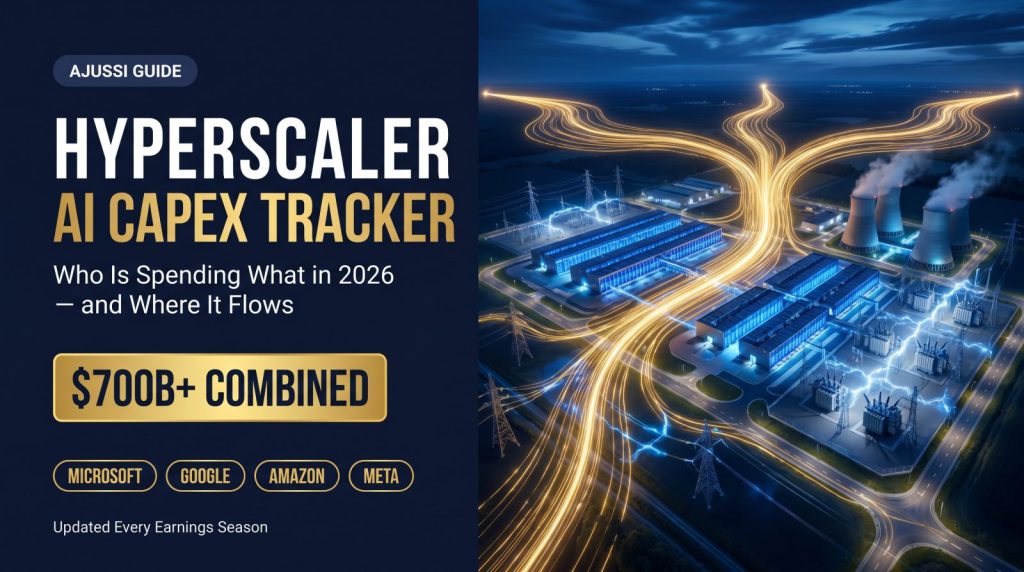
If you own any AI infrastructure stock — cooling, power, memory, networking — there is exactly one number upstream of your entire thesis: hyperscaler capex. When Microsoft, Alphabet, Amazon, and Meta raise their capital spending guidance, orders eventually flow down to every company we cover on this blog. When they cut, everything downstream feels it. So Ajussi built this tracker: one page, updated every earnings season, showing who is spending what and where the money actually goes.
The Big Four: 2026 Hyperscaler Capex at a Glance
| Company | Ticker | 2026 Capex Guidance (approx.) | Trend vs. 2025 |
|---|---|---|---|
| Amazon (AWS) | AMZN | ~$220B | Raised again at Q2 earnings (July 2026) — still the largest spender |
| Alphabet (Google Cloud) | GOOGL | ~$195–205B | Raised again at Q2 earnings — range up from $180–190B |
| Meta Platforms | META | ~$130–145B | Range floor raised at Q2 earnings; no 2027 outlook yet |
| Microsoft (Azure) | MSFT | ~$175B (calendar-year basis) | Restated from ~$190B on a lease-accounting change — underlying spend unchanged; fiscal year ends June |
Add it up and the four largest hyperscalers have guided to roughly $720–745 billion of combined capital spending for 2026 — up from about $410 billion in 2025, an increase in the neighborhood of 80%, per reporting from CNBC and industry analysts. For context, that single-year jump is larger than the entire annual capex of the global oil majors combined. Analysts are already discussing a path above $1 trillion in 2027. Figures are approximations from company guidance and can change at any earnings call — treat the table as a snapshot, not gospel.
Where the Money Actually Flows
Headlines focus on GPUs, but a data center is mostly not chips. Industry analyses of the AI buildout through 2030 consistently sketch the same rough split: the largest share goes to compute hardware (GPUs, custom silicon, servers, memory), roughly a quarter flows to power, electrical equipment, and cooling, and the remainder goes to land and construction. That second bucket is where most of the companies on this blog live. Here is the map, with our full analysis linked for each lane.
Lane 1: Compute & Memory
Every AI server needs high-bandwidth memory stacked next to the GPU. This is the most direct beneficiary lane — and the most crowded trade. Our breakdown: HBM Memory Stocks 2026.
Lane 2: Power & Electrical Infrastructure
Every gigawatt of new AI capacity needs transformers, switchgear, UPS systems, and power distribution — before a single GPU boots. Deep dives: Eaton Power Stocks: 5 Data Center Picks and Vertiv Stock Analysis 2026.
Lane 3: Cooling — Air Out, Liquid In
Blackwell-class GPUs pushing past 1,000W per chip have made liquid cooling mandatory at scale, and consolidation has already started — Ecolab paid $4.75 billion for CoolIT in 2026. Our coverage: the Ecolab-CoolIT deal, nVent Electric, and Modine Manufacturing. For the full picture of how much of this capex actually flows into thermal management, see Hyperscaler Cooling Costs: Who Gets Paid to Keep AI Cool.
Lane 4: Networking
Tens of thousands of GPUs are useless unless they can talk to each other at extreme bandwidth. Our picks: AI Networking Stocks 2026.
Prefer One Ticket for the Whole Ride?
If picking lanes feels like too much, there are funds that bundle the theme: Best AI Infrastructure ETFs for 2026. And if you want my seven favorite individual names across all four lanes in one place, that list lives in AI Infrastructure Stocks: 7 Pick-and-Shovel Plays.
Why This Number Rules Everything Downstream
Think of hyperscaler capex as the water level of the whole AI infrastructure lake. Vertiv’s backlog, Eaton’s data center orders, HBM contract pricing, nVent’s cooling growth — all of it is downstream of four budget lines set in Redmond, Mountain View, Seattle, and Menlo Park. That’s why every earnings season, before I look at any supplier’s numbers, I check whether the Big Four raised or held their guidance. Suppliers can execute perfectly and still get crushed if the water level drops.
The bear case is equally simple: this pace of spending is running far ahead of AI revenue, and markets have started asking when the gap closes. If AI monetization disappoints through 2027, capex guidance gets cut — and high-multiple infrastructure names would correct hard. Owning this theme means watching this page, not just the stocks.
What to Watch Next
The next hyperscaler capex update lands after the October–November 2026 earnings round, when the Big Four report their September quarters. Three things I’ll be checking: whether Amazon’s ~$220B keeps climbing (Andy Jassy already says even that won’t cover 2026 demand, and expects the same squeeze in 2027), whether Meta finally puts a number on 2027 — its CFO declined to at the Q2 call — and Microsoft’s first full quarter under its new lease accounting (it guided to more than $50B of capex in the September quarter alone). Analysts still whisper about a combined $1 trillion for 2027. Bookmark this page or find it anytime in the sidebar under Ajussi’s Picks.
Update Log
- 2026-08-05 — Q2 2026 earnings round, all four reported: AMZN raised to ~$220B (from ~$200B); GOOGL raised to $195–205B (from $180–190B); META floor raised to $130–145B (from $125–145B); MSFT restated to ~$175B on a calendar-2026 basis after a finance-to-operating-lease accounting change — underlying investment unchanged. Combined guidance now ~$720–745B. June-quarter actuals (approx.): AMZN $54.2B, GOOGL $44.9B, MSFT $41B, META $31.1B.
- July 18, 2026: Anthropic reportedly in talks to lease Meta data center compute (up to $10B over two years, per NYT) — early-stage, not a signed deal. If confirmed, a first sign of hyperscaler capex converting to rental revenue. Full note.
- 2026-07-16 — Corrected Microsoft to ~$190B on a calendar-2026 basis (guidance from the April 29, 2026 earnings call, including a stated ~$25B impact from higher component prices), replacing the ~$120B shown at launch. Combined total unchanged at ~$700–725B.
- 2026-07-12 — Tracker launched with FY2026 guidance: combined ~$700–725B (AMZN ~$200B, GOOGL ~$185B, META $125–145B, MSFT ~$120B). Baseline 2025: ~$410B.
FAQ
Q: How often is this tracker updated?
The hyperscaler capex table above is refreshed after each quarterly earnings season for the Big Four — roughly every three months, with the date stamped at the top of the page.
Q: Are these exact figures?
No. They are approximations built from company guidance, earnings commentary, and reputable reporting, and companies revise guidance mid-year. Always check the companies’ own investor relations pages for precise, current numbers before making decisions.
Capex is one side of the trade. The software layer that runs on top of it reports very differently, and Palantir Ontology disclosures are a good case study in which numbers a filing will actually give you.
Disclaimer: This page is for informational purposes only and is not financial advice. Capex figures are company guidance approximations as of the last update date and may have changed. Do your own research.
Planning the power side of these budgets? Our data center PUE calculator converts IT capacity and a PUE target into facility power, annual energy and an energy-cost estimate.
Between quarters, the daily numbers sit in the Ajussi Market Desk.