Hyperscaler cooling costs are no longer a footnote on a quarterly earnings call — they are quietly becoming one of the biggest line items in the entire AI buildout story, and most retail investors are sleeping on it.
I’m Ajussi. I’ve been watching capital cycle shifts long enough to know that the real money in any tech revolution rarely goes to the glamour companies. It goes to whoever solves the ugly, unglamorous physical problems that everyone ignores. Right now, that problem is heat — specifically, how do you stop billion-dollar AI clusters from melting themselves?
Let me walk you through what I know, what the numbers actually look like, and where I think the smart money is paying attention.
Why Hyperscaler Cooling Costs Are Exploding Right Now
A traditional data center server might consume 5 to 10 kilowatts per rack. A modern AI training cluster stuffed with NVIDIA H100 or B200 GPUs? We’re talking 40 to 100+ kilowatts per rack. That is not a linear jump — that is a different animal entirely.
Heat is the direct byproduct of computation. Every watt of power a chip consumes eventually has to leave the building as heat. When you’re running tens of thousands of GPUs simultaneously — which Microsoft, Google, Amazon, and Meta all are — you need an industrial-scale thermal management operation running 24 hours a day, 365 days a year.
The International Energy Agency has flagged data centers as one of the fastest-growing sources of electricity demand globally. You can read their analysis at iea.org. What they describe matches exactly what I’m seeing in hyperscaler capex disclosures: cooling is eating an ever-larger share of the budget.
The Real Numbers Behind Hyperscaler Cooling Costs
Let me give you the honest picture. Cooling has historically represented roughly 30 to 40 percent of a data center’s total energy consumption. That ratio is measured by a metric called Power Usage Effectiveness, or PUE. A perfect PUE is 1.0 — meaning every watt goes to compute, none to overhead. In the real world, even the best hyperscalers run PUEs of 1.1 to 1.3, meaning 10 to 30 cents of every dollar of power spend goes purely to cooling.
Now apply that to the scale of modern capex programs. For 2026, the four largest hyperscalers have guided to roughly $700 billion of combined capital spending — Amazon around $200 billion, Microsoft around $190 billion on a calendar-year basis, Alphabet around $185 billion, and Meta $125–145 billion — up from about $410 billion in 2025. I track these numbers quarter by quarter in my Hyperscaler Capex Tracker, and the trend has been one-directional: up.
If we assume conservatively that 15 to 20 percent of total data center capex and opex relates directly to cooling systems, equipment, and energy — and many engineers put it higher — we are talking about tens of billions of dollars per year flowing into the cooling supply chain across just these four companies.
That is not a rounding error. That is an industry.
Air Cooling vs. Liquid Cooling: The Big Shift
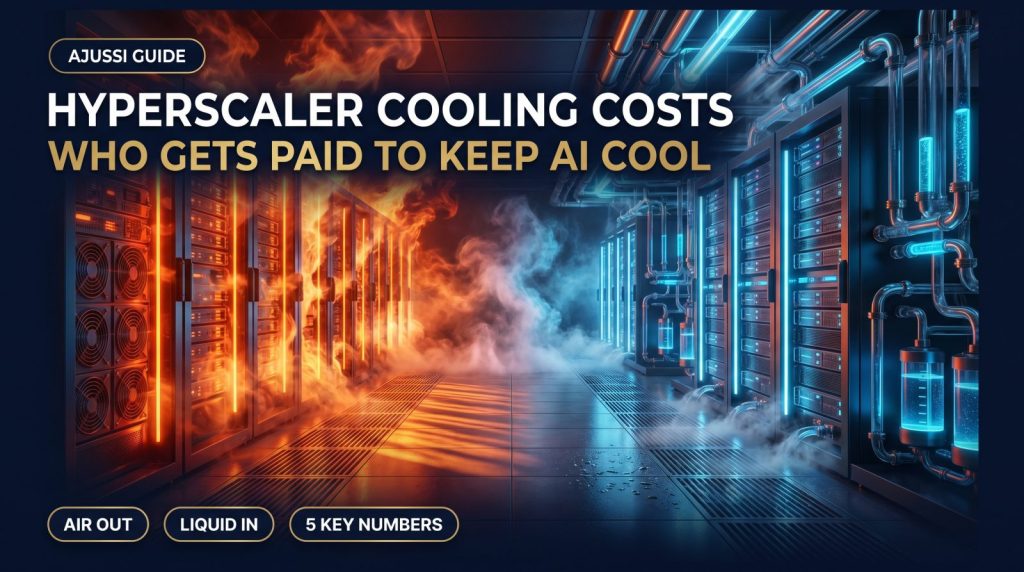
Here is where it gets interesting for investors. Traditional data centers use air — chilled air blown across server racks by enormous CRAC units (computer room air conditioners) and supported by giant cooling towers outside the building. This works fine for conventional servers. It does not work well for 100kW GPU racks.
The industry is rapidly pivoting to liquid cooling. There are two main variants: direct liquid cooling (DLC), where cold plates are attached directly to chips and water carries the heat away, and immersion cooling, where servers are submerged in a non-conductive liquid bath. Both are dramatically more efficient than air, but they require completely different facility designs, different plumbing, different maintenance, and different equipment vendors.
Microsoft has publicly committed to liquid cooling for its next-generation AI data centers. Google has been deploying liquid cooling at scale for years. This transition is accelerating, and it’s pulling in a set of industrial and infrastructure companies that most retail investors have never thought about as AI plays.
Hyperscaler Cooling Costs: Who Actually Gets Paid?
This is the part I want you to pay close attention to. The hyperscalers themselves are the spenders. The winners are the companies in the supply chain. Let me walk through the major categories.
Electrical infrastructure and power management: Before you can cool anything, you need reliable power delivery. Companies like Eaton (ticker: ETN) and Schneider Electric make the switchgear, UPS systems, and power distribution units that sit upstream of every cooling system in every data center.
Cooling equipment manufacturers: Vertiv Holdings (ticker: VRT) is probably the most direct pure-play on data center thermal management in the US public markets. They make precision air conditioners, liquid cooling systems, and rack-level cooling for hyperscale facilities. Their revenue growth has been closely correlated with hyperscaler capex acceleration.
HVAC and industrial cooling: Trane Technologies (ticker: TT) and Carrier Global (ticker: CARR) both serve the heavy commercial and industrial cooling market, with growing exposure to data centers through chillers and large-scale HVAC systems.
Heat exchangers and fluid systems: SPX Technologies and several smaller industrial companies supply the heat exchanger hardware that sits at the heart of liquid cooling loops.
Water and water treatment: This one surprises people. Cooling towers and liquid cooling systems consume enormous quantities of water. Data centers in water-stressed regions are under increasing scrutiny. Companies providing water treatment and efficiency solutions are quietly benefiting.
| Company | Ticker | Primary Cooling Exposure | 2024 Revenue (approx.) |
|---|---|---|---|
| Vertiv Holdings | VRT | Precision cooling, liquid cooling systems, thermal mgmt | ~$8.0B |
| Eaton Corporation | ETN | Power distribution, electrical infrastructure for data centers | ~$24.9B |
| Trane Technologies | TT | Industrial chillers, HVAC, large-scale cooling systems | ~$20.2B |
| Carrier Global | CARR | Commercial HVAC, data center cooling expansion | ~$22.0B |
| Schneider Electric | SU (Paris) | Power mgmt, data center cooling infrastructure, EcoStruxure | ~€37B |
Note: Revenue figures are approximate, based on publicly available annual reports. Always verify current figures through company investor relations pages before making any investment decision.
The PUE Efficiency Race and What It Means for Investors
Here’s a nuance that separates serious investors from casual ones. Hyperscalers are under enormous pressure — from regulators, from sustainability commitments, and from their own electricity bills — to improve PUE. Google, for instance, reports a trailing twelve-month average PUE around 1.10, which is exceptionally efficient. Microsoft and Amazon are in similar territory for their newest facilities.
Better PUE means less energy wasted on cooling per unit of compute. So doesn’t that mean less spending on cooling equipment? Not necessarily. Better efficiency often requires more sophisticated, more expensive equipment upfront. And the raw volume of compute is growing so fast that absolute cooling spend keeps rising even as efficiency improves. You can get 10% more efficient per rack while deploying 40% more racks — the math still goes up.
Reuters has covered the data center energy and cooling demand story extensively. You can follow their technology coverage at reuters.com for ongoing updates on hyperscaler infrastructure announcements.
What Ajussi Is Actually Watching in 2026
I’m not going to tell you to buy any specific stock today. But I’ll tell you what signals I’m watching.
First, watch the hyperscaler earnings calls for any mention of cooling constraints or cooling capex specifically. When executives start quantifying this line item separately, it means it’s big enough that analysts are asking about it. That’s a signal the supply chain is under stress — and stress creates pricing power for the vendors.
Second, watch Vertiv’s order backlog. Backlog is a leading indicator. If their backlog keeps expanding quarter over quarter, it means hyperscalers are committing to cooling infrastructure spending well in advance. That’s a durable revenue stream, not a one-quarter pop.
Third, pay attention to liquid cooling adoption timelines. Every percentage point of the market that shifts from air to liquid is a tailwind for higher-value, higher-margin equipment. The companies that can deliver at hyperscale volumes will compound their advantage.
Fourth, don’t ignore the power side. Cooling doesn’t exist in isolation — it’s part of the broader power infrastructure stack. The companies that can sell both power management and thermal management to the same hyperscaler customer have a structural advantage in terms of integration, maintenance contracts, and switching costs.
The hyperscaler cooling cost story is still early innings. The capex commitments are locked in, the GPU deployments are happening, and the heat has to go somewhere. That somewhere is a multi-billion-dollar annual market that is growing faster than almost any other infrastructure segment right now.
Don’t be the investor who only bought the chip companies and missed the radiator.
🚀 Ajussi’s Trading Desk Gear
Watching this sector means watching a lot of charts. The gear guides I actually researched for my own desk:
📊 Best Monitors for Stock Trading (2026)
🤾 Best Dual Monitor Arms for a Clean Setup
🔌 Thunderbolt 5 & USB-C Docks — One-Cable Desk
💡 Best Monitor Light Bars — Save Your Eyes at Night
Frequently Asked Questions
How much do hyperscalers actually spend on cooling each year?
There is no single published figure because hyperscalers do not break out cooling as a separate capex line. However, industry estimates suggest cooling-related spending — including equipment, energy, water, and maintenance — represents 15 to 25 percent of total data center operating costs. Applied to combined hyperscaler infrastructure budgets guided at roughly $700 billion for 2026, that implies tens of billions of dollars flowing into the cooling supply chain each year across the major players.
Is liquid cooling really replacing air cooling in AI data centers?
Yes, for the highest-density AI workloads, the transition is clearly underway. Air cooling becomes physically impractical above roughly 40 to 50 kilowatts per rack, and modern GPU clusters regularly exceed that threshold. Liquid cooling — both direct liquid cooling and immersion cooling — handles these densities far more efficiently. The transition will not happen overnight, but new hyperscale AI facilities are increasingly being designed liquid-first from the ground up.
Which publicly traded companies have the most direct exposure to hyperscaler cooling costs?
Vertiv Holdings (VRT) is the most direct US-listed pure-play on data center thermal management. Eaton (ETN), Trane Technologies (TT), and Carrier Global (CARR) have significant but more diversified exposure. Schneider Electric (listed in Paris) is another major player globally. For investors wanting broader exposure, some infrastructure-focused ETFs include these names alongside power and data center REITs. Always verify current holdings and business mix before investing.
Disclaimer: This article is for informational purposes only and is not financial advice. Do your own research.