Search “AI semiconductor ETF” and, as of August 2026, two US-listed AI semiconductor ETF products answer to the name. The Global X AI Semiconductor & Quantum ETF (CHPX) launched September 30, 2025 and buys the global AI compute chain. The xETFs Korea AI Semiconductor ETF (KSMH) began trading on Nasdaq on August 19, 2026 — eleven days before this article — and buys only Korean names, with SK hynix and Samsung Electronics around 40% of the portfolio at launch. Every other AI semiconductor ETF search result is a broad semiconductor fund — SMH, SOXX, SOXQ, XSD, PSI — that holds AI chip makers because AI chip makers now dominate the semiconductor industry, not because the fund targets them.
The dedicated funds do not look the way the name suggests. CHPX’s largest holding is Micron at 12.7%, a memory company, and Nvidia sits third at 10.4%. KSMH holds no Nvidia at all, by design. Meanwhile SMH, the biggest fund in this comparison at $67.6 billion, holds Nvidia at 22.9% — more than double CHPX’s weight — without the letters “AI” anywhere in its name. And XSD, an equal-weight fund, holds Nvidia at 3.1%, less than it holds Impinj, a maker of RFID chips. Seven funds, seven different answers to the same search.
This article compares the two dedicated funds and the five broad ones, plus EUV, a lithography-and-photonics fund launched in May 2026 that has gathered $428 million in under four months. Figures are issuer snapshots from August 25–28, 2026 where issuers publish them, and database snapshots dated per fund where they do not. Korean-listed AI semiconductor ETFs are compared in the Korean edition, AI 반도체 ETF 비교. For memory-only exposure, see the HBM ETF comparison.
The two dedicated AI semiconductor ETF products
| CHPX | KSMH | |
|---|---|---|
| Fund | Global X AI Semiconductor & Quantum | xETFs Korea AI Semiconductor |
| Listed | Sep 30, 2025 | Aug 19, 2026 |
| Fee | 0.50% | 0.75% gross, 0.65% net (waiver to Aug 2027) |
| Assets | $118.7M (8/28) | Not yet disclosed (new fund) |
| Holdings | 38 | 10–25 Korean companies |
| Style | Index (Global X AI Semiconductor & Quantum Index) | Active |
| Top exposure | Micron 12.7%, TSMC 10.6%, Nvidia 10.4% | SK hynix + Samsung ≈40% at launch |
CHPX is the global AI semiconductor ETF. Its top 10 — 69% of the fund — is Micron 12.7%, TSMC 10.6%, Nvidia 10.4%, Broadcom 9.1%, ASML 4.8%, AMD 4.6%, Arista 4.4%, SK hynix 4.3%, MediaTek 4.2%, Cisco 4.2% (issuer, August 28). Three things stand out. First, memory leads: Micron on top and SK hynix in the top 10 put roughly 17% in memory names before counting the tail — a bet that AI demand is bottlenecked by high-bandwidth memory as much as by GPUs. Second, direct Asian access: CHPX holds local-market names such as SK hynix in Seoul and MediaTek in Taipei, while the five broad funds compared here rely mainly on US-listed securities for their foreign exposure (TSMC and ASML via ADRs). Third, networking counts: Arista and Cisco are switch and router companies, and the index also includes quantum computing names by design. The 31% of the fund below the top 10 mixes smaller semiconductor, infrastructure and quantum names — the exact quantum weight requires the issuer’s full holdings file. Read CHPX as an AI compute value chain fund, not a pure chip fund. Trade-offs: 0.50% fee, the smallest disclosed asset base in this comparison at $119 million, eleven months of history, semi-annual distributions, and a slightly negative 30-day SEC yield.
KSMH is the single-country AI semiconductor ETF. Actively managed, 10 to 25 Korean companies across memory, materials and equipment, manufacturing and packaging, substrates and PCBs, and testing — with SK hynix and Samsung Electronics around 40% at launch, alongside names such as Hanmi Semiconductor, Samsung Electro-Mechanics and Isu Petasys. It is a concentrated bet that the AI memory bottleneck is a Korean story; if that is your thesis, the HBM ETF comparison and Micron vs SK hynix cover the same ground stock by stock. The caution flags are bigger here: the fund is days old, assets are not yet disclosed, the 0.65% net fee reverts toward 0.75% after August 2027 unless the waiver is extended, and two stocks are 40% of the portfolio.
The five broad funds vs a dedicated AI semiconductor ETF
| ETF | Fund | Fee | Assets | Holdings | Nvidia weight | Approach |
|---|---|---|---|---|---|---|
| SMH | VanEck Semiconductor | 0.35% | $67.6B (8/28) | 26 | 22.9% (8/27) | Market-cap, top-25 US-listed |
| SOXX | iShares Semiconductor | 0.33% | $41.5B (8/25) | 30 | 8.9% (8/26) | Market-cap, capped (ICE index) |
| SOXQ | Invesco PHLX Semiconductor | 0.19% | $3.0B (8/28) | 30-stock index | 13.2% (8/28) | Market-cap, PHLX index |
| XSD | SPDR S&P Semiconductor | 0.35% | $2.7B (8/27) | 47 | 3.1% (8/27) | Equal weight |
| PSI | Invesco Semiconductors | 0.56% | ~$2.4B (8/28) | 30-stock index | 5.9% (8/28) | Multi-factor (Intellidex) |
SMH, SOXX and XSD figures are issuer-published; SOXQ and PSI weights are database snapshots dated August 28 and may lag issuer files. All figures move daily.
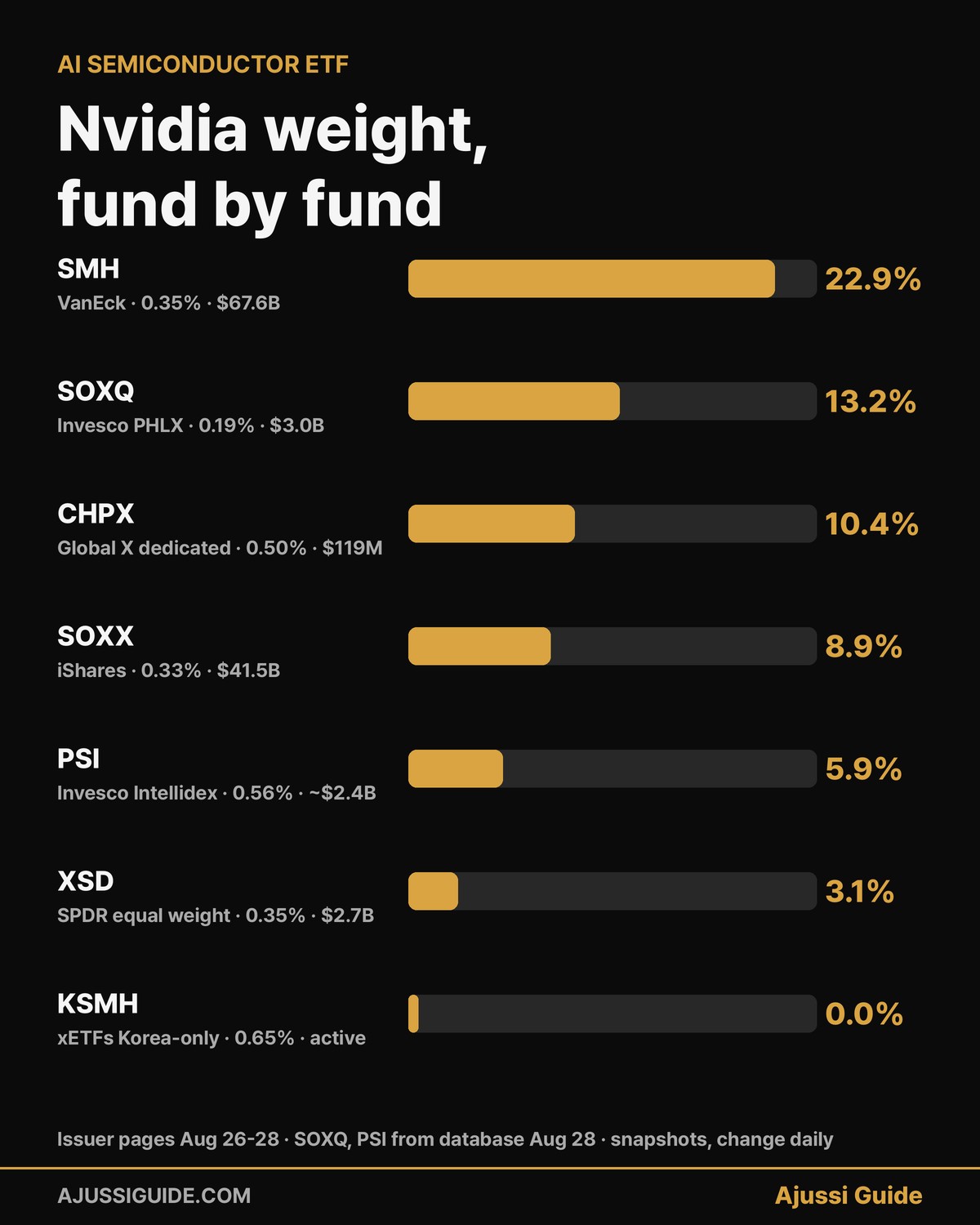
SMH is the concentrated bet. Nvidia 22.9%, TSMC 9.5%, Broadcom 5.9% — the three companies at the center of AI compute are 38% of the fund, the top five are just under half, and the top six pass 54%. It is the largest fund in this comparison at $67.6 billion, and in practice the most AI-heavy of the broad funds precisely because it lets winners run to the index cap.
SOXX tracks the ICE Semiconductor Index with tighter caps: Nvidia 8.9%, Micron 8.6%, AMD 8.3%, Broadcom and Marvell behind (issuer, August 26). No single name dominates, so it behaves like a spread bet across the AI complex rather than a Nvidia proxy. At 0.33% it undercuts SMH slightly.
SOXQ is the cheap one. Same PHLX index family the SOX benchmark comes from — a 30-stock US-listed universe — at a 0.19% fee, roughly half of SMH, with Nvidia at 13.2% and Broadcom at 10.0%. For buy-and-hold exposure to the same large-cap universe the fee gap compounds; the trade-off is a $3 billion fund with thinner volume than the two giants.
XSD is the contrarian shape. Equal weighting across 47 names means Nvidia gets 3.1% — less than Impinj at 3.7% (issuer, August 27). That mutes the AI giants and amplifies small-cap chip makers; by construction it will generally capture less of a rally led narrowly by mega-cap names, and more of a broadening one.
PSI sits between: an Intellidex multi-factor screen over a 30-stock universe that currently puts Nvidia at 5.9% alongside equipment makers Applied Materials and Lam Research at similar weights. It tilts toward fabrication equipment, carries the highest fee of the broad five at 0.56%, and its factor rotation means today’s tilt is not a permanent feature.
The new listings: EUV, KSMH, and the edges of the theme
The category is adding funds, not losing them. Three launches in the past four months touch AI semiconductors directly or at the edge.
EUV, the Corgi Lithography & Semiconductor Photonics ETF, launched May 5, 2026 and has already reached $428 million. Actively managed, 0.35%, 41 holdings, it buys the machines rather than the chips: TSMC 11.4%, ASML 10.1%, Lam Research 6.1%, Applied Materials 6.1%, then optics names Lumentum, Corning, Credo and Coherent. If your thesis is that AI demand flows through to toolmakers and the optical layer, EUV packages that. A 2x leveraged sibling (EUVX, listed June 3) is a trading product, not a holding.
KSMH, covered above, listed August 19. PSOX, the Tema MLCC & PowerSemi ETF, listed August 17 at 0.75% — multilayer ceramic capacitors and power semiconductors for AI infrastructure (Delta Electronics, Infineon, Murata on top). It is adjacent to rather than inside the AI chip theme, so it is noted here but excluded from the comparison. I found no closure or delisting announcement for any of the funds covered in this comparison over the past three months.
How to choose
Start from what an AI semiconductor ETF means to you. If it means Nvidia and the companies that fab and feed it, SMH is the most direct expression and SOXQ the cheapest one. If it means the whole AI compute chain including memory, Asian names and networking, CHPX is the only fund built that way. If it means the Korean memory complex specifically, KSMH now exists — young, concentrated and undisclosed in size. If it means the industry will broaden beyond the giants, XSD’s equal weight is that bet. If it means the equipment layer, EUV or PSI.
Then check three numbers before the fee. Nvidia weight (22.9% down to 3.1% across the six funds that hold it) sets how much of your return one earnings report drives. Assets and age separate the $40–68 billion incumbents from the sub-$500 million funds launched in the past year, where spreads and closure risk are real considerations — and KSMH has not yet disclosed assets at all. And overlap: if you already hold a broad tech or S&P 500 fund, SMH’s top three are likely already among your largest indirect positions. The semiconductor stocks map covers the underlying companies one by one, and the data center ETF comparison covers the funds one layer downstream.
Risks
All weights are snapshots at the dates stated and change with every rebalance and every price move; Nvidia’s weight in cap-weighted funds is itself a function of the AI rally continuing. CHPX is under a year old, KSMH and PSOX are days old, and small funds can close. CHPX’s non-top-10 tail is 31% of the fund and its quantum weight is not separately disclosed — read the issuer’s full holdings file before buying the name on the label. KSMH’s fee rises from 0.65% toward 0.75% if the waiver lapses after August 2027. SOXQ and PSI weights are database snapshots that may lag issuer files by a day or two. This is not investment advice; it is a map of what each fund holds.
One more risk sits outside the funds above: their leveraged cousins. Daily-reset 2x and 3x products on chip stocks or the index behave nothing like a plain holding over longer periods – we ran 27 years of actual numbers in our leveraged ETF decay analysis.
Summary
Two US-listed ETFs are now dedicated to AI semiconductors: CHPX, the global version that buys memory first, Nvidia third, plus Asian names and networking — and KSMH, a Korea-only fund listed August 19, 2026 with SK hynix and Samsung around 40%. The five broad semiconductor ETFs deliver AI exposure in five different concentrations, from SMH’s 22.9% Nvidia to XSD’s 3.1%, at fees from 0.19% (SOXQ) to 0.56% (PSI). EUV adds a lithography-and-photonics angle at $428 million since May, and PSOX sits at the theme’s power-component edge. For an AI semiconductor ETF, the name on the fund tells you the theme; the weight table tells you the bet.
Frequently asked questions
Is there a dedicated AI semiconductor ETF?
There are now two on US exchanges. The Global X AI Semiconductor & Quantum ETF (CHPX, listed September 30, 2025, 0.50% fee, $118.7 million, 38 holdings) buys the global AI compute chain, with Micron 12.7% on top. The xETFs Korea AI Semiconductor ETF (KSMH, listed August 19, 2026, 0.65% net fee) actively holds 10–25 Korean names, with SK hynix and Samsung around 40% at launch.
Which semiconductor ETF has the most Nvidia?
SMH, at 22.9% (issuer, August 27, 2026). Then SOXQ 13.2%, CHPX 10.4%, SOXX 8.9%, PSI 5.9%, and equal-weight XSD 3.1%. SOXQ and PSI figures are database snapshots from August 28; the rest are issuer-published. KSMH holds no Nvidia — it is Korea-only by design.
What is the cheapest semiconductor ETF?
SOXQ at 0.19%. SOXX is 0.33%, SMH, XSD and EUV 0.35%, CHPX 0.50%, PSI 0.56%, KSMH 0.65% net (0.75% gross).
Does CHPX hold quantum computing stocks?
The index includes quantum companies by design, but the disclosed top 10 — 69% of the fund — is all semiconductors, memory and networking. The remaining 31% mixes smaller semiconductor, infrastructure and quantum names; the exact quantum weight has to be calculated from the issuer’s full holdings file.
Are there Korean AI semiconductor ETFs?
On Korean exchanges, yes — the Korean edition, AI 반도체 ETF 비교, compares 12 Korean-listed products under its stated scope. On US exchanges, KSMH is the Korea-focused option.