Search “AI power ETF” and the first page is mostly a single fund page repeated: AIPO on the issuer site, AIPO on Morningstar, AIPO on Schwab. That hides the fact that at least four U.S.-listed ETFs now sell the same story, and they hold very different things. One puts NVIDIA and Broadcom in its top ten. One is 77% regulated utilities. One is led by Schneider Electric and ABB, which are not American companies at all.
This post compares AIPO, ZAP, POWR and GRID on expense ratio, assets, top holdings and distribution schedule, using each issuer’s own page (Defiance, Global X, iShares, First Trust) between August 20 and 26, 2026. It does not pick a winner. It shows what you are actually buying under each ticker.
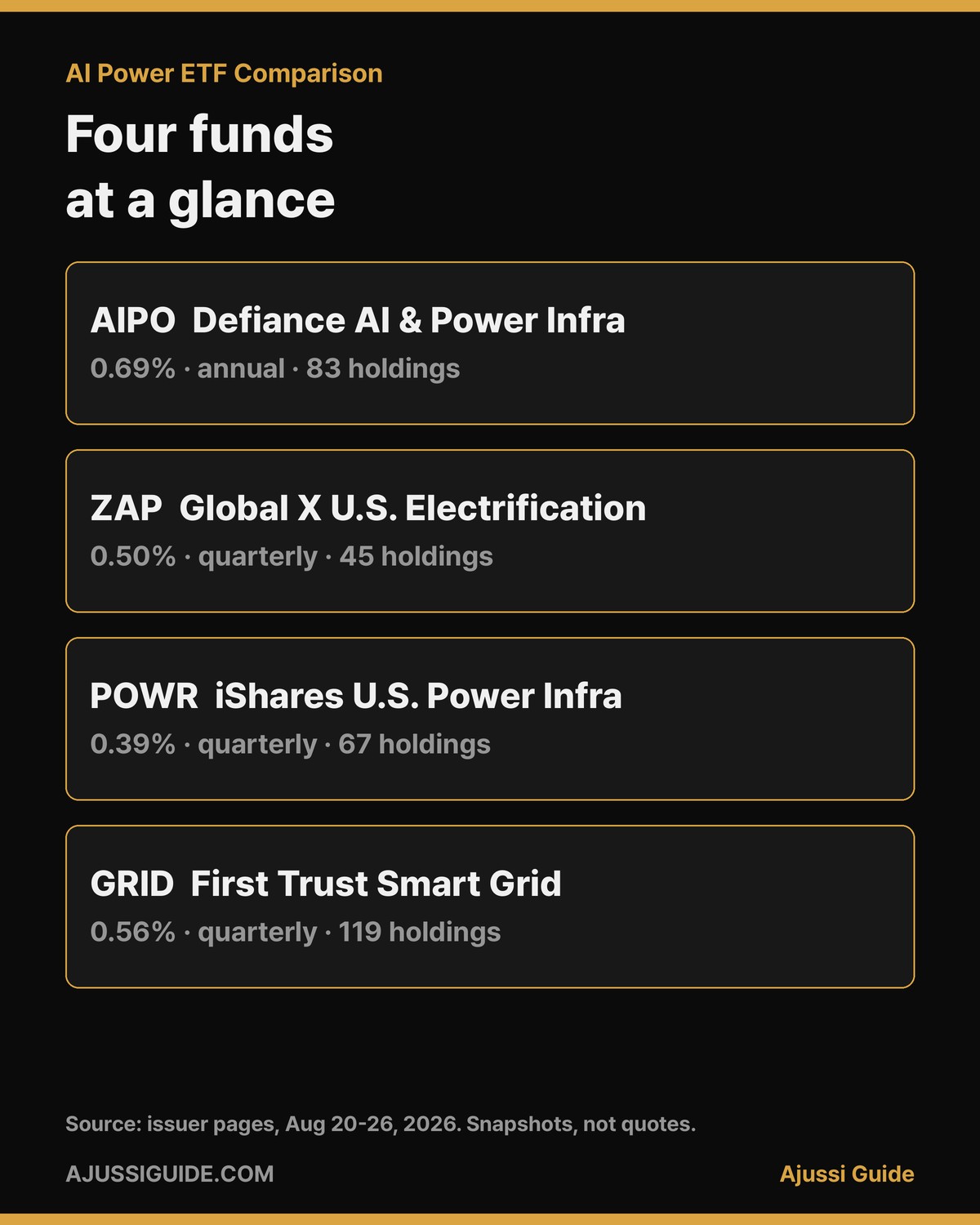
The four funds
| Fund | Ticker · Launched · Expense |
|---|---|
| Defiance AI & Power Infrastructure | AIPO · Jul 2025 · 0.69% |
| Global X U.S. Electrification | ZAP · Dec 2024 · 0.50% |
| iShares U.S. Power Infrastructure | POWR · Jan 2012, strategy changed Oct 2025 · 0.39% |
| First Trust Smart Grid Infrastructure | GRID · Nov 2009 · 0.56% |
GRID is the largest of the four at $11.71 billion in net assets (Aug 24) and has been running since 2009. AIPO, the newest, holds $916 million (Aug 24) after roughly a year. ZAP holds $460 million and POWR $453 million (Aug 25). POWR’s 2012 inception date belongs to the same legal fund under a different name and strategy. Until October 29, 2025, it was the iShares MSCI Global Energy Producers ETF (FILL), so its earlier performance is not a record of the current power-infrastructure strategy.
What each fund actually holds
AIPO (top ten as of Aug 26): Eaton 8.96%, GE Vernova 8.79%, Quanta Services 7.62%, Vertiv 7.26%, Cameco 4.38%, NVIDIA 4.37%, Bloom Energy 4.25%, Constellation Energy 4.24%, Broadcom 3.94%, AMD 2.39%. Eighty-three holdings. The top four are the same equipment names that lead our AI power infrastructure stocks list, but three of the top ten are chip companies. NVIDIA, Broadcom and AMD together account for 10.70% of AIPO, so the fund may overlap with semiconductor exposure already held elsewhere. It is fairly broad at 83 names, though GRID’s 119 is broader.
ZAP (Aug 24): sector split is 77.1% utilities and 22.9% industrials. Top ten: Dominion 4.52%, Quanta 4.34%, Ametek 4.32%, Eaton 4.26%, Bloom 4.15%, Consolidated Edison 4.14%, Duke 4.03%, Xcel 4.02%, Southern 4.01%, Exelon 3.99%. It holds 45 names, with each of the top ten weighted at roughly 4%. ZAP is utility-led, while AIPO is equipment-led; the utilities here are the same companies covered in our utility stocks and data center demand post. Distributions are quarterly.
POWR (Aug 24): Eaton 6.64%, GE Vernova 6.63%, NextEra 6.03%, Quanta 5.78%, EQT 4.46%, Southern 4.04%, Duke 3.78%, Constellation 3.47%, nVent 3.29%, Hubbell 3.27%. Sixty-seven holdings; by sector, electric utilities 35.5%, electrical components and equipment 18.2%, multi-utilities 11.2%. Equipment, utilities and natural gas in one basket, which makes it the mixed U.S. power value-chain fund of the four. At 0.39% it is the cheapest, and iShares publishes the full holdings file daily.
GRID (Aug 20): Schneider Electric 9.35%, Eaton 8.89%, Johnson Controls 8.30%, ABB 7.95%, Quanta 7.64%, National Grid 4.21%, E.ON 4.07%, Prysmian 3.56%, nVent 2.73%, Hubbell 2.49%. One hundred nineteen holdings. Five of the top ten are European. The name says U.S.-listed, the portfolio says global transmission and distribution, which is how that industry is actually structured.
Four different products under one label
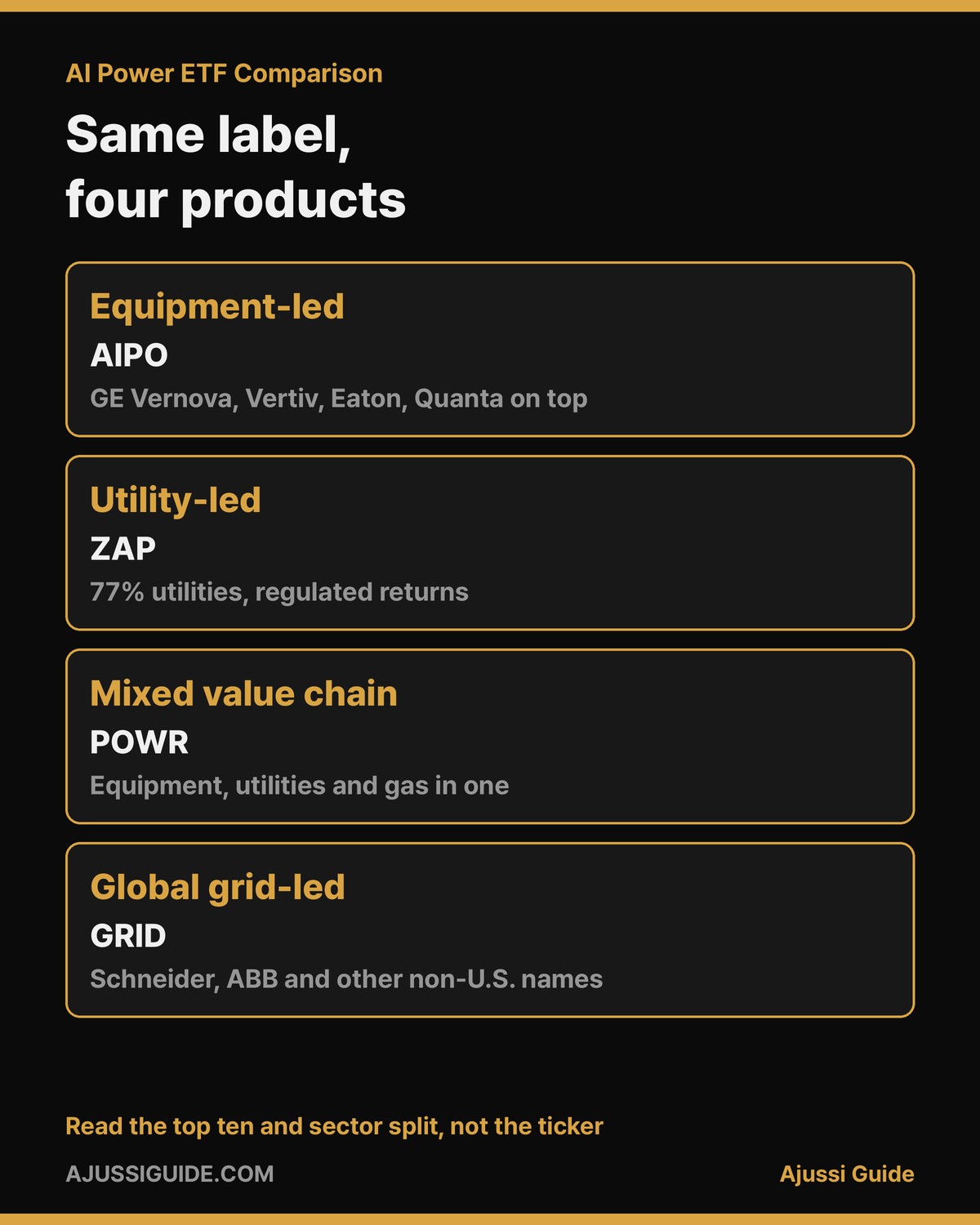
Sorted by what leads the portfolio, the four funds fall into four types.
Equipment-led: AIPO. GE Vernova, Vertiv, Eaton and Quanta carry the fund, with chips mixed in. This is the part of the chain that gets orders first when hyperscalers raise capital spending, and volatility can run higher.
Utility-led: ZAP. Seventy-seven percent of the portfolio earns regulated returns on rate base. It moves on rate cases and interest rates more than on data center announcements, and pays quarterly.
Mixed value chain: POWR. Equipment makers, utilities and a gas producer in one fund, weighted so no single name exceeds 7%.
Global grid-led: GRID. Transmission and distribution equipment is a market dominated by European and U.S. suppliers, and GRID reflects that. It is also the only one of the four with a strategy-relevant record dating to 2009.
Same search term, four different exposures. The ticker alone does not reveal the portfolio mix; the top ten and the sector split do.
What to check before choosing
First, the current top ten. The tables above are late-August snapshots and indexes rebalance; open the issuer’s holdings file rather than trusting a blog post, including this one.
Second, chip exposure. AIPO’s NVIDIA, Broadcom and AMD are the obvious case, but do not assume the others are clean. Check the latest holdings file for semiconductor names and weights rather than judging by fund name or type.
Third, distribution schedule. AIPO pays once a year; ZAP, POWR and GRID pay quarterly. For an income sleeve that difference matters more than a few basis points of expense ratio.
Risks
Several related ETFs were launched from late 2024 onward. Assets under management alone do not establish future returns or actual net inflows. Equipment-led funds can come under pressure if hyperscaler capex guidance is cut. Utility-led funds can be pressured when rates rise. GRID adds European macro and currency to the mix. Every asset and weight figure in this post is a dated snapshot and will have moved by the time you read it.
FAQ
What is the best AI power ETF?
This post does not rank them. It shows that AIPO is equipment-led with chips mixed in, ZAP is utility-led, POWR is a mixed value-chain fund, and GRID is led by global grid equipment makers. The comparison should focus in part on how each exposure overlaps with an investor’s existing portfolio.
Does AIPO hold NVIDIA?
Yes. As of August 26, 2026, NVIDIA was 4.37% of AIPO, with Broadcom at 3.94% and AMD at 2.39%, all inside the top ten. The index defines AI power infrastructure broadly enough to include chip makers.
What is the difference between ZAP and AIPO?
ZAP is 77% regulated utilities (Dominion, Duke, Southern, Exelon), holding 45 names with each of the top ten weighted near 4%. AIPO concentrates in equipment makers (Eaton, GE Vernova, Quanta, Vertiv) and adds semiconductors, across 83 names. ZAP pays quarterly; AIPO pays annually.
Is GRID a U.S. ETF?
It is listed on Nasdaq and run by First Trust, but five of its top ten holdings are European: Schneider Electric, ABB, National Grid, E.ON and Prysmian. It tracks the Nasdaq Clean Edge Smart Grid Infrastructure Index and is the largest of the four at $11.71 billion.
Which AI power ETF has the lowest expense ratio?
POWR at 0.39%, then ZAP 0.50%, GRID 0.56% and AIPO 0.69%. POWR is listed on NYSE Arca; the other three trade on Nasdaq.
The data center side of the same question, DTCR, SRVR, IDGT, RACK and NCLD, is covered in the data center ETF comparison.
This article is for informational purposes only. It is not a recommendation to buy or sell any security mentioned, and investment decisions and their outcomes are your own responsibility.
Last verified: 2026-08-26