Interest in photonics stocks has exploded this year, and most of the lists floating around are built the same way: grab every ticker that has ever appeared in a photonics headline and rank them by vibes. I did something slower. I ran exact-phrase searches for “silicon photonics” across SEC EDGAR filings and then read the underlying documents, because what a company says in a press release and what it reports in a filing under securities law are not the same kind of evidence. This post maps what those filings actually say, company by company, and separates business evidence from money flows, because mixing the two is how investors get fooled.
Why Photonics Stocks Are Suddenly Everywhere in 2026
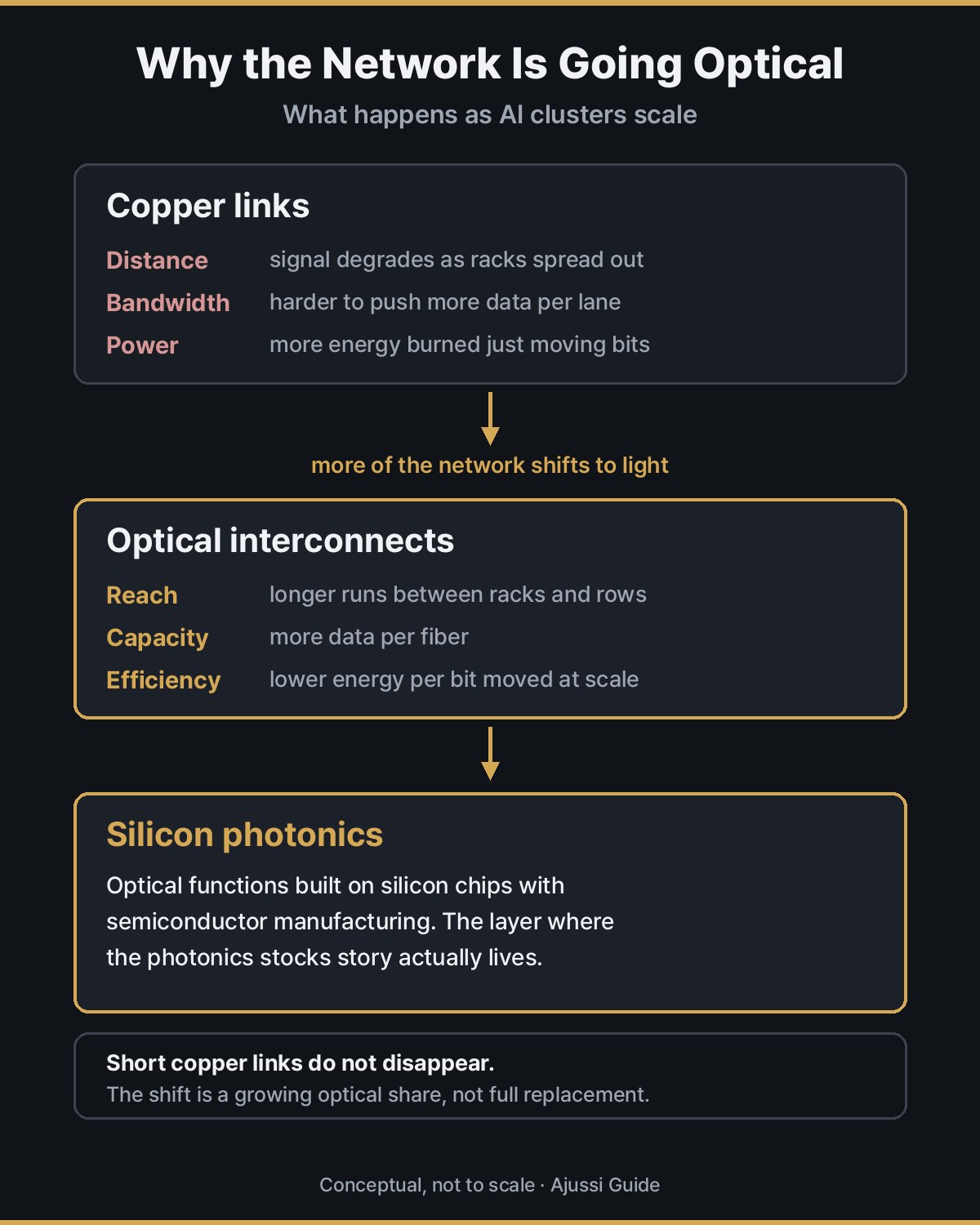
The short version: AI data centers are running into the limits of copper. As AI clusters scale, copper links face tighter distance, bandwidth, and power constraints, pushing more of the network toward optical interconnects. Silicon photonics, which puts optical components onto silicon chips using semiconductor manufacturing, sits at the center of that transition inside the networking layer of the AI infrastructure stack.
The money followed. In March 2026, NVIDIA completed three separate $2 billion equity investments in optics and interconnect suppliers: Lumentum (LITE) and Coherent (COHR) on March 2, and Marvell (MRVL) on March 31, alongside strategic agreements including silicon photonics collaboration. When a company that has become a major disclosed source of capital and purchase commitments across the AI optics supply chain writes checks like that, search interest in photonics stocks follows. The problem is that a rally built on headlines pulls in every company with the word photonics anywhere near it, whether or not the filings support the story.
How I Screened Photonics Stocks: Phrase Search, Not Headlines
My screen was an exact-phrase search for “silicon photonics” in SEC EDGAR full-text search, covering filings from January 2025 through late August 2026. On Form 10-K that returned 41 documents across 25 distinct registrants. Form 20-F added foreign issuers including GlobalFoundries (GFS), Tower Semiconductor (TSEM), and UMC.
Two honest caveats before anything else. First, a phrase hit is not a business: market descriptions, customer mentions, and even SPAC boilerplate all match an exact phrase, so each hit has to be read in context. Second, I opened and read the full annual reports for five companies in this pass, Tower, GlobalFoundries, Marvell (MRVL), Coherent, and Credo (CRDO), plus the 8-K transaction filings for Lumentum. Everything I say below is scoped to those documents, not to the entire US market. The rest of the hit list, names like MACOM and a long tail of small registrants, is confirmed for the phrase but not yet read in full.
The Evidence Ladder: Seven Levels of Silicon Photonics Exposure
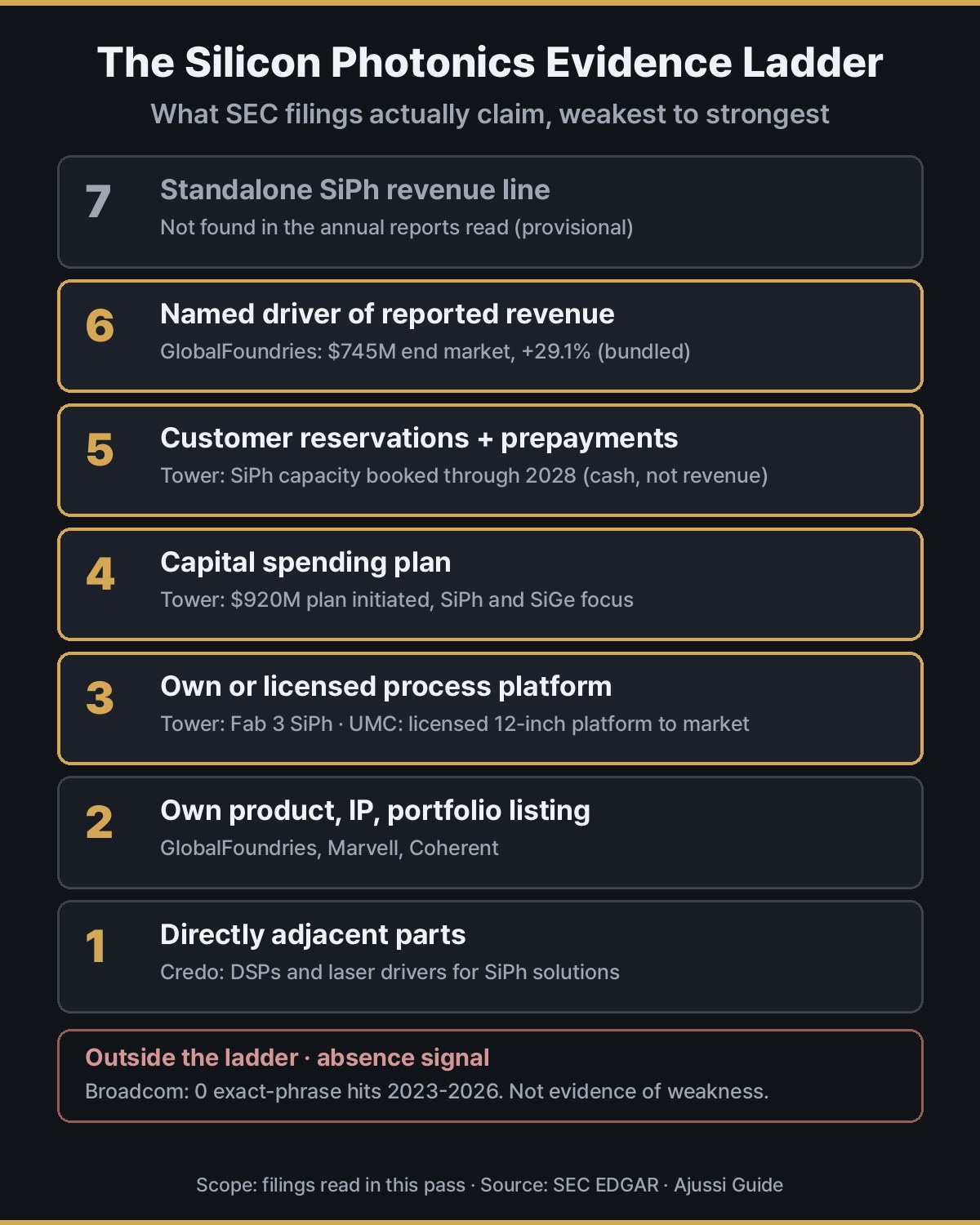
Once you read the filings, the claims sort themselves into a ladder, from weakest to strongest business evidence. At the bottom sits adjacency: a company whose products serve silicon photonics without being it. One step up is a portfolio mention: silicon photonics listed among a company’s products or intellectual property. Above that come the physical commitments: owning your own process and fab, disclosing a capital spending plan, and, rarer, customers reserving your capacity with prepayments. Near the top is reported revenue where silicon photonics is named as a growth driver. The top rung, a separately disclosed silicon photonics revenue line, is one I did not find in any of the five annual reports I read, and I flag that as a provisional finding rather than a verdict, since I have not yet decomposed every revenue table line by line and Lumentum’s annual report was outside this pass.
That last point deserves emphasis because it is the single most useful thing this exercise produced: even the companies most associated with the photonics trade do not yet break out silicon photonics as its own revenue line in the documents I reviewed. The investment story is real, but it lives in the stages before revenue.
Tower Semiconductor: The Most Complete Business Chain
Of everything I read, Tower Semiconductor’s 20-F builds the most complete chain of silicon photonics business evidence, in three linked steps.
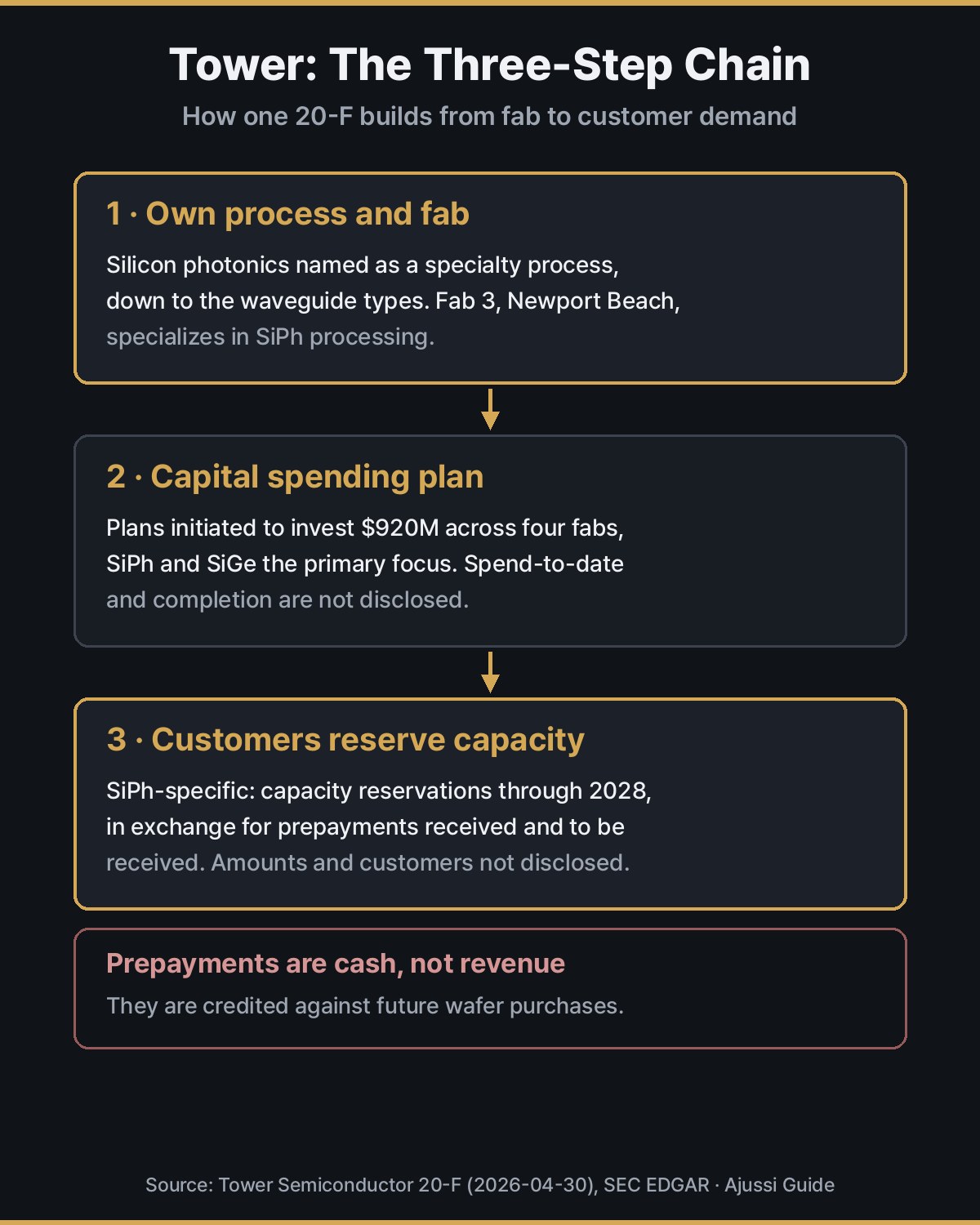
Step one, it owns the process and the fab. Tower lists silicon photonics among its specialty process technologies, down to the waveguide types, silicon and low-loss silicon nitride, and states that Fab 3 in Newport Beach, California specializes in silicon photonics processing. Step two, it discloses a capital plan: the company writes that over the last two years it has initiated plans to invest an aggregate of $920 million in capital expenditures, primarily to expand silicon photonics and silicon germanium capacity across four fabs. Note the wording, initiated plans: the filing does not disclose how much has actually been spent or how complete the buildout is, and the $920 million also covers power and other capacity, so this is not a pure photonics number.
Step three is the rarest disclosure in this entire survey. Specifically for silicon photonics, Tower states that during 2026 it engaged customers for committed capacity reservations through 2028 in exchange for prepayments received and to be received, credited against future purchases. Customers are paying cash today to lock up photonics manufacturing capacity two years out. Two cautions: prepayments are not revenue, they are cash that will be credited against future wafer purchases, and neither the amounts nor the customers are disclosed. But as demand evidence, a customer prepaying for 2028 capacity is a stronger signal than any product list.
GlobalFoundries: The Closest Thing to Photonics Revenue
GlobalFoundries gets closer to the revenue line than anyone else I read. Its 20-F names silicon photonics as one of its differentiated product lines and gives it an independent row in the company’s technology and end-market matrix. Then comes the number: the Communications Infrastructure and Data Center end market reported $745 million of revenue, up 29.1 percent year over year, and the filing attributes that growth to silicon photonics optical networking and satellite communications.
Read that carefully. It is real, reported revenue with silicon photonics named as a growth driver, which is a heavier claim than a product list. But it is not a silicon photonics revenue figure: the $745 million is a bundled end market that also includes satellite communications and other technologies. Anyone quoting it as photonics revenue is misreading the filing.
Marvell, Coherent, Credo: Products, Portfolios, and Adjacent Parts
Marvell’s 10-K places silicon photonics in two lists that matter: its interconnect product family, alongside PAM DSPs, laser drivers, and co-packaged optics chipsets, and its own intellectual property suite that underpins its custom silicon platform. Of everything I read, Marvell’s language most clearly claims silicon photonics as its own technology rather than a market it sells into.
Coherent’s fiscal 2026 10-K states that its portfolio includes silicon photonics, co-packaged optics, and optical circuit switches supporting AI datacenter architectures, and the annual report itself, not just a press release, records the NVIDIA strategic supply agreement. The same passage notes Coherent received a $50 million preliminary memorandum of terms under the CHIPS and Science Act for its Sherman, Texas expansion. That phrase matters: a preliminary memorandum of terms is neither a finalized award nor cash received, and writing it as fifty million dollars in CHIPS funding secured would overstate it.
Credo sits one rung down, and the filing is precise about it: its DSP families ship with integrated laser-driver options for silicon photonics, EML, and VCSEL-based solutions. Credo builds parts that directly drive silicon photonics systems. That is real, adjacent exposure, not the same thing as owning a photonics platform.
One more name moved out of the unread pile during cross-review: UMC. Its 20-F discloses a December 2025 licensing agreement for imec’s iSiPP300 silicon photonics process, with co-packaged optics compatibility, and states that the licensed technology will enable UMC to bring a 12-inch silicon photonics platform to market for next-generation connectivity. The packaging architecture driving that demand, and the fight over its rollout schedule, is the subject of my separate co-packaged optics stocks guide. That is direct, company-level platform evidence, sitting alongside owned process capability on the ladder, though the filing discloses no standalone silicon photonics revenue line.
The NVIDIA Money Is a Different Axis
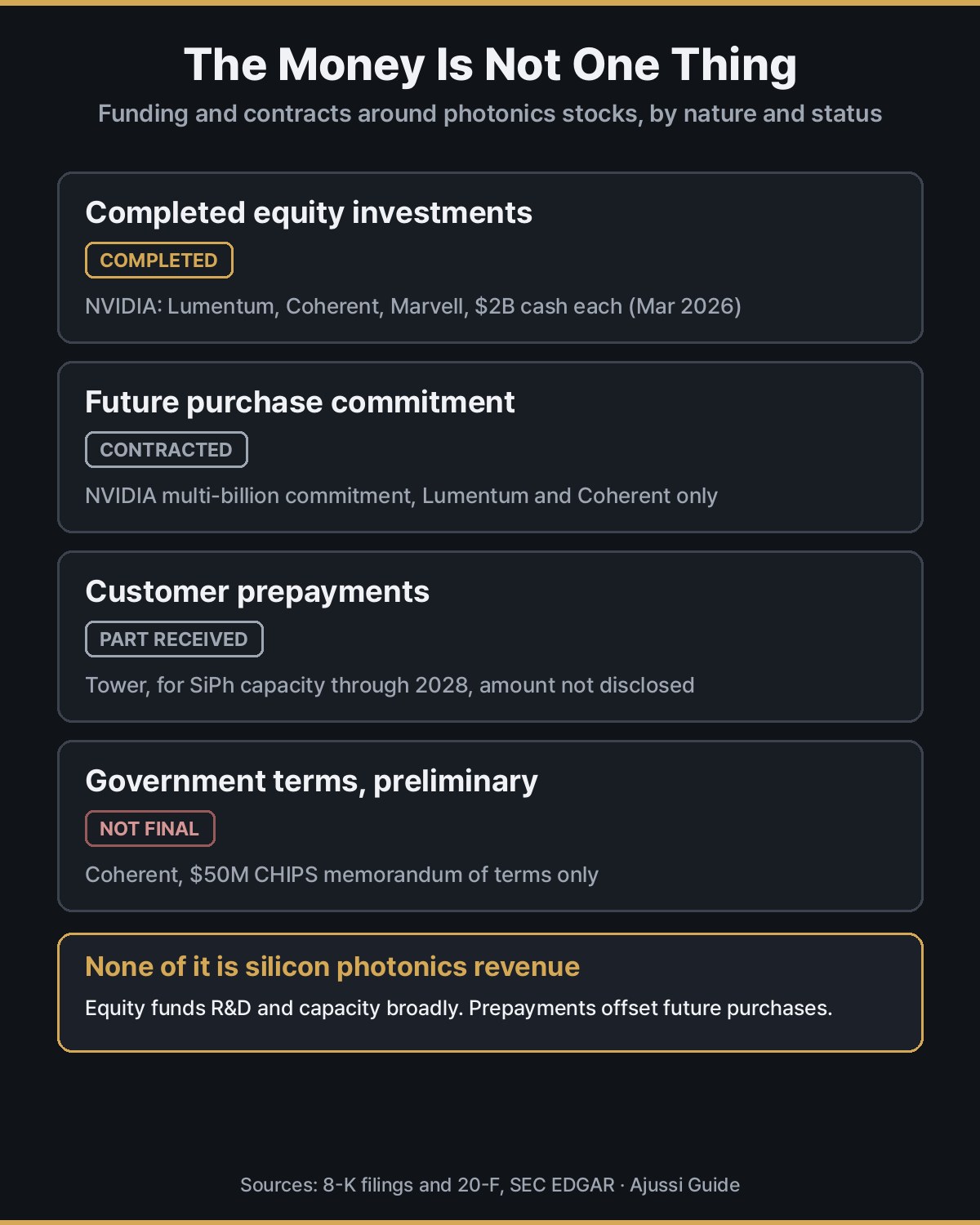
Here is where most photonics stocks coverage goes wrong: it stacks the money on top of the business evidence as if they were one ranking. They are not, and the filings force the distinction.
The NVIDIA investments are completed transactions, verified in the 8-K filings themselves, not just the press releases. Lumentum issued 2,876,415 shares of Series A convertible preferred stock at $695.31 per share for $2.0 billion in cash, and Coherent issued 7,788,161 common shares at $256.80 for $2.0 billion in cash, both on March 2. On March 31, Marvell completed the sale of 2,000,000 Series A convertible preferred shares to NVIDIA for $2.0 billion in cash, and the accompanying announcement states the companies will collaborate on silicon photonics technology. One distinction matters: the Lumentum and Coherent filings also reference a separate NVIDIA multi-billion dollar purchase commitment with future capacity access rights, with no precise amount disclosed, while no comparable purchase commitment appears in the Marvell announcement.
But note what Coherent’s own 8-K says the money is for: research and development, future capacity expansion, and operational capabilities as Coherent expands US manufacturing. It is not ring-fenced silicon photonics funding. A completed $2 billion equity investment is a major signal about the optics supply chain, and it still tells you less about a company’s silicon photonics business substance than Tower’s unglamorous customer prepayment sentence. Keep the two axes separate: business evidence on one, money and contracts on the other.
The Broadcom Absence, and What It Does Not Mean
One control test: I ran the same exact-phrase search against Broadcom’s filings, restricted to its own registrant number, from January 2023 through August 2026. Zero hits for silicon photonics as an exact phrase. NVIDIA itself returned four, Lumentum two, Coherent twenty.
Be careful with what that means. Broadcom describes its co-packaged optics technology on its own product pages as an integration of optics and silicon, so the gap reflects disclosure channels and vocabulary, not proof that the business is absent; the company may simply describe this work in terms such as co-packaged optics or optical interconnects, and that possibility is not excluded by this search. I flag it because Broadcom appears on nearly every photonics stocks list on the internet, and it is worth knowing that the exact phrase driving this trade does not appear in the filings I searched.
How I Think About Photonics Stocks as a Self-Directed Investor
The line that separates a real photonics stock from a story stock is not revenue, because on the evidence above, separately disclosed silicon photonics revenue barely exists yet anywhere. The line is the stage before revenue: who owns process and capacity, whose customers are prepaying, whose products and IP are named in their own filings, and who is merely adjacent to the theme.
The money axis, NVIDIA’s investments and purchase commitments, tells you the direction of the supply chain and who the anchor buyer wants to strengthen. It does not tell you which business converts photonics demand into margin first. When I weigh these names, I read the two axes side by side and treat any list that ranks photonics stocks on a single scale, including this market’s many AI-generated listicles, as a starting point for verification rather than an answer.
Frequently Asked Questions
What are photonics stocks?
Publicly traded companies whose business involves generating, moving, or processing data with light: lasers, optical transceivers, optical components, and increasingly silicon photonics, where optical functions are built on silicon chips. In 2026 the term is used mostly for companies tied to AI data center optical networking.
What is the difference between photonics stocks and silicon photonics stocks?
Photonics is the broader category, covering everything from industrial lasers to sensors. Silicon photonics is the subset that integrates optics onto silicon using chip manufacturing, and it is the part most directly tied to the AI data center interconnect story. Some classic photonics companies have little silicon photonics exposure, which is exactly why reading filings beats keyword matching.
Which photonics stocks are the best buys right now?
I do not rank buys, and I would be skeptical of anyone who ranks them off headlines. What I can offer is the evidence map above: filings-based signals like owned fabs, customer prepayments, and named growth drivers on one axis, and investment and contract flows on the other. Where each company trades relative to that evidence is a judgment you have to make with current prices in front of you.
Did NVIDIA really invest in photonics companies?
Yes, three times over. The 8-K filings confirm completed $2 billion cash investments into Lumentum and Coherent on March 2, 2026, and into Marvell on March 31, 2026, in preferred and common stock structures. Lumentum and Coherent also carry a multi-billion dollar NVIDIA purchase commitment whose exact amount is not disclosed; the Marvell announcement instead cites strategic collaboration including silicon photonics. The filings describe the money as supporting R&D, capacity, and US manufacturing broadly, not silicon photonics exclusively.
Is Broadcom a silicon photonics stock?
The exact phrase returned zero hits in my EDGAR search of Broadcom filings from 2023 through August 2026, while peers returned multiple. That is an absence signal, not a verdict: Broadcom may describe its optics work in other terms. If you own it for the optics story, that distinction is worth checking against its own disclosures.
Do any companies report silicon photonics revenue separately?
In the five annual reports I read in full, Tower, GlobalFoundries, Marvell, Coherent, and Credo, I did not find a separately disclosed silicon photonics revenue line. GlobalFoundries comes closest, naming silicon photonics as a growth driver of a bundled $745 million end market. Treat this as a provisional finding limited to the five annual reports reviewed.
How can I verify photonics claims myself?
Use SEC EDGAR full-text search with the phrase in quotation marks, then open the actual filing and read the sentence in context. Check whether the subject of the sentence is the company itself or its market, and whether a number is revenue, a capital plan, a prepayment, or an investment. Those distinctions, not the ticker lists, are where the real information lives.
Last verified: 2026-08-24. This post reflects filings available on SEC EDGAR as of that date, and the revenue finding is provisional and scoped to the five annual reports read in full. Verify all claims against the primary documents at SEC EDGAR full-text search before making any decision.
This is information, not investment advice. I am not recommending buying or selling any security. All investment decisions carry risk and are entirely your own responsibility.