An Oklo vs NuScale stock comparison in 2026 comes down to one question: which company has the more believable path from story to cash flow? Oklo is a microreactor developer with early backing from OpenAI CEO Sam Altman, no commercial power revenue yet, and data-center and defense customers in its sights. NuScale is the only SMR developer with a US Nuclear Regulatory Commission standard design approval for its light-water reactor design, yet it had to restructure after its first major project was cancelled. Both trade on US exchanges as pure-play small modular reactor stocks. Neither has a completed, operating reactor generating commercial revenue today. That gap between story and cash flow is exactly what this post is about.
Why an Ajussi Is Writing About SMR Stocks
I run my own money. I do not manage anyone else’s capital, which means I can say the uncomfortable parts out loud. SMR stocks are popular right now because AI data centers need enormous amounts of firm, carbon-light power and the grid cannot supply it fast enough. That narrative is real. The question is whether either Oklo or NuScale can actually deliver a reactor before the market loses patience.
I started watching this sector when hyperscalers began signing nuclear power agreements. Once Microsoft, Google, and others started putting actual dollars behind nuclear power, I knew retail money would be tempted by anything with “nuclear” in the ticker. That is when the homework matters most.
Oklo vs NuScale Stock Comparison: The Core Business Models
Oklo is designing a fast fission microreactor called the Aurora. The company wants to use recycled nuclear fuel, which is a genuine differentiator if the supply chain works. Its target customers are data centers, remote industrial sites, and the US military. Oklo went public via SPAC and was chaired by Sam Altman until April 2025, an association that still drives a lot of retail interest that goes beyond the fundamentals.
NuScale’s technology is a light-water small modular reactor, a design philosophy much closer to conventional nuclear plants. The NRC issued a standard design approval for an earlier version of its reactor design, making NuScale the first SMR developer to clear that hurdle in the United States. However, NuScale lost its anchor project, the Carbon Free Power Project in Idaho, after cost estimates rose sharply and utility subscribers withdrew. The company has since refocused on international projects such as its Romanian RoPower plant and, more recently, a utility-led US program with TVA and ENTRA1 targeting up to 6 GW of NuScale modules.
The business model difference matters for investors. Oklo is earlier stage and carries more technology risk but also more optionality if its fuel-recycling approach works at scale. NuScale has demonstrated more regulatory progress but faces the harder question of whether it can find customers willing to accept its cost structure.
Revenue Status as of Mid-2026
Oklo has no commercial reactor operating and generating revenue. The company has signed letters of intent and other preliminary agreements with several parties, but letters of intent are not the same as signed, financed power purchase agreements. The January 2026 agreement with Meta, supporting a planned 1.2 GW campus in Ohio with a prepayment mechanism, is a real step beyond that, but first power there is targeted for as early as 2030. Oklo has not recognized any operating revenue at all yet. Its most recent quarterly income statement shows no revenue line, only interest income on its cash.
NuScale also does not have an operating reactor. The company has engineering services revenue and has been working to reposition itself after the Idaho project cancellation. Investors should treat both companies as pre-commercial-revenue in the most important sense: neither is yet selling power at commercial scale.
Regulatory Milestones: Where Each Company Stands
NuScale’s standard design approval from the NRC is a genuine competitive advantage on paper. Getting a reactor design through the NRC review process takes years and enormous resources. NuScale has done that. NuScale has since added a standard design approval for its uprated 77 MWe module in 2025, so the approval story now covers its current offering. Even so, design approval is not the same thing as a fully financed, built, and operating commercial plant.
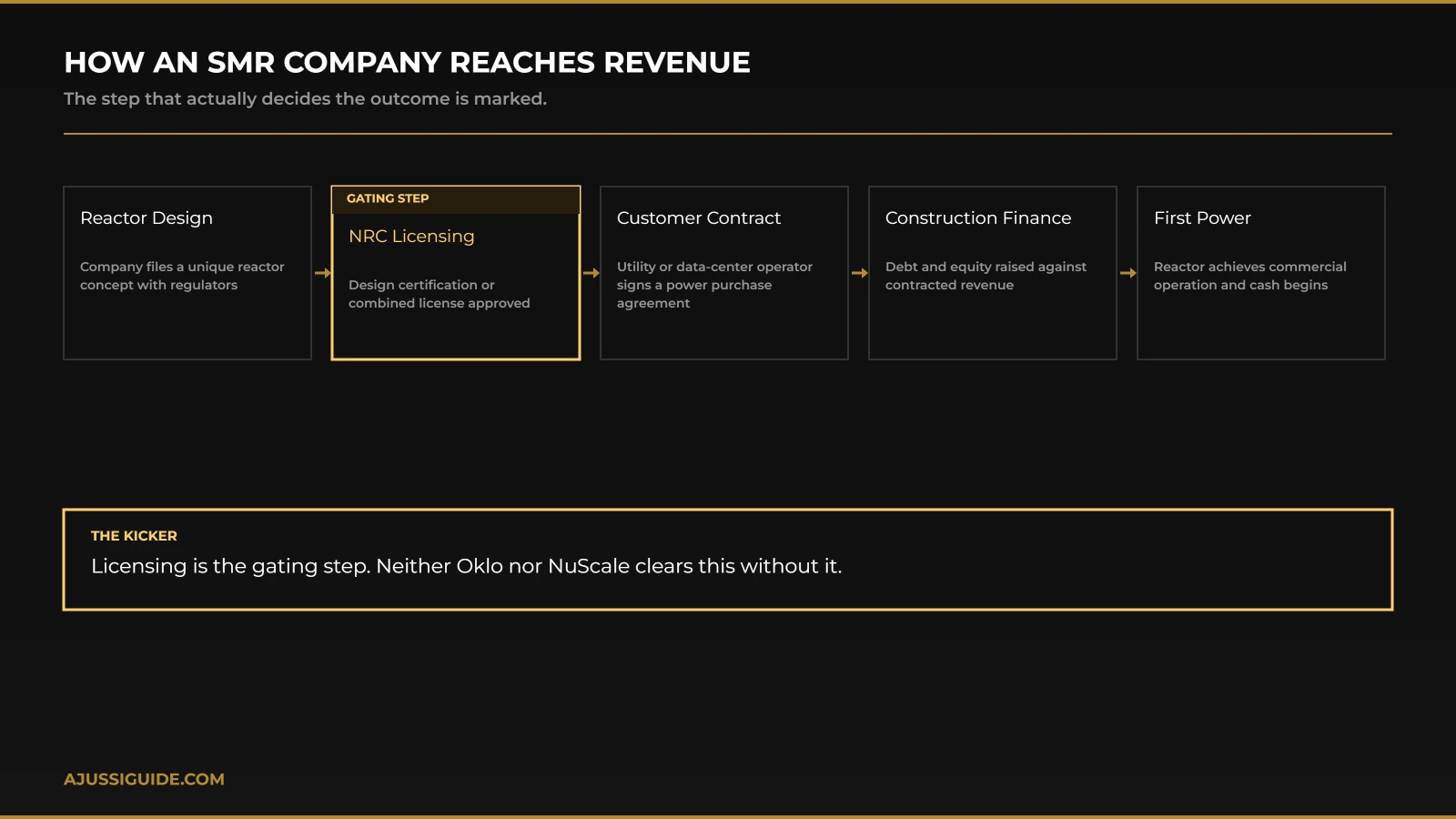
Oklo submitted a combined license application to the NRC, which was previously rejected and required resubmission. As of mid-2026, Oklo is working through that licensing process. The Aurora design is different enough from conventional light-water reactors that the NRC review timeline is genuinely uncertain. Investors who have not read an NRC combined license application probably underestimate how long and expensive this process is.
For a primary source on the NRC licensing process and current application statuses, the NRC’s own reactor licensing page is the right place to check: NRC Small Modular Reactors overview.
What Licensing Delay Actually Costs
Every year of licensing delay is another year of cash burn without revenue. Both companies fund operations through equity raises and government grants. Equity raises dilute existing shareholders. This is not a theoretical risk; it is a recurring reality for pre-commercial nuclear developers.
Comparing the Two Companies Across Key Variables
| Variable | Oklo | NuScale |
|---|---|---|
| Reactor type | Fast fission microreactor (Aurora) | Light-water small modular reactor |
| Current NRC status | Combined license application in process | Standard design approvals achieved, including the uprated 77 MWe design; commercial deployment work remains |
| Commercial revenue from power sales | None yet | None yet |
| Primary near-term customers targeted | Data centers, defense, remote industry | Utilities, international markets |
| Key differentiator claimed | Recycled fuel, smaller footprint | Regulatory precedent in the US |
| Notable backer or board profile | Early Sam Altman backing, chairman until 2025 | Established utility and government relationships |
| Path to market risk level | Higher (technology and licensing) | Medium-high (commercial and cost risk) |
The AI Infrastructure Angle
The reason both stocks have attracted attention far beyond the traditional nuclear investor community is the AI power demand story. Large language model training and inference require enormous, continuous electricity loads. Data center operators have publicly said they cannot get enough firm power from the grid to meet their build-out plans. Nuclear, in theory, solves this because it runs around the clock regardless of weather.
Oklo has positioned itself most explicitly around this theme, partly because of its early association with Sam Altman, who stepped down as Oklo chairman in April 2025 precisely so the company could pursue supply deals with AI firms. The market has priced in some version of an AI-nuclear partnership that has not yet been finalized in the form of an operating reactor delivering power to a data center. Investors who understand AI infrastructure know that hyperscalers need power on a specific schedule. A reactor that might come online in several years does not solve a problem the operator has today.
NuScale is also pursuing data-center customers but from a different angle, emphasizing its regulatory track record. The honest assessment is that both companies need the AI power narrative to stay strong and need their own execution to catch up with the narrative.
The Risks I Am Watching Closely
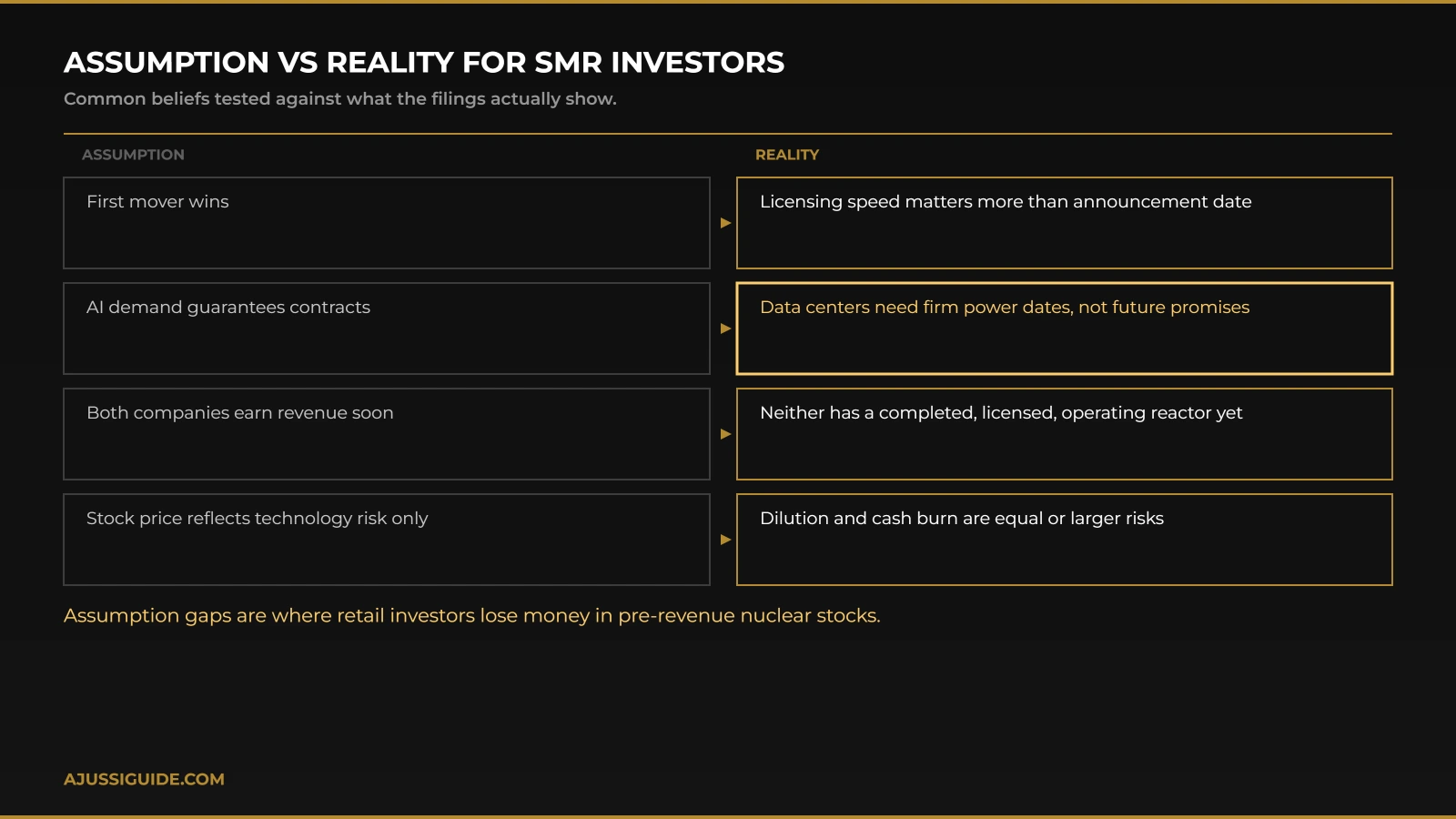
The first risk is licensing duration. The NRC process for a genuinely novel reactor design does not have a fixed clock. Oklo’s Aurora is novel enough that historical timelines for conventional plant reviews do not apply cleanly. Any investor modeling a specific first-power date for Oklo is making an assumption, not reading a guarantee.
The second risk is dilution. Both companies need large amounts of development and construction capital before any reactor is operational, and even with sizable cash balances today, delays or cost growth could force additional raises. Each raise is a potential dilution event. I watch the cadence of equity issuance closely because it tells me how much runway management thinks they have.
The third risk is cost escalation. NuScale already experienced this at the Idaho project. Nuclear construction cost estimates have historically grown from initial projections. A company’s ability to hold costs to a level that makes power purchase agreements economical is unproven at the SMR scale for both of these developers.
The fourth risk is competition. South Korean, Canadian, and European advanced nuclear developers are also competing for customer attention, and some are pursuing US-facing licensing or partnership paths. The SMR market is not a two-horse race globally, even if Oklo and NuScale are the two most prominent US pure plays on US exchanges.
How I Think About Position Sizing for Pre-Commercial Nuclear
I do not treat either of these as a core position. They belong in the speculative sleeve of a portfolio, sized so that a total loss would be painful but not catastrophic. That is not pessimism about nuclear energy; it is realism about the gap between a promising technology and a revenue-generating business.
The investors who made money on early-stage tech stocks were usually the ones who sized correctly for the binary outcomes, not the ones who concentrated because the story was compelling. SMR stocks have the same profile: the upside is large if execution happens, and the downside is significant if licensing stalls or capital runs out.
I also pay attention to what institutional investors are doing. When large funds with actual nuclear expertise take or add positions, that tells me something different than retail momentum. Retail momentum can move a stock for months; deeper institutional conviction is more often what helps sustain a re-rating.
Frequently Asked Questions
Is Oklo or NuScale a better investment right now?
Neither is clearly better without knowing your risk tolerance. Oklo carries higher technology and licensing risk but has a differentiated fuel approach and strong AI-sector connections. NuScale has more regulatory precedent but faces commercial execution challenges after its Idaho project cancellation. A proper Oklo vs NuScale stock comparison forces you to decide which risk profile fits your portfolio, not which story sounds better.
Does NuScale have NRC approval for its reactor?
NuScale received a standard design approval from the NRC for an earlier version of its light-water SMR design, making it the first SMR developer to achieve that milestone in the United States. The company has since received meaningful NRC design approvals, including for its updated 77 MWe design. Still, approval of a reactor design is not the same as having a fully licensed, financed, and operating commercial plant.
When will Oklo have a reactor running?
Oklo has not publicly committed to a final commercial operation date that is backed by a completed license and financed construction contract. The company is working through its NRC combined license application process. Timeline estimates from management should be understood as targets, not guarantees. Licensing processes for novel reactor designs have historically taken longer than initial projections.
Why do SMR stocks move with AI news?
AI data centers consume large, continuous electricity loads that the existing grid struggles to supply reliably. Nuclear power, including SMRs, can run around the clock regardless of weather, making it attractive for baseload data-center power. When AI companies announce nuclear power agreements or when AI capex spending rises, investors bid up SMR stocks on the assumption that demand for nuclear power will grow. The narrative is real. The uncertain part is execution and timing.
What happened to NuScale’s Idaho project?
NuScale’s Carbon Free Power Project in Idaho was cancelled after cost estimates rose substantially and utility subscribers withdrew from the purchasing consortium. The project had been a flagship demonstration of NuScale’s technology and its cancellation was a significant setback for the company. NuScale has since restructured its strategy around international projects and utility-led US programs.
Are Oklo and NuScale generating revenue?
Neither company is generating commercial revenue from selling nuclear power. Oklo has not recognized operating revenue at all yet, while NuScale has recognized engineering and licensing services revenue. In the most important sense for long-term investors, neither company earns reactor revenue yet: no completed reactor is selling kilowatt-hours at commercial scale as of mid-2026.
What is the biggest risk in owning SMR stocks long term?
Dilution and licensing delay are the two risks that can kill returns even if the underlying technology works. Each year a reactor is not operating is another year of cash burn funded by equity raises that dilute existing shareholders. Investors who model a specific timeline and ignore the possibility of multi-year delays tend to be the ones most surprised by how their position performs.
How does an Oklo vs NuScale stock comparison help me decide?
A structured comparison forces you to separate the story from the business fundamentals. Oklo and NuScale have different reactor technologies, different regulatory positions, different customer strategies, and different risk profiles. Understanding those differences lets you decide which specific risks you are willing to accept rather than just buying whichever stock has momentum. Comparison is a framework for discipline, not a buy signal.
Last verified: 2026-08-05.
This post is information only. Nothing here is investment advice, and no buy or sell recommendation is made for any security mentioned. You carry the decision and its consequences.