Utility stocks and data center electricity demand are now directly connected in a way that did not exist five years ago. Hyperscalers building AI training and inference infrastructure need enormous, reliable power — and that power has to come from somewhere. Regulated electric utilities are the entities that build, own, and operate the grid infrastructure those data centers plug into. For investors, this creates a structural tailwind for certain utilities that is different from the old slow-and-steady utility story. The question is not whether demand is real. The question is which utilities capture it, at what allowed return, and at what price you are buying in.
Why Data Center Electricity Demand Is Reshaping the Utility Business
AI model training and inference are extraordinarily energy-intensive. A single large GPU cluster running continuously can consume tens of megawatts — comparable to a small town. When you multiply that across dozens of hyperscale campuses, the aggregate load growth becomes material to regional utility planning horizons in a way that ordinary residential or commercial growth never was.
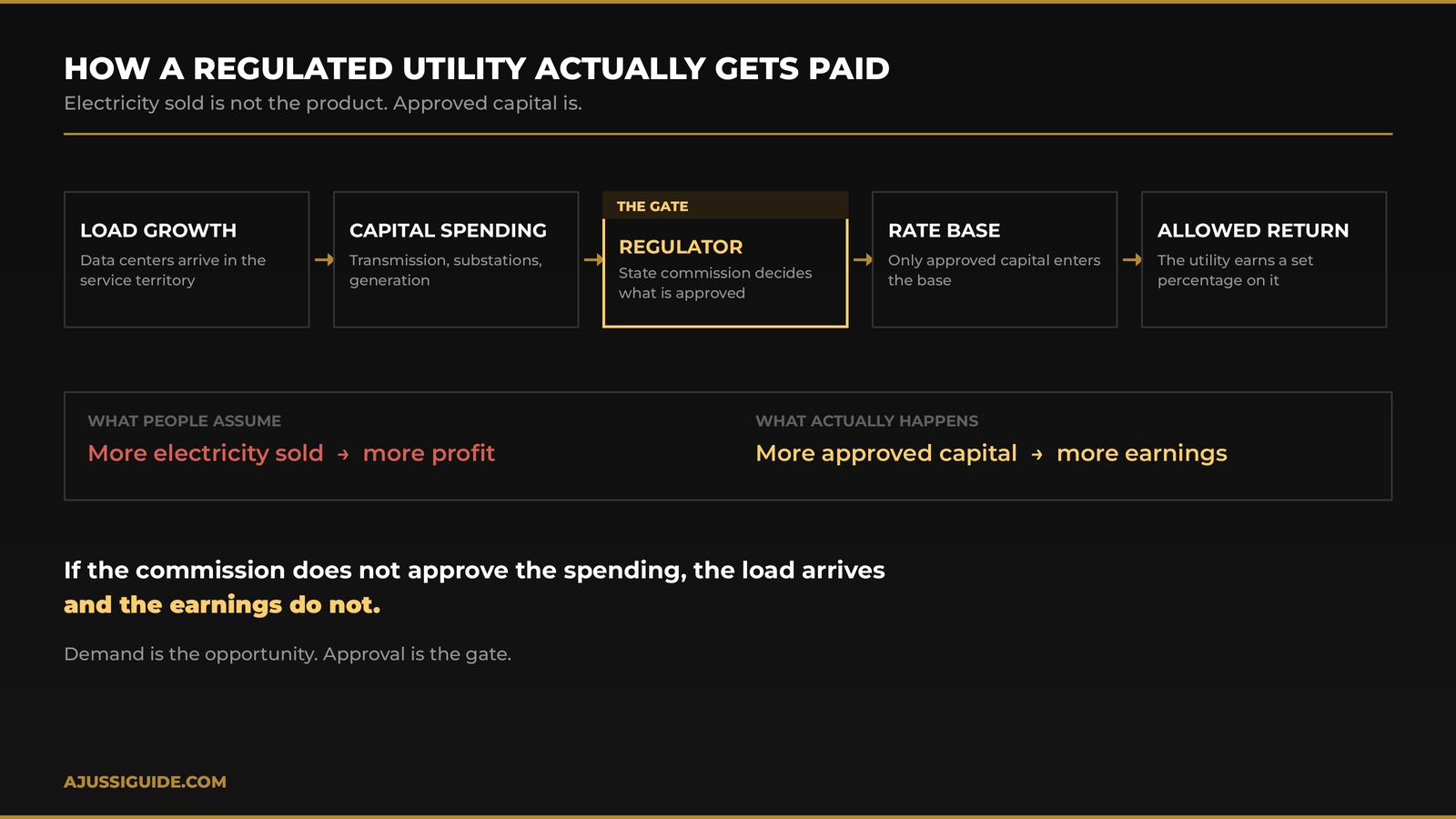
The key word for utility investors is load growth. Regulated utilities earn a return on rate base — the capital they are allowed to invest in infrastructure. More load growth means regulators are more willing to approve new transmission lines, substations, and generation capacity. That new capital investment becomes rate base, and rate base is what earns the allowed return. Data center demand is essentially a permission slip to grow faster.
The same demand story is also pulling speculative money toward nuclear startups. If you are curious about that end of the spectrum, I broke down the two US SMR pure plays in my Oklo vs NuScale stock comparison — a very different risk profile from a regulated utility.
This appears to be a structural shift rather than a cycle. Utilities that spent decades managing flat or declining load in mature service territories are now being asked to plan for significant new demand. That changes their capital expenditure profiles, their financing needs, and arguably their valuation multiples.
How Regulated Utilities Actually Capture Data Center Electricity Demand
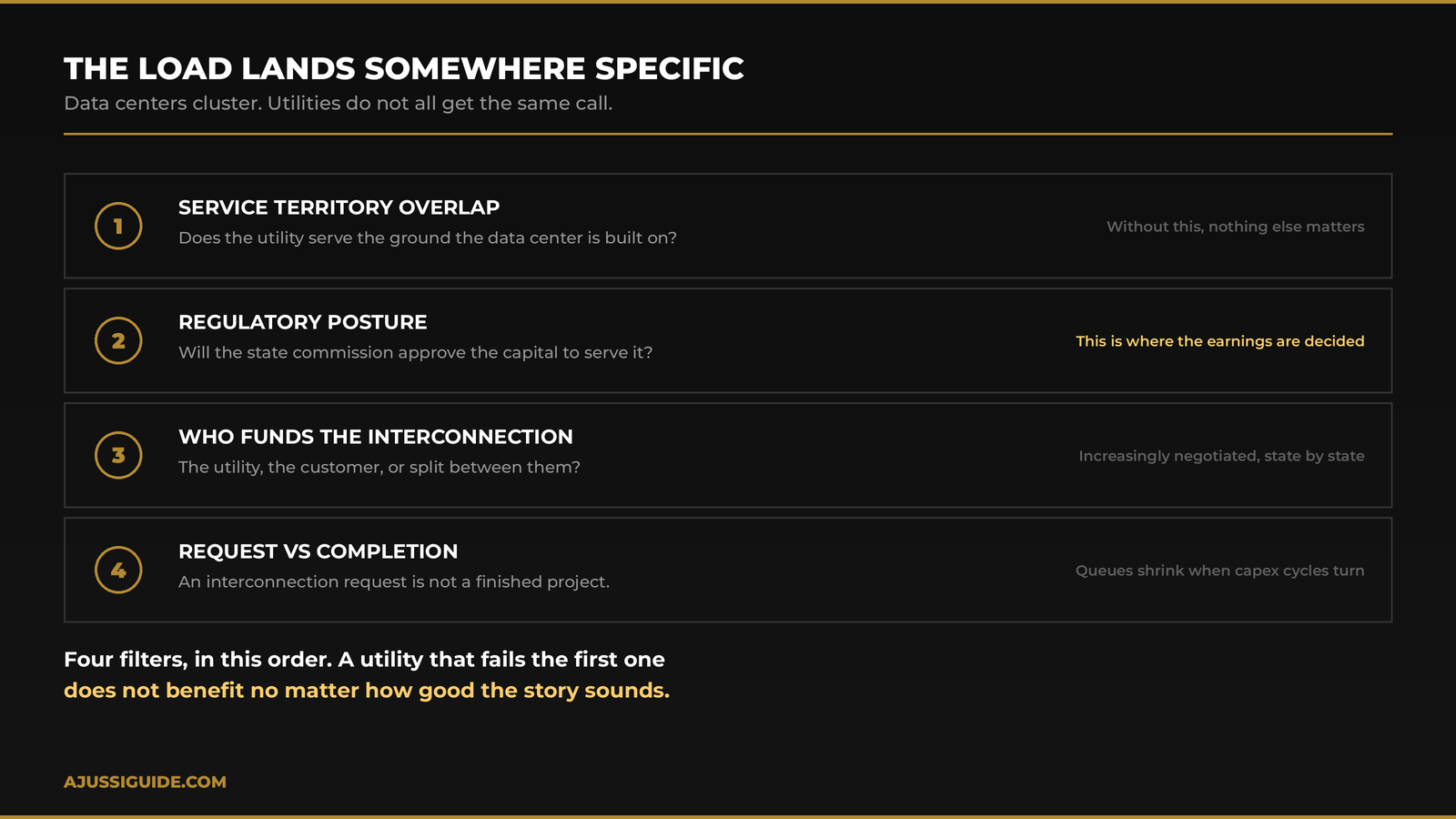
Not every utility benefits equally. The benefit accrues to utilities whose service territory overlaps with where data centers are actually being built. Data centers cluster around certain regions for reasons including land cost, fiber connectivity, tax incentives, and water availability for cooling. Utilities in those regions get the load; utilities elsewhere do not.
The regulatory compact matters too. A utility must go before its state public utility commission to get new capital investments approved and included in rate base. If the commission is supportive of data center-driven infrastructure investment — and many are, because data centers bring jobs and tax revenue — the utility can deploy capital quickly and earn its allowed return. If the commission is skeptical or slow, the benefit is delayed or diluted.
Large data center customers often negotiate special tariffs or economic development rates. This can compress the margin per kilowatt-hour compared to standard commercial rates, but the sheer volume of consumption can still make these customers economically attractive on a fully allocated basis. Utilities also value the load factor: data centers run at high utilization around the clock, which is far more valuable than peaky residential load.
Key Utilities With Significant Data Center Exposure
Several large regulated utilities have publicly discussed data center load growth as a material driver of their capital plans. I am describing the business situation as of mid-2026 based on what these companies have communicated. I am not recommending any of them or guaranteeing any return.
| Utility | Key Service Territory | Data Center Exposure | Primary Regulator |
|---|---|---|---|
| Dominion Energy (D) | Virginia, Carolinas | Northern Virginia, widely regarded as one of the world’s largest concentrations of data center capacity | Virginia SCC |
| Duke Energy (DUK) | Carolinas, Midwest, Florida | The Carolinas have become an increasingly active location for new data center development, and Duke has discussed this load growth in its planning | NC and SC PUCs |
| American Electric Power (AEP) | Ohio, Texas, Oklahoma, and others | Data center interconnection requests have grown sharply; interconnection requests are not the same as completed projects | Multiple state PUCs |
| Entergy (ETR) | Arkansas, Louisiana, Mississippi, Texas | Gulf Coast industrial and data center load growing | Multiple state PUCs |
| Eversource (ES) | New England | Compared with some peers, its direct data center exposure appears smaller; New England grid congestion is a frequently cited constraint | CT, MA, NH PUCs |
Dominion’s Virginia territory deserves special mention. Northern Virginia is the single largest data center market in the world by capacity, and Dominion is the primary regulated utility serving that territory. The company’s capital expenditure plans have grown substantially as a direct result. This does not mean Dominion is automatically a good investment at any price — but the strategic position is real.
The Rate Base Math: Why This Matters for Utility Investors
Utility valuation is grounded in rate base growth. The regulated return on equity allowed by state commissions in the US has generally been in a range that makes utilities defensive but not exciting — until load growth changes the growth rate of rate base itself. When rate base grows faster, earnings per share growth accelerates, and the multiple the market assigns can expand.
The flip side is that rapid capital deployment requires financing. Utilities issue debt and equity to fund construction. If interest rates remain elevated, the cost of that capital goes up. Regulators may lag in approving rate cases that reflect higher financing costs. This is the tension that every utility investor has to model carefully.
From my own spreadsheet work, the utilities with the clearest data center tailwinds are also the ones with the heaviest near-term capital spending programs. Heavy capex means dilution risk if equity issuances are large. It also means near-term earnings can be pressured by construction work in progress that has not yet been placed in service. Patience is required.
Risks That Can Undercut the Data Center Electricity Demand Story
If you want to track this yourself rather than take anyone’s word for it, the US Energy Information Administration publishes an updated national electricity demand forecast every month in its Short-Term Energy Outlook. It is the same primary source the sell-side notes are built on, and it is free.
The biggest risk is that data center demand projections prove optimistic. Hyperscalers have historically overbuilt and then pulled back. If AI capex cycles turn, interconnection requests that look firm today could be withdrawn or delayed. A utility that built transmission infrastructure for a campus that never opened has stranded cost problems.
Regulatory risk is real and often underestimated. State PUCs have the power to disallow capital investments, reject rate increases, or impose conditions that reduce the allowed return. In some states, consumer advocates are already questioning whether ordinary ratepayers should subsidize infrastructure primarily benefiting large tech companies. This is a live political debate in several jurisdictions.
Technology risk also exists on the demand side in a different direction. If AI inference becomes dramatically more efficient — requiring less compute per output — then the electricity intensity of AI workloads could decrease. This is unlikely to eliminate demand growth entirely, but it could moderate it. I keep this in mind when I hear the most aggressive load growth projections.
A new variable emerged in August 2026: Amazon confirmed acquiring the GW Ranch site in Pecos County for a data center campus designed to start from dedicated on-site generation rather than a utility interconnection. If more hyperscalers take that route, part of the load growth utilities are counting on could bypass the rate base entirely. Our Amazon off-grid data center write-up covers what the permit filing actually shows.
How I Think About Sizing a Utility Position Around This Theme
I do not treat utility stocks as a pure AI infrastructure play. That is exactly why I own them differently. The regulated utility business is still slow and steady at its core — the data center angle adds a growth layer on top of a defensive base. That is actually a combination I find interesting, because I get some downside cushion from the regulated earnings floor while participating in the upside from load growth.
For position sizing, I think about utilities differently from the semiconductor or hyperscaler names in my portfolio. Utilities are income-and-growth hybrids. I size them so that the dividend yield contributes meaningfully to my total return target, and I do not expect the kind of multiple expansion I might see in a pure growth name. If the multiple expands because of data center excitement, I treat that as a bonus, not a base case.
I also watch regulatory proceedings carefully. When a utility files a rate case in a key jurisdiction, the outcome tells me a lot about the risk-adjusted return I should expect. I have seen rate cases come in below what the utility asked for, and I adjust my assumptions accordingly. Regulatory outcomes are public information — there is no excuse for not reading them.
Frequently Asked Questions
Do utility stocks directly benefit from data center electricity demand?
Yes, but only the utilities whose service territories overlap with actual data center construction. Regulated utilities earn a return on infrastructure capital investment, so more demand from data centers means more approved capital spending and faster rate base growth. The benefit is real but geographically concentrated, not spread evenly across all US utilities.
Which US state has the most data center electricity demand for utilities?
Virginia, specifically Northern Virginia, is widely regarded as one of the world’s largest concentrations of data center capacity. Dominion Energy is the primary regulated utility serving that territory. Other states with growing data center loads include North Carolina, Georgia, Texas, and Ohio, each served by different regulated utilities.
Is data center load growth already priced into utility stocks?
The market has repriced utilities with clear data center exposure upward since the AI infrastructure buildout accelerated. Whether that repricing is complete or partial depends on how actual load materializes versus current projections. Investors should not assume the market has missed this — it is widely discussed and partially reflected in valuations already.
What is the main risk to utilities from data center electricity demand?
The main risks are demand disappointment and regulatory pushback. If hyperscalers slow their buildout, utilities that have invested in new infrastructure could face stranded cost problems. Separately, state regulators in some jurisdictions are questioning whether ordinary ratepayers should fund grid upgrades that primarily serve large tech tenants. Both risks are worth monitoring closely.
How do I find out if a utility has data center load in its territory?
Read the utility’s investor presentations and earnings call transcripts. Most utilities with material data center exposure now discuss it explicitly in their capital expenditure guidance and load growth slides. FERC interconnection queues are also public data — a surge in large commercial interconnection requests in a service territory is an early signal of data center activity.
What is rate base, and why does it matter for utility stocks?
Rate base is the value of capital a regulated utility is allowed to earn a return on. When a utility builds transmission lines, substations, or generation, the regulator decides how much of that spending enters rate base. The utility then earns an approved percentage on it. This is why data center electricity demand matters to a utility investor: it justifies capital spending, and approved capital spending is what compounds earnings.
Does data center electricity demand affect utility dividends?
Indirectly, yes. Stronger earnings growth from rate base expansion supports higher dividend growth rates over time. However, heavy capital spending programs also require significant equity and debt financing in the near term, which can constrain near-term dividend growth. The long-run direction is supportive, but the path depends on financing execution and regulatory outcomes.
Why doesn’t more electricity demand automatically mean higher utility profits?
Because a regulated utility does not profit from selling more electricity the way a normal company profits from selling more units. It earns a regulated return on approved capital. If a state commission rejects the spending, or requires the data center customer to pay for the connection directly, the utility carries the load without the earnings. Data center electricity demand is the opportunity; regulatory approval is the gate.
Can a utility refuse to connect a data center?
Rarely outright, but the terms are negotiable and increasingly negotiated. Regulated utilities generally have an obligation to serve, yet large-load customers can be required to fund interconnection costs, sign long-term contracts, or accept a special rate class. Several states have opened proceedings on exactly this question. The relevant risk for investors is not refusal; it is who pays for the buildout.
If you already own AI names and are adding utilities, it is worth seeing which layers you hold before you add another. Owning several AI stocks does not always mean you are diversified. They may all depend on the same infrastructure layer. The AI infrastructure exposure checker shows which of the eight layers a portfolio actually owns.
Utility exposure can also be bought as a basket. Our AI power ETF comparison shows ZAP holding Dominion, Duke, Southern and Exelon at roughly 4% each, against equipment-led AIPO and mixed POWR.
Last verified: 2026-08-02. This post reflects information available as of that date. Business conditions, regulatory decisions, and company strategies change. Nothing here is investment advice or a recommendation to buy or sell any security.
Last verified: August 2, 2026. Utility rate cases and interconnection queues change quarterly; check the current filings before acting on anything here.
Related posts
- Transformer Stocks: 5 AI Data Center Plays for 2026
- Grid Infrastructure Stocks: 7 Best Plays for AI Electricity Demand in 2026
- AI Infrastructure ETF Best Picks for 2026: Ajussi’s Complete Guide
To turn GW-scale IT-capacity forecasts into actual grid demand, run them through our data center PUE calculator, which converts IT load and PUE into facility power and annual energy.
On the equipment side of this demand story, our comparison of Arista vs Cisco AI networking stocks looks at who actually sells the switches these data centers run on.
Utilities move and sell electricity, but someone has to generate it first. For the companies on the generation side of this buildout, and how to read a signed power agreement, see power grid stocks: who generates the power AI data centers need.