Transformer stocks are having a moment that most retail investors completely missed — and I want to make sure you’re not one of them.
I’ve been watching markets for a long time, nephew. I’ve seen semiconductors boom, solar cycle through, and crypto go crazy. But quietly, right underneath everyone’s noses, one of the most boring categories in industrial manufacturing turned into a full-blown supply-demand crisis story: electrical power transformers.
And the reason? Three letters. A-I.
Why AI Data Centers Are Driving a Transformer Stocks Boom
Here’s the thing nobody on financial Twitter talks about enough. Every single AI data center — whether it’s being built by Microsoft, Google, Amazon, or Meta — runs on electricity. A lot of it. We’re not talking about your office router. We’re talking about hundreds of megawatts of continuous power demand per facility.
According to the International Energy Agency, global data center electricity demand is heading toward roughly 945 TWh by 2030 — more than double the 2024 level. That power has to come from somewhere, and every watt of it has to be stepped up, stepped down and distributed through the grid using — you guessed it — transformers.
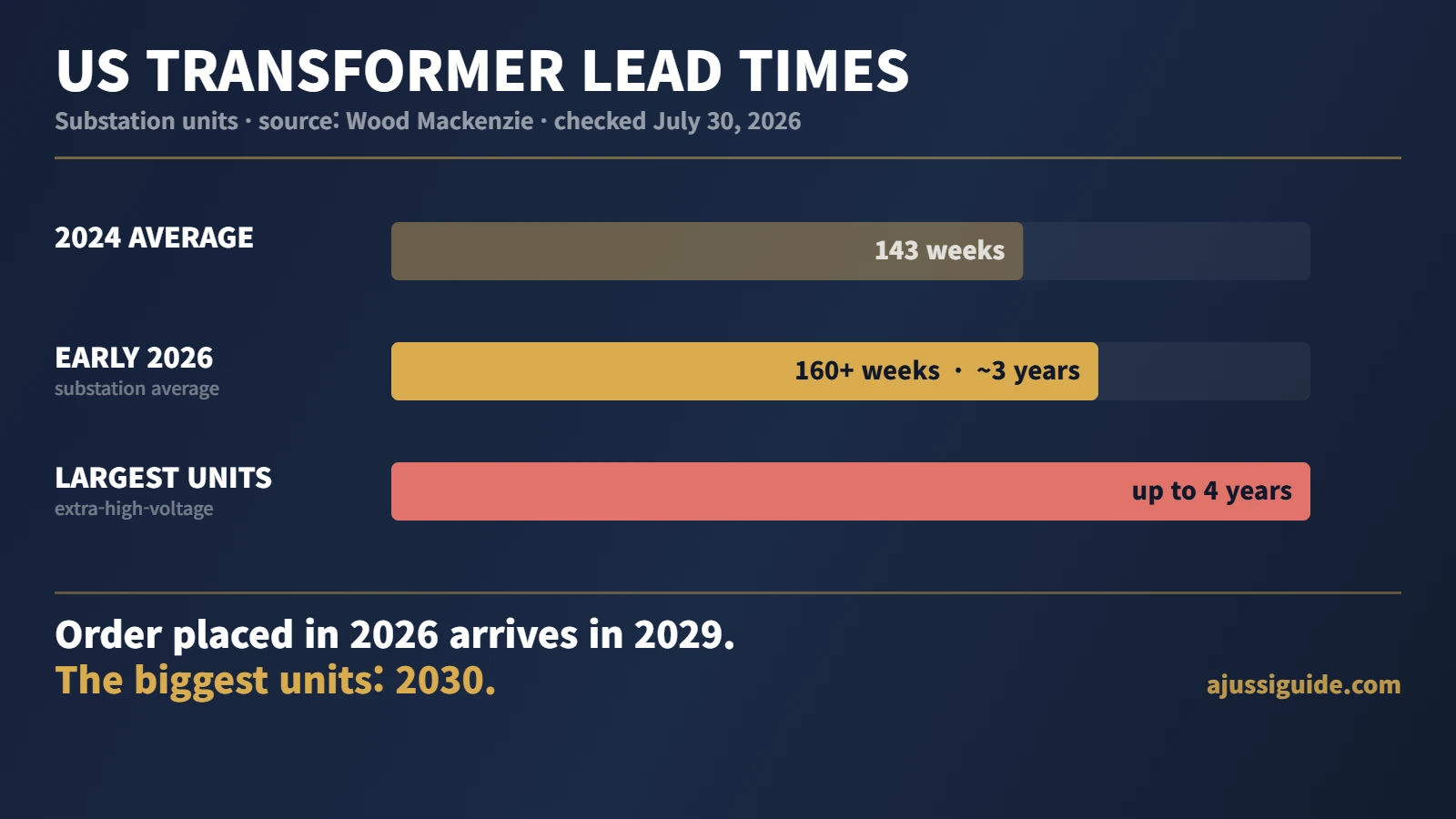
Large power transformers are not like iPhones. You can’t spin up a factory overnight and start shipping. Lead times on large transformers have stretched past three years, and the biggest units are quoted out to four. Demand is outpacing supply, and that’s a beautiful setup for the companies that make them.
What Exactly Is a Power Transformer? (Quick Refresher)
I know, I know — it sounds like high school physics. But stay with me.
A transformer is a device that transfers electrical energy between circuits by changing voltage levels. When power leaves a generation plant at extremely high voltage, transformers step it down so it can be safely used by homes, businesses, and yes — data centers.
Every new data center campus needs multiple transformers at different points in the power delivery chain. A hyperscale facility can require dozens of large units. Now multiply that by the hundreds of data centers being announced every quarter across the United States and Europe.
The generation side of this story has its own AI-driven bets too. I compared the two small modular reactor pure plays in my Oklo vs NuScale stock comparison if you want to see the speculative end of the power build-out.
This is why transformer stocks are not a fad. This is a decade-long infrastructure buildout, and the bottleneck is real.
And here is the number that proves the bottleneck is real rather than rhetorical. According to Wood Mackenzie, US substation transformer lead times have stretched from an average of 143 weeks in 2024 to more than 160 weeks — roughly three years — by early 2026, and the largest high-voltage units are quoted out to four years. Order one today and it lands in 2029, or 2030 for the big ones. When a factory is sold out that far ahead, pricing power stops being a theory.
Top Transformer Stocks to Watch in 2026
Let me be clear: I’m not telling you to buy anything today. I’m telling you who the players are so you can do your own homework.
And here is how I ordered them — by how much of the business is actually transformers, not by market cap. That distinction matters more than most write-ups admit, and you’ll see why by the time we get to the fifth name.
1. GE Vernova (GEV)
This is the name that redrew the map. On February 2, 2026, GE Vernova closed the buyout of the remaining 50% of Prolec GE for $5.275 billion, taking full ownership of a joint venture it had run with Xignux for three decades. Prolec GE is one of North America’s largest transformer businesses — about 10,000 employees and seven manufacturing sites across the Americas, five of them in the United States.
Read that again, nephew. A company put $5.275 billion — half of it cash, half of it debt — into owning more transformer capacity. That is not what you do when you think the demand is a fad.
2. Siemens Energy (SMNEY)
If you want to see how long the queue is, look at Siemens Energy’s order book. Total backlog sits around €154 billion, and the Grid Technologies division booked close to €7 billion of new orders in a single quarter of fiscal 2026 — driven overwhelmingly by US demand for power transformers.
They are spending to catch up, too: up to €2 billion in capacity investment, including €220 million into the Nuremberg transformer plant plus expansions in the US, India, Croatia, Austria, Saudi Arabia and Brazil.
⚠️ SMNEY is an unsponsored ADR that trades over the counter, not on a US exchange. Liquidity is thinner and your broker may handle it differently. The primary listing is in Frankfurt.
3. Hitachi (HTHIY)
Here is where the search intent breaks, and I want you to read this part slowly.
If you came here looking for ABB, you should be looking at Hitachi instead. ABB sold its Power Grids business — the one that built large power transformers — to Hitachi: 80.1% in 2020, and the remaining 19.9% in December 2022. Those transformer factories now operate as Hitachi Energy. ABB kept automation and electrification. The heavy grid iron went to Tokyo.
⚠️ Two warnings on this one, and the second matters more than the first. HTHIY is an ADR trading over the counter, not on a US exchange. And more importantly: you are not buying a transformer company. You are buying a diversified industrial group — digital services, rail systems, appliances, semiconductor equipment — that happens to own Hitachi Energy. Size the position with that in mind.
4. Hubbell Incorporated (HUBB)
Hubbell is the quiet one. They make utility and commercial electrical products including distribution transformers — the smaller units that sit closer to the end user. The utility segment has been riding grid modernization and data center buildout for a while now.
They are buying as well: Hubbell closed a $3.0 billion acquisition of NSI Industries on June 9, 2026, which helped push Electrical Solutions net sales up 25% in the second quarter.
5. Eaton Corporation (ETN)
I put Eaton last on purpose, and it has nothing to do with quality. Eaton is the name I hear most often in power management conversations, it is the most liquid of this group, and hyperscaler orders keep piling up.
But be precise about what you are buying. Eaton’s data center exposure is weighted toward switchgear, power distribution units and busway more than large power transformers. It is an excellent electrification business. Transformer exposure is meaningful, but power distribution remains the larger business — and anyone selling Eaton to you as a transformer pure-play is being loose with the word.
The Consolidation Pattern: Why There Is No US-Listed Pure-Play
Here is what actually happened while I was checking these names, and it changed how I think about the whole theme.
I thought I was looking for transformer companies. Instead, I kept finding transformer businesses disappearing into larger platforms.
Two cases, and they are not coincidences.
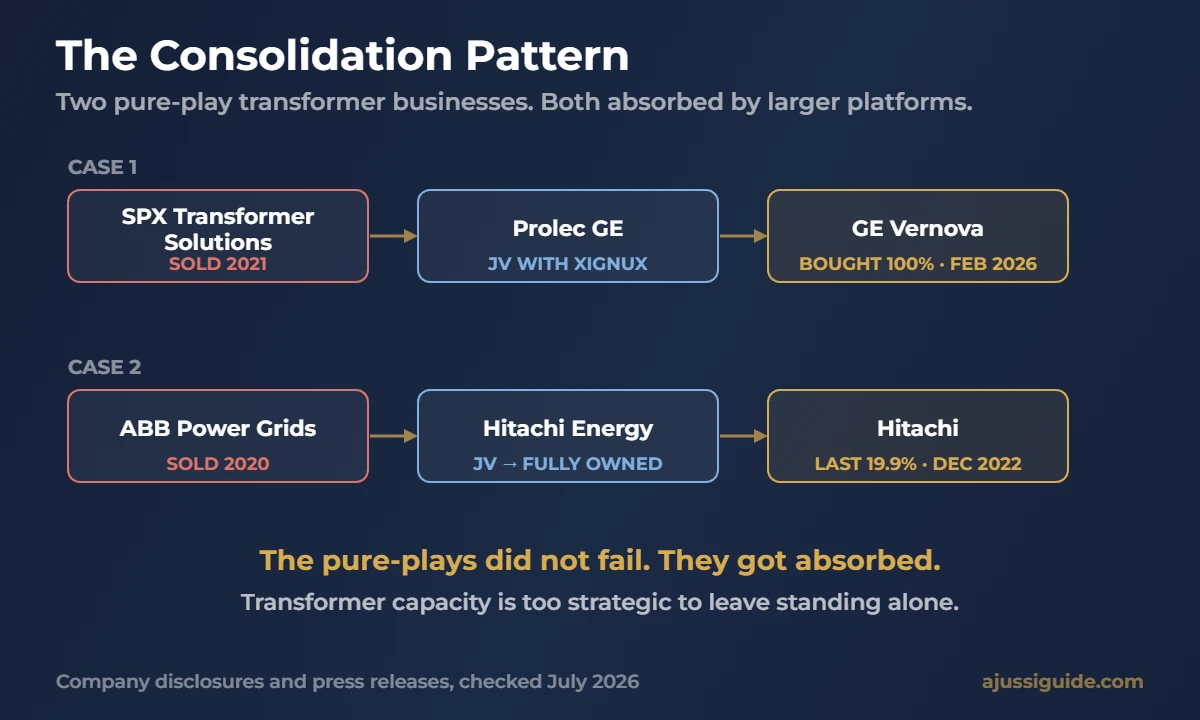
SPX Technologies used to be the closest thing to a US-listed pure-play. It owned SPX Transformer Solutions until it sold that business to Prolec GE in 2021. Prolec GE was a joint venture — and in February 2026, GE Vernova bought the whole thing.
ABB built large power transformers through its Power Grids division. It sold 80.1% of that division to Hitachi in 2020 and the last 19.9% in December 2022. Today it is Hitachi Energy.
So in both cases the transformer business did not fail. It got absorbed — by a platform big enough to fund multi-year capacity expansion and absorb multi-year order backlogs. That is the shape of this industry right now, and it tells you something useful: transformer capacity is too strategic to leave standing alone.
Which means transformer stocks, in practice, are large diversified industrials with a transformer engine inside. Your job is not to find a pure-play. Your job is to figure out how big that engine is relative to everything else the company does.
Transformer Stocks Comparison Table
Checked July 30, 2026. These are snapshots, not quotes — verify current figures before you act on anything.
| Company | Ticker | Where it trades | Transformer exposure | Market cap (approx.) |
|---|---|---|---|---|
| GE Vernova | GEV | NYSE | Prolec GE, wholly owned since Feb 2026 | ~$275B |
| Siemens Energy | SMNEY | OTC (unsponsored ADR) | Grid Technologies — large power transformers | ~$140B |
| Hitachi | HTHIY | OTC (ADR) | Hitachi Energy — former ABB Power Grids | ~$135B |
| Eaton Corporation | ETN | NYSE | Power distribution & switchgear-weighted | ~$155B |
| Hubbell Incorporated | HUBB | NYSE | Distribution transformers, utility products | ~$28B |
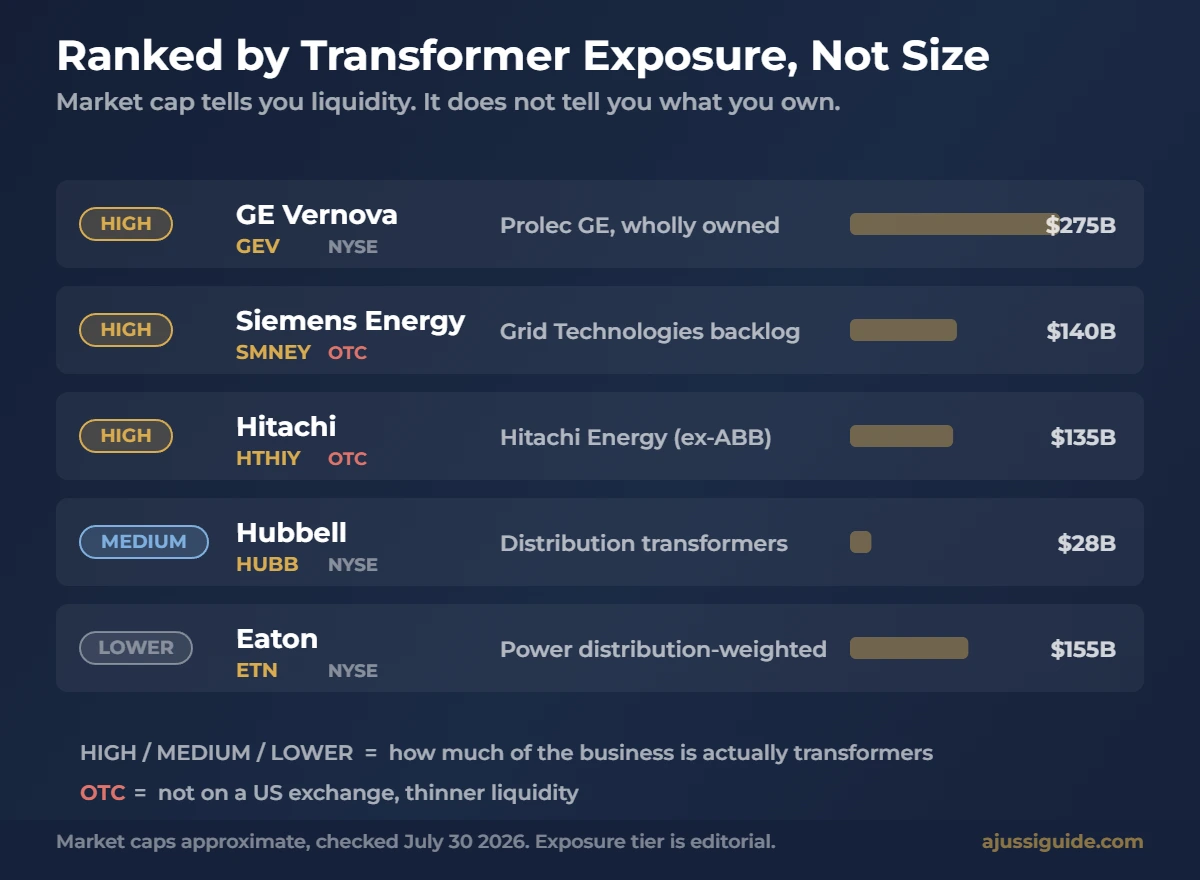
Two of these five are not on a US exchange. Market caps are approximate — ADR providers differ depending on the ratio used, so treat the last column as an order of magnitude rather than a precise number.
The Risk Side of Transformer Stocks (Don’t Skip This)
I’ve been doing this long enough to know that when a theme gets hot, people forget about risk. Let me be your ajussi and remind you.
First, valuation. Stocks like Eaton have already run hard. You’re not getting in at 2022 prices. If the AI buildout slows, delays, or gets disrupted — say, by regulatory pushback, financing constraints, or a broader recession — orders could soften and these stocks could correct significantly.
Second, supply chain normalization. Right now, transformer supply is extremely tight. But manufacturing capacity is being added. If supply catches up faster than expected, the pricing power that’s inflating margins today could fade. Watch for this in quarterly earnings commentary.
Third, interest rates. Industrial companies with large capital expenditures are sensitive to borrowing costs. Higher-for-longer rates can compress multiples and slow customer spending. Keep one eye on the Fed.
Finally, geopolitical risk. Several major transformer manufacturers have significant operations or supply chains in Europe and Asia. Trade tensions, tariffs, or supply chain disruptions could create volatility. This is not unique to transformer stocks, but worth keeping in mind.
How I Think About Position Sizing Here
When I look at a thematic trade like this, I think about it in layers.
The large caps — GE Vernova, Hitachi, Eaton — are the foundation. Earnings visibility, strong balance sheets, diversified revenue. They are the “sleep at night” part of the trade, and none of them lives or dies on transformers alone. That is a feature, not a bug, but it does dilute the theme.
Hubbell is the interesting middle. At roughly $28 billion it is a fraction of the others, so grid and transformer demand moves the needle more — and so does a stumble. That cuts both ways.
And as we covered above, there is no US-listed pure-play left to chase. So the concentrated version of this trade is not a small-cap hunt — it is accepting an OTC ADR (Siemens Energy or Hitachi) and living with thinner liquidity. That is a real trade-off, not a footnote.
Broad industrial and grid-infrastructure ETFs are the other route. You give up precision and you get diversification. For most people reading this, that is the honest answer.
Frequently Asked Questions
Are transformer stocks a good long-term investment for 2026 and beyond?
The underlying demand driver — AI data center power consumption — is a multi-year trend that appears durable. However, no stock is guaranteed, and valuations in some names are already pricing in significant growth. Do your own analysis, consider your time horizon, and don’t overconcentrate in any single name or theme.
Is there an ETF that focuses specifically on transformer stocks?
I couldn’t find a pure-play transformer ETF as of mid-2026 — if one exists, I have not come across it. However, ETFs focused on industrial infrastructure, grid modernization, and power equipment — such as broad industrial ETFs or utilities-adjacent funds — often include meaningful exposure to companies in this space. Check the holdings of any ETF carefully before investing.
What is the relationship between AI spending and transformer demand?
AI training and inference workloads require massive, continuous electricity consumption at data centers. Each new large-scale data center campus requires transformers at multiple stages of the power delivery chain. As hyperscalers like Microsoft, Amazon, and Google commit to billions in capex for AI infrastructure, electrical equipment manufacturers — including transformer producers — see a direct downstream boost in orders.
Final Word from Ajussi
The chip story got all the headlines. Nvidia became a household name. But when you trace the AI opportunity all the way back to its physical foundation — the electricity that powers every GPU cluster — you find transformer stocks sitting quietly at the center of it all.
This isn’t sexy. It’s not a meme. It’s infrastructure. And infrastructure, in my experience, is where serious long-term money gets made.
Do your research. Know what you own. And don’t let anyone rush you into a trade — not even your ajussi.
Two of those names now report on very different measurement bases. If you are weighing them directly, GE Vernova vs Siemens Energy: 5 numbers that do not compare lines up the labels first.
Disclaimer: This article is for informational purposes only and is not financial advice. Do your own research.
Related posts
- AI Infrastructure Dividend Stocks: 7 Income Picks for 2026
- Small Cap AI Infrastructure Stocks: 5 Picks Under $2B for 2026
- Data Center Water Stocks: 6 Ways to Play AI’s Cooling Problem in 2026
- AI Stock Analysis Prompts: 5 I Actually Use, and Where Each One Broke — including the prompt built after the lead-time error in this piece
Transformers are one part of a larger delivery layer. For the switchgear, cables, substations and interconnection work that surround them, and for what each company in that layer actually discloses about demand, see transmission and distribution stocks: from the transformer to the interconnection queue.