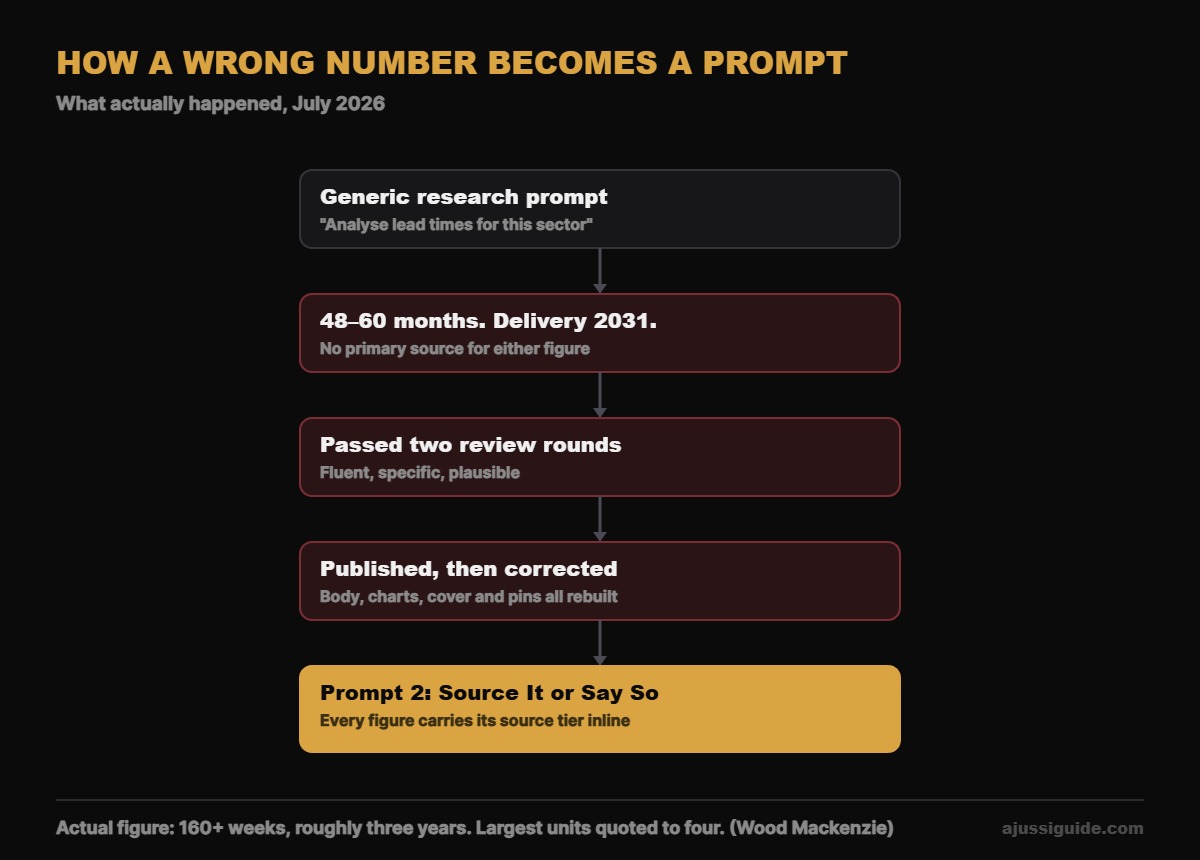
Three weeks ago I published a piece on transformer stocks. It said lead times ran 48 to 60 months and that orders placed today would arrive in 2031.
Neither number was supported by a primary source. Both had come out of a research pass, survived my own review, survived a second review, and landed on a live page read by people making money decisions.
The actual figure, from Wood Mackenzie, was 160+ weeks, roughly three years, with the largest high-voltage units quoted out to four. Order in 2026, take delivery 2029, or 2030 for the big ones.
That one incident is why I rewrote every research prompt I use. The five AI stock analysis prompts below are the result. Each one exists because something specific broke, and I have kept the broken version next to the fixed version so you can see what changed and why.
One distinction matters before you read on. Two of the errors below reached publication and had to be corrected on a live page. The rest were caught before publishing, by the prompts themselves. That split is the point: the goal is not a process that never produces a wrong number, because no such process exists. The goal is a process where wrong numbers surface before a reader sees them.
If you only want the text, every prompt is in a copy block. If you want to know why the constraints are worded the way they are, the failure notes are underneath.
Why Generic AI Stock Analysis Prompts Fail
Search for AI stock analysis prompts and you will find dozens of variations on “act as a senior equity analyst and analyse TICKER.” They produce fluent output. That is the problem.
Most AI stock analysis prompts you find online share one flaw. A language model asked for analysis will always produce analysis. It will not stop and tell you the company sold that division four years ago, or that the number it just quoted has no source, or that the figure in your headline contradicts the table three paragraphs down. Fluency is the default output; accuracy is not.
The AI stock analysis prompts below therefore do the same structural thing: it forces the model to separate what it can verify from what it cannot, and to label the difference in the output itself. That single move catches most of what went wrong in my own drafts.
The Five Prompts at a Glance
Each prompt exists because something specific went wrong. The table is the short version; the sections below carry the failure that produced each one.
| Prompt | What it checks | The failure that created it | When to run it |
|---|---|---|---|
| 1. Entity verification | Is the company still in that business? | SPX Technologies listed as a transformer play, four years after selling that unit | Before any research on a named company |
| 2. Source it or say so | Every figure carries a URL or the tag UNSOURCED | A confident 48-to-60-month figure that survived two review passes with no source | While building the number table |
| 3. Orders vs revenue vs cash | Do not mix bookings, recognised revenue and cash in one column | $60B of quarterly orders sat next to $60B of annual revenue guidance as if equal | While assembling any table of financial figures |
| 4. Reported vs guided vs expected | Is this number filed, guided, or an analyst estimate? | An unreported forward expectation ($11.9B) used as a filed quarterly result ($10.7B) | Before quoting any earnings number |
| 5. Self-contradiction check | Does the draft agree with itself, end to end? | Headline promised 7 stocks, body had 5; the year was wrong in title, slug and meta | Last, on the finished draft, right before publishing |
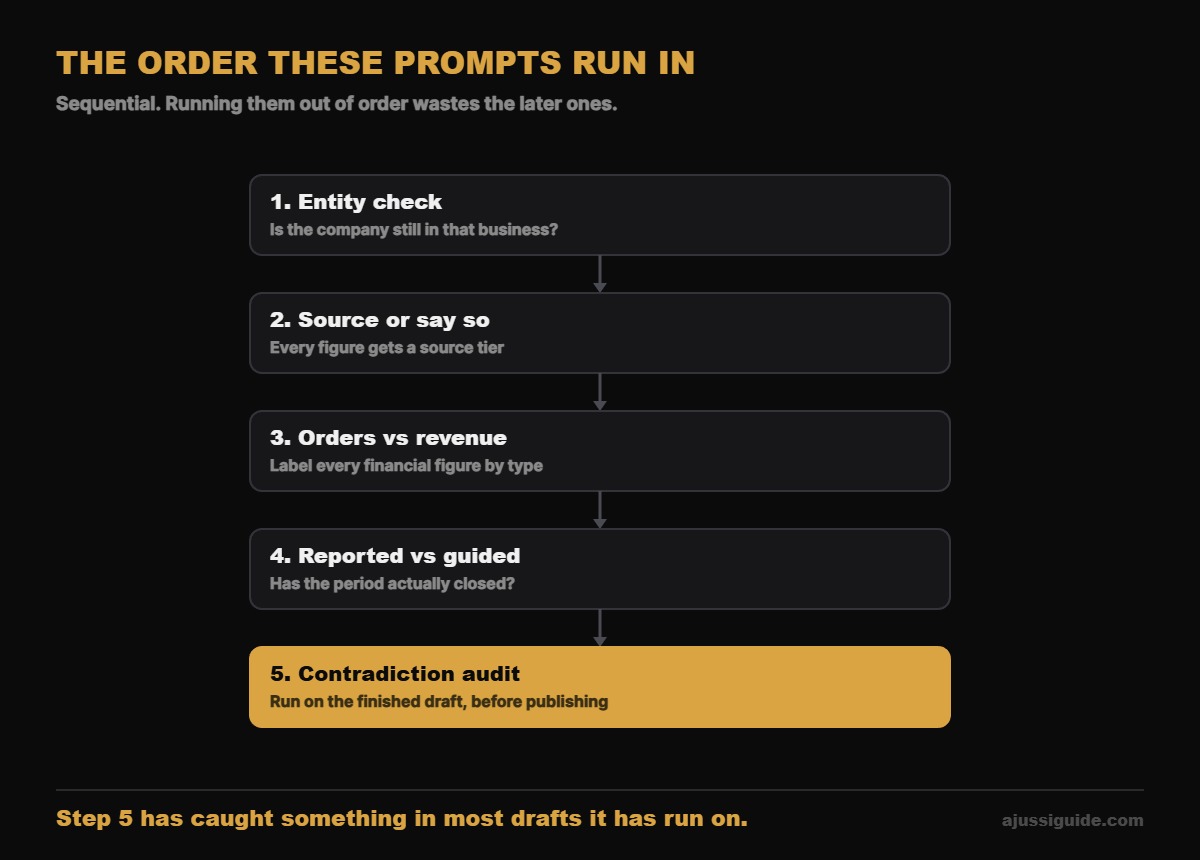
They are sequential, not a menu. Running them out of order wastes the later ones.
Prompt 1. Entity Verification: Is the Company Still That Company?
The first of my AI stock analysis prompts exists because of a divestiture I missed.
What broke. Drafting a piece on transformer manufacturers, a research pass returned SPX Technologies as a transformer play. SPX sold its transformer business to Prolec GE in 2021. The model was describing a company that had not been in that business for four years.
A second version of the same failure showed up this week. Researching Taiwanese server ODMs, sources kept blurring Hon Hai Precision Industry (2317) and Foxconn Technology (2354), two separately listed companies whose names both map to “Foxconn” in English. I ended up publishing without a ticker for either, because I could not confirm which security was which.
The fix. Ask about the business line before asking about the stock, and require the model to flag corporate actions in the last 24 months.
For each company below, answer ONLY these questions. Do not give
investment commentary.

1. Does this company still operate in [BUSINESS LINE] as of today?
   If it divested, name the buyer and the year.
2. What is the exact legal entity name and primary listing venue?
   If multiple listed entities share a common brand name, list all
   of them separately and state which one operates [BUSINESS LINE].
3. Any merger, acquisition, spin-off or divestiture announced in the
   last 24 months? Include announced-but-not-closed deals.
4. Roughly what share of revenue comes from [BUSINESS LINE]?
   If you cannot source this, write "not sourced" — do not estimate.

For every factual claim, give the source and its date. If no source
exists, write [UNSOURCED] on that line.

Companies: [LIST]
Business line: [e.g. large power transformers]
Point 3 matters more than it looks. If you recommend two companies as diversification and one is acquiring the other, you have written a concentration piece by accident.
Prompt 2. Source It or Say So
What broke. The 48-to-60-months figure from the opening. It was specific, plausible, and completely unsupported. It survived two review passes precisely because it looked like a real datapoint.
The defence is not “check the numbers.” I did check numbers. The defence is making the model mark its own confidence inline, so unsourced figures are visually obvious before anyone reads for meaning.
Research [TOPIC] and return findings as a table with these columns:

| Claim | Figure | Source name | Source date | Source URL | Confidence |

Rules:
- Confidence is exactly one of, in descending order of authority:
    COMPANY       — the issuer's own filing, IR release or transcript
    REGULATOR     — SEC, exchange, central bank, statistical agency
    PRIMARY_MEDIA — wire or publication reporting its own reporting
                    (name it), or a body like the IEA / EIA
    SECONDARY     — outlet citing one of the above (name both)
    UNSOURCED     — no source found
- If a figure is UNSOURCED, still include the row. Do not drop it
  and do not substitute a different number.
- Never combine two sources into one figure without saying so.
- If two credible sources disagree, give both rows and mark the
  conflict.
- Do not round. Give the figure as published.

Topic: [TOPIC]
Time window: [e.g. last 6 months]
“Do not round” is there for a reason. A deal I described as $5.25 billion was actually $5.275 billion. Small, but it is the kind of drift that tells a careful reader you did not open the filing.
Prompt 3. Orders, Revenue and Cash Are Three Different Things
What broke. This one nearly went out last week. Super Micro announced more than $60 billion of new orders in a single quarter. Dell guided to roughly $60 billion of AI server revenue for a full fiscal year. Identical number, opposite meaning. One is a quarter of intent; the other is a year of expected recognised revenue. A draft that puts them in the same table without labels is actively misleading.
Worse, the same Super Micro release said revenue would land near the low end of guidance. Orders exploded; recognised revenue did not. A model summarising “record $60B quarter” is not lying, but it is not telling you the thing that matters either.
For each financial figure you report about [COMPANY], label it with
exactly one of the following, and never mix them in one column:

- ORDERS / BOOKINGS  (customer intent; may be cancellable)
- BACKLOG            (accumulated unfulfilled orders)
- REVENUE_REPORTED   (recognised, in a filed statement)
- REVENUE_GUIDED     (company's own forward range)
- REVENUE_CONSENSUS  (analyst estimate — name the source)
- CASH               (collected; from the cash flow statement)

Additional rules:
- State the exact period each figure covers (quarter vs full year).
- If the company disclosed that orders may be cancelled, delayed or
  are not firm commitments, quote that sentence verbatim.
- If reported revenue landed outside or at the edge of prior
  guidance, say so explicitly.
- Do not compare figures with different labels unless you state that
  they are not comparable.

Company: [COMPANY]  Period: [PERIOD]
Prompt 4. Reported vs Guided vs Expected
What broke. Writing about server makers, I had HPE’s quarter as $11.9 billion, up about 30%. That figure was a forward expectation for a quarter that had not been reported. The company’s actual filed result was $10.7 billion, up 40%, with non-GAAP EPS of $0.79 against its own guidance of $0.51–0.55, and full-year EPS guidance raised by more than 40%.
The correction did not just fix a number. It broke my thesis. I had been writing that profitability was lagging across the sector. HPE had beaten its own guidance and raised the year. The honest version of the story was that margin outcomes diverge sharply between these companies, which is a better article than the one I nearly published.
Before reporting any earnings figure for [COMPANY], establish and
state which of these it is:

A. REPORTED   — appears in a filed statement or official release.
                Give the filing date.
B. PRELIMINARY— company-issued estimate ahead of full results.
                Note that it is unaudited and subject to revision.
C. GUIDED     — company's own forward range. Give the range, not a
                midpoint.
D. CONSENSUS  — analyst estimate. Name the aggregator.

Then answer:
- Has the period in question actually closed and been reported? Yes/No.
- If a company issued PRELIMINARY figures, what did it say could
  change them? Quote it.
- Did the result beat, meet or miss the company's own prior guidance?
- What is the date of the next scheduled report?

Do not present C or D as if it were A.

Company: [COMPANY]  Period: [PERIOD]
The last line is the whole prompt. Nearly every “AI got the earnings wrong” story I have seen is a category error, not a hallucination.
Prompt 5. The Self-Contradiction Check
What broke. A draft headline promised 7 stocks. The body covered five. The same draft carried 2025 in the title, the slug, the meta description and a subheading, in the middle of 2026. In another piece I wrote that one company’s market cap was “about two and a half times” another’s; the actual ratio was 2.41.
None of these are research failures. They are consistency failures, and they are the easiest category to automate away.
Audit the draft below for internal contradictions. Report only
problems found, as a list. Do not rewrite the text.

Check:
1. Any number in the headline or subheadings that does not match the
   number of items actually covered in the body.
2. Any year in the title, slug, meta description, subheadings or body
   that is not the current year, where a current year is implied.
3. Every derived figure (ratios, multiples, percentage changes,
   "X times larger"). Recalculate each from its stated inputs and
   flag any material difference beyond normal rounding.
4. Units and scale: billions vs millions, quarter vs year, local
   currency vs USD.
5. Any claim in the introduction that the body does not support.
6. Any figure stated twice with different values.

For each problem: quote the exact text, state the conflict, and give
the corrected value where one is calculable.

Draft:
[PASTE]
Point 3 catches the “two and a half times” class of error, which is the most common thing I fix. Rounded language creeps in when you are writing quickly, and it reads as sloppiness to anyone who checks.
How These AI Stock Analysis Prompts Behave in Different Tools
These are observations from running the same prompts in different places, not a ranking. Which tool is “better” depends on the task, and any comparison I published would be stale within weeks.
I have since run that comparison once, under fixed conditions — the same 10-K and these same five prompts, given to Claude and ChatGPT on the same day. It carries a date for the reason above, and it is one run rather than a ranking. Three of the eight figures that came back are not in the filing at all.
- Tools with live web access handle Prompt 2 much better, because they can actually return a URL. Without retrieval, the source column fills with plausible-looking citations that do not resolve, which is worse than an empty column.
- Long-context tools are where Prompt 5 works. Pasting a 2,000-word draft into a short-context tool produces an audit of the first third only, and it will not tell you it truncated.
- Structured-output modes matter for Prompt 3. If the tool will not hold a table format, the labels drift back into prose and the whole point is lost.
- Retrieval-first tools are strongest on Prompt 1, because entity questions are lookups, not reasoning.
The practical takeaway: run Prompts 1 and 2 wherever you have live retrieval, and Prompts 4 and 5 wherever you have the longest context. That split matters more than which brand you use.
For a worked example of what happens without these checks, see my test of a viral set of Gemini stock analysis prompts: three of five screened stocks came back with wrong dividend streak counts, and the top-rated pick had already frozen its dividend.
The Order I Run Them In
These five AI stock analysis prompts are sequential, not a menu. Running them out of order wastes the later ones.
- Prompt 1 first. If a company is not in the business you think it is in, nothing downstream matters.
- Prompt 2 next, to build the number table. Anything marked UNSOURCED either gets sourced or gets cut before writing starts.
- Prompt 3 while assembling any table that mixes financial figures.
- Prompt 4 before quoting any earnings number.
- Prompt 5 last, on the finished draft, immediately before publishing.
Prompt 5 has caught something in most drafts I have run it on. That is not a comment on the model. It is a comment on how easy it is to write a headline early and forget to update it.
If you would rather have a book answer these questions than a prompt, I tested a converter that turns one into a Claude Code skill: book to skill, and the three things I measured first.
What These Prompts Do Not Do
These AI stock analysis prompts do not tell you whether to buy anything. They do not price a security, forecast a quarter, or judge whether a valuation is reasonable. Every prompt above is a verification instrument. It makes the research surface what it does not know, so a human can decide what to do about the gap.
They also do not remove the need to open the primary document. Prompt 2 will hand you a source URL; reading it is still your job. The Super Micro release that produced the $60 billion headline also disclosed, several paragraphs down, that the board was conducting an independent review of certain transactions connected to alleged export-control issues, and that the outcome could affect forecasts and prior-period results. No summary I received surfaced that. I found it by reading the release.
Related reading on how I use the output: AI server stocks compared by margin, the transformer lead-time bottleneck, and the AI Capex Tracker.
Frequently Asked Questions
What are the best AI stock analysis prompts?
The useful ones are not the ones that ask for analysis. They are the ones that force the model to separate verified facts from unverified ones. The five above cover entity verification, source labelling, financial-term separation, reported-vs-guided figures, and internal consistency. A prompt that just says “act as an equity analyst” will give you fluent output with no way to tell which parts are real.
Can I use these AI stock analysis prompts with any tool?
Yes, with one caveat. Prompts 1 and 2 need live web access to be worth running; without retrieval the source column fills with citations that do not resolve. Prompt 5 needs enough context length to hold your full draft, or it will silently audit only part of it.
Why do these AI stock analysis prompts include the broken versions?
Because the constraints look arbitrary until you see what they prevent. “Do not round” seems fussy until a $5.275 billion deal becomes $5.25 billion in print. Every rule in these prompts traces to a specific error that reached a draft.
Do AI stock analysis prompts make research reliable enough for investing decisions?
No. They lower the error rate on facts that are checkable. They do nothing about judgement, and they cannot see a document they were not given. Treat the output as a first pass that still requires you to open the primary source before acting on anything.
The tooling around these prompts moves fast, and a lot of it arrives labelled free. The Open Design Codex install is a worked example of checking that claim before committing to it.
Last verified: July 31, 2026. This article is information, not investment advice. Prompts are provided as-is; verify any output against primary sources before acting on it.