⚡ Ajussi Market Watch — July 22, 2026
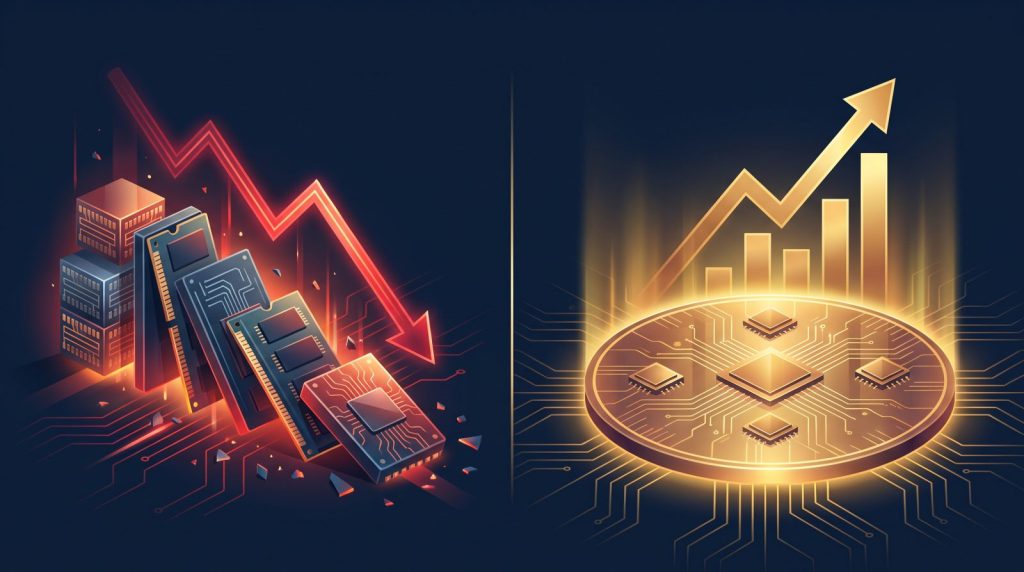
Trending now: why are memory stocks falling when earnings are at records? The sector just dropped 20%+ into an official bear market — in the middle of the best earnings season the industry has ever printed.
This one touches the heart of our cluster: the memory layer of AI infrastructure — and what happens when perfection is already in the price.
Today’s Lens: Semiconductor (the memory cycle). This piece only covers the memory/foundry decoupling. It does not cover AI model competition, Fed policy, or broad geopolitics.
For the structural picture behind the cycle rather than this episode, see the memory stocks guide, which compares conventional DRAM, NAND and HBM and what each maker discloses.
Samsung. Micron. TSMC.
All of them just reported exceptional — in several cases record — results. Samsung posted its biggest operating profit in history and beat estimates. Micron grew revenue 345% year over year with a record company-level non-GAAP gross margin of 84.9%. TSMC posted record quarterly results.
And memory stocks entered a bear market anyway. Micron, Samsung, and SK Hynix are all down 20% or more from their July highs — inside the strongest earnings season the industry has ever printed.
So why are memory stocks falling while the industry prints records? That is exactly the question this card answers — Ajussi has watched enough cycles to know this combination is worth slowing down for.
For the two names at the centre of that selloff, I broke the comparison down separately in Micron vs SK Hynix HBM Stocks (2026): Which Fits Your Strategy?, including how contract structure and the new Nasdaq ADR change the calculus.
Inside the Memory Stocks Bear Market: Two Weeks That Broke the Rally
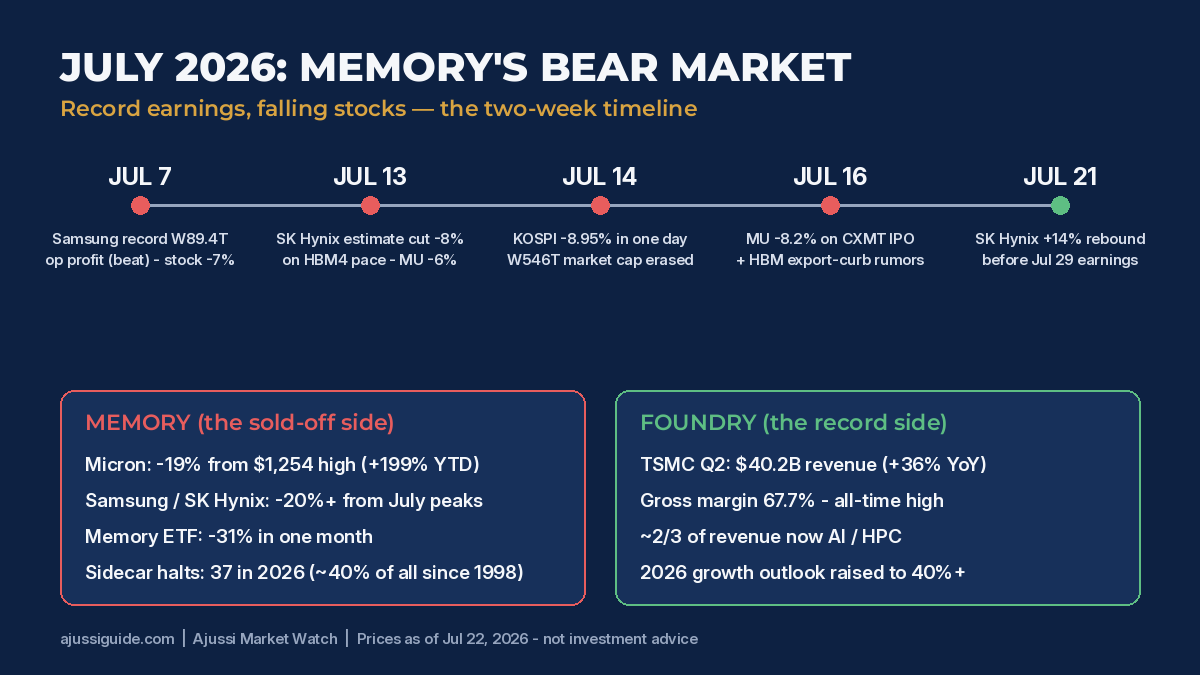
The sequence matters, so here it is in order:
- July 7 — Samsung’s preliminary Q2: operating profit of ₩89.4 trillion (~$58B), roughly 19x higher than a year ago, beating the ₩87.3T consensus. Revenue came in slightly light. The stock fell as much as 10% intraday and closed down 6.9%. Micron, SanDisk, and Western Digital fell ~7% in sympathy.
- July 13 — A Korean brokerage cut its SK Hynix Q2 profit estimate to 8% below consensus, citing a slower HBM4 shipment ramp. US memory names dropped another 6%.
- July 14 — The KOSPI fell 8.95% in a single session as Samsung and SK Hynix collapsed together, erasing roughly ₩546 trillion of market value in a day. Korea’s sidecar mechanism has now fired 37 times in 2026 — nearly 40% of all activations since it was introduced in 1998 — and full circuit breakers have triggered 7 times this year, versus 6 in the market’s entire prior history.
- July 16 — Micron slid 8.2% on two fresh worries: China’s CXMT pricing an $8.5B IPO (new memory supply), and rumors of HBM export restrictions.
- July 21 — The first real bounce: SK Hynix jumped 14% ahead of its July 29 earnings report, and Micron rebounded off support near $840.
Net result: the memory complex sits 20%+ below its July peaks (one memory-sector ETF is down 31% in a month), while Micron — even after the drawdown — is still up ~199% year to date.
The Paradox: The Numbers Were Not the Problem
The question “why are memory stocks falling?” sounds absurd next to what these companies actually reported:
| Company | Reported (Q2 / latest) | Stock reaction |
|---|---|---|
| Samsung | ₩89.4T op profit, ~19x YoY, beat consensus | -6.9% on the day; -20%+ from peak |
| Micron | $41.5B revenue (+345% YoY), 84.9% non-GAAP gross margin (company record), HBM sold out through 2027 | -19% from its $1,254 high |
| TSMC | $40.2B revenue (+36% YoY), record 67.7% gross margin, ~2/3 of revenue from its HPC platform (which includes AI accelerators) | Held up — the record side of the decoupling |
Why Are Memory Stocks Falling? The Transmission Channel
Following our usual order — event, then transmission, then industry, then names:
- Positioning, not fundamentals, broke first. Samsung was up ~150% and Micron ~200%+ for the year before July. When a stock is priced for a perfect quarter, a perfect quarter is no longer news — and a small revenue miss becomes a sell trigger.
- The market moved its clock forward one cycle. The HBM4 shipment-pace worry, the CXMT IPO (fresh Chinese supply), and export-restriction rumors all point at 2027, not 2026. Memory is a cyclical business; investors are trying to sell the next downturn before it exists.
- Concentration amplified everything. Semiconductors are now such a large share of the KOSPI that fund flows move the whole index — 37 sidecar halts in 2026 (out of 97 ever) says the volatility is structural, not incidental. Analysts largely describe July 14 as mechanical selling, not a demand signal.
- Foundry and memory decoupled — logically. TSMC sells scarce advanced manufacturing capacity that nearly every AI chip needs; memory remains more exposed to cyclical supply and pricing — and new entrants add to that risk. The market is paying record multiples for the toll booth and discounting the more cyclical layer. Whether that discount is overdone is the real question of this story.
What Is Confirmed vs What Is Not
| Label | Item |
|---|---|
| Confirmed | Samsung ₩89.4T op profit (beat); TSMC $40.2B / 67.7% GM / +36% YoY / ~2/3 HPC platform (incl. AI accelerators); Micron +345% YoY, HBM sold out 2026–27; memory names -20%+ from July peaks; KOSPI -8.95% on Jul 14 (₩546T erased) |
| Likely Transmission | Selloff driven mainly by positioning and index concentration (mechanical flows), not by any reported demand deterioration |
| Scenario | If CXMT supply scales into 2027, HBM/DRAM pricing power weakens; if export-restriction rumors become policy, memory trade routes get re-priced again |
| Unknown | Whether July 14 marked the cycle top for memory stocks; actual HBM4 shipment numbers (first hard data point: SK Hynix earnings, July 29) |
Key Names to Watch — and Where the Exposure Sits
Most exposed: Micron (MU) — the only pure-play US-listed name in the group; its order book (~$100B in contracted minimum revenue across 16 take-or-pay customer agreements, per its Q3 FY26 disclosures) is the bull case, and its cyclical history is the bear case. Samsung and SK Hynix carry the same exposure plus KOSPI concentration risk. The contrast name: TSMC (TSM), which just showed the market treats foundry as structurally different from memory. The gauge: memory-sector ETFs, which compress the whole argument into one drawdown chart. None of this is a buy or sell call — it is a map of where the story lands.
Ajussi’s Strategy: A Frame, Not a Forecast
Short term (next two weeks): July 29 is the whole ballgame — SK Hynix’s actual HBM4 shipment commentary either validates or kills the estimate-cut narrative. Also watch whether the export-restriction rumor becomes an actual policy announcement.
Medium term: track the decoupling itself. If TSMC keeps printing records while memory languishes, the market is saying AI demand is real but memory’s share of it is contestable. That thesis gets tested when CXMT’s real output (not its IPO deck) shows up in pricing data next year.
Risk path to respect: this is the second memory selloff in three weeks (we covered the first leg in early July). Repeated 8–9% index days on record earnings are what “priced for perfection” looks like from the inside — the same pattern we flagged in our AI capex bubble checklist. Record capex demand (tracked here quarterly) can be completely real while individual stocks still correct 30%.
Why are memory stocks falling, then? Not because demand broke — no evidence of demand deterioration has been reported yet — but because perfection was already in the price. That distinction is the whole frame.
Update (Jul 23): The same week delivered a second, related shock — China’s open-weight Kimi K3 release knocked the SOX into a bear market. We covered who is actually exposed in Kimi K3 Selloff: Who Is Actually Exposed in AI Infrastructure.
Not investment advice. Ajussi shares research and observation frames, not recommendations. Prices and figures are as of July 22, 2026 and will change.