A data center announcement usually leads with chips. Whether the building ever switches on is decided earlier, by whether enough electricity can be generated and delivered to it at all.
Searching for power grid stocks mostly returns lists of tickers. The question people actually ask is narrower: which companies benefit from, and offer a solution to, the strain data centers put on the electrical grid?
That strain starts at generation. Before power can reach anything, someone has to produce it, and the companies doing that are not the ones most AI coverage names. Most power grid stocks coverage skips straight past them.
Chips can be shipped and stored. Electricity has to be generated and delivered in real time through a grid capable of serving the load.
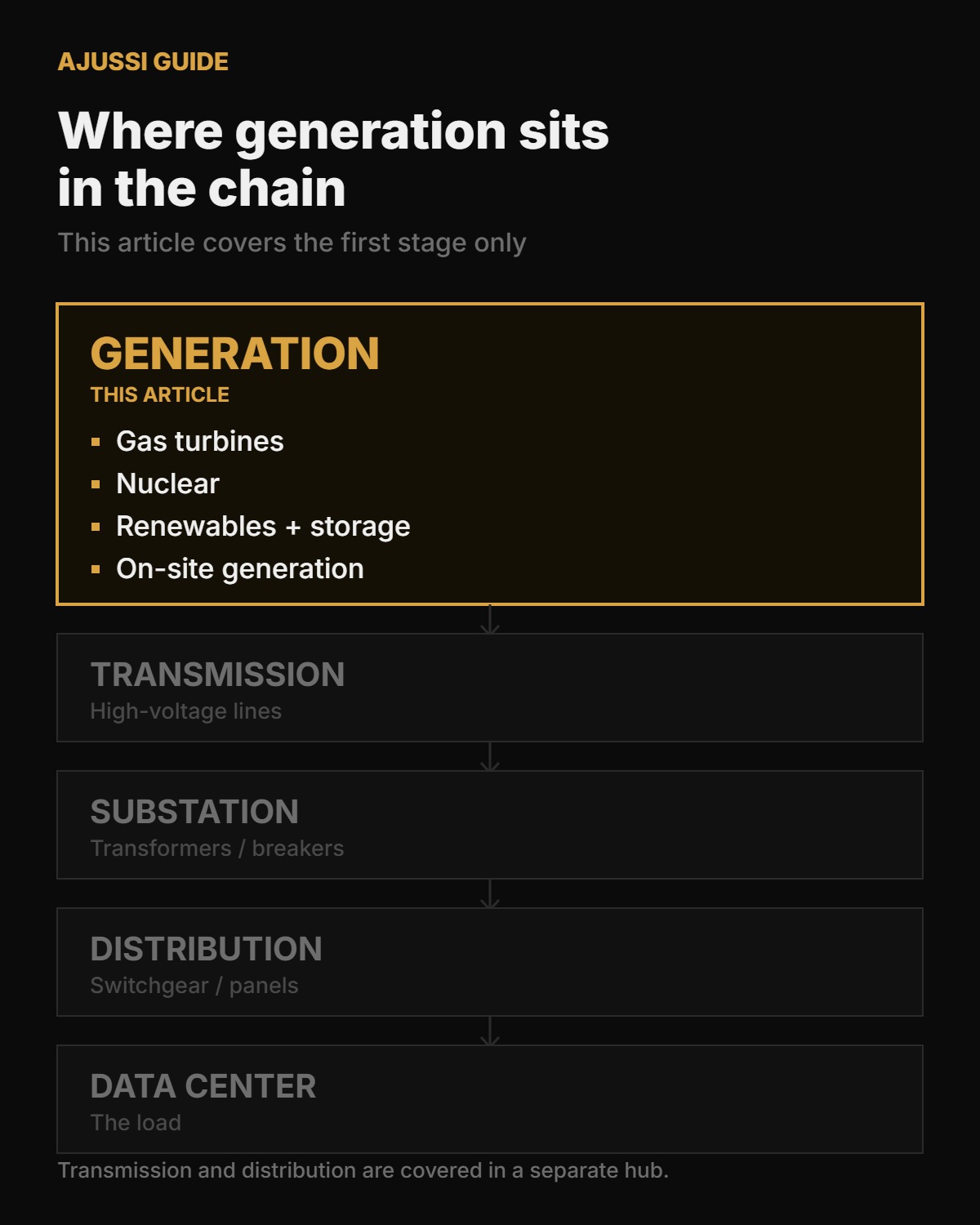
Generating the electricity is only the first step. The equipment and contractors that move it from the plant to the building are mapped separately in transmission and distribution stocks: from the transformer to the interconnection queue.
What you need to know before the company names
Four ideas carry most of this topic, and they explain why power grid stocks that look alike can behave nothing alike.
Data center load is large, steady, and concentrated
A large data center campus draws power measured in hundreds of megawatts, continuously or near-continuously, in a small number of regions. That profile differs from most industrial demand, which varies by shift and season.
Steady load favors generation that can run without interruption. Nuclear and gas feature prominently in firm 24/7 supply discussions, while renewables remain widely used in large energy-matching agreements.
Regional load and generation data are published by the US Energy Information Administration.
Capacity, output, and contracted volume are three different numbers
A plant’s nameplate capacity is what it could produce at full output. What it actually produces depends on how often it runs. What a customer has rights to depends on the contract.
When a headline says a data center “secured 1 gigawatt,” check which of the three it means.
Power contracts are financial and physical at the same time
This is the part most coverage gets wrong.
A power purchase agreement does not usually mean specific electrons travel from one plant to one building. In most US structures the plant delivers into the regional grid, and the agreement settles price, volume, and environmental attributes between the two parties.
That is why a data center can contract with a plant hundreds of miles away. The grid does the physical work; the contract does the financial work.
An order is not revenue
For equipment makers this distinction decides whether a story is real.
| Term | Meaning, and when cash arrives |
|---|---|
| Order | Customer commits to buy. Cash: not yet |
| Slot reservation | Manufacturing capacity held, not contracted. Cash: not yet, and may never convert |
| Backlog | Orders not yet delivered. Cash: over the contract life, often years |
| Revenue | Delivered and recognized. Cash: this period |
A record backlog tells you demand exists. It does not tell you the margin, the delivery date, or whether the customer can still pay when the equipment ships.
The four sources of power in play
Power grid stocks divide first by what they generate, because the fuel decides the timeline. That is why two companies in the same index can be years apart in when they actually deliver.
Gas turbines
Combined-cycle gas plants can generally be permitted and built faster than most alternatives and run continuously. That combination is why gas has absorbed much of the near-term demand.
The constraint is manufacturing. Heavy-duty turbines come from a small number of suppliers, and order books extend years out. A developer who wants power in two years may be unable to buy a turbine on that schedule.
The trade-off is fuel. Gas plant economics move with fuel prices, and emissions accounting is harder for buyers with climate targets.
Nuclear
Existing reactors feature in many of the large agreements signed to date. The appeal is continuous output and fuel costs that are generally a smaller and more stable share of operating costs than gas fuel costs.
Three structures appear in these deals, and they are not equivalent.
Contracting output from an operating plant. Power that already flows into the grid becomes contractually allocated to support a specific buyer’s load.
Restarting a retired plant. Longer timeline and higher cost, but returns capacity that had left the system.
Uprating an existing plant. Incremental output increases at a plant already running.
Several agreements combine these. A single deal can contract existing output while also funding uprates that add capacity later.
New reactors, including small modular designs, are a separate question. Several are in development, and commercial operation timelines vary widely by project. Licensing status is public through the US Nuclear Regulatory Commission.
Renewables and storage
Solar and wind have no fuel cost but variable output. Paired with batteries they can serve part of a load profile.
Storage shifts electricity across time; it does not generate electricity. A battery discharges what something else produced earlier, which is why storage capacity and generation capacity are counted separately.
For a facility that must run continuously, solar alone generally cannot provide firm physical supply around the clock. Renewable agreements remain widely used by data center operators for energy procurement and emissions matching, and some of the largest corporate power agreements signed to date are renewable frameworks rather than firm supply contracts.
On-site generation
Some operators install generation at the site itself, ranging from fuel cells to gas engines. One reason is timing: it can reduce dependence on grid connection schedules.
It also draws regulatory attention, because a large load taking power outside the shared grid raises questions about who funds shared infrastructure. Outcomes have varied by case and jurisdiction. Relevant proceedings are filed with the Federal Energy Regulatory Commission.
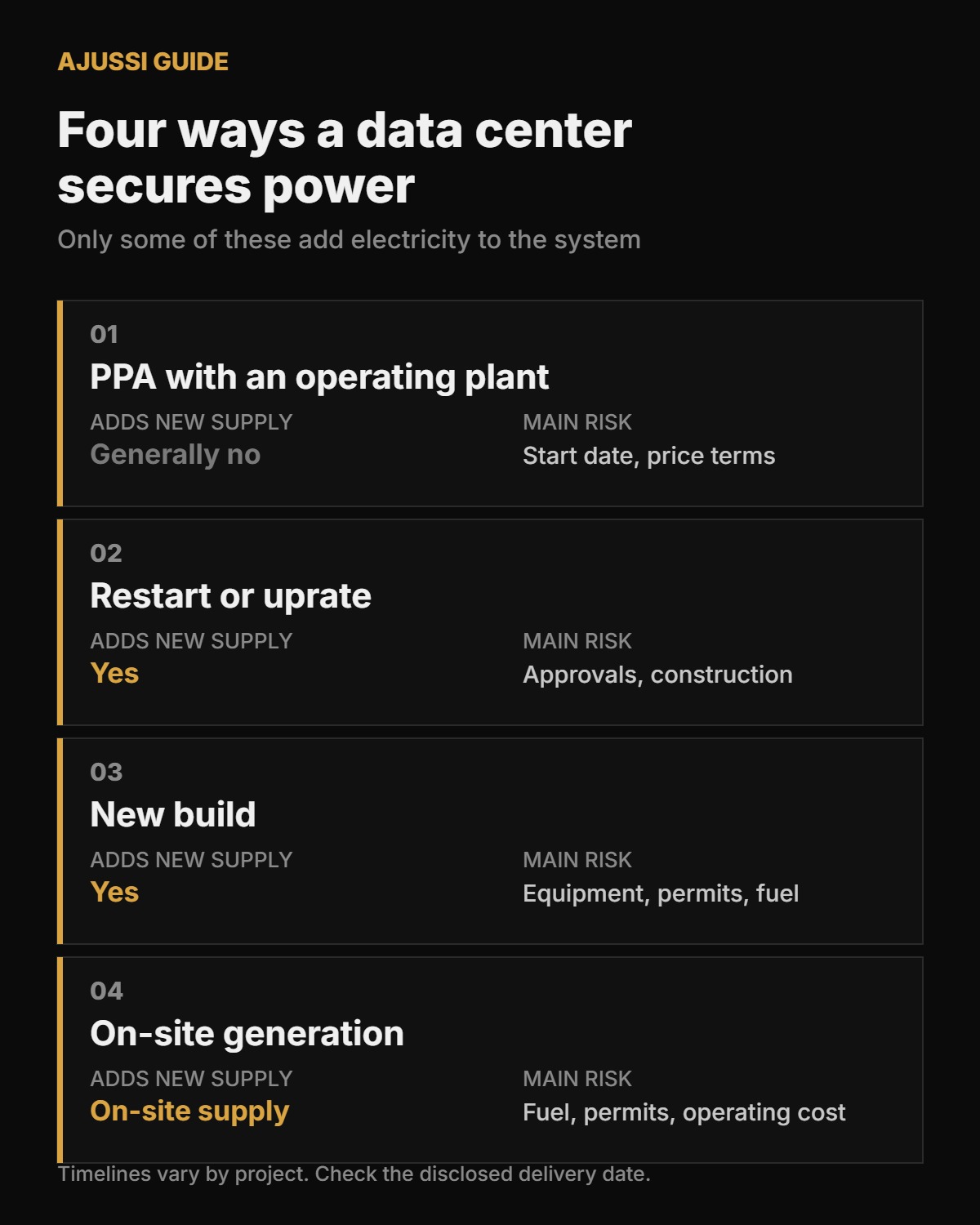
| Route | What it does, and what can go wrong |
|---|---|
| PPA with an operating plant | Adds new supply: generally no. Timeline: varies by contract. Main risk: start date, price terms |
| Restart or uprate | Adds new supply: yes. Timeline: multiple years. Main risk: approvals, construction |
| New build | Adds new supply: yes. Timeline: multiple years or more. Main risk: equipment, permits, fuel |
| On-site generation | Adds new supply: on site only. Timeline: varies by project. Main risk: fuel, permits, operating cost |
How power grid stocks actually make money
Equipment makers and plant operators earn on completely different schedules. Confusing them is the most common error in this sector, and it is why two power grid stocks described with the same headline can behave nothing alike.
Equipment makers sell turbines, fuel cells, and generators. Revenue is recognized as contractual performance obligations are satisfied, which may occur over production milestones or at delivery. A reservation alone is not revenue. Either way, a large order signed today may not appear in reported revenue for a year or more.
Plant operators sell electricity. Under a long-term agreement, revenue reflects contracted terms once deliveries begin, which can be years after the announcement.
So the schedule, not the sector label, is what separates power grid stocks from one another.
Contracting an operating plant does not automatically raise its earnings. Its earnings impact depends on price, volume, duration, prior market exposure, and the costs required to deliver the agreement.
Every participant announces the same project as its own good news, at a different moment. Reading those announcements as independent confirmations is how this sector gets overcounted.
Boundary note: none of this reaches a building without transmission, substations, and distribution equipment. Those are separate businesses with separate companies, covered in the grid layer.
Current Snapshot, August 2026
Data as of 2026-08-17. These are the figures most often quoted about power grid stocks right now.
Generation equipment
GE Vernova (GEV) REPORTED Q2 2026, reported 2026-07-22
| Metric | Value |
|---|---|
| Gas turbine equipment backlog | 53 GW |
| Slot reservation agreements | 63 GW |
| Combined figure often quoted | 116 GW |
| Power segment orders | +134% organic |
⚠️ The widely quoted “116 GW” is equipment backlog plus slot reservations, not firm turbine backlog. Slot reservations are capacity holds that have not become contracts.
⚠️ The company cites data centers as one demand driver alongside grid reliability and broader electrification. It does not disclose what share of Gas Power backlog is attributable to data centers.
Contracted supply agreements
| Agreement | Volume, type, and status |
|---|---|
| Vistra and Meta | 2,600+ MW, 20 years. Nuclear.CONTRACTED 2026-01-09. Approximately 2,176 MW operating capacity plus about 433 MW planned uprates. Deliveries from late 2026; additions through 2034 FORWARD-LOOKING |
| Microsoft and Constellation, Crane Clean Energy Center | ~835 MW. Nuclear restart.CONTRACTED. Supports restart of a retired unit. Restart pending |
| Amazon and Talen | 1,920 MW through 2042. Nuclear.CONTRACTED. Front-of-the-meter structure delivering into PJM. Ramping toward full volume by 2032 |
| Google and NextEra, Duane Arnold | 615 MW, 25 years. Nuclear restart.CONTRACTED + FORWARD-LOOKING. Target operation Q1 2029, subject to regulatory approval |
| Microsoft and Brookfield Renewable | 10.5 GW+ target, 2026 to 2030. Renewables.ANNOUNCED framework. Target volume through 2030 FORWARD-LOOKING. Individual projects contracted separately |
| Bloom Energy and Equinix | 100 MW+ across sites. On-site fuel cells. ~75 MW OPERATING, ~30 MW UNDER CONSTRUCTION |
| Oklo and Switch | Up to 12 GW master power agreement. Next-generation nuclear.ANNOUNCED FORWARD-LOOKING. Explicitly non-binding. No operating plant to date |
⚠️ These agreements are not comparable to one another. A binding contract on an operating plant, a framework covering future projects, and a non-binding master agreement for reactors that do not yet exist sit at different levels of commitment, and the headline megawatt figure does not indicate which is which.
The power grid stocks company map
Most power grid stocks lists rank companies. This one maps them by role instead, because role determines when and whether a company gets paid. It is not a ranking and not a list of recommendations. The power grid stocks below are grouped by what they actually sell.
| Company | Role, business, and evidence |
|---|---|
| GE Vernova (GEV) | Generation equipment. Heavy-duty and aeroderivative gas turbines. AI link: cites data centers as one demand driver. Evidence: attribution not disclosed |
| Constellation (CEG) | Plant operator. Nuclear fleet. AI link: long-term agreement with Microsoft supporting a unit restart. Evidence: confirmed by company disclosure |
| Vistra (VST) | Plant operator. Nuclear and gas fleet. AI link: multi-decade agreement with Meta covering operating capacity and planned uprates. Evidence: confirmed by company disclosure |
| Talen (TLN) | Plant operator. Nuclear. AI link: expanded agreement with Amazon through 2042, delivering into PJM. Evidence: confirmed by company disclosure |
| NextEra Energy (NEE) | Plant operator and developer. Nuclear, gas, renewables. AI link: 25-year agreement with Google supporting a nuclear restart, target 2029. Evidence: confirmed by company disclosure, operation pending approval |
| Brookfield Renewable (BEP / BEPC) | Developer and operator. Renewables. AI link: multi-gigawatt framework agreement with Microsoft. Evidence: confirmed by company disclosure, framework rather than project contracts |
| Bloom Energy (BE) | On-site generation equipment. Solid oxide fuel cells. AI link: deployments at data center sites, portions operating and under construction. Evidence: confirmed by company disclosure |
| Oklo (OKLO) | Next-generation nuclear developer. Small modular reactor development. AI link: master power agreement with a data center operator. Evidence: non-binding, no operating plant |
⚠️ These evidence levels are not interchangeable. An operating deployment, a signed contract pending regulatory approval, a framework agreement, and a non-binding announcement sit at four different distances from revenue.
A company using the word “AI” in a press release is not an evidence level.
Coverage note: this map covers the four generation types described above. Companies whose data center exposure could not be verified against primary disclosure are not listed. Hitachi Energy is a business within Hitachi Ltd. rather than a separately listed security, so it is excluded from a stock-level map.
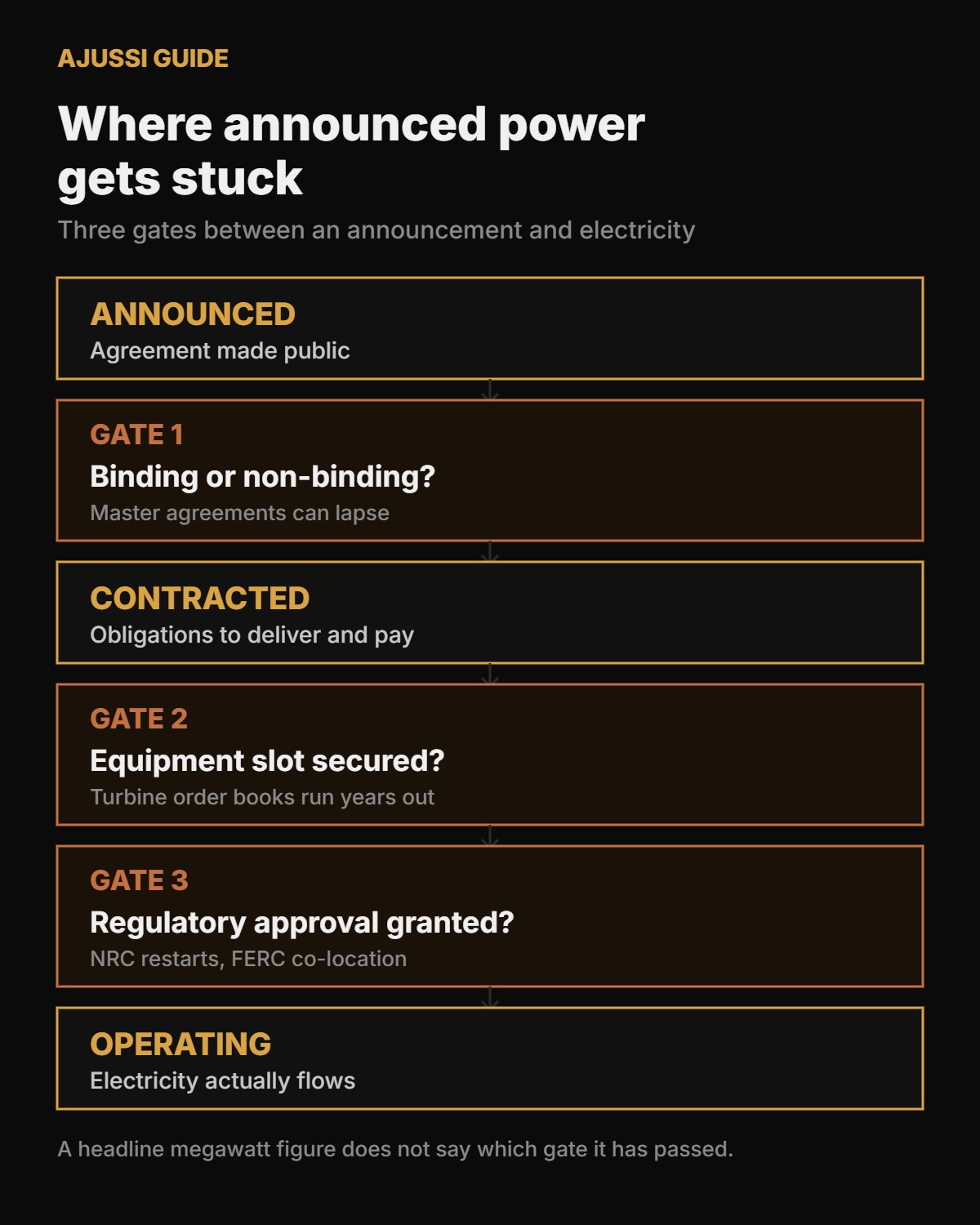
What actually goes wrong
Most of the gap between what power grid stocks announce and what they deliver comes from a few recurring places.
Turbine manufacturing capacity. Order books extend years out. Wanting power sooner does not create a delivery slot.
Slot reservations are not orders. A reservation holds manufacturing capacity and can lapse.
Non-binding agreements are not contracts. Some large headline volumes come from master agreements that either party can walk away from.
Delivery start dates. A contract signed today may deliver in three years. Revenue follows delivery.
Contracting existing output may not add supply. Whether a deal increases total generation depends on whether it includes restarts, uprates, or new build.
Restart timelines slip. Returning a retired plant to service involves regulatory approval, equipment refurbishment, and grid reconnection. Each can move.
Development-stage companies may have no operating asset or current revenue from an announced agreement. A next-generation reactor developer with a multi-gigawatt announcement may have no operating plant at all.
Regulatory uncertainty on on-site and co-located arrangements. Structures placing large loads outside the shared grid have drawn scrutiny in the US. Rules are still developing and outcomes have varied.
Customer concentration. A small number of hyperscalers drive most of this demand. If two slow their capital spending, contract quality changes across the sector.
Fixed-price contracts cut both ways. They stabilize revenue and can also cap it.
Attribution is often unclear. Companies rarely disclose what share of a backlog or order book comes from data centers specifically.
What to watch, and where to find it
Tracking power grid stocks is mostly a matter of watching for a small number of disclosures.
Binding versus non-binding. Master agreements and letters of intent appear alongside contracts in coverage. Only one creates an obligation.
Firm orders versus slot reservations. Some equipment makers disclose these separately.
Backlog conversion, not backlog size. How much converts to revenue this year. Backlog stretching further out is a slower business, not automatically a better one.
Delivery start dates. The announcement date and the first delivery date are different, and the gap is often years.
Whether capacity is existing, restarted, uprated, or new. This determines whether a deal adds supply or contracts existing output.
Regulatory filings. Nuclear restarts and uprates require NRC approvals with dates attached. Co-location and interconnection questions appear in FERC dockets. These provide some of the earliest verifiable evidence beyond a company announcement.
Disclosed attribution. Whether the company states a data center share, or only names it as a driver.
Primary sources: 10-K and 8-K filings on SEC EDGAR, quarterly earnings presentations, NRC licensing records, FERC dockets, and EIA generation data.
The short version
Generation is where the AI power story starts, and power grid stocks move on a slower clock than anything else in the buildout. A chip order can be filled in months. A turbine slot or a restarted reactor is measured in years.
That timing gap explains most of what looks confusing in power grid stocks headlines. Companies announce agreements that will not produce revenue for several years, and the same project gets announced separately by the operator, the equipment maker, and the customer.
So the useful question to ask about power grid stocks is not which company is exposed to AI. Almost all of them claim to be. It is whether a specific agreement is binding, when it delivers, and whether it contracts existing output or brings new capacity into the system.
In this layer, the date matters as much as the number. A contract without a disclosed delivery date is much harder for an outside investor to evaluate.
Related reading
More on the power grid stocks layer, from generation outward:
- Utility Stocks and Data Center Electricity Demand: What Investors Need to Know covers the regulated utilities that sit between generation and the data center.
- AI Power Infrastructure Stocks: 5 Best Picks for 2026 Investors looks at the equipment side of the same buildout.
- SMR Nuclear Stocks for AI Data Centers: 7 Best Picks 2026 goes deeper on the next-generation nuclear names referenced above.
- Oklo vs NuScale Stock Comparison: Which SMR Stock Fits Your Portfolio? compares two development-stage companies against the evidence standard used in this article.
FAQ
What are the best electric grid stocks to buy right now?
There is no single answer, and a list of tickers is the least useful form of one. Several very different businesses sit under the power grid stocks label.
Equipment makers sell hardware and recognize revenue as performance obligations are satisfied, which may span production milestones or land at delivery. Plant operators sell electricity under agreements that may not start for years. Development-stage companies may have announcements but no operating asset at all. Decide which of those you are buying before comparing names, because they respond to entirely different events.
Which companies benefit from and solve the strain data centers put on the grid?
Different groups address different parts of it, and generation is only the first. The power grid stocks label covers all of them at once, which is where the confusion starts.
Equipment makers add the ability to produce power. Plant operators contract output to specific buyers and, in some cases, fund uprates or restarts. On-site generation suppliers reduce dependence on grid connection timing. Grid companies move the power, which is a separate layer.
No single group solves the problem alone. The binding constraint on any specific project may sit with any one of them, which is why power grid stocks should be read by role rather than as one basket.
Does a signed data center power agreement mean the operator earns more?
Not automatically, and this is the most common misreading in the sector.
The earnings impact depends on price, volume, duration, what the plant was previously earning in the market, and the costs required to deliver on the agreement. A restart, for instance, carries refurbishment costs before it carries revenue.
Check when deliveries start, whether the agreement includes restarts or uprates, and what the company says about cost recovery.
Does a data center power agreement mean electricity flows directly from that plant?
Usually not in a physical sense, and this trips up a lot of coverage.
In most US structures the plant delivers into the regional grid and the agreement settles price, volume, and environmental attributes between the parties. That is why a buyer can contract with a plant far from its facility.
On-site generation is the exception. Fuel cells or engines installed at the site do supply that facility directly.
What is the difference between a binding contract and a master agreement?
A binding contract creates obligations to deliver and to pay. A master agreement or framework sets terms for transactions that may follow.
Some of the largest headline volumes in this sector come from non-binding master agreements. They can be genuine indicators of intent and they can also expire without a single megawatt changing hands. Company announcements usually state which one it is, though coverage often does not.
What is the difference between a slot reservation and an order?
A slot reservation holds a place in a manufacturer’s production schedule. An order is a contract to buy.
Reservations can convert to orders, and they can also lapse. Some manufacturers disclose the two separately, which is why a single large gigawatt figure sometimes combines both. When a headline number looks unusually large, check whether it is a sum.
Why can a company report record backlog and still miss earnings?
Backlog measures demand. Earnings measure execution and pricing.
Work booked during a shortage can carry costs that move before delivery. Backlog stretching further out converts more slowly. Backlog is not cash, so it can grow while working capital tightens.
Read backlog alongside conversion rate and margin guidance, never alone.
Does contracting a nuclear plant to a data center add electricity to the system?
It depends on the structure, and the three cases are often blurred together.
Contracting output from an operating plant generally allocates generation that already exists. A restart returns capacity that had left the system. An uprate raises output at a plant already running. Some agreements combine more than one.
When reading a deal, check which components it contains rather than assuming the headline megawatt figure is all new supply.
When will we know whether these projects are real?
Regulatory filings provide some of the earliest verifiable evidence beyond a company announcement.
Nuclear restarts and uprates require NRC approvals with dates attached. Co-location arrangements appear in FERC dockets. Project progress becomes visible as backlog converts into reported revenue and deliveries advance. Commercial operation comes last.
A long announced project with no visible regulatory progress is worth checking directly rather than assuming either outcome. That check, repeated over time, is most of what separating real power grid stocks from announced ones actually involves.
Sources and update log
Primary sources
- GE Vernova, Q2 2026 financial results
REPORTED2026-07-22 - Vistra and Meta nuclear agreements
CONTRACTED2026-01-09 - Constellation, Crane Clean Energy Center
CONTRACTED - Talen Energy, expanded Amazon agreement
CONTRACTED - NextEra Energy and Google, Duane Arnold restart
CONTRACTED+FORWARD-LOOKING - Brookfield Renewable and Microsoft, renewable framework
ANNOUNCEDframework - Bloom Energy and Equinix, data center power agreement
OPERATING/UNDER CONSTRUCTION - Oklo and Switch, master power agreement
ANNOUNCED, non-binding
Reference sources: EIA electricity data · NRC reactor licensing · FERC · SEC EDGAR
If you would rather hold the whole power chain through a single ticker, our AI power ETF comparison breaks down what AIPO, ZAP, POWR and GRID actually hold, from equipment-heavy to utility-heavy to global grid names.
Data as of: 2026-08-17 · Last updated: 2026-08-17 · Change log: Initial publication
This article is for information only. It is not a recommendation to buy or sell any security. Investment decisions and their outcomes are your own.