Palantir describes the Palantir Ontology at length in its SEC filings. What it does not do is price it. The Ontology is not a reportable segment, not a separate product revenue line, and not a disaggregated financial metric anywhere in the filings.
That gap matters, because the Palantir Ontology is the piece analysts most often point to when they describe Palantir’s durability. The company explains it in detail. It never tells you what it earns.
So the useful question is not “how much revenue does the Palantir Ontology generate.” It is: which disclosed numbers move when the Palantir Ontology is working, and how confident can you be in each one? This piece sorts every metric by what kind of disclosure it actually is.
What the Palantir Ontology is, in the company’s own framing
Palantir’s Form 10-Q describes four principal software platforms: Gotham, Foundry, Apollo, and AIP. The filing presents the Palantir Ontology as part of Foundry rather than as a separate principal software platform. Foundry is described as the foundational data operations platform covering data management, logic authoring, systemic mapping through the Palantir Ontology, analytics, and workflow development.
That structure is the direct answer to why there is no Ontology revenue line. It is a layer inside a platform, not a platform sold on its own.
The filing’s own definition is worth reading closely. Ontology generally refers to the systematic mapping of data to meaningful context. Palantir’s version, per the filing, goes beyond that by integrating the elements of a decision, meaning data, logic, and actions, into a foundational representation of the organization, so users can build interconnected workflows.
How this differs from a database
A database can store relationships, schemas, and constraints. That much is not unique. What the filing describes on top of that is an operational layer: business objects, permissions, actions, and governed write-back workflows.
The practical distinction is between a system that reports a plane is grounded and a system in which an authorized user reassigns the part, and that decision propagates back into the systems of record.
An interpretation, flagged as such: my inference is that this accumulated operational modeling, built against one customer’s specific operations, can create switching costs. Palantir does not disclose a standalone retention or switching-cost metric for the Palantir Ontology, so treat that as a thesis rather than a reported fact.
What changed in August 2026: SuperRepo
In the week of August 3, 2026, Palantir moved SuperRepo into beta. Per Palantir’s own documentation, it is a single monorepo holding Ontology definitions, functions, and a React application together, developed, built, and deployed as one versioned artifact.
The mechanism is Ontology-as-code: object types, links, interfaces, and actions are declared in TypeScript. Those definitions are the source of truth and materialize as real entities on the enrollment when the product is deployed. The Foundry CLI runs the repo locally, with an embedded Ontology preview and an SDK regenerated whenever the definitions change.
What this is, and is not. The design appears intended to reduce development friction and align Ontology work with conventional software engineering practice. Palantir has not disclosed adoption, productivity gains, or revenue impact. It is a beta developer-surface change. Nothing about demand follows from it.
The metrics, sorted by what kind of disclosure they are
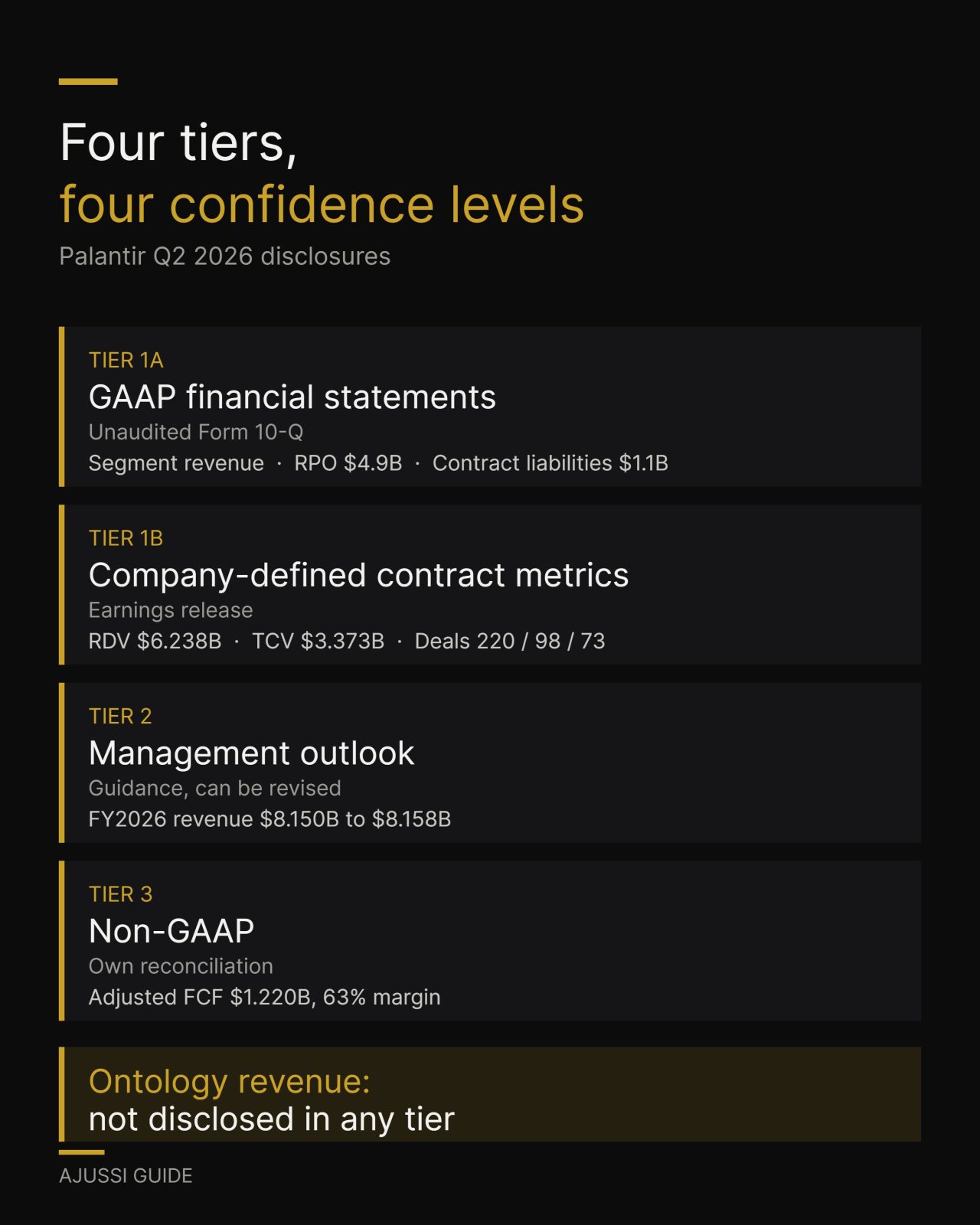
Do not read across these tiers as if they were one number. They carry different weights, and mixing them is how investors end up with confident conclusions the filings do not support.
Tier 1A: financial-statement and contractual disclosures
| Metric | Q2 2026 |
|---|---|
| Government segment revenue | $990.0M |
| Commercial segment revenue | $945.4M |
| Contract liabilities | $1.1B (vs $0.8B at Dec 31, 2025) |
| Remaining performance obligations | $4.9B, with about 43% expected as revenue within 12 months and 36% over the following 13 to 36 months |
| Customer concentration | No customer exceeded 10% of total revenue |
| Purchase commitment | Cloud hosting commitment of at least $5.6B, with annual minimums of $268M to $979M, through February 29, 2036 |
These figures are drawn from Palantir’s unaudited Form 10-Q. Financial-statement amounts follow GAAP unless otherwise noted. Government and Commercial are reported as operating segments under the filing’s segment note, evaluated by the chief operating decision maker.
Tier 1B: company-defined contract metrics
| Metric | Q2 2026 |
|---|---|
| Deals closed at $1M or more | 220 |
| Deals closed at $5M or more | 98 |
| Deals closed at $10M or more | 73 |
| Total contract value closed | $3.373B, up 49% year over year |
| U.S. commercial TCV closed | $2.132B, up 153% year over year |
| U.S. commercial remaining deal value | $6.238B, up 124% year over year and 27% sequentially |
| Rule of 40 score | 155% |
Directly disclosed is not the same as GAAP, and these are not GAAP measures. They are company-defined contract metrics reported in the earnings release, not line items in the financial statements.
They also carry a caveat the company states outright. Per the release’s own definitions, TCV, ACV, and RDV each presume the exercise of all contract options and no termination of contracts. But the majority of Palantir’s contracts are subject to termination provisions, including for convenience, and RDV may exclude some value based on assessments of customers’ financial condition. These are ceiling figures, not committed revenue. RPO in Tier 1A is the non-cancelable measure.
Read the RDV figure carefully. U.S. commercial remaining deal value rising 124% is a proxy showing commercial demand deepening. It does not show that the Palantir Ontology caused it. AIP, new contract scope, added seats, and services expansion all sit inside the same number, and the disclosure does not split them.
Tier 2: management outlook
| Metric | Company figure |
|---|---|
| Q2 revenue | $1.935B, up 93% year over year |
| U.S. commercial revenue growth | Up 149% year over year |
| Q3 2026 revenue guidance | $2.160B to $2.164B |
| FY2026 revenue guidance | $8.150B to $8.158B |
| FY2026 U.S. commercial revenue guidance | In excess of $3.424B, growth of at least 134% |
Guidance of this shape reads differently next to what the hyperscalers are actually spending. I keep those numbers current in the AI capex tracker, updated each quarter.
Tier 3: non-GAAP
| Metric | Q2 2026 |
|---|---|
| Adjusted income from operations | $1.194B, 62% margin |
| Adjusted free cash flow | $1.220B, 63% margin |
| Adjusted EBITDA | $1.203B, 62% margin |
For contrast, the GAAP figures for the same quarter were income from operations of $912.0M at a 47% margin and net income attributable to common stockholders of $1.062B at a 55% margin. Watch which one a headline is quoting.
What you cannot conclude
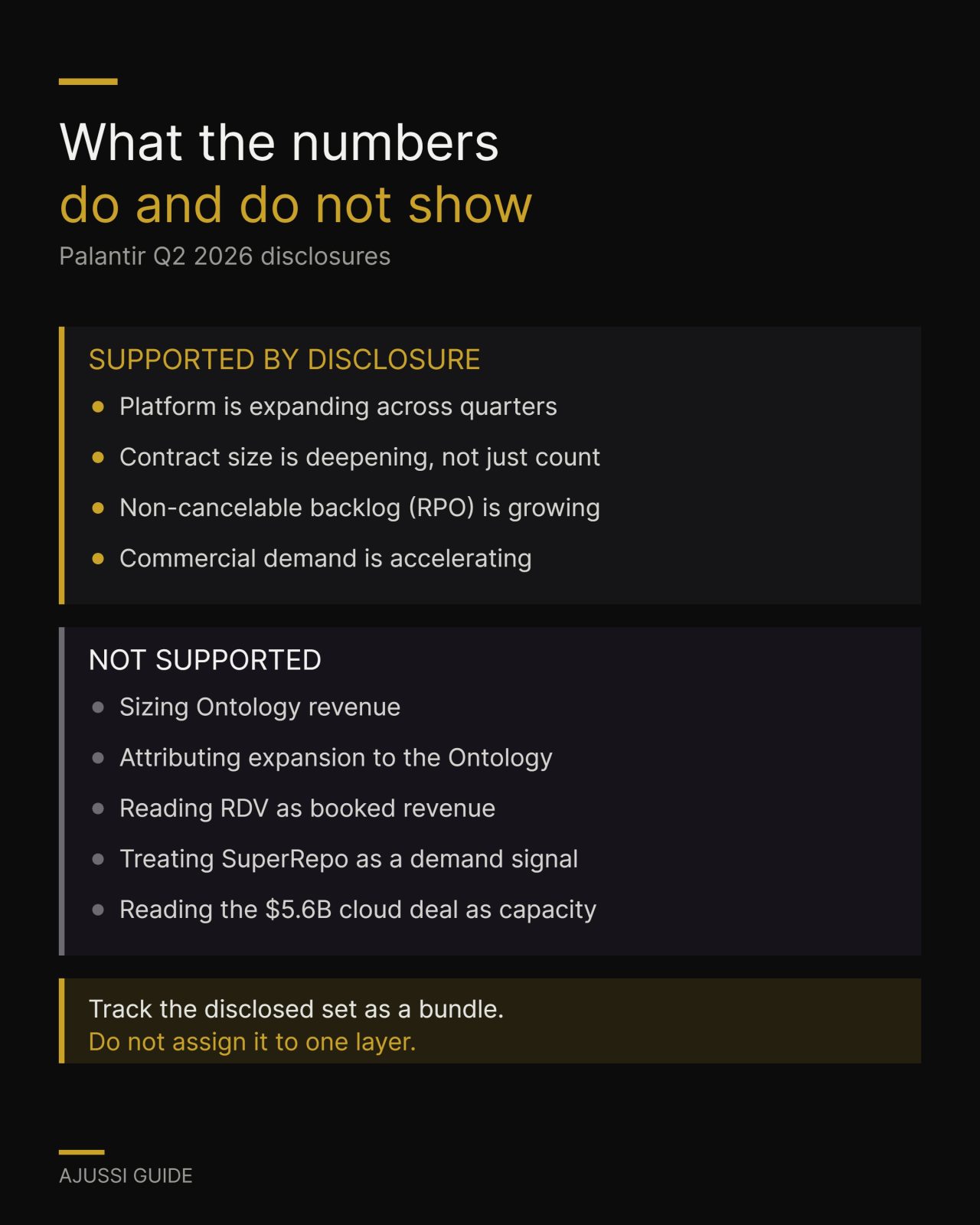
- You cannot size Ontology revenue. It is not disclosed. Any figure attributed to “Ontology revenue” is an estimate.
- You cannot attribute account expansion to the Ontology specifically. RDV, TCV, and deal counts are platform-level.
- You cannot read RDV as booked revenue. It presumes every contract option is exercised and none terminated, which the company itself flags as unlikely to hold.
- You cannot treat SuperRepo as a demand signal. Beta, week of August 3, 2026, with no disclosed adoption.
- You cannot read the $5.6B cloud commitment as Ontology capacity. It is a hosting purchase obligation disclosed without a workload breakdown.
The workable posture is to track the disclosed set as a bundle. If RPO, U.S. commercial RDV, large-deal counts, and commercial revenue growth move together across several quarters, the platform is expanding. Assigning that movement to any single layer of the stack is the step the filings do not support.
If you are working through the AI infrastructure stack more broadly, the site map lays out how the layers connect, from power and cooling through to the software that sits on top.
Frequently asked questions
Does Palantir report Palantir Ontology revenue separately?
No. The filings describe the Ontology in detail but do not disclose revenue for it. It is not a reportable segment or a separate product revenue line. Structurally this follows from the Ontology being presented as part of Foundry rather than as a standalone platform.
Is remaining performance obligation the same as backlog?
RPO is non-cancelable contracted revenue not yet recognized. Palantir disclosed $4.9B as of June 30, 2026, expecting roughly 43% within twelve months and 36% over the following 13 to 36 months. It signals commitment rather than recognition, and it can move sharply on the timing of a small number of large contracts. It is a stricter measure than RDV, which assumes all options are exercised.
Why are adjusted figures labeled differently from the others?
Because they are non-GAAP measures. Adjusted free cash flow, adjusted income from operations, and adjusted EBITDA exclude items such as stock-based compensation and related employer payroll taxes. They are useful for watching trends, but they are not GAAP line items, and the company publishes its own reconciliations.
Which disclosed metric best tracks expansion inside existing customers?
In my view, U.S. commercial remaining deal value, at $6.238B and up 124% year over year, paired with the distribution of deals closed at $1M, $5M, and $10M or more, which was 220, 98, and 73 respectively. Together they show contract size deepening rather than logo count rising. Note that RDV presumes all contract options are exercised, so read it as a ceiling. These are signals of broader platform expansion, not direct measures of Ontology adoption.
What would weaken the argument that the Ontology is a moat?
Deal counts rising while the $10M-and-above tier flattens would suggest the company is adding contracts without deepening them. RPO, the non-cancelable measure, decelerating while revenue growth holds would suggest recognition is outrunning new commitments. Neither would settle the question on its own, which is the honest state of the evidence.
Figures last verified against primary sources on August 8, 2026. Next update: early November 2026, after Q3 results. Sources: Form 10-Q for the quarter ended June 30, 2026, Q2 2026 earnings release, and Form 10-Q for the quarter ended March 31, 2026. Nothing here is investment advice.