When investors ask about Micron vs SK Hynix HBM stocks, the honest answer is that both companies are real participants in the highest-margin segment of the memory market, but they sit in different competitive positions. SK Hynix was first to volume production of high-bandwidth memory for AI accelerators and still holds the largest share of HBM revenue. Micron is the US-based challenger that has closed the technology gap faster than most analysts expected. The question is not which one is good. The question is what you are paying for relative to where each company actually stands in the supply chain today. It is also, as of August 2026, a question being asked in a drawdown: both stocks trade far below their recent peaks even though HBM demand has not cracked. The reasons for that gap are part of the comparison, and this post covers them directly. If you want the layer around these two names first, the memory stocks guide compares conventional DRAM, NAND and HBM and shows what each maker actually discloses.
How HBM Supply Chains Actually Work
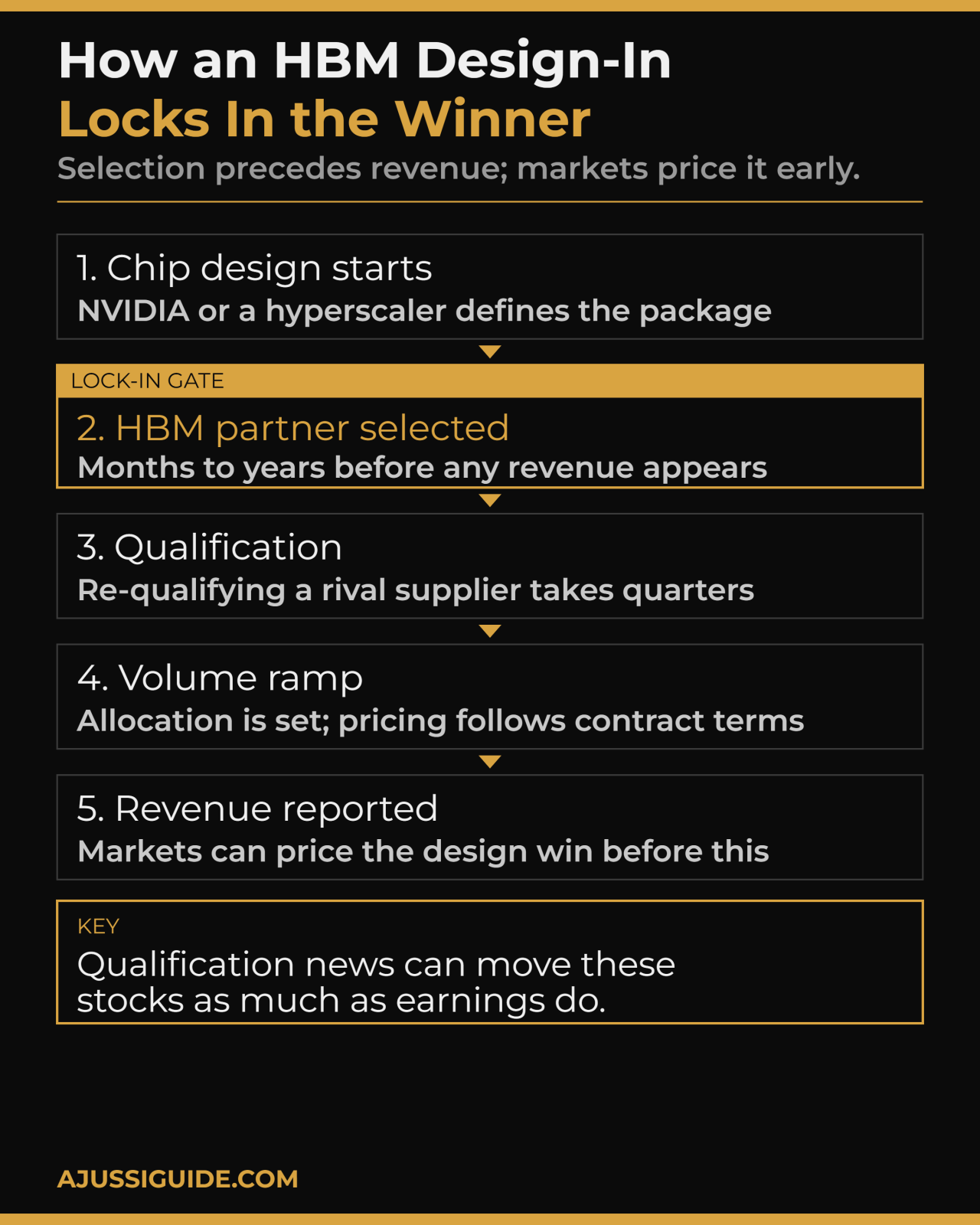
High-bandwidth memory is not a commodity memory chip. High-bandwidth memory stacks multiple DRAM dies vertically using through-silicon vias. The stack then sits beside the AI accelerator inside the same package, typically connected through a silicon interposer. The supplier is chosen at the package design stage, not at the moment of purchase. This means a customer like NVIDIA or a hyperscaler building custom silicon picks their HBM partner months or even years before volume revenue appears on anyone’s income statement.
Once a supplier wins a design-in, switching costs become very high for the customer. The alternative supplier must re-qualify, and that takes quarters. This is why qualification announcements can move these stocks as much as quarterly revenue beats do.
There are three credible HBM suppliers in the world: SK Hynix, Micron, and Samsung. Samsung entered 2026 carrying a qualification overhang from earlier HBM generations, but that picture changed fast: it cleared NVIDIA and AMD qualification for HBM4 and announced its first commercial HBM4 shipments in February 2026 (Samsung newsroom). Technologically it is a three-way race again, though industry estimates still put SK Hynix clearly ahead on HBM share. Those estimates move with the methodology and the survey date: the widely quoted 62% figure is a second-quarter 2025 shipment estimate, and the ordering below the leader looks unsettled now that Samsung is shipping HBM4. For investors, though, Samsung remains the hardest of the three to own directly from a US account, which keeps the Micron vs SK Hynix HBM stocks debate the practical comparison for AI infrastructure exposure.
SK Hynix: The First-Mover Position
SK Hynix was the first memory company to ship HBM at scale for AI training workloads, and that timing advantage was enormous. Being inside the NVIDIA H-series supply chain early meant SK Hynix built process knowledge, yield curves, and customer relationships that competitors had to reconstruct from scratch.
The company’s HBM revenue has grown sharply as a share of total DRAM revenue over the past two years, and it remains the largest single supplier by volume to the AI accelerator market. Its advanced packaging operations, including hybrid bonding capability for future HBM generations, are considered best-in-class by most independent analysts.
The risk side for SK Hynix is its listing. It trades on the Korea Exchange under ticker 000660. Access used to be the catch for US investors, but that changed on July 10, 2026, when SK Hynix listed a sponsored ADR on Nasdaq under the ticker SKHY in the largest ADR offering on record (company announcement). Ten ADSs represent one Korean common share, so the per-ADR price runs at roughly one-tenth of the Seoul share converted to dollars. The practical comparison is no longer a Nasdaq stock versus a thin OTC workaround. It is an established US domestic filer, Micron with its 10-K and 10-Q reports, versus a newly listed foreign private issuer, SK Hynix reporting on 20-F and 6-K. Won-dollar movement still flows through to ADR holders, and the Seoul listing remains the primary market. This structural friction is real and should be priced into any comparison with Micron.
Micron: The US-Based Challenger
Micron Technology trades on Nasdaq under the ticker MU, and until July 2026 it was the only practical Nasdaq route to HBM exposure. It remains the structurally simpler one: common stock of a US domestic issuer rather than a depositary receipt on a Korean share. For an ajussi managing his own US brokerage account, that simplicity matters.
Micron was behind SK Hynix in HBM qualification cycles for prior-generation products, but it has publicly confirmed volume HBM shipments to major AI customers and has announced qualification progress on its most advanced HBM generation. The company has also benefited from US CHIPS Act funding, which supports domestic capacity expansion. SK Hynix holds a CHIPS award too, for its Indiana packaging site, but the Micron award is an order of magnitude larger, up to about $6.165 billion for Idaho and New York fabs against up to $458 million plus up to $500 million in loans for Indiana packaging, roughly a thirteenfold gap in direct funding (Micron award, SK Hynix award), and it attaches to core fab capacity rather than packaging.
The concern with Micron is that closing a yield and volume gap takes capital, and memory fabs are extraordinarily expensive to build and upgrade. Micron’s balance sheet and free cash flow have improved as AI-related memory demand has grown, but it is still investing heavily. Investors are essentially paying now for future HBM share that has not fully materialized in reported revenue.
Why Both Stocks Sold Off in Mid-2026
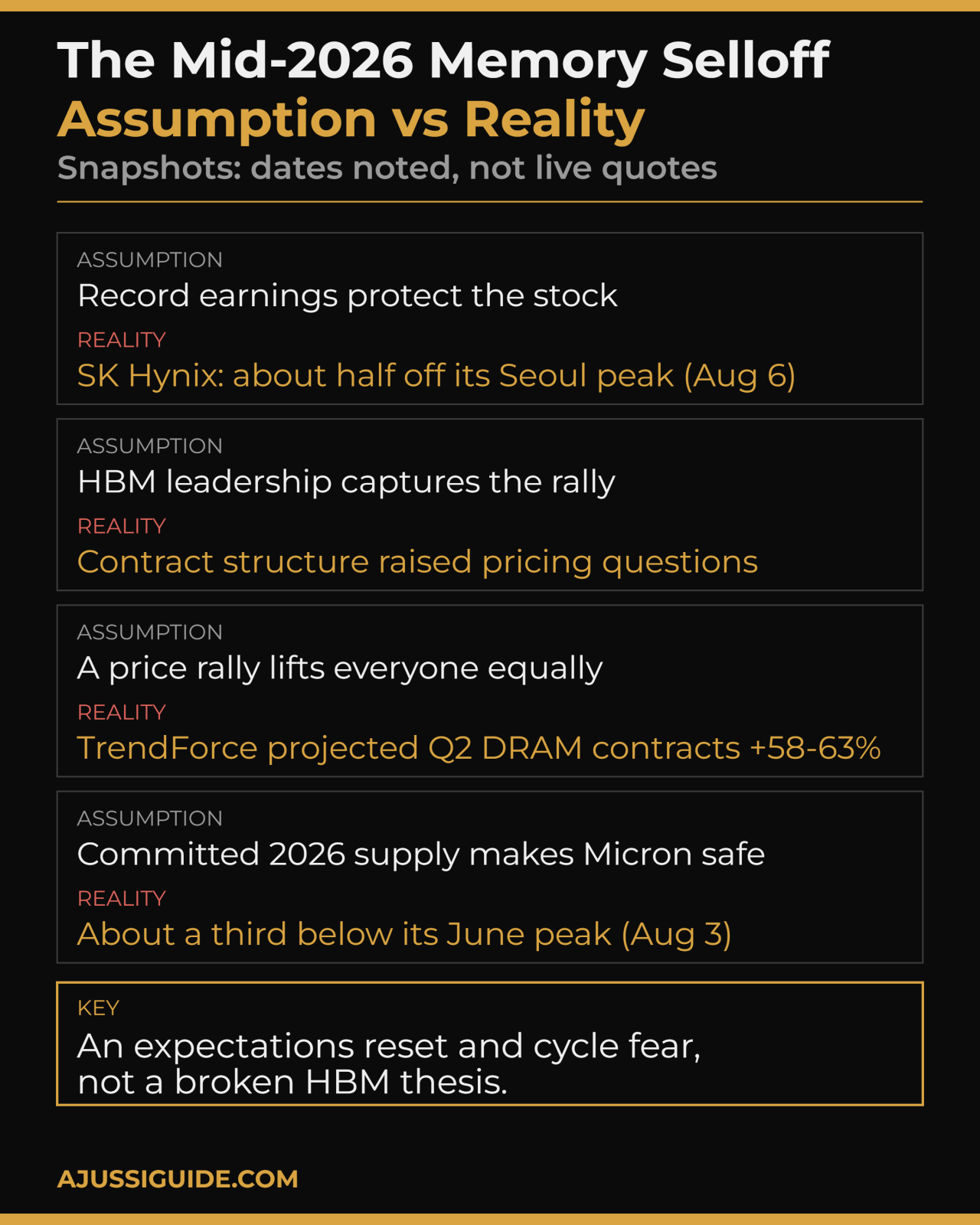
The Micron vs SK Hynix HBM stocks question in mid-2026 is mostly being asked by people staring at red screens. By late July 2026, SK Hynix had fallen more than 45% in about a month on the Seoul listing, and by August 6 it sat roughly half below its peak. Micron was down about a third from its June peak as of August 3, with Samsung also down sharply. These are snapshots of a moving tape, not live quotes. None of this happened because HBM demand disappeared. I covered the anatomy of the broader memory selloff in a separate post; this section is about what it means for the head-to-head.
SK Hynix announced preliminary record quarterly results in late July and the stock fell anyway: revenue and operating profit both landed below the market’s supercharged expectations, which is what happens when a stock is priced beyond perfection (CNBC coverage). The structural detail that spooked investors sits deeper. SK Hynix has said it finalized long-term agreements with around ten customers (Q2 2026 results) and is discussing further multi-year deals, but it has not disclosed how much HBM volume those cover or the pricing formulas involved. Investors worried that such contracts could limit near-term participation in rising prices. That is an inference from the structure, not a disclosed contract term. Meanwhile conventional memory pricing was ripping: TrendForce projected second-quarter contract-price increases of 58% to 63% for conventional DRAM and 70% to 75% for NAND flash. Against that backdrop, contracted HBM economics started to look like a ceiling instead of a floor. That contract structure appears to have been one factor investors repriced in mid-2026.
Micron’s slide is a different flavor. Its calendar 2026 HBM supply is committed on agreed price and volume, and recent quarters have been strong. What the market is pricing is a memory-cycle peak: the fear that once spot prices top out, the next move in earnings estimates is down. That is a cycle call, not a company-specific indictment.
One mechanical detail worth knowing if you follow the Korean listing: SK Hynix shares were hit by two 30% pre-market flash crashes within about a week on Nextrade, a thinly traded alternative Korean venue. The August 6 print involved just 11 shares, a few thousand dollars of volume. Both reversed quickly and said more about thin pre-market liquidity than about the business, but they show how jumpy positioning around this name has become.
The honest read: this selloff is an expectations reset plus cycle-top fear, not evidence that the HBM thesis broke. The two things worth watching from here are 2027 HBM contract pricing, which gets negotiated against a much higher spot backdrop, and hyperscaler capital spending guidance.
Micron vs SK Hynix HBM Stocks: My Comparison Table
The table below organizes the key variables I actually look at when deciding how to size these two positions. I am not including live prices or current market caps because those numbers are stale the moment I write them.
| Variable | SK Hynix (000660.KS / SKHY) | Micron (MU) |
|---|---|---|
| HBM market position | Leader on industry estimates (the quoted 62% is a Q2 2025 shipment estimate) | Qualified shipping supplier with a smaller share; the order below the leader is unsettled |
| Primary exchange | Korea Exchange + Nasdaq ADR (SKHY, since July 2026) | Nasdaq |
| US retail accessibility | Nasdaq ADR SKHY (10 ADSs = 1 Korean share) | Direct common stock (MU) |
| Geopolitical tailwind | Moderate (US ally, CHIPS award, new Nasdaq ADR) | Strong (US-domiciled, larger CHIPS award) |
| Customer concentration risk | High exposure to a small number of AI customers | Customer base expanding; HBM concentration not broken out |
| Technology generation status | HBM4 mass shipments began in Q2 2026 | HBM4 high-volume shipments began in Q1 2026, a quarter ahead of plan |
| Currency risk for USD investor | Underlying won exposure through the ADR | No holding-currency risk; global FX exposure remains |
| CHIPS Act benefit | Up to $458M + $500M loans (Indiana packaging) | Up to ~$6.17B direct (Idaho and New York fabs) |
The Risk Factors I Think About Most
For SK Hynix, my biggest concern is customer concentration. A large share of its HBM revenue runs through one chip architecture generation. If NVIDIA’s next-generation design shifts packaging approach or if a large hyperscaler accelerates its custom silicon program and qualifies a different memory supplier, SK Hynix feels that quickly. The company’s dominance is real but it is tied to a relatively small number of design wins. Contract structure adds a second layer. The company has confirmed long-term agreements with around ten customers without disclosing their share of volume or their pricing terms. Whatever the specifics, the market treated that structure as a reason to question how much of a price spike flows through, and that repricing showed up in the stock.
For Micron, my concern is execution timing. The HBM market is generous right now because AI infrastructure spending remains strong. But if Micron’s advanced HBM qualification takes longer than expected at its largest target customer, it misses an allocation window and that revenue does not come back. Memory markets can soften faster than most investors expect when the cycle turns.
There is also a shared macro risk that both companies face: an AI infrastructure spending pause. If hyperscalers slow their capital expenditure in response to margin pressure or regulatory friction, HBM demand softens across the board. In that scenario, which company holds up better depends on who has the most locked-in contracted volume versus spot exposure.
How I Would Frame the Choice
I am not going to tell you which stock to buy, and this is not a portfolio disclosure. The useful move is to name the risk each route actually adds, because they are not the same risk.
Micron is the simple structure: a Nasdaq listing in dollars, CHIPS Act support, and a mix of spot-exposed memory alongside contracted HBM. The price of that simplicity is full exposure to the memory cycle in both directions, which the 2026 drawdown just demonstrated. SK Hynix is the leadership structure: the largest HBM supplier with best-in-class packaging, now one Nasdaq ticker away as SKHY, but still carrying won exposure, a foreign-issuer reporting regime, and contract terms that can cap upside in a price spike.
The question that decides it is not which company is better. It is which risk your portfolio has room for: access friction and currency on one side, or cycle beta and execution timing on the other. If your existing AI infrastructure positions already lean on US large caps, the overlap math matters more than the head-to-head.
Before sizing anything, read the primary documents yourself. Both companies now file with the SEC, and everything is free on SEC EDGAR: Micron as a US domestic issuer on 10-K and 10-Q, and SK Hynix, since its July 2026 ADR listing, as a foreign private issuer on 20-F and 6-K. Ten minutes with the actual numbers beats any comparison table, including mine.
Frequently Asked Questions
Which is better right now, Micron or SK Hynix for HBM exposure?
Neither is objectively better. SK Hynix leads in HBM market share and technology generation as of mid-2026. Since July 2026, SK Hynix is also directly buyable on Nasdaq as the SKHY ADR, so access is no longer the dividing line. Micron remains the structurally simpler holding, a US domestic issuer in dollars with the larger CHIPS award, while SK Hynix brings larger direct HBM revenue exposure with won and foreign-issuer overlays.
Is SK Hynix available to buy in a US brokerage account?
Yes. Since July 10, 2026, SK Hynix trades on Nasdaq as a sponsored ADR under the ticker SKHY, with ten ADSs representing one Korean common share, following the largest ADR offering on record. Before that, US investors were limited to a thin unsponsored OTC line or direct Korean market access. The ADR still carries won exposure, the company reports as a foreign private issuer on 20-F and 6-K, and the Seoul listing remains the primary market.
Does Micron actually compete with SK Hynix in HBM or just in standard DRAM?
Micron competes directly in HBM. The company has confirmed volume shipments of its HBM products to AI accelerator customers as of 2026. SK Hynix retains the larger share of HBM revenue, but Micron is a qualified, shipping supplier, not merely an aspirant. The gap is in volume allocation, not in product existence.
What is the biggest risk to HBM demand that would hurt both stocks?
A slowdown in AI infrastructure capital spending is the shared risk. If hyperscalers pause GPU cluster buildouts or if custom AI chip programs shift to memory architectures that require less HBM per unit, demand softens for all three suppliers simultaneously. That risk stopped being purely hypothetical in August 2026, when AMD agreed to acquire Taalas, a startup that hardwires model weights directly into silicon instead of stacking HBM (AMD press release). Taalas already offers a beta inference API running on its first hard-wired chip, a design its documentation describes as needing no HBM and no advanced packaging. The approach is highly specialized and there is no evidence yet of broad hyperscale adoption, but it removes HBM from that specific inference system rather than merely proposing to. A broader memory oversupply cycle, which has happened before, would compound the problem by collapsing DRAM pricing alongside HBM margins.
How does the US CHIPS Act affect the Micron vs SK Hynix comparison?
The CHIPS Act provides grants and tax incentives to companies building semiconductor fabs on US soil. Both companies are recipients. Micron holds direct awards of up to about $6.17 billion for its Idaho and New York projects, while SK Hynix received up to $458 million in direct funding plus up to $500 million in loans for its Indiana advanced-packaging facility. The scale difference matters: the Micron award attaches to core fab capacity, while the SK Hynix award covers packaging.
Is Samsung a meaningful competitor to watch in HBM?
Yes, and more than before. Samsung cleared HBM4 qualification at leading AI chip customers and began commercial HBM4 shipments in February 2026, so the technology race is three-way again. For US investors the practical constraint is access: Samsung has no US listing comparable to MU or SKHY, so portfolio-level comparisons usually still come down to Micron vs SK Hynix, with Samsung as the swing factor in supply and pricing.
Should I own both Micron and SK Hynix to cover HBM exposure?
Owning both reduces single-company execution risk but increases currency and complexity. If you hold SK Hynix through ADRs alongside Micron, you are running two memory positions with overlapping AI demand exposure. That makes sense if you want maximum HBM weight. If you want simpler exposure with less currency management, the US-listed route is the structurally simpler path. Which fits depends on what your portfolio already carries.
Where can I find official HBM revenue data for Micron?
Micron reports segment and product category data in its quarterly earnings releases and 10-Q filings, available through its investor relations page and the SEC EDGAR database. SK Hynix reports comparable data through its Korean exchange filings and investor relations site. Neither company breaks out HBM as a standalone line item, but management commentary in earnings calls provides directional guidance.
Last verified: 2026-08-07. Company business descriptions and competitive positions reflect publicly available information as of that date.
This post is information only. It is not investment advice and contains no buy or sell recommendation for any security. All investment decisions are yours alone, and you carry full responsibility for the outcome.
Related posts
- Super Micro vs Dell AI Server Stocks: An Ajussi Breaks It Down
- HBM Memory Stocks 2026: Best Picks and Complete Guide
- Why Are Memory Stocks Falling Despite Record Earnings? (2026)
For holding both names through one product, the HBM ETF comparison shows how DRAM, HBMX and 442580 weight Micron and SK hynix.