Small cap AI infrastructure stocks are where I have been spending most of my research time lately, and not because they are exciting. They are the opposite of exciting. They make cooling systems, fiber cabinets, grid hardware and chip design tools — the plumbing that has to exist before a single GPU turns on. I am Ajussi. I watched the fiber-optic buildout of 2000 and the cloud infrastructure wave of 2012. Both times the suppliers made real money, and both times most retail investors were looking at the wrong end of the supply chain.
Why Most Small Cap AI Stock Lists Are Already Out of Date
Here is the problem I ran into while researching this piece, and it is worth your attention before you read anyone’s list — including mine.
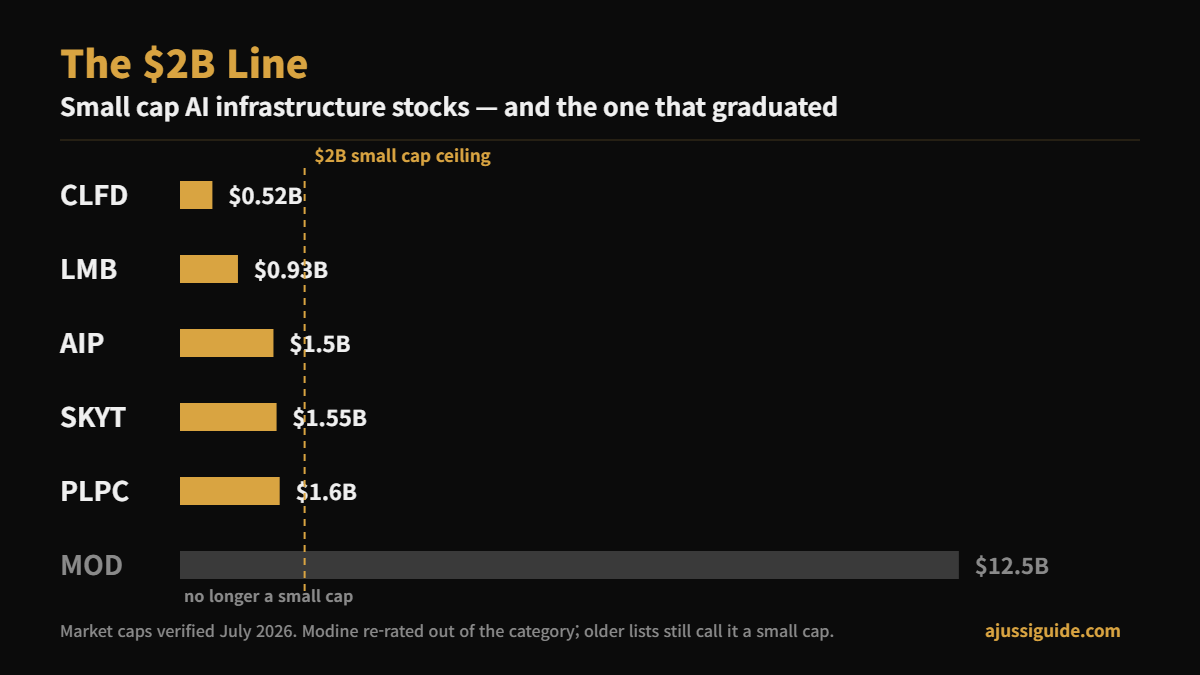
Modine Manufacturing (MOD) still shows up on published lists as a “small-cap pure play” in data center cooling. It is not. Modine now carries a market cap in the $12 to $13 billion range as of July 2026. The data center pivot worked. The stock re-rated. It outgrew the category, and the lists never got updated.
NV5 Global is worse. It appears on older infrastructure lists as a small cap engineering play. It was acquired and delisted in August 2025. You cannot buy it. Photronics (PLAB), another regular on these lists at “under $1 billion,” now sits around $2.65 billion.
None of those are typos. They are what happens when a list written eighteen months ago gets recycled. If a screen for small cap AI infrastructure stocks does not tell you when the market caps were checked, treat it with caution and verify the numbers yourself before relying on it.
How I Screened These Small Cap AI Infrastructure Stocks
My rules for this list were deliberately boring:
- Market cap under $2 billion, verified in July 2026. That is the conventional small cap ceiling, and I applied it strictly rather than stretching to “small-to-mid” to make the list longer.
- US-listed and currently trading. No delisted names, no ADRs of foreign parents.
- Revenue tied to physical AI buildout — power, cooling, connectivity, or chip enablement. Not AI software, not AI branding.
That screen is why this list has five names and not twenty. Most of the companies people file under small cap AI infrastructure stocks are either software companies wearing an infrastructure label, or they are no longer small caps. You can pull current filings yourself through SEC EDGAR full-text search if you want to check my work — and you should.
The AI Infrastructure Stack
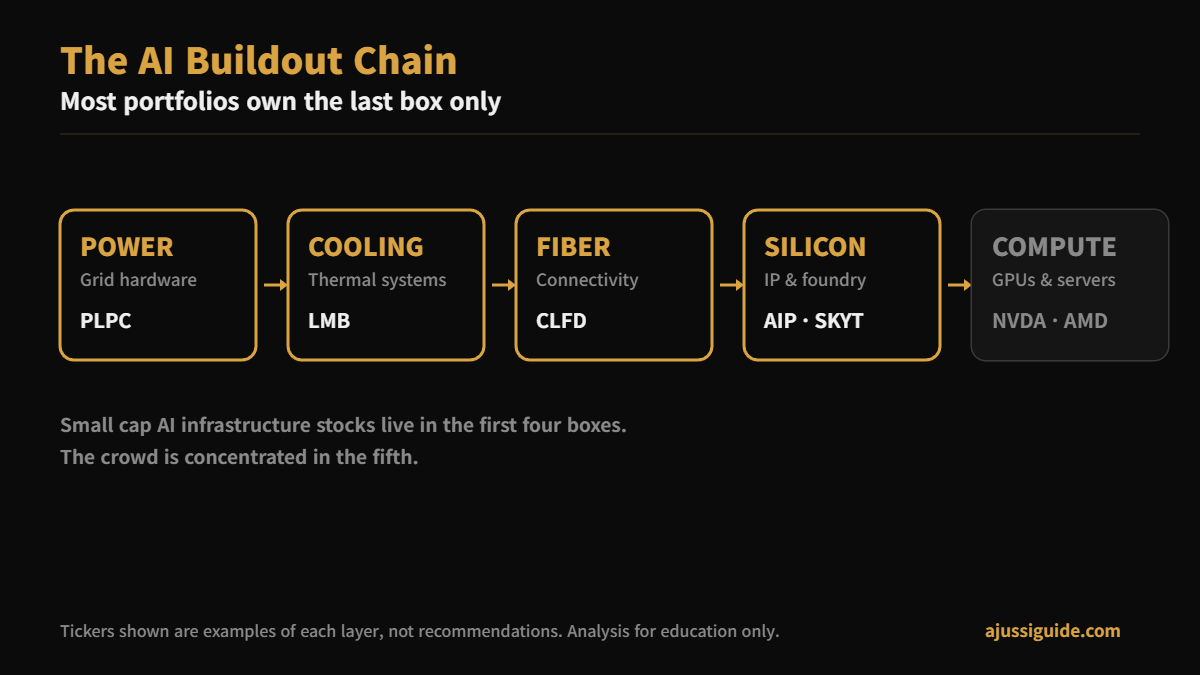
⚡ Power — grid hardware that feeds the campus · PLPC
💧 Cooling — thermal and mechanical systems · LMB
🌐 Fiber — connectivity between racks and buildings · CLFD
🧠 Silicon IP — the wiring inside custom accelerators · AIP
🏭 Manufacturing — specialty foundry capacity · SKYT
Compute sits on top of all five. Most retail portfolios own only that top layer.
The Four Infrastructure Pillars Behind Small Cap AI Infrastructure Stocks
1. Power Delivery and Grid Hardware
Before compute, electricity. Before electricity, the hardware that moves it — connectors, splices, cable anchoring, protective fittings. Unglamorous, consumable, and required at every substation and transmission line feeding a new campus.
Preformed Line Products (PLPC), roughly $1.5 to $1.7 billion, makes exactly that. It is not an AI company and does not pretend to be. Utility capital spending drives it, and data center load growth is one input among several. That diversification cuts both ways: less torque on an AI narrative, but the business does not evaporate if one hyperscaler trims capex.
2. Cooling and Thermal Systems
Dense AI racks generate heat that traditional air cooling cannot remove economically. That is why liquid cooling has gone from niche to planning assumption. MarketsandMarkets sizes the data center liquid cooling market at roughly $4 billion in 2026 with a path to the high twenties of billions by 2033 — a growth rate that has already attracted strategic buyers.
Limbach Holdings (LMB), around $925 million, is the mechanical systems contractor angle rather than the equipment manufacturer angle. It designs, installs and maintains HVAC and mechanical infrastructure for large facilities. The exposure here is not a story — it is in the numbers. On the Q1 2026 earnings call the company put the data center vertical at roughly 27% of bookings, including a single contract worth more than $30 million, with a 1.5x book-to-bill ratio driven by that demand. Read that carefully: 27% of bookings, not of revenue. Bookings convert to revenue later, and some do not convert at all. Services work is stickier than equipment sales, which I like. Project concentration is the offsetting risk.
3. Fiber and Connectivity
AI clusters move enormous volumes of data between racks and between buildings. Every one of those paths is physical fiber terminating in a physical enclosure.
Clearfield (CLFD), roughly $435 to $595 million, is the genuine small cap in this group — fiber management and connectivity products for broadband and data center operators. It is also the most volatile business here. Clearfield went through a brutal inventory correction when its customers over-ordered and then stopped, and revenue has been lumpy since. That is the price of being this small and this exposed to one product cycle.
4. Custom Silicon Enablement
Hyperscalers designing their own accelerators do not build every block from scratch. They license interconnect IP and rely on specialty foundries for parts that leading-edge fabs will not prioritize.
Arteris (AIP), about $1.4 to $1.6 billion, licenses network-on-chip interconnect IP — the internal wiring of a complex chip. It gets paid on licenses and royalties rather than on wafer volume, which makes revenue lumpier but margins structurally attractive.
SkyWater Technology (SKYT), about $1.5 to $1.6 billion, is a US specialty foundry. It does not compete at the bleeding edge. It makes the sensors, analog and specialty parts that surround the accelerator. Customer concentration is real and should be read straight from the filings.
Small Cap AI Infrastructure Stocks: 2026 Comparison Table
| Company | Ticker | Role in AI Buildout | Market Cap (Jul 2026) | Key Risk |
|---|---|---|---|---|
| Preformed Line Products | PLPC | Power / Grid Hardware | ~$1.5-1.7B | Utility capex cycles, not AI-driven |
| Limbach Holdings | LMB | Cooling / Mechanical Systems | ~$925M | Project concentration, labor costs |
| Clearfield | CLFD | Fiber / Connectivity | ~$435-595M | Severe inventory cycle volatility |
| Arteris | AIP | Custom Silicon IP | ~$1.4-1.6B | Lumpy licensing revenue |
| SkyWater Technology | SKYT | Specialty Foundry | ~$1.5-1.6B | Customer concentration |
What Could Go Wrong – And I Mean Really Wrong
I would rather give the downside its own section than bury it.
Capex is a decision, not a law. Hyperscaler spending is running hot, but these are discretionary budgets. Every one of these companies would be hit harder than Nvidia if guidance gets trimmed, because they have less pricing power and thinner customer lists.
Liquidity is thin. A $500 million company trades very differently from a $500 billion one. Spreads widen, and exits in a panic are expensive. Position sizing matters more here than stock picking.
Some of these are not AI stories yet. PLPC in particular sells mostly into ordinary utility work. If you buy it expecting an AI multiple, you may be waiting a long time.
Category drift is guaranteed. If the thesis works, the winners stop being small caps — exactly what happened to Modine. That is a good problem, but it means this list has a shelf life.
How I Size Positions in Small Cap AI Infrastructure Stocks
I treat small cap AI infrastructure stocks as a satellite allocation, not a core holding. In practice that means a smaller position than I would take in a large cap, spread across pillars rather than concentrated in one, and sized so that a 40% drawdown in any single name is annoying rather than damaging. A broad small cap index such as the Russell 2000 is the honest benchmark — if the basket cannot beat that, the extra work was not worth it.
Frequently Asked Questions
What is the best small cap AI stock?
There is no single best one, and anyone naming one without stating their screen is selling you something. Within infrastructure specifically, Clearfield (CLFD) is the purest small cap by market cap, while Arteris (AIP) has the most attractive margin structure. Different risks, different roles in a portfolio.
What are the 5 AI infrastructure stocks?
The five in this screen are PLPC, LMB, CLFD, AIP and SKYT — chosen because each sits in a different infrastructure layer and each traded under a $2 billion market cap in July 2026. Large cap AI infrastructure names such as Vertiv or Eaton do similar work at far greater scale.
What are the top 3 AI stocks to invest in?
That depends entirely on what you already own and what risk you can tolerate, so I will not rank three names as universal picks. If your portfolio is already heavy in chips and hyperscalers, the useful question is not which AI stock to add but which layer of the buildout you have no exposure to at all.
What AI infrastructure should I invest in?
Start by mapping the chain: power, cooling, connectivity, silicon enablement, then compute. Most retail portfolios own compute and nothing else. The layers underneath are where valuations are less stretched, and where small cap AI infrastructure stocks actually live.
Ajussi’s Final Word
The AI buildout is real and physical. Somebody has to move the power, remove the heat, run the fiber and design the chips. Those companies exist, most of them are boring, and a handful are still small enough that the crowd has not arrived.
But be honest about what you are buying. These are small, volatile companies with concentrated customers, and the category itself will keep changing as winners graduate out of it. Check the market caps yourself before you act on any list — including this one. Mine was accurate in July 2026 and will not stay that way.
AI does not run on hype. It runs on power, cooling, fiber and silicon. Somebody has to supply all four, and the small cap AI infrastructure stocks in this screen are five ways to own that work while the companies doing it are still small enough to matter to a portfolio like yours.
Analysis for education only, not investment advice. Do your own research.