Data center water stocks are quietly becoming one of the most compelling infrastructure plays of the AI era — and most retail investors haven’t even looked up from their Nvidia charts long enough to notice. I’m Ajussi, and I’ve been around long enough to know that the picks-and-shovels angle almost always outlasts the headline darling. Today, water might be the shovel nobody’s talking about.
Why AI Data Centers Are Draining the Planet’s Water
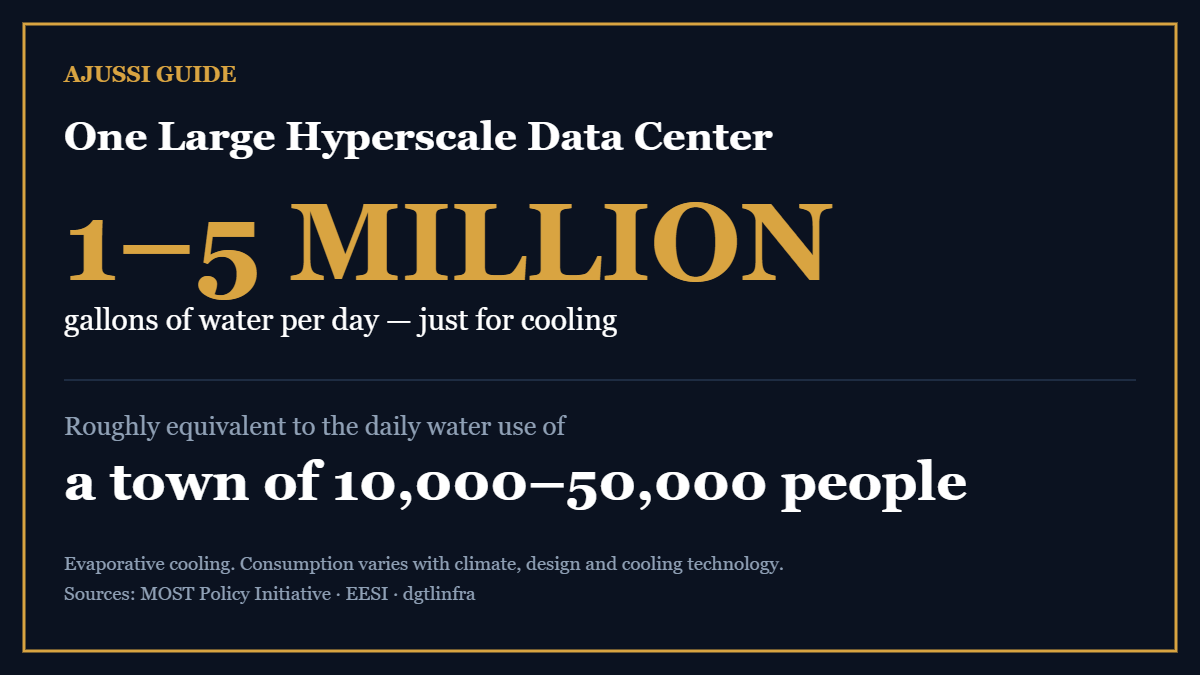
Let me paint you a picture. A large hyperscale data center can consume anywhere from 1 to 5 million gallons of water per day just for cooling. That’s not a typo. We’re talking Olympic swimming pools, plural, every single day.
The reason is simple physics. Chips generate heat. Cooling systems — mostly evaporative cooling towers — use water to pull that heat away. The more compute you run, the more heat, the more water. AI workloads are far more energy-intensive than traditional web serving, so the water bill scales up hard.
Water availability is becoming a first-order planning issue as AI infrastructure expands, particularly in water-stressed regions where large hyperscale campuses are being developed. Governments, utilities, and operators are all paying closer attention to how cooling demand affects local water resources. The IEA’s Energy and AI report lays out the scale of the data center buildout driving that demand.
The Investment Angle: Who Profits From Data Center Water Demand?
Here’s where I want you to think like a veteran, not a speculator. The companies that benefit from AI data center water demand fall into three broad buckets: water utilities, water technology firms, and industrial cooling equipment makers. Each has a different risk/reward profile.
1. Water Utilities With Data Center Exposure
Regulated water utilities are the boring-but-beautiful play. They supply the actual water, often under long-term contracts with data center operators. Their revenues are predictable, their dividends are reliable, and when AI capex spending booms, their volume goes up.
American Water Works (AWK) is the largest publicly traded U.S. water utility. It is not a pure data-center play, but its broad commercial and industrial customer base makes it a reasonable way to take indirect exposure to long-term infrastructure growth. It’s not a pure-play, but the scale and dividend history make it a sensible anchor position for conservative investors.
Essential Utilities (WTRG) serves parts of Pennsylvania and Ohio where data center development is expanding. Smaller than AWK, but with solid regulated returns and a decent yield.
2. Water Technology and Treatment Companies
This is where it gets more interesting for growth-oriented investors. Data centers don’t just use water — they need to treat, recycle, and discharge it under strict environmental rules. Companies that make water treatment systems, filtration equipment, and monitoring technology are seeing rising demand from this sector.
Xylem (XYL) is my go-to name here. They make pumps, sensors, and water analytics software used in industrial applications including large commercial facilities. Their digital water solutions segment is growing fast, and data center clients are a natural fit. Check their investor relations page at xylem.com for the latest segment breakdowns.
Veolia Environnement (listed in Paris, ADR available) is the global giant in water and wastewater management. They operate water systems for industrial campuses around the world. Not a pure US play, but worth knowing.
Watts Water Technologies (WTS) makes flow control and water quality products used in commercial buildings and industrial facilities. Smaller cap, but direct exposure to the plumbing and treatment infrastructure that data centers depend on.
3. Cooling Equipment Manufacturers
Water doesn’t cool itself — it needs engineered systems. Cooling towers, chillers, and liquid cooling infrastructure are a big sub-sector within data center water stocks that retail investors often overlook entirely.
Vertiv Holdings (VRT) makes thermal management and power systems specifically for data centers. They are one of the most direct ways to play data center cooling infrastructure as a public equity. Their liquid cooling product line is expanding rapidly with AI GPU clusters in mind.
Eaton Corporation (ETN) makes power management and cooling systems used in data centers. Not a pure water play, but its liquid-cooling and power-management solutions are increasingly deployed alongside modern AI data-center infrastructure.
Data Center Water Stocks Comparison Table
| Company | Ticker | Bucket | Data Center Angle | Dividend? |
|---|---|---|---|---|
| American Water Works | AWK | Water Utility | Water supply to industrial/commercial users | Yes |
| Essential Utilities | WTRG | Water Utility | Regional utility serving growing data center corridors | Yes |
| Xylem | XYL | Water Technology | Pumps, sensors, digital water management systems | Yes |
| Watts Water Technologies | WTS | Water Technology | Flow control, water quality for commercial facilities | Yes |
| Vertiv Holdings | VRT | Cooling Equipment | Liquid cooling and thermal management for AI data centers | No |
| Eaton Corporation | ETN | Cooling Equipment | Power and thermal systems for hyperscale facilities | Yes |
Will Closed-Loop Cooling Reduce Demand for Data Center Water Stocks?
This is the single biggest risk to the thesis, so I’d rather give it its own section than bury it in a bullet list. The industry is actively developing air cooling, immersion cooling, and closed-loop liquid cooling. Industry estimates put air-cooled and adiabatic designs at roughly 6 to 30 times less water consumption than traditional evaporative cooling. If those designs become standard faster than expected, the water intensity of AI computing could actually decline — good for the planet, potentially less good for water utilities banking on volume growth.
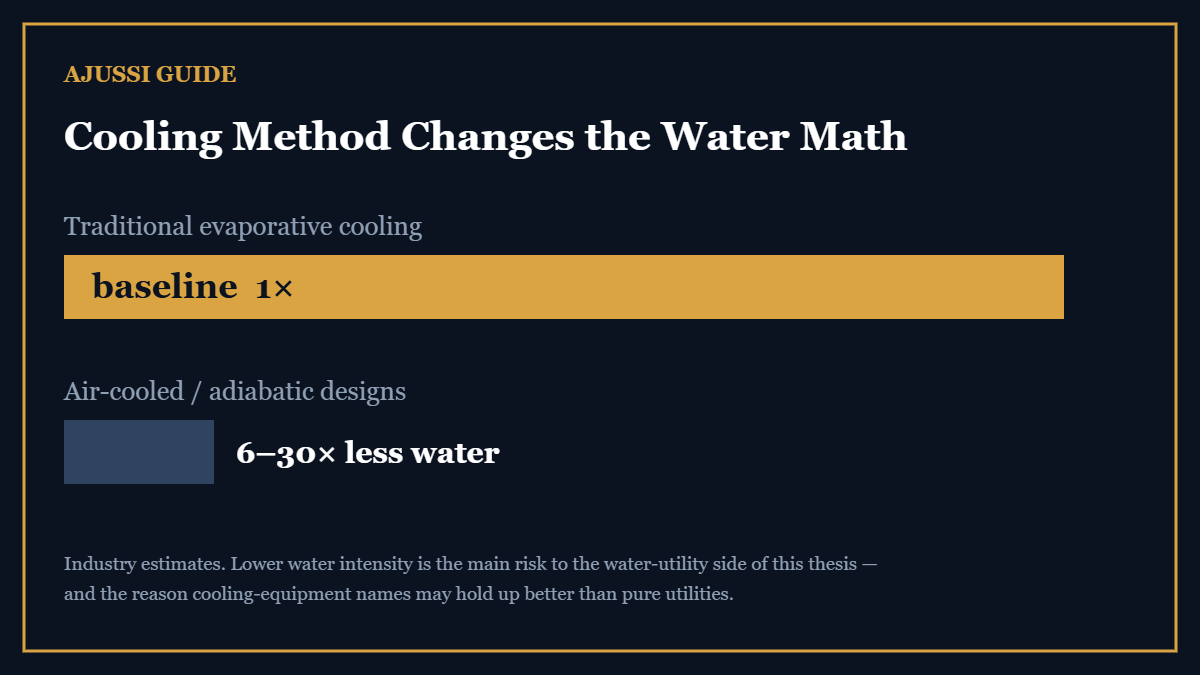
My honest read: this doesn’t kill the case for data center water stocks, but it changes which bucket you want to own. Cooling equipment makers get paid either way, because somebody has to build the closed-loop systems. Pure water utilities carry more of this risk.
Risks Ajussi Wants You to Take Seriously
I’m not here to sell you a fairy tale. Data center water stocks come with real risks and you should size your positions accordingly.
Regulatory backlash is real. Several US states and municipalities are already pushing back on data center water permits. Arizona, in particular, has tightened water allocation rules. If regulators start capping data center water use, demand growth for some of these plays gets constrained.
Utility valuations are rate-sensitive. Water utilities tend to carry moderate debt loads and their stocks trade like long-duration bonds. When interest rates stay elevated, utility valuations get compressed. Don’t ignore the macro context.
Valuation already pricing in optimism. Vertiv has had a massive run. Some of these data center water stocks have already re-rated significantly. Do your homework on entry points — buying a great theme at a terrible price is still a bad trade.
Ajussi’s Take: How I’d Position This
If I’m building a water-and-AI basket today, I anchor it with a regulated utility like AWK for stability and yield. I add Xylem for the technology growth angle. And I keep a smaller allocation in Vertiv for direct data center cooling exposure, knowing the volatility is higher.
The meta-thesis here is simple: AI needs compute, compute needs power, power generates heat, heat needs cooling, cooling needs water. That chain of dependencies is structural, not cyclical. AI infrastructure will keep requiring large-scale thermal management, although the amount of freshwater consumed per unit of compute may decline as cooling technology evolves. The question is which companies are best positioned to supply, treat, and manage it profitably.
Data center water stocks won’t make you rich overnight the way a well-timed Nvidia trade might. But in five years, when water stress from AI infrastructure is front-page news, you’ll be glad you planted the seed early. That’s how experienced investors build durable wealth — not by chasing, but by positioning before the crowd arrives.
Frequently Asked Questions
Q: How much water does an AI data center actually use?
A: It varies significantly by size, location, and cooling technology. Water consumption varies widely depending on cooling technology, climate, and facility design. Large hyperscale campuses may consume millions of gallons per day, while facilities using closed-loop or advanced cooling designs can require significantly less freshwater.
Q: Are data center water stocks a good long-term investment because of AI?
A: The structural demand case is credible — AI compute growth is real and water-intensive cooling is currently the dominant method. However, long-term returns depend on your entry price, regulatory environment, and whether alternative cooling technologies reduce water intensity faster than expected. No investment is guaranteed. Do your own research and consider your time horizon.
Q: Is there an ETF that covers data center water stocks?
A: There are broad water-focused ETFs such as the Invesco Water Resources ETF (PHO) and the First Trust Water ETF (FIW) that hold baskets of water utilities and technology companies. These include names like AWK, XYL, and WTS. They’re not pure-play AI data center water funds, but they offer diversified exposure to the water infrastructure theme. Check expense ratios and holdings before investing.
Disclaimer: This article is for informational purposes only and is not financial advice. Do your own research.
Water is one branch of the cooling layer. For the full picture of how heat leaves an AI rack and which listed companies sit on each branch, see our liquid cooling stocks guide.