Data center construction stocks are one of the most misunderstood corners of the AI trade. Search the term and you mostly get data center REITs or chip equipment makers — two completely different businesses. The companies that actually pour the concrete, pull the conduit and commission the electrical rooms rarely make those lists at all.
I’m Ajussi. I have watched enough cycles to know that the physical backbone of a boom is usually the last place retail money looks. The dot-com era had fiber. The shale era had pressure pumping. The AI era has buildings, substations and cooling loops — and a handful of listed engineering and construction firms whose order books have swollen because of it.
So this article does something the usual data center construction stocks lists do not. Instead of ranking names, it goes to the filings. Every figure below comes from a company’s own quarterly report to the SEC, with the as-of date attached — because in this sector the headline numbers are easy to misread, and most articles misread them.
What data center construction stocks actually are
There are three separate families of companies that get lumped together, and mixing them up leads to bad comparisons.
Data center REITs — Equinix (EQIX), Digital Realty (DLR) — own and lease the finished facilities. They earn recurring rent. Real estate valuation frameworks apply: funds from operations, lease escalators, cost of capital.
Semiconductor and equipment suppliers — the chip and hardware names — sell what goes into the racks. Their cycle follows silicon, not construction schedules.
Engineering and construction firms — the actual subject here — win contracts to design, build and fit out the facility. They earn project revenue recognized over time, and their forward visibility shows up as remaining performance obligations. This is the group almost nobody covers properly, which is exactly why it is worth understanding.
The four layers of a data center build
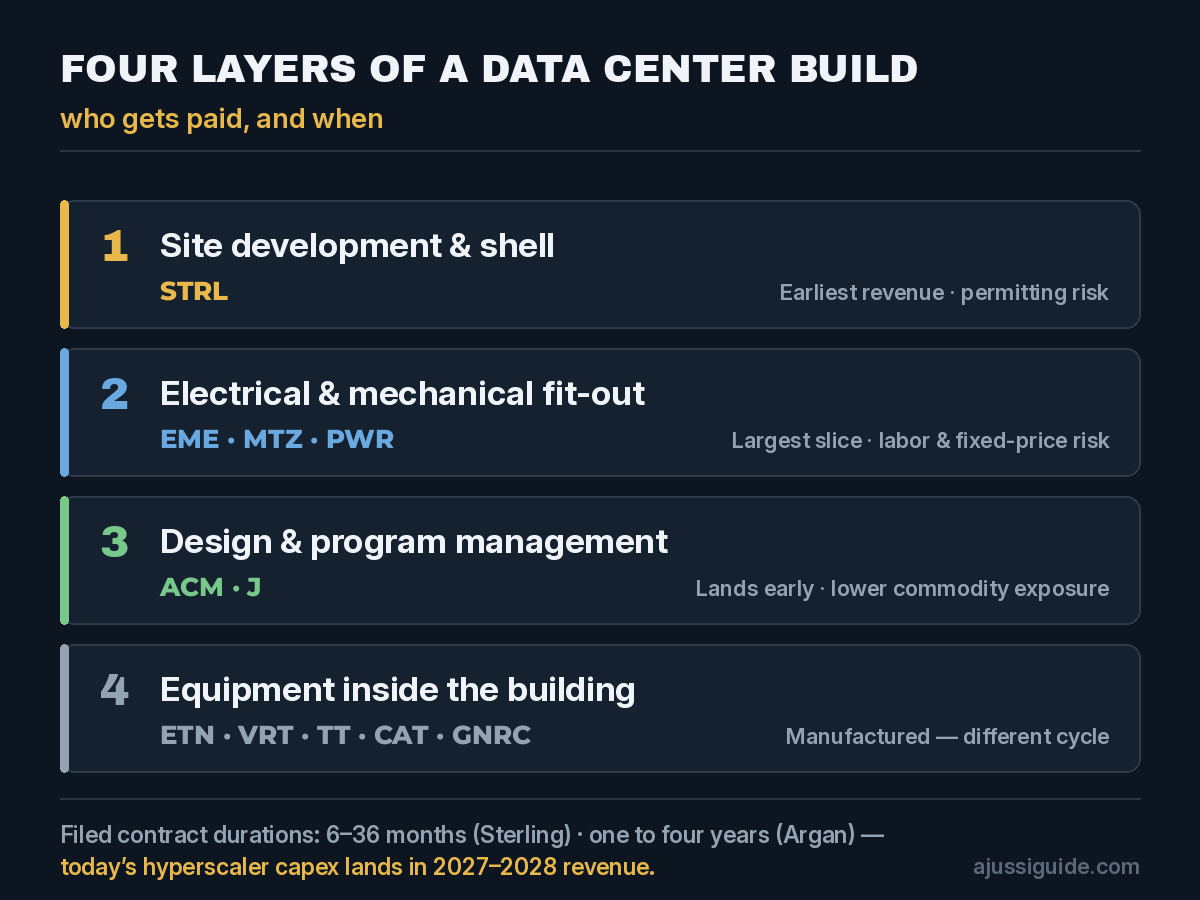
A hyperscale campus is not one contract. It is a stack of them, awarded at different times to different specialists. Knowing which layer a company sits in tells you when its revenue arrives and what can delay it. Most data center construction stocks sit in only one or two of these layers, not all four.
Layer 1: Site development and the shell
Before anything else, someone clears and grades the land, lays utilities and builds the structure. Sterling Infrastructure (STRL) groups this work into its E-Infrastructure segment, which covers site development for data centers and other mission-critical facilities. Among data center construction stocks this is the earliest revenue in the chain, and the most sensitive to permitting.
Layer 2: Electrical and mechanical fit-out
This is the largest and least glamorous slice of the data center construction stocks universe. EMCOR Group (EME) is a specialty contractor whose two biggest reporting segments are United States mechanical construction and United States electrical construction — piping, ductwork, conduit, switchgear installation, controls. MasTec (MTZ) covers heavy civil and utility infrastructure including the power delivery work that gets a campus energized. Quanta Services (PWR) specializes in high-voltage electrical contracting at the grid connection point.
Layer 3: Design and program management
Large campuses need engineering, permitting support and program management across multiple sites. AECOM (ACM) and Jacobs Solutions (J) are the two big listed names here. Their revenue per project is smaller than a builder’s, but it lands earlier in the cycle and is less exposed to commodity and labor cost swings.
Layer 4: The equipment that goes inside
Transformers, switchgear, UPS systems, chillers and generators are manufactured rather than constructed — Eaton (ETN), Vertiv (VRT), Trane Technologies (TT), Caterpillar (CAT), Generac (GNRC). Different margin structure, different cycle. I treat them as a separate theme rather than folding them in here: see the deeper breakdowns of AI power infrastructure stocks, data center liquid cooling suppliers and nuclear and grid names.
One power-adjacent builder deserves its own mention. Argan (AGX), through its subsidiary Gemma Power Systems, is an engineering and construction firm for power generation facilities. It does not build data centers — it builds the plants that feed the grid those data centers draw from. Useful exposure, but a different contract cycle.
Data center construction stocks: what the filings actually show
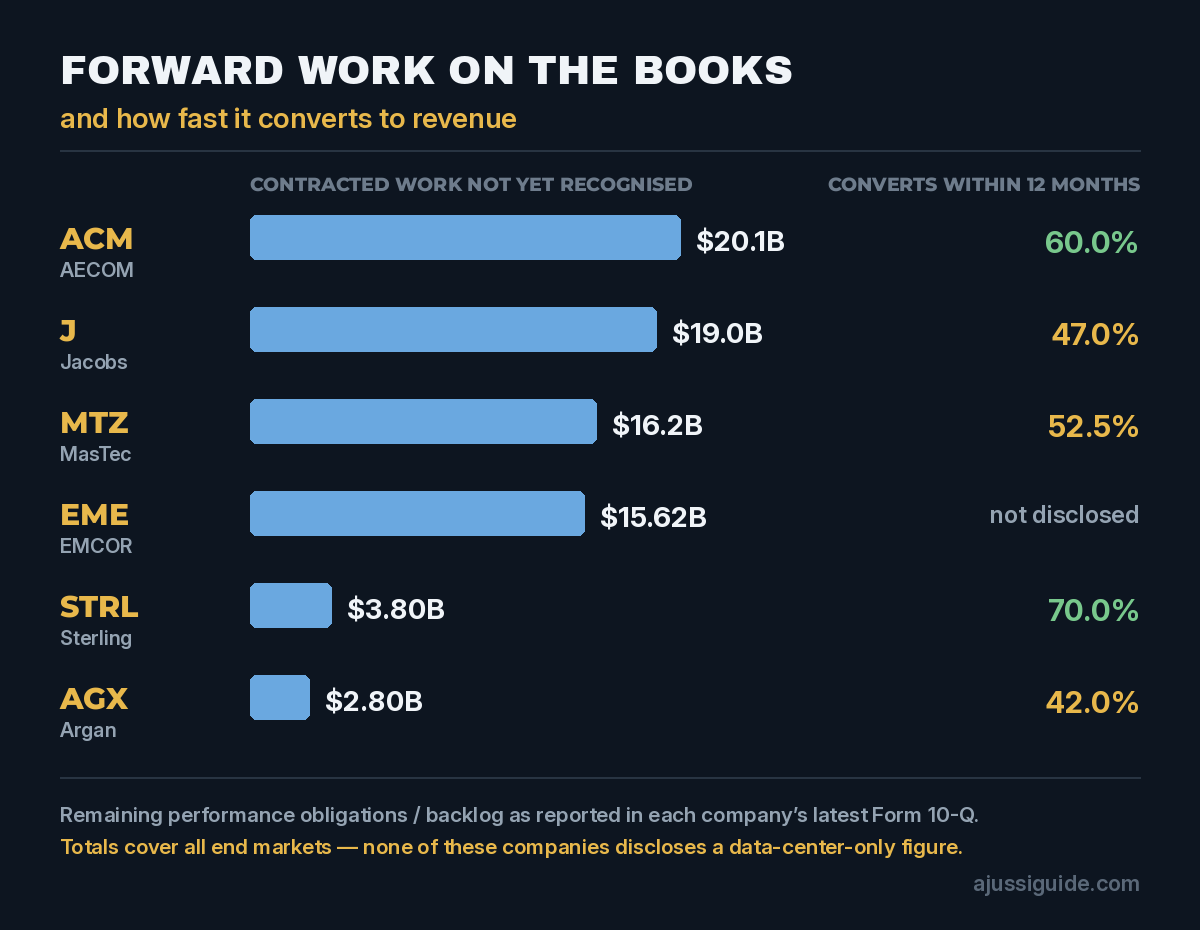
Here is the forward-work disclosure from each company’s most recent quarterly report. Read the as-of dates carefully — these companies do not share a fiscal calendar.
| Company | Ticker | Role in the build | Forward work disclosed | As of |
|---|---|---|---|---|
| EMCOR Group | EME | Mechanical & electrical fit-out | RPO $15.62B (US mechanical 55%, US electrical 36%) | Mar 31, 2026 |
| MasTec | MTZ | Heavy civil, power delivery | RPO $16.2B; ~$8.5B (52.5%) expected in 2026 revenue | Mar 31, 2026 |
| AECOM | ACM | Design, engineering, program management | $20.1B allocated to unsatisfied performance obligations; ~60% within 12 months | Mar 31, 2026 |
| Jacobs Solutions | J | Design, program management | RPO ~$19.0B; ~47% within 12 months | Mar 27, 2026 |
| Sterling Infrastructure | STRL | Site development (E-Infrastructure) | Backlog $3.80B, up from $3.01B at Dec 31, 2025; combined $5.15B including unsigned awards; ~70% within 12 months | Mar 31, 2026 |
| Argan | AGX | Power plant EPC (grid-adjacent) | RUPO $2.8B; ~42% within 12 months | Apr 30, 2026 |
Primary sources for every row above, if you want to check them yourself: EMCOR, MasTec, AECOM, Jacobs, Sterling and Argan — all Form 10-Q. Reading the revenue-recognition note takes ten minutes and is more useful than any summary of it.
Why “backlog” is the wrong word for most of these companies
This is where most coverage of data center construction stocks goes wrong, and it is worth slowing down for. Three disclosure traps show up again and again.
Remaining performance obligations is an accounting term, not a marketing one. It captures contracted revenue not yet recognized, under a specific standard, with defined inclusion rules. EMCOR, MasTec, Jacobs and Argan headline RPO or RUPO. Backlog, by contrast, is a company-defined measure. When a press release says “backlog” and the filing says “RPO”, you are often looking at two different numbers for the same business.
Signed is not the same as expected. Sterling’s filing shows $3.80 billion of backlog and a combined $5.15 billion that includes unsigned awards and future project phases. Both are legitimate disclosures. Quoting the larger one without the qualifier inflates the company by 36%.
Guidance often is not in the 10-Q at all. I checked: Sterling’s quarterly report for the period ended March 31, 2026 contains no full-year revenue guidance. Guidance lives in press releases and 8-Ks. If two articles quote different guidance ranges for the same company, at least one of them is quoting a superseded press release.
The fiscal calendars do not line up. AECOM and Jacobs both label a calendar first-quarter period as fiscal Q2 2026. Argan’s quarter ended April 30, 2026 is its fiscal Q1 2027. Comparing “Q1” across this group without checking the period end date produces nonsense. I ran into the same trap building the hyperscaler capex tracker, where one company’s fiscal year forced a calendar-year restatement before the comparison meant anything.
How much of that work is data centers? Nobody tells you
Here is the honest limit of this analysis, and I would rather state it plainly than paper over it.
Not one of these companies reports a “data center revenue” line. EMCOR segments by trade and geography. MasTec segments by end market — communications, power delivery, pipeline, clean energy — none of which is “data centers”. Sterling’s E-Infrastructure segment is the closest thing to a proxy in the group, and even that includes non-data-center mission-critical work.
Data center construction stocks are routinely marketed as AI plays, but when you read that a company is “an AI data center play”, that is an interpretation, not a disclosure. A $16 billion RPO tells you the company has contracted work. It does not tell you how much of it depends on hyperscaler capex continuing. Anyone quoting a precise data center percentage for these names is estimating, whether or not they say so.
That gap is why I built the AI infrastructure exposure checker — to make the estimate explicit and visible rather than buried in a narrative.
The demand signal sitting behind those order books
The reason these order books grew is electricity, and the scale is documented. According to the IEA’s Energy and AI report, global data center electricity consumption was around 415 TWh in 2024 and is set to reach roughly 945 TWh by 2030 in its Base Case, with the range across the IEA’s scenarios spanning 700 to 1,700 TWh by 2035.
Every one of those terawatt-hours needs a building to arrive in, a substation to arrive through and a cooling system to carry the heat away. That is construction work, and it is contracted years before the load shows up — which is why the order books at data center construction stocks lead the electricity demand rather than following it.
The cycle length matters more than most people treat it, and the filings put their own numbers on it. Sterling states that the contracts in its backlog are “typically completed in 6 to 36 months”, while Argan describes its EPC work as having “typical performance durations of one to four years”. Either way, capex announced today lands in these companies’ revenue in 2027 and 2028 — not next quarter. Anyone trading these names on a hyperscaler headline is trading a signal that will take years to show up in the numbers.
Risks you cannot ignore
Data center construction stocks carry a specific set of risks that differ from the equipment names, and four of them deserve attention.
Hyperscaler spending can pause. Cloud capex decelerated in 2022 and 2023 when enterprise customers pulled back, and order books across the supply chain felt it. If AI monetization disappoints, the same mechanism applies with more force, because the capex commitments are far larger this time.
Grid interconnection is the real bottleneck. Multi-year waits for utility interconnection are common in the US. A project announced today may not break ground for years, which stretches the revenue cycle and makes reported forward work harder to convert on schedule.
Long-duration equipment lead times cut both ways. Scarce large power transformers and specialty cooling equipment support supplier pricing, but they also cause slippage for the contractor waiting on delivery. The same shortage that helps a manufacturer’s margin can push a builder’s revenue into a later quarter.
Labor and fixed-price exposure. Specialty trade labor is scarce in the metros where these campuses cluster. On fixed-price contracts, wage inflation lands on the contractor, not the customer.
Concentration risk on both sides. A small number of hyperscalers award a large share of this work. Customer concentration cuts both ways — it delivers scale, and it means one budget decision can move a quarter.
What Ajussi actually watches here
I am not going to tell you what percentage of a portfolio belongs in this sector, or when to buy. That depends on circumstances I know nothing about, and anyone who gives you a number without knowing them is guessing on your behalf.
What I do watch across data center construction stocks is narrower and checkable. Is forward work growing quarter over quarter, or just being restated? Is the company converting it — revenue rising alongside RPO, rather than RPO rising while revenue stalls? Are margins holding as mix shifts toward larger and more complex projects, which is where contractors historically get hurt? And is the growth organic or acquired, because an acquisition can lift reported backlog without telling you anything about underlying demand.
Those four questions can be answered from the filings every quarter. That is the whole appeal of data center construction stocks as a research subject: the disclosure is unusually concrete, if you are willing to read it.
Frequently asked questions
What are the best data center stocks to invest in?
There is no single answer, and this site does not publish buy lists. What helps is separating the three families first: REITs that own finished facilities and earn rent, equipment makers that supply what goes inside, and engineering and construction firms that build the sites. They respond to different drivers and carry different risks, so comparing them on the same multiple is a mistake. Decide which layer you actually want exposure to before you look at any individual name, because data center construction stocks and data center REITs answer completely different questions.
Who are the largest data center construction companies?
Among US-listed firms, the largest forward order books in this space belong to AECOM (about $20.1 billion allocated to unsatisfied performance obligations as of March 31, 2026), Jacobs Solutions (about $19.0 billion as of March 27, 2026), MasTec ($16.2 billion as of March 31, 2026) and EMCOR Group ($15.62 billion as of March 31, 2026). Sterling Infrastructure is smaller at $3.80 billion but more concentrated in site development for data centers. Note that none of these totals is data-center-only — they include all end markets.
How to invest in data center construction?
The direct route is owning shares in the listed engineering, construction and specialty contracting firms doing the work — the data center construction stocks covered above. The indirect routes are diversified infrastructure or industrial funds, which dilute the theme but also dilute single-project risk. Either way, the practical work is the same: read the revenue-recognition note in the latest 10-Q, check whether forward work is converting into revenue, and confirm the fiscal period you are comparing.
Are data center construction stocks the same as data center REITs?
No, and the distinction matters. REITs such as Equinix and Digital Realty own and operate facilities and collect lease revenue. Construction and engineering firms earn project-based revenue recognized over time as work is performed. One is a real estate business valued on rental cash flow; the other is an industrial services business valued on contract execution and margin. Different frameworks entirely.
What does remaining performance obligation mean for these companies?
Remaining performance obligations, or RPO, is contracted revenue the company has not yet recognized. It is defined by accounting standards, which makes it more comparable across companies than “backlog”, a company-defined measure that can include work not yet under contract. Filings also disclose how much of RPO is expected to convert within twelve months — roughly 70% for Sterling, 60% for AECOM, 47% for Jacobs and 42% for Argan on their latest reported dates. That conversion rate tells you how quickly the order book becomes revenue.
Is it too late to invest in data center construction stocks in 2026?
That question cannot be answered generically, and the honest response is that it depends on the individual name and on what is already priced in. What the filings do show is that contracted work at these companies rose through the first half of 2026 and that a meaningful share of it is scheduled to convert beyond the next twelve months. That describes a demand cycle with time left on the clock. It says nothing about whether any given share price already reflects it.
What is the biggest catalyst to watch for this sector in 2026?
Hyperscaler capital expenditure guidance, updated each quarter on earnings calls. Because these contractors sit downstream of that spending, a raised or lowered capex outlook from the major cloud providers moves the whole chain. The second thing worth tracking is grid interconnection and permitting news in the states where campuses cluster, since that determines how fast contracted work can actually start.
Disclosure and disclaimer: this article is analysis and education, not investment advice, and it is not a recommendation to buy or sell any security. All financial figures are taken from the companies’ own SEC filings on the dates stated and may be superseded by later filings. Verify current data before making any decision. I hold no position in any company named here.