⚡ Ajussi Market Watch — July 20, 2026
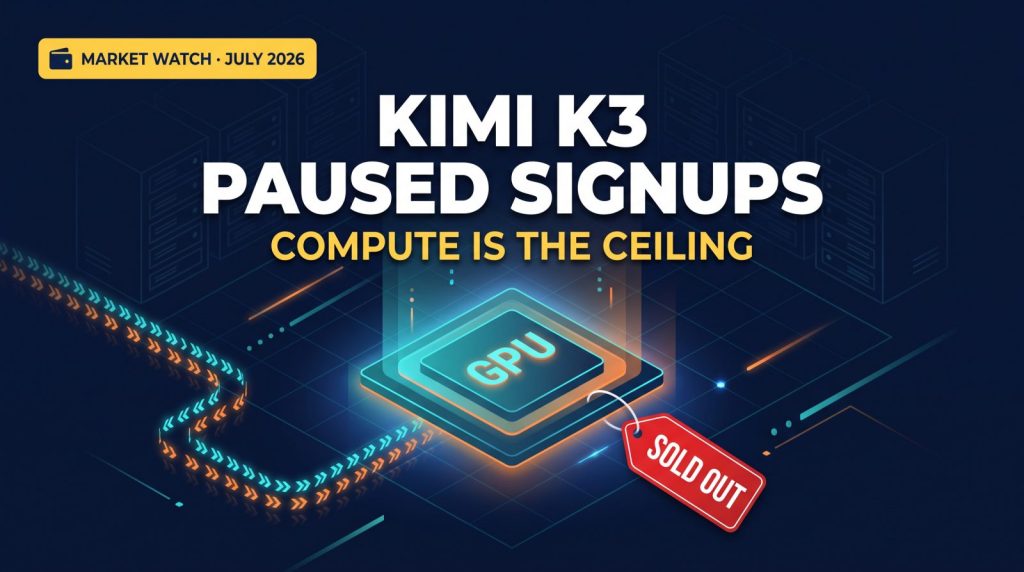
Trending now: Kimi K3 paused new signups just 48 hours after launch — Moonshot AI ran out of GPU capacity for its new frontier open-weight model.
Why this matters to us: when a hot model launch stalls on compute, the bottleneck thesis stops being a thesis. And the real constraint behind China’s AI push is HBM memory — the same supply chain we track every quarter.
What Happened: Kimi K3 Sold Out Its Compute
On July 16, Chinese AI lab Moonshot AI released Kimi K3, a 2.8-trillion-parameter open-weight model that immediately drew comparisons to top US frontier models. Demand was so heavy that within roughly 48 hours the company paused new paid signups, saying its GPU capacity could not keep up. Existing subscribers keep access, and Moonshot says it will restructure membership into two tiers as it adds capacity (Bloomberg, Pandaily).
Read that again: the product was not the ceiling. The silicon was.
Why It Matters for AI Infrastructure Investors
1. The bottleneck thesis just got a live demo. A cheap, frontier-class open model is exactly what was supposed to make AI “commoditized software.” Instead, the moment demand showed up, the limiting factor was compute — power, chips, cooling, memory. AI is an infrastructure game, and Kimi K3 proved it in two days.
2. The real constraint is HBM. China’s domestic accelerator push has die capacity — SMIC can reportedly produce around a million AI accelerator dies a year — but analysts estimate only roughly 250,000-300,000 finished chips, because domestic high-bandwidth memory (CXMT) cannot supply enough HBM (SemiAnalysis). Memory, not logic, is the choke point — which is structurally bullish for the established HBM suppliers: SK Hynix, Micron, and Samsung.
3. Open models grow the infrastructure pie. Cheaper capable models mean more inference happening in more places — and every unit of inference needs power, cooling, and memory behind it. The software getting cheaper makes the picks and shovels more valuable, not less.
The Ajussi Take
This is not a “buy something today” note — it is a data point. The bottleneck rotates: GPUs yesterday, HBM today, power and cooling tomorrow. Watch where the queue forms. That is where the pricing power lives.
Related Reading
📉 Memory Stocks Selloff: What It Means for AI Infrastructure Investors
💰 AI Capex Tracker — Who Is Spending What in 2026
💧 Liquid Cooling Suppliers: 7 Stocks Behind Nvidia’s AI Racks
Disclaimer: This article is for informational purposes only and is not financial advice. Facts and figures as of July 20, 2026. Do your own research.