AI infrastructure dividend stocks — that is the combo I keep coming back to in 2026, and if you are a US retail investor who wants income and a seat at the AI table, you need to hear what this old Korean uncle has to say.
I have been investing through the dot-com bust, the 2008 crisis, COVID — you name it. Every decade has a theme. Right now the theme is artificial intelligence, and the smart money is not just buying flashy chipmakers with no dividends. The real play? Find the companies quietly collecting rent on the AI buildout while cutting you a quarterly check.
Why AI Infrastructure Dividend Stocks Make Sense Right Now
Think about what AI actually needs to run. It needs electricity. It needs cooling. It needs fiber. It needs physical space in data centers. It needs transformers, switchgear, and backup power. These are not glamorous businesses — but they are essential, and many of them have been paying dividends for decades.
The International Energy Agency projects global data centre electricity demand rising to roughly 945 terawatt-hours by 2030 — more than double 2024 levels, and about the annual consumption of Japan. That demand has to be generated, delivered, cooled and housed by someone. Why not own the companies doing it and get paid while you wait?
This is not a speculative thesis. This is infrastructure investing with an AI tailwind. The dividend is your patience premium — and that, more than any single ticker, is the case for AI infrastructure dividend stocks.
The 7 AI Infrastructure Dividend Stocks I Actually Watch
1. Realty Income (O) — The Monthly Cheque, With a Small AI Toehold
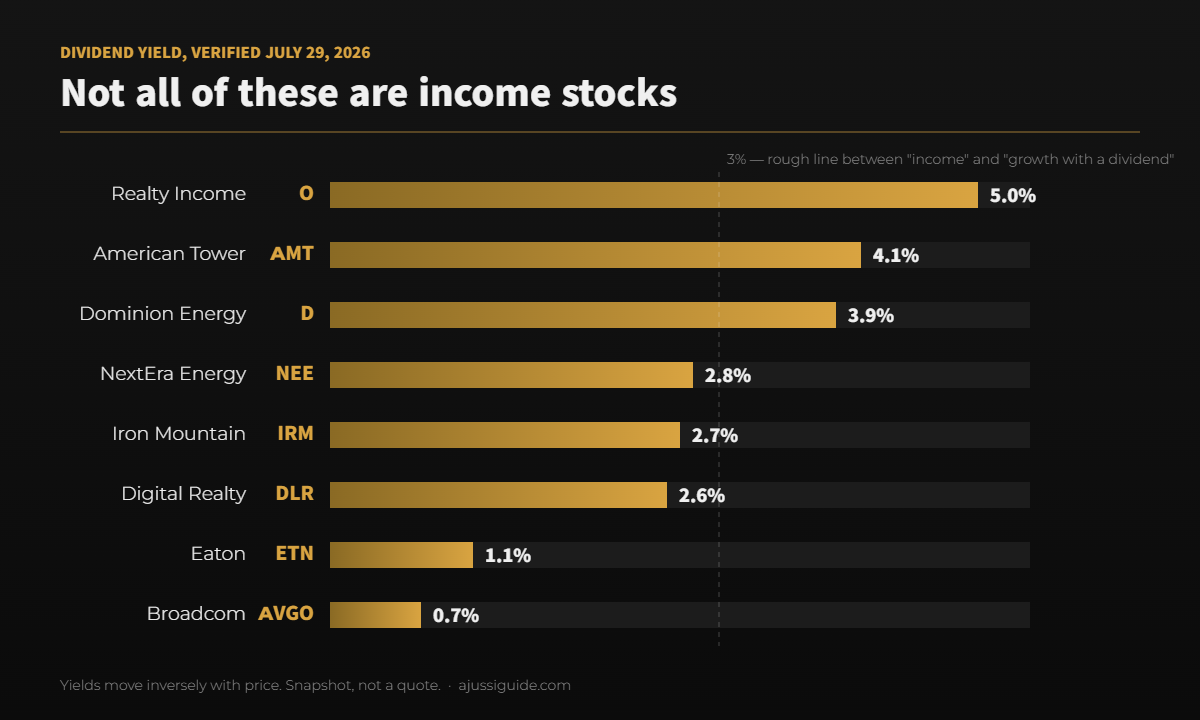
Realty Income is a net-lease REIT built on retail and industrial properties, and it is the most reliable payer on this list: monthly dividends, 670-plus consecutive months of them, and more than three decades of increases. At roughly 5.0% it also carries the highest yield here.
Be clear about what it is not. Realty Income is not a data center company. Its exposure to the theme runs through a development joint venture with Digital Realty and a broader push into industrial assets — meaningful as a signal, small as a share of rent. Own it for the monthly income and the discipline, and treat the AI angle as an option you did not pay much for, not the reason to buy.
2. American Tower (AMT) — Cell Towers Meet Edge Computing
American Tower owns and operates over 220,000 communication sites globally. As AI inference moves to the edge — meaning closer to you, on smaller regional servers — tower infrastructure becomes more critical. AMT pays a growing dividend and trades as a REIT, so it must distribute at least 90% of taxable income. That is music to an income investor’s ears.
3. Eaton Corporation (ETN) — Power Management Is the Real AI Bottleneck
You cannot run a GPU cluster without serious power management. Eaton makes electrical components — circuit breakers, UPS systems, switchgear — that every data center needs. I went through the company in detail in Eaton and the data center power trade. ETN has raised its dividend consistently and benefits directly from the surge in data center construction spending. The revenue connection is direct and durable — but at roughly 1.1%, you are buying Eaton for the earnings growth, not the cheque.
4. Digital Realty Trust (DLR) — The Data Center Landlord
If AI needs a home, Digital Realty is the landlord. They operate over 300 data centers across 50+ metros worldwide and count hyperscalers — including major cloud providers — as tenants. DLR is a REIT that pays a solid dividend, and as demand for colocation space accelerates with AI workloads, occupancy and lease rates climb. Check their latest investor relations materials at Digital Realty Investor Relations.
5. NextEra Energy (NEE) and Dominion Energy (D) — Now One Bet, Not Two
Most lists still count these as two picks. They are not. On May 18, 2026, NextEra agreed to acquire Dominion in an all-stock deal valued at roughly $67 billion, creating what would become the largest regulated electric utility in the world at about $420 billion enterprise value. Dominion holders receive 0.8138 NextEra shares per share; NextEra holders would own about 74.5% of the combined company. Both companies filed for regulatory approval on July 15, 2026 with FERC, the NRC, and the Virginia, North Carolina and South Carolina commissions. Management guided to a 12-to-18-month close [Confirmed].
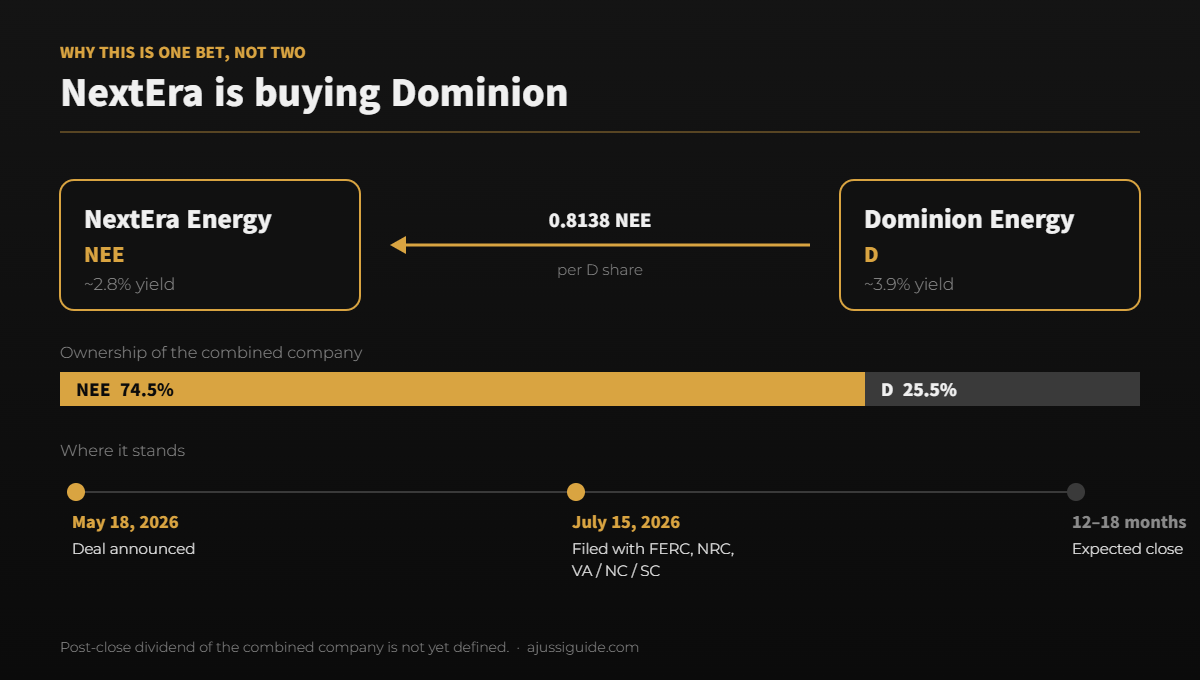
Why this matters for income investors: buying NEE and D as separate positions no longer diversifies you — it doubles you down on one balance sheet. Both boards said their existing dividend policies stay in place until the deal closes, so today’s payouts are intact, but the post-close dividend of the combined company is not yet defined [Unknown].
The strategic logic is squarely on theme. NextEra is the world’s largest wind and solar generator and has been signing long-term power purchase agreements with hyperscalers. Dominion serves Northern Virginia’s Data Center Alley, the densest concentration of data centers on earth. Generation plus the corridor that consumes it, under one roof. Whether regulators agree is the open question — and it is a real one, since Virginia regulators have to weigh what this concentration means for ratepayers.
6. Broadcom (AVGO) — Custom AI Chips, Tiny Yield, Fast Growth
Broadcom designs custom AI accelerator chips (XPUs) for major cloud companies and generates enormous free cash flow. Since acquiring VMware it has redirected cash toward dividends and buybacks, and it has raised the dividend for 15 straight years.
Be honest about the yield. At roughly 0.7%, AVGO is not an income stock — the payout has grown fast, but so has the share price, and the yield has compressed accordingly. Own it for the AI revenue mix and the dividend growth rate, not for the current check.
7. Iron Mountain (IRM) — The Boring Vault That Became a Data Center REIT
Not every AI infrastructure company builds chips or power lines. Iron Mountain spent decades storing paper records in warehouses. That legacy business still funds the company, but the growth engine is now its data center segment, which management has called the key driver — helped by AI demand, rising utilization and firmer renewal pricing. The company raised full-year 2026 guidance after its first-quarter results.
It yields about 2.7% (roughly $3.46 per share annually). What earns it a slot here is that its business overlaps least with the other six: it is neither a utility nor a chipmaker, and its records-management cash flow is largely uncorrelated with the AI cycle. That is the point of a seventh name — not more of the same, but something that behaves differently when the theme goes out of favor.
Quick Comparison: AI Infrastructure Dividend Stocks at a Glance
| Company | Ticker | Type | Dividend Yield | AI Infrastructure Angle |
|---|---|---|---|---|
| Realty Income | O | Net-lease REIT | ~5.0% | Monthly payer; small data center JV exposure |
| American Tower | AMT | Tower REIT | ~4.1% | Towers and edge compute sites |
| Digital Realty Trust | DLR | Data center REIT | ~2.6% | Colocation landlord to hyperscalers |
| Iron Mountain | IRM | REIT | ~2.7% | Records storage funding data center buildout |
| NextEra Energy | NEE | Utility | ~2.8% | Largest wind/solar generator; hyperscaler PPAs |
| Dominion Energy | D | Utility (being acquired by NEE) | ~3.9% | Serves Northern Virginia Data Center Alley |
| Eaton Corporation | ETN | Industrial | ~1.1% | Data center power distribution and management |
| Broadcom | AVGO | Semiconductor | ~0.7% | Custom AI accelerators (XPUs) |
Yields verified July 29, 2026 and rounded. Yields move inversely with share price, so treat these as a snapshot, not a quote — check current figures before you act. NEE and D are listed separately because both still trade, but they are one pending transaction, not two independent positions.
How I Think About Position Sizing for This Theme
I do not go all-in on one name. Never have, never will. My rough framework for AI infrastructure dividend stocks is to split the theme into three buckets: power and utilities (NEE/D — count them as one), real estate and towers (DLR, AMT, O, IRM), and hardware and components (ETN, AVGO).
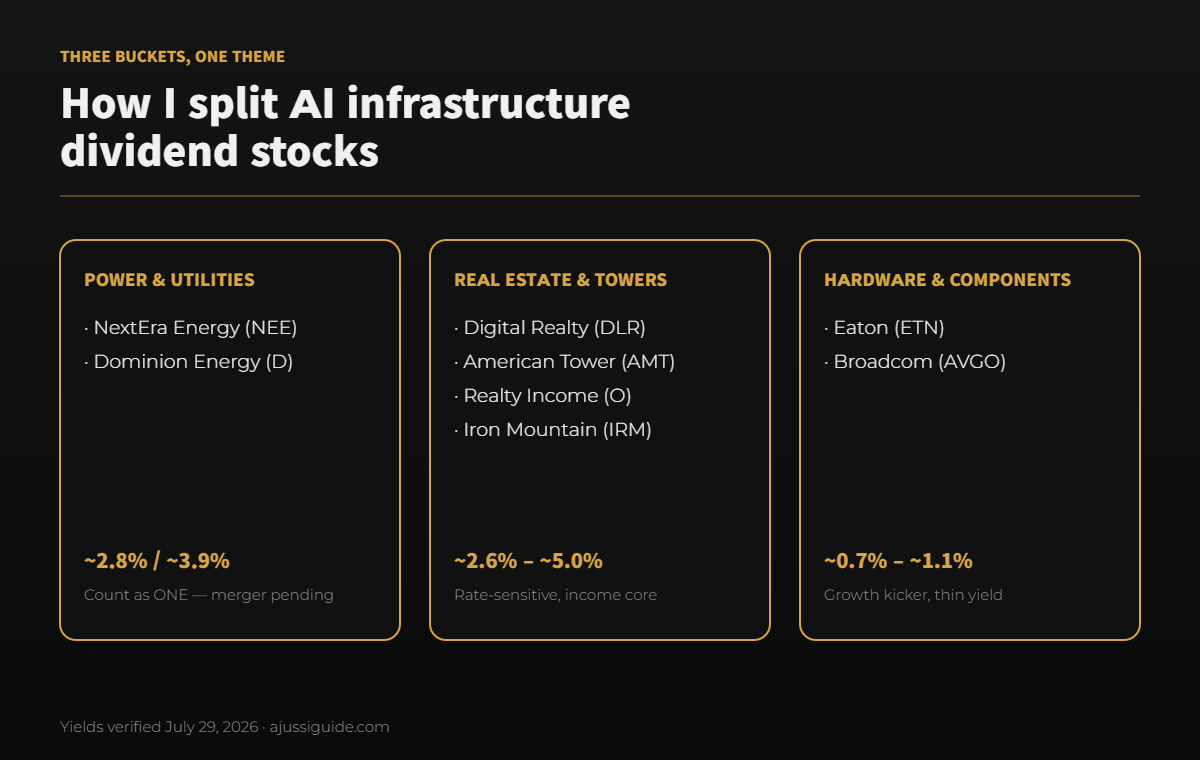
Each bucket behaves differently in different interest rate environments. Utilities and REITs are rate-sensitive — they get punished when rates rise. Industrial names like Eaton and semiconductors like Broadcom are less so. Diversifying across all three gives you AI infrastructure exposure without betting the house on one macro outcome. And since the NextEra-Dominion deal turned two utility names into one, the power bucket is now thinner than it looks on a seven-name list — size it accordingly.
My personal preference? I weight toward the utilities and REITs for income, and keep a smaller position in Eaton and Broadcom for growth kicker. But that is me — 60-something uncle who has seen enough market cycles to sleep better with cash flow.
Risks You Should Not Ignore
I am not here to sell you a dream. Every one of these names carries real risk. REITs like DLR and AMT are sensitive to interest rates — if the Fed keeps rates higher for longer, their valuations compress. Utilities like NEE and Dominion face regulatory risk and capital-intensive balance sheets, and their pending merger adds deal risk on top: regulators in Virginia, the Carolinas and at FERC still have to sign off, and the combined company has not yet defined its post-close dividend. Broadcom carries integration risk from the VMware deal. And the plainest risk of all: a dividend is a decision, not a contract. Boards cut payouts when cash flow tightens — utilities and REITs have done it before and will again. A yield on a screen tells you what was paid last quarter, not what will be paid next year.
The AI buildout itself could also slow if hyperscaler capex cools, if AI monetization disappoints, or if a new efficiency breakthrough (think DeepSeek-style compression) reduces compute demand. These are real scenarios, not just tail risks — and they would hit AI infrastructure dividend stocks through valuation long before they showed up in the payout.
What I like about owning dividend payers in this theme is that you are getting paid while uncertainty plays out. Think of the dividend as compensation for the patience and uncertainty you are taking on. If the thesis plays out over 3-5 years, you have been collecting income the whole time. If it stalls, the dividend cushions the blow. That is the whole idea.
Frequently Asked Questions
Are AI infrastructure dividend stocks appropriate for income investors, or just growth investors?
Both, honestly. That is what makes AI infrastructure dividend stocks unusual as a category. Classic dividend stocks — utilities, REITs, industrials — are now sitting at the center of one of the biggest growth stories in a generation. Income investors get the dividend. Growth investors get the AI tailwind. It is not always that clean, but right now the overlap is real.
Do I need to buy all 7 stocks, or can I pick just one or two?
You do not need all seven. Two or three AI infrastructure dividend stocks across different buckets already gets you most of the diversification. If I personally wanted only two names, I would lean toward Digital Realty Trust (DLR) for direct data center exposure and NextEra Energy (NEE) for the power demand story. Together they give you two different angles on the AI infrastructure buildout with two different yield profiles. But do your own research — your situation is not mine.
How do AI infrastructure dividend stocks compare to just buying an AI ETF?
A pure AI ETF will likely give you more upside volatility — more growth names, higher valuations, little or no income. Dividend stocks with AI infrastructure exposure give you lower volatility, real cash flow, and arguably more defensive positioning if the AI hype cools. They are complements, not substitutes. Many experienced investors own both: an AI ETF for growth and dividend names for income and ballast.
Disclaimer: This article is for informational purposes only and is not financial advice. Do your own research.