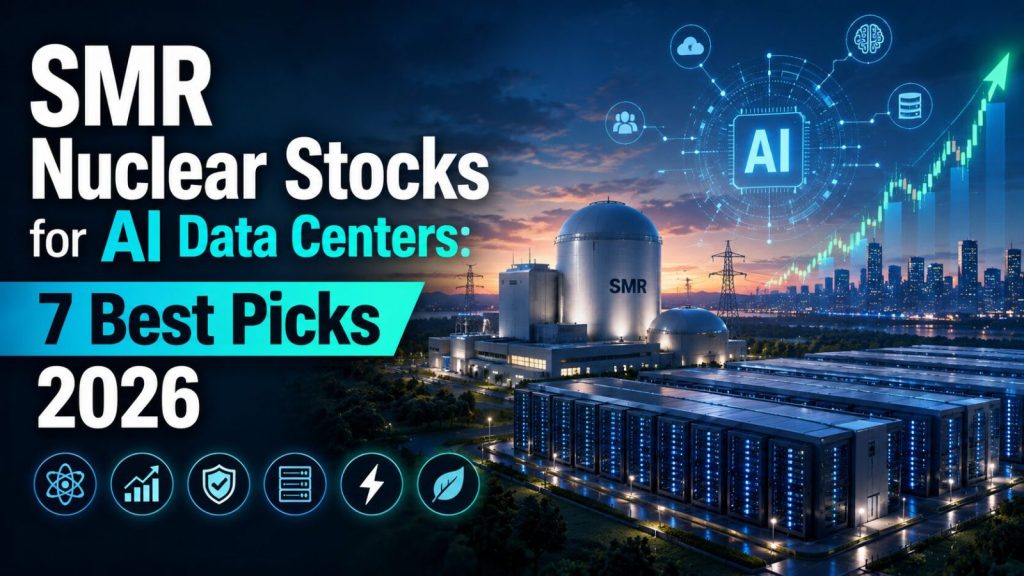
SMR nuclear stocks for AI data centers are quietly becoming one of the most serious infrastructure plays I’ve watched in my 25+ years of following markets — and uncle Ajussi is here to walk you through exactly what’s happening before the crowd catches on.
The AI buildout is creating an electricity crisis nobody in Silicon Valley wants to talk about loudly. Every time you run a ChatGPT prompt, generate an image, or let an AI agent browse the web on your behalf, somewhere a data center gulps down power. Big power. The kind of power that municipal grids struggle to deliver reliably and cleanly.
That’s where small modular reactors — SMRs — enter the story. And that’s where your investment thesis might be hiding.
Why AI Data Centers Are Creating a Nuclear Energy Crisis
Let me give you the honest numbers first. According to the International Energy Agency’s Electricity 2024 report, global data center electricity consumption could more than double by 2026 compared to 2022 levels. That’s not a fringe forecast — that’s the IEA.
Hyperscalers like Microsoft, Google, and Amazon have already started signing nuclear power agreements. Microsoft made headlines with a deal to restart a unit at Three Mile Island. Google signed a power purchase agreement with Kairos Power for advanced reactors. These aren’t PR stunts. These are 20-year power contracts.
Traditional grid power is too unreliable, too carbon-heavy for ESG commitments, and frankly too slow to build out. Natural gas is fast but politically complicated. Renewables are intermittent. Nuclear — specifically SMRs — checks boxes that nothing else does: 24/7 baseload, zero carbon emissions, small footprint, and potentially co-locatable next to a data campus.
What Exactly Is an SMR? A Quick Primer for Retail Investors
A small modular reactor is a nuclear fission reactor with an output typically under 300 megawatts electric (MWe), designed to be factory-built in modules and shipped to site. That’s a stark contrast to the 1,000+ MWe gigantic plants that take 15 years and cost overruns to construct.
The modular approach theoretically means lower upfront capital, faster deployment timelines, and more predictable construction costs. Theoretically. I’ll be blunt: SMRs are still mostly pre-commercial as of 2025, and the gap between a design on paper and electrons flowing into a data center is wide.
But here’s what I tell younger investors: the time to research a sector is before the commercial inflection point, not after. You don’t buy the obvious — you buy the plausible. Right now, SMRs are moving from plausible to probable.
The Regulatory Landscape Is Actually Moving
The U.S. Nuclear Regulatory Commission (NRC) has been modernizing its licensing framework for advanced reactors under the ADVANCE Act signed into law in 2024. That’s a genuine policy tailwind. NuScale Power received the first-ever NRC design approval for an SMR design, though its flagship Utah project was later cancelled due to cost escalation — a real and sobering reminder that early-stage nuclear investing carries project risk.
Still, the regulatory machinery is turning in a friendlier direction than it has in decades. That matters for timelines, and timelines matter for stock catalysts.
SMR Nuclear Stocks for AI Data Centers: The Key Names to Watch
I want to be careful here. This is a YMYL topic — your money, your life. I’m not going to give you price targets or tell you to buy anything. What I will do is lay out the landscape with the publicly traded and soon-to-be-public names that serious investors are tracking, along with honest notes on each.
| Company | Ticker | Technology Type | Stage (as of 2025) | Key Risk |
|---|---|---|---|---|
| NuScale Power | SMR | Light Water SMR | NRC certified; seeking new customers after Utah cancellation | Cost competitiveness, customer pipeline uncertainty |
| Oklo Inc. | OKLO | Fast fission / microreactor | Pre-revenue; NRC application refiled; Altman-linked (former board chair, stepped down April 2025) | Long runway to revenue; speculative valuation |
| Kairos Power | Private | Fluoride salt-cooled high-temp | Google PPA signed; demo reactor (Hermes) under construction | Not publicly investable yet; watch for IPO signals |
| Centrus Energy | LEU | HALEU uranium fuel enrichment | Commercial; producing HALEU fuel needed by advanced reactors | Regulatory/export restrictions; small cap liquidity |
| BWX Technologies | BWXT | Nuclear components/microreactors | Revenue-generating; DoD and NASA contracts | Defense budget sensitivity; slower commercial SMR exposure |
| Constellation Energy | CEG | Existing large nuclear fleet | Operational; Microsoft Three Mile Island deal signed | Regulation, wholesale power price sensitivity |
Notice how the list spans a spectrum — from pure-play speculative (Oklo) to large-cap operational nuclear (Constellation). That’s intentional. Your exposure should probably span that spectrum too, weighted by your own risk tolerance. Uncle Ajussi doesn’t do one-size-fits-all.
The Picks I Think Get Under-Discussed
Everyone on financial Twitter talks about Oklo because of the Sam Altman halo — he took it public and chaired the board until stepping down in April 2025 to clear the way for potential OpenAI–Oklo supply talks. The story is clean and well-marketed.
Centrus Energy is less glamorous but actually producing high-assay low-enriched uranium (HALEU) — the fuel that many next-generation SMR designs require. If the SMR ecosystem grows, Centrus sits at a critical bottleneck. Their investor relations page is worth bookmarking for contract announcements.
BWX Technologies manufactures naval nuclear reactors and has real engineering credibility. They’re quieter about it, but their microreactor program for the DoD gives them a path to commercial SMR manufacturing at scale.
SMRs are the long-dated answer to this demand. The near-term answer is the regulated grid that already exists, which is a different risk profile entirely — I covered that in utility stocks and data center electricity demand.
How to Think About Position Sizing in Early-Stage Nuclear
Here’s the part where I put on my uncle hat and get real with you. Most retail investors who get excited about a theme like this over-concentrate. They go all-in on the single sexiest name and then panic when deployment timelines slip — and in nuclear, they almost always slip.
A more experienced approach: treat your SMR exposure as a basket. A small allocation spread across two or three names at different points on the risk spectrum — say, a speculative pure-play, a fuel/component supplier, and an existing nuclear operator — gives you thematic exposure without betting your retirement on a single NRC filing outcome.
Also consider the picks-and-shovels angle. Data center construction itself — the cooling systems, the electrical infrastructure, the fiber — is also a legitimate AI infrastructure play that complements nuclear energy exposure without the regulatory risk unique to nuclear. But that’s a separate post.
Timing: When Does This Theme Actually Pay Off?
Honest answer: 2027–2030 is the realistic commercial inflection window for most U.S. SMR projects currently in licensing or early construction. That’s not a trading horizon — that’s an investing horizon. If you need to be right in 6 months, this theme may frustrate you.
Stock prices can move much earlier, driven by contract announcements, licensing milestones, or a major hyperscaler signing an SMR power purchase agreement. Those are the catalysts to watch in 2025 and 2026.
Frequently Asked Questions
Are SMR nuclear stocks for AI data centers a good investment in 2025?
SMR nuclear stocks for AI data centers represent a high-conviction long-term thesis, but most pure-play SMR companies are pre-revenue and speculative. Existing nuclear operators like Constellation Energy offer more near-term earnings stability with AI data center power demand as a tailwind. Position sizing matters enormously given the long timelines involved. This is not financial advice — do your own research.
Which SMR company is furthest along in the U.S.?
As of 2025, NuScale Power holds the only NRC-approved SMR design in the U.S., though its first commercial project was cancelled. Kairos Power is constructing its Hermes demonstration reactor in Tennessee under an NRC construction permit. Both represent genuine progress, but no U.S. SMR is yet delivering commercial electricity to a data center. The sector is advancing — just not on the timeline hype suggests.
How does nuclear power specifically help AI data centers versus other energy sources?
Nuclear provides 24/7 carbon-free baseload power — something solar and wind cannot guarantee without expensive storage. For a hyperscale data center running inference workloads around the clock, power reliability is as important as cost. SMRs can theoretically be sited close to data campuses, reducing transmission losses and grid dependency. That co-location potential is the core reason major tech companies are signing nuclear power agreements now.
🖥️ Ajussi’s Trading Desk Gear
Watching this sector means watching a lot of charts. The gear guides I actually researched for my own desk:
📊 Best Monitors for Stock Trading (2026)
🦾 Best Dual Monitor Arms for a Clean Setup
🔌 Thunderbolt 5 & USB-C Docks — One-Cable Desk
💡 Best Monitor Light Bars — Save Your Eyes at Night
Disclaimer: This article is for informational purposes only and is not financial advice. Do your own research.
Related posts
- Data Center Cooling ETF: Best 7 Facts for 2026
- Immersion Cooling Stocks: 7 Best Picks for 2026
- Best Data Center Liquid Cooling Stocks: 5 to Watch in 2026
- 미국 SMR 관련주 정리 (Korean) — eight U.S.-listed SMR names sorted by business type and regulatory stage as of Q2 2026, including X-energy after its April 2026 Nasdaq listing