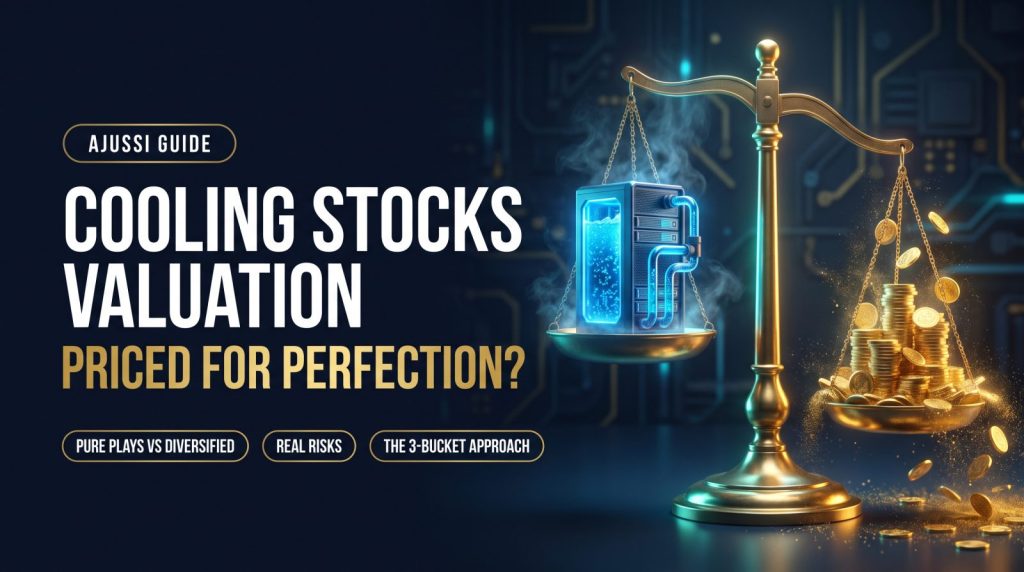
Cooling stocks valuation is the question I keep getting from readers — and honestly, it’s the right question to be asking right now.
Look, I’ve been around long enough to remember when everyone said fiber optic cable companies were a sure thing in 1999. The underlying technology was real. The demand was real. The valuations were absolutely insane, and most of those stocks still haven’t recovered.
I’m not saying data center cooling is the same story. But I am saying you need to go in with your eyes open. So let’s talk about it like adults.
Why Cooling Stocks Are Suddenly Everyone’s Favorite Trade
The simple version: AI chips run hot. Very hot. An NVIDIA H100 GPU cluster can consume 10 to 20 times the power density of a traditional server rack. That heat has to go somewhere, and traditional air cooling can barely keep up.
According to the International Energy Agency (IEA), data centers already consume roughly 1.5% of global electricity, and the IEA projects that to roughly double to about 945 TWh by 2030 as AI workloads scale. More power means more heat. More heat means more cooling infrastructure. Simple math.
So companies that make liquid cooling systems (I profiled the main names in my liquid cooling stocks guide), cold plates, immersion cooling tanks, precision air handling units, and thermal management components are suddenly in the spotlight. The narrative is clean. The tailwind is real. And that’s exactly when I get nervous about price.
Cooling Stocks Valuation: What the Numbers Actually Look Like
Here’s where I want to slow everybody down. A good business and a good stock are two different things. Let me show you a rough comparison of some of the major names in this space and where valuations stand as of mid-2026. Keep in mind these figures are approximate and change daily — always verify before you buy.
| Company | Ticker | Primary Cooling Exposure | Approx. Forward P/E (mid-2026) | YTD Price Change (2026) |
|---|---|---|---|---|
| Vertiv Holdings | VRT | Thermal management, liquid cooling systems | ~45-55x | Volatile; check current |
| Eaton Corporation | ETN | Power & thermal infrastructure | ~28-35x | Moderate growth |
| Modine Manufacturing | MOD | Liquid & air cooling for data centers | ~20-28x | High volatility |
| Schneider Electric | SBGSY | Full data center infrastructure incl. cooling | ~25-30x | Steady European exposure |
| Asetek | ASTK (Oslo) | Liquid cooling for servers | Not yet profitable | Speculative |
See the spread? You’ve got everything from a profitable industrial giant like Eaton trading at a premium-but-reasonable multiple, all the way to pure-play smaller names trading at nosebleed valuations or not yet profitable at all.
The market is essentially pricing in perfection for the pure plays. That’s where I get cautious.
Vertiv: The Poster Child for This Debate
Vertiv (VRT) is the name that comes up most often when people ask about cooling stocks valuation, and with good reason. The company has real revenue, real backlog growth, and genuine exposure to the liquid cooling buildout.
But at a forward P/E that has ranged from 45 to 55 times earnings depending on the week, you’re paying a steep price for that growth. Vertiv needs to execute flawlessly for several years just to grow into its current valuation. One guidance miss and you can lose 20-30% very fast — we’ve already seen that happen at least once.
I’m not saying avoid it forever. I’m saying size it appropriately and don’t bet the farm at these levels.
The Diversified Names Offer More Cushion
Companies like Eaton (ETN) and Schneider Electric give you data center cooling exposure without betting everything on one theme. Eaton has electrical infrastructure, power quality products, and industrial automation alongside its data center work. You’re not going to 3x in a year, but you’re also not going to get cut in half if the AI capex story slows down for two quarters.
For most retail investors, this is the smarter entry point into the cooling infrastructure theme. Boring? Maybe. Survivable? Definitely.
Real Risks That the Hype Cycle Is Ignoring
Let me put on my grumpy uncle hat for a second, because there are real risks here that the bulls are glossing over.
Risk 1: Hyperscaler capex can slow or shift. (I track the Big Four budgets quarterly in my Hyperscaler Capex Tracker.) Microsoft, Google, Amazon, and Meta are the biggest buyers of data center infrastructure. If any of them pull back on capex — due to economic conditions, regulatory pressure, or simply catching up on overbuilding — the order book for cooling suppliers shrinks fast. We saw a version of this with networking equipment companies in prior cycles.
Risk 2: Technology disruption. The liquid cooling systems being deployed today are the dominant solution — but they’re not the only one. Immersion cooling, two-phase cooling, and even chip-level innovations could shift which type of cooling equipment wins. A company betting heavily on one architecture could find itself undercut.
Risk 3: Competition and margin pressure. As the market grows, more players enter. Chinese manufacturers, in particular, have shown the ability to undercut Western suppliers on price in hardware categories. Margin compression is a real risk for companies that aren’t deeply embedded in long-term service contracts.
Risk 4: Valuation multiple compression. Even if earnings grow 20% a year, if the P/E multiple compresses from 50x to 25x, your stock goes nowhere or declines. This is the cruelest trick the market plays on growth investors — the business wins but the stock disappoints.
For more context on data center energy trends driving this whole story, I recommend reading the IEA’s electricity reports at iea.org — they put out solid, non-promotional data on where energy consumption is headed.
So Are Cooling Stocks Overvalued? Ajussi’s Honest Take
Here’s my answer: some of them, yes. All of them, no. It depends which name you’re looking at and what price you’re paying.
The pure-play, small-cap cooling stocks with no profits and P/S ratios above 10? Those are priced for a world where everything goes perfectly. That’s speculation, not investing. Cooling stocks valuation in that segment looks stretched to me.
The large-cap diversified infrastructure names with real earnings and a cooling tailwind as one of several growth drivers? Those are expensive relative to history, but not absurdly so given the interest rate environment and the quality of the underlying business. I can justify holding those in a diversified portfolio.
My actual approach: I think about cooling stocks valuation in three buckets.
Bucket 1 — Core position: Diversified industrial names (Eaton, Schneider) where cooling is maybe 20-30% of the story. These are long-term holds.
Bucket 2 — Satellite position: A focused name like Vertiv with a smaller allocation that I’m willing to hold through volatility but won’t let become more than 3-5% of my portfolio.
Bucket 3 — Watchlist only: The smaller pure plays and unprofitable companies. I watch them, I read their earnings calls, and I wait for either profitability or a serious price correction before I touch them.
That structure lets me participate in the theme without getting wiped out if the AI capex narrative hits a rough quarter.
🚀 Ajussi’s Trading Desk Gear
Watching this sector means watching a lot of charts. The gear guides I actually researched for my own desk:
📊 Best Monitors for Stock Trading (2026)
🤾 Best Dual Monitor Arms for a Clean Setup
🔌 Thunderbolt 5 & USB-C Docks — One-Cable Desk
💡 Best Monitor Light Bars — Save Your Eyes at Night
Frequently Asked Questions
Q: Is Vertiv (VRT) still a buy at current prices?
A: Vertiv is a legitimate business with real backlog and genuine AI infrastructure exposure. But cooling stocks valuation for Vertiv specifically is demanding — you’re paying 45-55x forward earnings, which means flawless execution is required. If you want exposure, consider a small position and dollar-cost average rather than going all in. Any guidance miss could result in a painful drawdown.
Q: What’s the difference between air cooling and liquid cooling stocks?
A: Traditional air cooling (CRAC units, computer room air handlers) is a mature, lower-growth market. Liquid cooling — which includes direct liquid cooling (DLC), cold plate systems, and immersion cooling — is where the AI-driven growth is concentrated because it can handle 10-100x higher power densities. Companies with strong liquid cooling exposure command higher growth multiples than those stuck in legacy air cooling products.
Q: Are there ETFs that give exposure to data center cooling stocks without single-stock risk?
A: There are data center and AI infrastructure ETFs that hold some cooling-related names, but most of them are heavily weighted toward REITs, chip companies, and hyperscalers rather than pure cooling plays. As of mid-2026, there is no dedicated cooling-only ETF that I’m aware of. You’ll likely get indirect exposure through broader AI infrastructure ETFs, which dilutes the theme but also dilutes the risk.
Disclaimer: This article is for informational purposes only and is not financial advice. Do your own research.