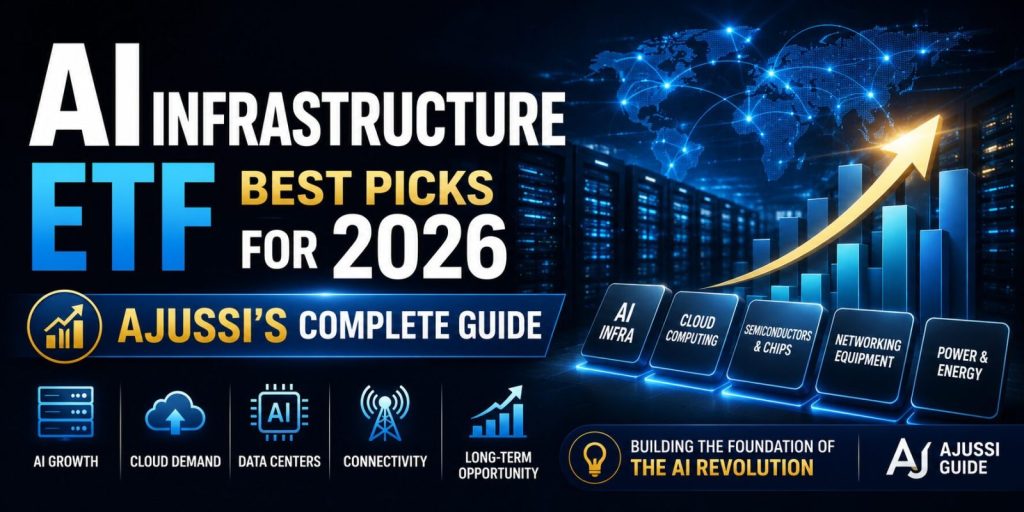
The AI infrastructure ETF space has exploded with options, and frankly, half of them are dressed-up versions of the same thing — so let me save you some time and cut through the noise like only an old ajussi can.
I’ve been watching the AI buildout since before most retail investors could spell ‘hyperscaler.’ And right now, heading into 2026, the question I get more than any other from younger investors is: which AI infrastructure ETF should I actually own? Not which one has the flashiest name, but which one gives you real, durable exposure to the pipes, power, and processors that make AI run.
This post is my honest, plain-spoken breakdown. No hype. Just what Ajussi actually thinks.
Why the AI Infrastructure ETF Category Matters More Than Ever in 2026
Here’s the thing most people miss: the AI trade in 2024 and 2025 was largely about software promises. Models, agents, chatbots. But the companies actually printing money right now are the ones building the physical foundation — data centers, high-bandwidth networking, power management systems, and advanced semiconductors.
According to the International Energy Agency (IEA), global data center electricity consumption is projected to more than double by the late 2020s. That’s not a narrative — that’s a capital expenditure cycle already in motion. Hyperscalers like Microsoft, Amazon, Google, and Meta have each committed to hundreds of billions in infrastructure spending through 2026 and beyond.
When the capex is that certain, I want exposure through an ETF — diversified, liquid, low-friction. That’s why the AI infrastructure ETF category deserves serious attention from every US retail investor right now.
Top AI Infrastructure ETF Options: What’s Actually Out There
Let me walk you through the main funds I watch. These are real, US-listed ETFs with real tickers. I’m not going to pretend every one of them is perfect — each has a different angle, and the right one depends on what you already own.
1. Global X Data Center & Digital Infrastructure ETF (DTCR)
DTCR — which traded under the ticker VPN until Global X renamed it — focuses on companies involved in data center REITs, tower operators, and digital infrastructure globally. It’s one of the more pure-play infrastructure funds — you’re not accidentally buying a bunch of software companies. Top holdings have included Equinix, American Tower, and Digital Realty Trust.
The expense ratio is around 0.50%. For a thematic ETF, that’s reasonable. The trade-off is it’s more REIT-heavy, which means it’s sensitive to interest rates. Worth knowing before you size your position.
2. iShares Semiconductor ETF (SOXX)
SOXX is not marketed as an AI infrastructure ETF specifically, but let’s be honest — semiconductors ARE the infrastructure. NVIDIA, Broadcom, AMD, Qualcomm, Texas Instruments. These chips are the foundation everything else runs on.
Expense ratio is about 0.35%, which is very reasonable for a focused sector fund. Liquidity is excellent. If I had to pick just one fund to hold for the 2026 AI infrastructure cycle, SOXX would be in my top two. It’s that important.
3. Invesco AI and Next Gen Software ETF (IGPT)
IGPT blends infrastructure and software exposure. It holds semiconductor companies alongside AI software and cloud platforms. The expense ratio runs around 0.56%. This one is better suited for investors who want a broader AI bet rather than pure infrastructure.
I treat IGPT as a complement, not a core holding, if you already have semiconductor-heavy exposure elsewhere in your portfolio.
4. First Trust Nasdaq AI and Robotics ETF (ROBT)
ROBT covers AI, robotics, and automation companies. Its infrastructure component is mixed with industrial automation names. The expense ratio is around 0.65%. It gives you some exposure to the physical-world AI buildout — think factory automation and logistics robotics alongside data center plays.
5. Roundhill Generative AI & Technology ETF (CHAT)
CHAT is a newer, actively managed fund focused on the generative AI ecosystem. Because it’s actively managed, fees are higher — around 0.75%. The holdings lean toward large-cap AI enablers: NVIDIA, Microsoft, Alphabet, Meta. It’s more concentrated and higher-beta. Good for investors comfortable with volatility.
AI Infrastructure ETF Comparison Table
| ETF Name | Ticker | Expense Ratio | Core Focus | Ajussi’s Take |
|---|---|---|---|---|
| Global X Data Center & Digital Infrastructure ETF | DTCR | ~0.50% | Data center REITs & towers | Pure infrastructure play; rate-sensitive |
| iShares Semiconductor ETF | SOXX | ~0.35% | Semiconductor companies | Core holding; deep AI chip exposure |
| Invesco AI and Next Gen Software ETF | IGPT | ~0.56% | AI chips + cloud software | Good blend; complement to SOXX |
| First Trust Nasdaq AI and Robotics ETF | ROBT | ~0.65% | AI, robotics, automation | Broader bet; adds industrial exposure |
| Roundhill Generative AI & Technology ETF | CHAT | ~0.75% | Generative AI ecosystem | High conviction; higher volatility |
Note: Expense ratios are approximate and subject to change. Always verify current figures on the fund provider’s website before investing.
How Ajussi Thinks About Sizing an AI Infrastructure ETF Position
Here’s where experience matters more than any screener. I’ve watched too many retail investors pour 40% of their portfolio into a single thematic ETF at the peak of a hype cycle. Don’t be that person.
My rule of thumb: thematic ETFs like these belong in the satellite portion of your portfolio — typically 10–25% of total holdings for someone with moderate risk tolerance. Your core should still be broad-market index funds. The AI infrastructure ETF position is your conviction overlay, not your retirement plan.
I also think about layering. If you want genuine AI infrastructure exposure without doubling up, consider pairing SOXX (semiconductor depth) with DTCR (physical infrastructure and power). Together they cover the silicon layer and the physical layer without massive overlap.
And watch for overlap with your existing holdings. If you already own QQQ or VGT, you likely have significant NVIDIA and Broadcom exposure. Adding SOXX on top might overweight you in semis without you realizing it. Use a free tool like ETF Research Center’s overlap checker to audit your portfolio before adding positions. For more context on how the big platforms are allocating capital, Reuters’ tech coverage consistently tracks hyperscaler capex announcements worth monitoring.
What Makes a Strong AI Infrastructure ETF for 2026 Specifically?
The 2026 cycle has a few specific dynamics that should shape your fund selection. First, power infrastructure is becoming as important as silicon. AI data centers are power-hungry monsters, and utilities, power management companies, and grid infrastructure players are increasingly relevant. Look for ETFs that have begun including this exposure — or consider adding a dedicated energy infrastructure fund alongside your primary AI ETF.
Second, geographic diversification is quietly important. US hyperscalers dominate, but Asian semiconductor manufacturers — particularly in Taiwan and South Korea — are critical to the supply chain. An AI infrastructure ETF with zero international exposure may be missing part of the story.
Third, fee discipline matters over a multi-year hold. A 0.35% fund versus a 0.75% fund doesn’t sound dramatic, but compounded over five years on a meaningful position, you’re talking real money left on the table. All else being equal, choose the cheaper fund.
Frequently Asked Questions
Q: Is an AI infrastructure ETF better than buying individual AI stocks?
For most retail investors, yes — and here’s why. Individual AI stock picks require you to correctly identify winners within a fast-moving, technically complex industry. An AI infrastructure ETF spreads that risk across dozens of companies. You’ll likely underperform the single best stock, but you’ll also avoid the single worst one. For a satellite position in a thematic trend, ETF diversification is usually the smarter play unless you’re doing deep, ongoing research on individual names.
Q: Should I worry about AI ETF overlap with funds I already own?
Absolutely — this is one of the most underappreciated risks in thematic investing. If you hold QQQ, SPY, VGT, and then add SOXX and CHAT, you might have 15–20% of your total portfolio in NVIDIA alone without realizing it. Always check holdings overlap before adding a new thematic ETF. Free tools are available online to run overlap analysis between any two ETFs.
Q: How long should I plan to hold an AI infrastructure ETF position?
Ajussi’s answer: minimum three to five years. Thematic ETFs tied to infrastructure buildouts are not short-term trading vehicles. The AI capex cycle is measured in years, not quarters. If you’re buying an AI infrastructure ETF hoping to flip it in six months, you’re speculating, not investing. Size your position accordingly, and be prepared to hold through inevitable corrections along the way.
🖥️ Ajussi’s Trading Desk Gear
Watching this sector means watching a lot of charts. The gear guides I actually researched for my own desk:
📊 Best Monitors for Stock Trading (2026)
🦾 Best Dual Monitor Arms for a Clean Setup
🔌 Thunderbolt 5 & USB-C Docks — One-Cable Desk
💡 Best Monitor Light Bars — Save Your Eyes at Night
An ETF does not guarantee layer diversification either. Several AI infrastructure funds concentrate in the same two layers. They may all depend on the same infrastructure layer. The AI infrastructure exposure checker shows which of the eight layers a portfolio actually owns.
A narrower look at the five US data center ETFs, with every holding sorted by layer, is in the data center ETF comparison.
Disclaimer: This article is for informational purposes only and is not financial advice. Do your own research.