AI power infrastructure is, without a doubt, the most important investment theme I’ve watched develop in my 25+ years of following markets — and 2026 is shaping up to be the year it finally demands your full attention.
I’m Ajussi. I’ve seen dot-com booms, housing busts, and crypto manias. But I’ve never seen a technology trend that created such an immediate, physical, measurable strain on the real world as AI is creating on our power grid right now.
When you train a large language model or run inference at scale, it doesn’t just burn CPU cycles — it burns megawatts. And somebody has to build the wires, transformers, switchgear, and generators to deliver those megawatts. That somebody is your next investment opportunity.
Equipment is only half of the picture. The generation layer, meaning the companies that actually produce the electricity and contract it to data centers, is mapped separately in power grid stocks: who generates the power AI data centers need.
Why AI Power Infrastructure Is the Trade of the Decade
Let me give you a number that stopped me cold. The International Energy Agency (IEA) projects in its latest Electricity 2026 report that global data center electricity consumption will top 1,000 terawatt-hours this year — roughly equivalent to Japan’s entire national electricity consumption. That’s not a rounding error. That’s a country-sized demand appearing out of nowhere.
Hyperscalers like Microsoft, Google, Amazon, and Meta are racing to build gigawatt-scale campuses. Each one of those campuses needs transformers, switchgear, backup generation, cooling, and transmission upgrades — all before a single GPU rack gets switched on.
The bottleneck isn’t compute anymore. The bottleneck is power delivery. And the companies solving that bottleneck are the picks and shovels of the AI era.
The Grid Was Not Built for This
Here’s the uncomfortable truth: America’s electrical grid was designed decades ago for a relatively predictable load profile. Factories, homes, offices. Not hyperscale AI campuses drawing 500 megawatts in a single location.
Utilities are reporting multi-year interconnection queues. Transformer lead times have stretched from 12 months to 3-4 years in some categories. That supply-demand imbalance in physical equipment is exactly the kind of setup that creates durable, multi-year earnings tailwinds for the right companies.
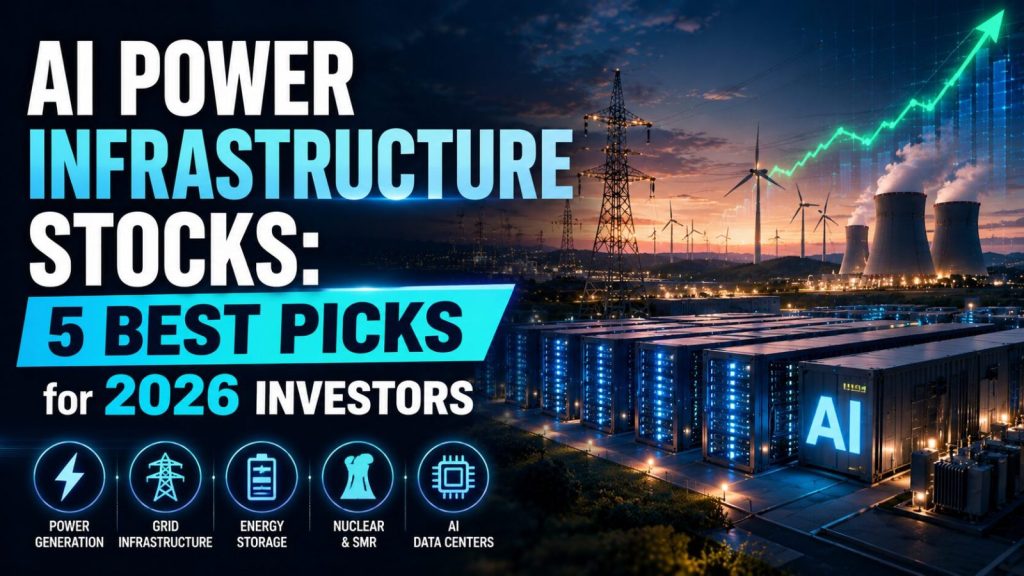
5 AI Power Infrastructure Stocks Worth Watching in 2026
I’m not here to give you a hot tip and run. I’m here to walk you through the landscape so you can make an informed decision. Here are five names I keep coming back to when I think about AI power infrastructure.
1. Eaton Corporation (ETN)
Eaton is the clearest pure-play I can find on AI power infrastructure. The company makes electrical components — switchgear, circuit breakers, power distribution units — that go into virtually every large data center built today. Their data center end market has been growing at double-digit rates, and management has explicitly called out AI buildout as a multi-year tailwind.
Eaton’s backlog has been expanding, and their Electrical Americas segment margins have been a bright spot. This isn’t a cheap stock, but premium quality rarely is.
2. Vertiv Holdings (VRT)
Vertiv is the name I hear most often from data center operators themselves. They make the critical infrastructure that sits inside the data center: power distribution, thermal management, and IT infrastructure. Their products are literally the life support system for AI servers.
Revenue growth has accelerated materially as hyperscaler capex has ramped. Watch their order book — it’s a leading indicator for where data center spending is headed 12-18 months out.
3. GE Vernova (GEV)
GE Vernova, spun off from General Electric in 2024, is the electrification and power generation business. They make gas turbines, grid solutions, and wind power equipment. As utilities scramble to add generation capacity to serve AI data centers — particularly natural gas peaker plants — GEV sits in a very strategic position.
Their grid solutions segment, which includes large power transformers and grid automation, is directly in the crosshairs of the AI-driven infrastructure buildout.
4. Constellation Energy (CEG)
Nuclear power is having a renaissance, and Constellation is the largest pure-play nuclear operator in the United States. Why does this matter for AI? Because hyperscalers desperately want 24/7 carbon-free power, and nuclear is the only technology that reliably delivers it at scale.
Microsoft’s deal to restart the Three Mile Island unit through Constellation sent a clear signal. Corporate power purchase agreements (PPAs) with data center customers are becoming a core part of Constellation’s business model. Constellation Energy’s investor relations is worth bookmarking if you want to track these deals as they develop.
5. Quanta Services (PWR)
Quanta builds and maintains the transmission and distribution infrastructure that actually moves power from generation sources to end users. As utilities invest heavily in grid upgrades to handle new data center loads, Quanta’s construction backlog grows. They’re the contractor that does the physical work nobody else wants to talk about — laying cable, building substations, upgrading transmission lines.
Quanta is a less glamorous name than the others, but in my experience, the unglamorous picks are often the ones that quietly compound for years.
Comparing AI Power Infrastructure Stocks at a Glance
Here’s a simplified comparison of the five names. Note that valuations shift constantly — use this as a starting framework, not a final answer.
| Company | Ticker | Primary AI Power Angle | Risk Level | Investor Type |
|---|---|---|---|---|
| Eaton Corporation | ETN | Electrical components & switchgear for data centers | Medium | Growth + Quality |
| Vertiv Holdings | VRT | In-rack power & thermal mgmt for AI servers | Medium-High | High-growth seeker |
| GE Vernova | GEV | Gas turbines, transformers, grid solutions | Medium | Growth + Diversified |
| Constellation Energy | CEG | Nuclear power PPAs with hyperscalers | Medium | Growth + ESG angle |
| Quanta Services | PWR | Transmission & substation construction | Medium-Low | Steady compounder |
Risks I Would Not Ignore
Ajussi doesn’t just sell you the dream. Let me tell you what keeps me up at night about this trade.
Valuation risk is real. Several of these names have already had big runs. When a story gets crowded, even a correct thesis can lead to poor returns if you overpay. Dollar-cost averaging into positions over time is smarter than buying all at once.
AI capex cycles can pause. If the hyperscalers hit a rough earnings quarter and pull back spending guidance, these infrastructure names will feel it quickly. They’re not insulated from the AI investment cycle — they’re deeply tied to it.
Execution risk in a tight supply chain. Transformer manufacturers are already stretched thin. If a company promises delivery timelines they can’t meet, contracts can be delayed or cancelled. Watch gross margins and backlog conversion rates in quarterly earnings calls.
Interest rate sensitivity. Several of these companies carry meaningful debt and capital-intensive business models. A prolonged high-rate environment compresses their economics. Keep an eye on the macro backdrop.
How Ajussi Thinks About Sizing This Position
I don’t put my whole portfolio into any single theme, no matter how convinced I am. For AI power infrastructure as a basket, I’d think about a 10-15% total allocation for an investor who is genuinely convicted on this theme — spread across three to five names to reduce single-stock risk.
If you want simpler exposure, there are ETFs that touch this theme — look at infrastructure-focused ETFs or clean energy ETFs that hold some of these names. Just read the holdings carefully before you buy. ETF names can be misleading.
The core logic here is simple and durable: AI needs power, power needs infrastructure, infrastructure takes years to build, the companies building it have full order books. That’s a setup I respect.
Frequently Asked Questions
Q: Is AI power infrastructure a long-term investment or a short-term trade?
In my view, it’s primarily a long-term investment theme. The infrastructure buildout needed to support AI workloads will take years — possibly a decade — to fully materialize. That said, valuations on some of these stocks have run hard, so entry timing still matters. I’d frame this as a 3-5 year core position, not a quarterly flip.
Q: Are utility stocks the same as AI power infrastructure stocks?
Not exactly. Traditional utilities are regulated, slow-growing businesses that pay dividends. AI power infrastructure stocks include a broader set: electrical equipment makers, grid construction contractors, nuclear operators with corporate PPAs, and critical data center power suppliers. Some utilities do benefit from AI demand, but the more direct plays are in the industrial and equipment space.
Q: How do I track AI-driven power demand going forward?
A few signals I watch: hyperscaler capex guidance on earnings calls (Microsoft, Google, Amazon, Meta), utility interconnection queue data published by grid operators like PJM and MISO, and transformer lead-time surveys from industry groups. The IEA also publishes regular reports on data center energy consumption that are worth bookmarking. When corporate capex guides up, these infrastructure names tend to follow.
For a closer look at the two largest listed pure plays in this chain, GE Vernova vs Siemens Energy works through the quarter where their wind businesses moved in opposite directions.
For a fund-level view of the same names, see our AI power ETF comparison: AIPO leads with Eaton, GE Vernova, Quanta and Vertiv, while ZAP tilts 77% toward utilities and GRID toward European grid suppliers.
🖥️ Ajussi’s Trading Desk Gear
Watching this sector means watching a lot of charts. The gear guides I actually researched for my own desk:
📊 Best Monitors for Stock Trading (2026)
🦾 Best Dual Monitor Arms for a Clean Setup
🔌 Thunderbolt 5 & USB-C Docks — One-Cable Desk
💡 Best Monitor Light Bars — Save Your Eyes at Night
Disclaimer: This article is for informational purposes only and is not financial advice. Do your own research.
Related posts
- SMR Nuclear Stocks for AI Data Centers: 7 Best Picks 2026
- Data Center Cooling ETF: Best 7 Facts for 2026
- Immersion Cooling Stocks: 7 Best Picks for 2026
- Transformer Stocks: 5 AI Data Center Plays — the lead-time bottleneck and who actually owns transformer capacity
- Best AI Server Stocks: 6 Names Where the Margin Stories Diverge — who assembles the racks the power actually feeds, and who keeps a margin