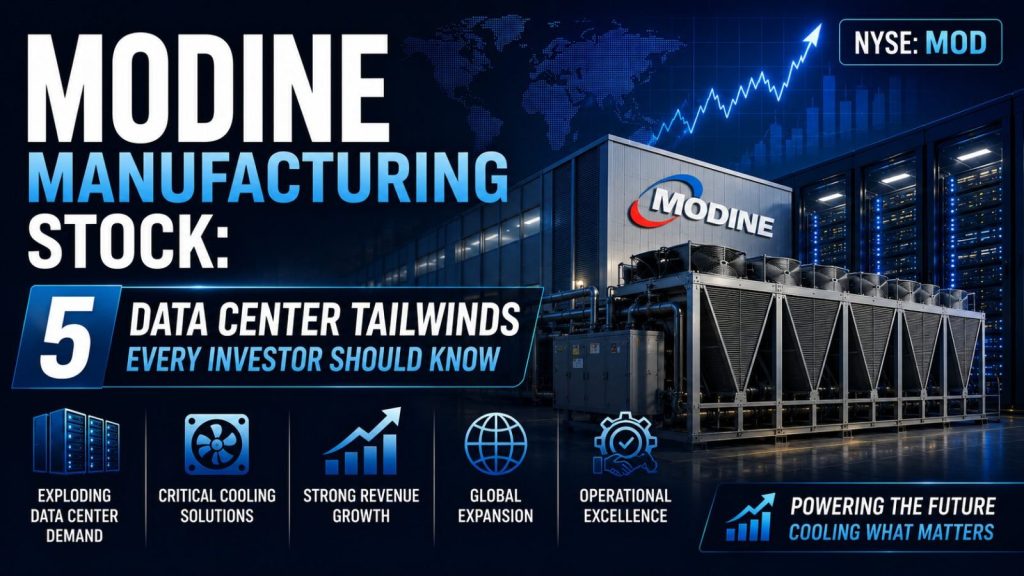
Modine Manufacturing stock (NYSE: MOD) has quietly become one of the most interesting plays in the AI infrastructure boom — and most retail investors have never heard of it. That changes today.
I’m Ajussi. I’ve been watching industrial and specialty manufacturers for decades, and I’ll tell you straight: when a boring, century-old company suddenly becomes a critical vendor for hyperscale data centers, you pay attention.
What Is Modine Manufacturing? A Quick Background
Founded in 1916, Modine Manufacturing is a Wisconsin-based thermal management company. For most of its history, it made heat exchangers and cooling systems for trucks, cars, and HVAC applications. Solid business. Unglamorous. The kind of stock your grandfather might have owned.
But over the past three years, the company has been quietly pivoting toward data center cooling — one of the fastest-growing infrastructure needs on the planet. That pivot is what makes Modine Manufacturing stock worth talking about right now.
The company operates through two main segments: Climate Solutions and Performance Technologies. It is the Climate Solutions segment — specifically its data center cooling products — that has been driving the narrative and the stock price.
Why Data Centers Need Modine: The Thermal Problem Explained
Here’s the simple truth: AI chips run hot. Very hot. An NVIDIA H100 GPU can draw 700 watts of power — and almost all of that becomes heat. Multiply that across tens of thousands of chips in a single data center, and you have an enormous thermal management challenge.
Traditional air cooling is hitting its physical limits. The industry is rapidly moving toward liquid cooling, direct-to-chip cooling, and advanced air-handling systems — all areas where Modine Manufacturing stock investors are betting the company has deep expertise.
Modine’s data center products include precision cooling units, computer room air handlers (CRAHs), and liquid cooling distribution units. These are not commodity parts. They require engineering precision and deep integration with data center architecture.
According to the International Energy Agency (IEA), global data center electricity consumption is projected to more than double by 2030, to around 945 TWh. More energy means more heat. More heat means more demand for exactly what Modine makes.
Modine Manufacturing Stock: 5 Data Center Tailwinds
1. Explosive Revenue Growth in Climate Solutions
In recent earnings reports, Modine’s Climate Solutions segment has posted significant double-digit revenue growth year-over-year. Management has consistently called out data center demand as the primary driver. This isn’t a one-quarter spike — it’s a multi-year structural trend. The numbers back it up: in fiscal 2026 (ended March 2026), net sales rose 23% to $3.18 billion, the fourth quarter alone grew 47%, and data center product sales jumped 158% year-over-year in that quarter. For fiscal 2027, management guides to another 60–80% increase in the data center business.
The company has been raising its own guidance, which is always a bullish signal. When management is confident enough to keep revising numbers upward, that tells me the order book is real and the backlog is growing.
2. The Shift to Liquid Cooling Is Accelerating
Air cooling alone can no longer handle the thermal density of modern AI clusters. Hyperscalers like Microsoft, Google, Meta, and Amazon are all investing heavily in liquid cooling infrastructure. Modine Manufacturing stock benefits directly from this transition because liquid cooling is a higher-margin, more complex product category.
This isn’t a future story — it’s happening now. Capital expenditure plans from major cloud providers are well into the hundreds of billions of dollars, and thermal management is a non-negotiable line item.
3. A Focused Strategic Pivot Under New Leadership
Modine’s leadership team has been explicit about repositioning the company as a high-growth data center and industrial cooling specialist. They’ve divested lower-margin automotive businesses and reinvested in higher-value data center product lines. The capstone came in January 2026: Modine agreed to spin off the entire Performance Technologies unit and combine it with Gentherm in a roughly $1 billion Reverse Morris Trust deal — once it closes (targeted for late 2026), Modine becomes a pure-play climate and data center cooling company. I respect companies that know what they want to be when they grow up.
You can read more about their strategic direction directly on the Modine Manufacturing investor relations page. Look at the recent investor presentations — management lays out the data center opportunity in clear terms.
4. Margin Expansion Story
As Modine shifts its revenue mix toward data center cooling and away from lower-margin auto thermal products, operating margins are expanding. Higher-value products, stickier customer relationships, and engineering complexity all contribute to better pricing power. This is the kind of mix shift that can re-rate a stock multiple significantly over time.
5. A $4 Billion Hyperscaler Commitment
Modine secured a landmark long-term agreement worth roughly $4 billion for chiller sales to a major hyperscale customer — the kind of multi-year commitment that turns a growth story into a contracted revenue base. It also tells you how hyperscalers see Modine: not as a spot vendor, but as a strategic supplier. That said, the market has noticed — the stock now carries a roughly 2 billion market cap, so the easy “undiscovered” money has been made and valuation discipline matters from here.
How Modine Compares to Other Data Center Thermal Plays
Let me put Modine Manufacturing stock in context with some of the other names in the thermal and cooling infrastructure space. This is not a buy/sell recommendation — it’s just context for your own research.
| Company | Ticker | Primary Data Center Angle | Market Cap (Approx.) | Key Risk |
|---|---|---|---|---|
| Modine Manufacturing | MOD | Precision air & liquid cooling units | Mid-cap (~$12B) | Spin-off execution; valuation after a big run |
| Vertiv Holdings | VRT | Power & thermal mgmt for data centers | Mid-to-large cap | Higher valuation multiple; more crowded trade |
| Eaton Corporation | ETN | Power management & cooling infrastructure | Large-cap | Data center is one of many segments; less pure-play |
| Comfort Systems USA | FIX | HVAC & mechanical systems for data centers | Mid-cap | Labor-dependent; project-based revenue lumpiness |
| Schneider Electric | SBGSY (ADR) | Integrated data center infrastructure | Large-cap (French) | Currency risk; European regulatory environment |
My take: Modine is the smallest and arguably the most leveraged to pure data center cooling growth. That means higher upside potential — and higher risk. Know what you’re buying.
Risks I’m Watching on Modine Manufacturing Stock
I’m not here to just cheerleader. Let me tell you what keeps me up at night about this one.
Valuation has already moved. Modine Manufacturing stock has been a big winner over the past couple of years. The market has already priced in a lot of the data center growth story. If execution stumbles or AI capex spending slows, there’s real downside from current levels.
Customer concentration risk. If a large portion of data center revenue is tied to a small number of hyperscale customers, a contract loss or renegotiation can hit hard. Watch for any disclosure around customer concentration in their SEC filings.
Competition is intensifying. Companies like Vertiv, Schneider Electric, and a range of Asian manufacturers are all fighting for the same data center wallet. Modine’s engineering advantage needs to be continuously defended.
Spin-off execution. The Performance Technologies (largely automotive) unit is being spun off into Gentherm, with closing targeted for late 2026. Until the deal closes, auto exposure still weighs on consolidated results — and Reverse Morris Trust transactions add regulatory and execution steps that can slip.
Frequently Asked Questions
Q: Is Modine Manufacturing stock a good buy right now?
That depends entirely on your risk tolerance and time horizon. Modine Manufacturing stock is now a roughly $12 billion mid-cap with real data center tailwinds, but it has already appreciated significantly. Chasing a stock that’s already run is always riskier than finding it early. Do your own valuation work — look at forward P/E, EV/EBITDA, and compare to peers. I never tell anyone to buy or sell. That’s your job.
Q: What does Modine actually sell to data centers?
Modine sells computer room air handlers (CRAHs), precision cooling units, and liquid cooling distribution systems. These products manage the heat generated by servers and networking equipment inside data centers. As AI chips consume more power and generate more heat, the demand for Modine’s thermal solutions increases. Their products are critical infrastructure — not optional extras.
Q: How is Modine Manufacturing stock different from Vertiv?
Both companies serve the data center thermal and power management market, but they differ in scale and scope. Vertiv (VRT) is larger, covers more of the data center infrastructure stack (including power), and is a more established name in the hyperscaler supply chain. Modine Manufacturing stock is smaller, more focused specifically on thermal/cooling, and may offer more upside leverage — but with correspondingly more risk. Vertiv is the better-known trade; Modine is the less-discovered one. Neither is automatically better. It depends on your portfolio strategy.
Ajussi’s Bottom Line
Here’s what I know after decades of watching markets: the best industrial plays in a technology supercycle are often the unsexy picks — the companies making the pipes, the pumps, the cooling units that nobody talks about at cocktail parties. Modine Manufacturing stock fits that profile almost perfectly.
The data center boom is real. The thermal problem is real. And a 100-year-old Wisconsin manufacturer quietly repositioning itself as a critical AI infrastructure vendor is a story worth understanding deeply.
That said — do your homework. Read the earnings transcripts. Look at the valuation. Understand the risks. And never put more into any single small-cap stock than you can afford to lose.
This uncle has seen too many good stories turn into expensive lessons when people got lazy with their due diligence.
🖥️ Ajussi’s Trading Desk Gear
Watching this sector means watching a lot of charts. The gear guides I actually researched for my own desk:
📊 Best Monitors for Stock Trading (2026)
🦾 Best Dual Monitor Arms for a Clean Setup
🔌 Thunderbolt 5 & USB-C Docks — One-Cable Desk
💡 Best Monitor Light Bars — Save Your Eyes at Night
Disclaimer: This article is for informational purposes only and is not financial advice. Do your own research.