HBM memory stocks are shaping up to be one of the most talked-about semiconductor plays heading into 2026 — and I’ve been watching this space long enough to know when the hype is real and when it isn’t.
My name is Ajussi. I’ve been investing in tech and semiconductor cycles since the late 1990s, survived the dot-com bust, the 2008 crash, and every memory down-cycle in between. So when I tell you HBM is different from the typical DRAM boom-bust story, I want you to understand that I’m not just riding the AI wave. I’m pattern-matching against decades of chip history.
Let me walk you through what HBM actually is, who the real winners are, and how to think about sizing a position in 2026 without getting burned.
This guide stays on HBM. If you want the wider layer first, the memory stocks guide covers conventional DRAM, NAND and HBM together, and what each maker actually reports.
What Is HBM and Why Does It Matter for AI?
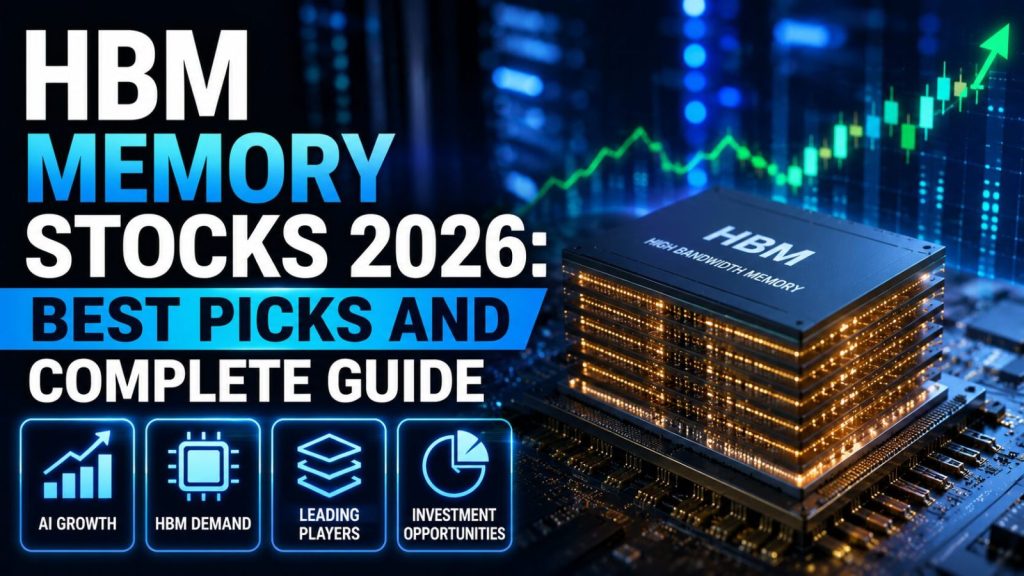
High Bandwidth Memory, or HBM, is a specialized type of DRAM that stacks multiple memory dies vertically and connects them using through-silicon vias (TSVs). The result is massively faster data transfer between the GPU and memory — exactly what AI training and inference workloads demand.
A standard GPU doing large language model inference can be bottlenecked not by compute cores but by how fast it can feed data to those cores. HBM solves that bottleneck. This is why Nvidia’s Blackwell Ultra accelerators pack up to 288GB of HBM3E each, why its new Rubin platform — unveiled at CES 2026 — moves to HBM4, and why every AI infrastructure buildout conversation eventually comes back to memory bandwidth.
According to the IEA’s Energy and AI research, global data center electricity demand is projected to more than double by 2030, to around 945 TWh. More AI compute means more HBM demand. That’s a simple but powerful tailwind.
The Top HBM Memory Stocks to Watch in 2026
There are really only three companies that manufacture HBM at commercial scale right now: SK Hynix, Samsung, and Micron Technology. Let me give you my honest take on each.
SK Hynix — The Current King
SK Hynix (Korea Exchange ticker 000660.KS, and since July 2026 also a sponsored Nasdaq ADR under SKHY, where ten ADSs represent one Korean share) remains the HBM leader by share. They were first to mass-produce HBM3, first to ship HBM3E, and they hold the deepest supplier relationship with Nvidia. On HBM4 the field tightened: Samsung announced first commercial shipments in February 2026 and Micron said high-volume shipments began a quarter ahead of its own plan.
US retail investors can get indirect exposure through ETFs or through brokerages that allow access to Korean equities. It’s a bit more work than buying a US-listed stock, but the position is worth understanding. SK Hynix’s HBM revenue has grown from a small fraction of their total DRAM business to a significant and high-margin segment. Management has said its entire 2026 HBM supply is already sold out, and SK Hynix was first again with HBM4 — now in mass production for Nvidia’s Rubin generation — the kind of pricing power that standard DRAM makers can only dream about.
Micron Technology (MU) — The American Play
Micron Technology (MU) is the most accessible HBM memory stock for US retail investors — it’s listed on Nasdaq and covered by every major analyst desk. Micron started the HBM race behind SK Hynix and Samsung, but it has closed the gap fast — in recent quarters it has even overtaken Samsung in overall HBM market share.
Micron’s HBM supply is effectively committed for calendar 2026 on agreed price and volume, and the company has said HBM4 high-volume shipments started a quarter earlier than it had guided. Their HBM gross margins are reportedly above corporate average, which is exactly the kind of mix shift that drives earnings upside. For a US investor who wants clean, liquid exposure to the HBM memory stocks theme, MU is the most straightforward vehicle. You can check their latest IR disclosures directly at Micron’s investor relations page.
Samsung Electronics — The Comeback in Progress
Samsung (005930.KS on the KRX) is the world’s largest memory chipmaker, and after well-publicized struggles getting HBM3E qualified at Nvidia, they finally passed qualification in late 2025 and have been shipping since. The comeback has momentum: Samsung’s HBM4 entered mass production in early 2026 and reportedly crossed $1 billion in cumulative revenue within about four months.
Samsung has the fab scale, the R&D budget, and the packaging technology to keep closing the distance. It is still chasing SK Hynix on HBM4 yields and on qualification for the newest Nvidia stacks, so meaningful share gains are possible but not guaranteed. I’d characterize Samsung as a higher-risk, higher-reward catch-up play within the HBM memory stocks universe.
HBM Memory Stocks Comparison Table
| Company | Ticker | US Accessibility | HBM Generation | Ajussi Risk Rating |
|---|---|---|---|---|
| SK Hynix | 000660.KS / SKHY | Nasdaq ADR since July 2026 | HBM4 (leading share) | Medium — won and foreign-issuer overlay |
| Micron Technology | MU | Nasdaq listed — easy | HBM4 (high-volume shipments began 2026) | Medium — most accessible |
| Samsung Electronics | 005930.KS | Korean exchange / ETF indirect | HBM4 (catching up) | Higher — recovery bet |
| Nvidia (indirect) | NVDA | Nasdaq listed — easy | Primary HBM customer | Medium — broader AI exposure |
I included Nvidia in the table because many investors ask me whether they should buy the HBM supplier or the HBM customer. My honest answer: both have merit, but they carry different risk profiles. Nvidia is a demand aggregator — when AI capex slows, their order book slows first. The memory makers feel it second but can also get hurt by oversupply if they overbuild capacity.
What Micron’s September 30 Results Said — October 2 Update
Micron reported fiscal Q4 2026 results (quarter ended September 3) on September 30: revenue of $54.23 billion versus $41.46 billion the prior quarter, GAAP gross margin of 86.8%, and full-year revenue of $133.19 billion. Guidance for fiscal Q1 2027 is $61.5 billion ± $1.5 billion in revenue with a non-GAAP gross margin of about 86.25%, which management described as the low point for the fiscal year. For HBM memory stocks, three details matter more than the headline.
2027 HBM is largely sold. Micron said it has completed agreements for the vast majority of its calendar 2027 HBM bit supply at significantly higher year-over-year prices. It did not disclose the percentage increase, so the +70–140% contract-price scenario from TrendForce and the +44–49% blended-ASP estimates from Korean brokers remain forecasts; what the company confirmed is the direction and that most of next year’s volume is already contracted.
HBM revenue is still not broken out. The Cloud Memory Business Unit, which houses HBM, posted $16.28 billion in the quarter and Core Data Center $18.00 billion. The slides say only that HBM revenue grew faster than total company revenue. Micron also said it is co-developing with NVIDIA the industry’s first custom HBM4E (NV-HBM) for next-generation GPUs and NVLink Fusion, and that HBM bit shipments should outgrow conventional DRAM through calendar 2028 while price increases narrow the HBM-versus-standard-DRAM margin gap. HBM4 volume and timing were not quantified.
Supply is tightening across the board. DRAM ASPs rose in the high-teens percent sequentially and NAND ASPs about 30%. Capex for the first half of fiscal 2027 is guided at roughly $25 billion (about $11.5 billion in Q1) with more in the second half, which strengthens the “three suppliers expanding at once” risk flagged below. The next checkpoint is late October, when SK hynix and Samsung report Q3 results and the HBM share debate (SK hynix ~62% in the latest reported split) gets fresh numbers.
>